.jpg)
The best B2B SaaS AI stack isn’t the one with the most tools. It’s the one where every tool solves a defined bottleneck, integrates with the wider technology stack, and earns its ongoing cost.
As AI adoption accelerates, many organizations already have more software than they can effectively integrate or govern. The priority in 2026 should therefore be auditing what you already have before buying what comes next.
This guide organizes the B2B SaaS AI stack into four functional layers: Thinking, Building, Running, and Seeing. Instead of another ranked tools list, it provides a framework for identifying capability gaps, eliminating unnecessary overlap, and deciding where additional AI investment can create measurable value.
Why Another Tools List is the Wrong Answer
Every week brings another AI tool, another model release, and another article that promises to reveal the definitive software stack. However, most B2B SaaS organizations have a management problem instead of a discovery problem. Before investing in another subscription, marketing and operations leaders have to understand which tools are creating measurable value, which overlap with existing capabilities, and which have become expensive complexity.
This guide takes a fresh approach by helping you understand the AI stack you already have. From there, it’s much easier to identify capability gaps, remove overlap, and make better long-term investment choices.
The Stack Problem, Not the Tool Problem
The majority of AI buying decisions start with the wrong question.
Rather than asking “Which AI tool should we buy next?”, companies need to ask which tools they already have that are actually solving the biggest bottleneck.
That distinction matters because enterprise AI adoption has accelerated faster than the majority of organizations’ ability to manage it. Salesforce’s latest Connectivity Benchmark found that enterprises now operate an average of twelve AI agents, with this figure projected to grow by 67% over the next two years. At the same time, around half of those agents operate in isolation, limiting the value they can deliver despite increasing investment.
The problem lies with a lack of architecture.
This article takes the opposite position to most AI tool roundups. Rather than encouraging you to buy more software, it will usually recommend buying less. Consolidating overlapping capabilities, integrating existing tools, and improving adoption usually creates greater business value than adding another subscription to an already fragmented stack.
The Four Layers
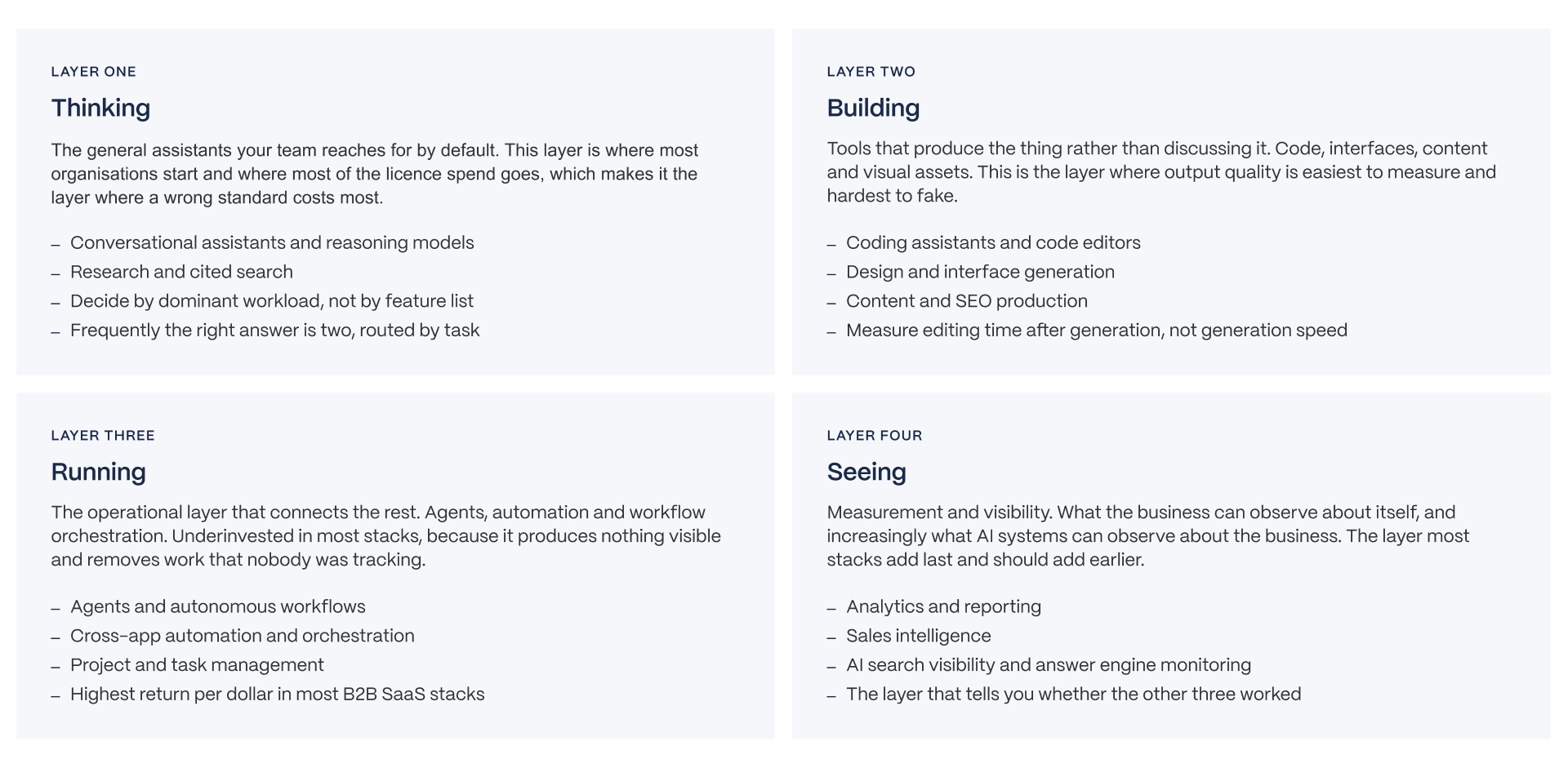
Four layers of a B2B SaaS AI stack: Thinking, Building, Running, and Seeing, with the main tool categories in each layer.
Most AI stacks are challenging to manage because organizations categorize tools by department as opposed to the job they perform.
This guide instead organizes AI into four functional layers: Thinking, Building, Running, and Seeing. Thinking tools help teams research, analyze, and make decisions. Building tools create content, software, presentations, and other business assets. Running tools automate workflows and orchestrate work across systems. Seeing tools measure performance, monitor visibility, and generate operational insight.
The job-based taxonomy solves a common problem. Marketing, sales, customer success, and product teams often purchase different software to perform essentially the same function, creating overlapping subscriptions owned by different departments. Before long, an organization has twenty AI tools but only four distinct capabilities.
A layered stack can reveal those overlaps. It makes duplicated capability, missing functionality, and integration opportunities immediately visible before another purchasing decision is made.
The Five-Point Stack Framework
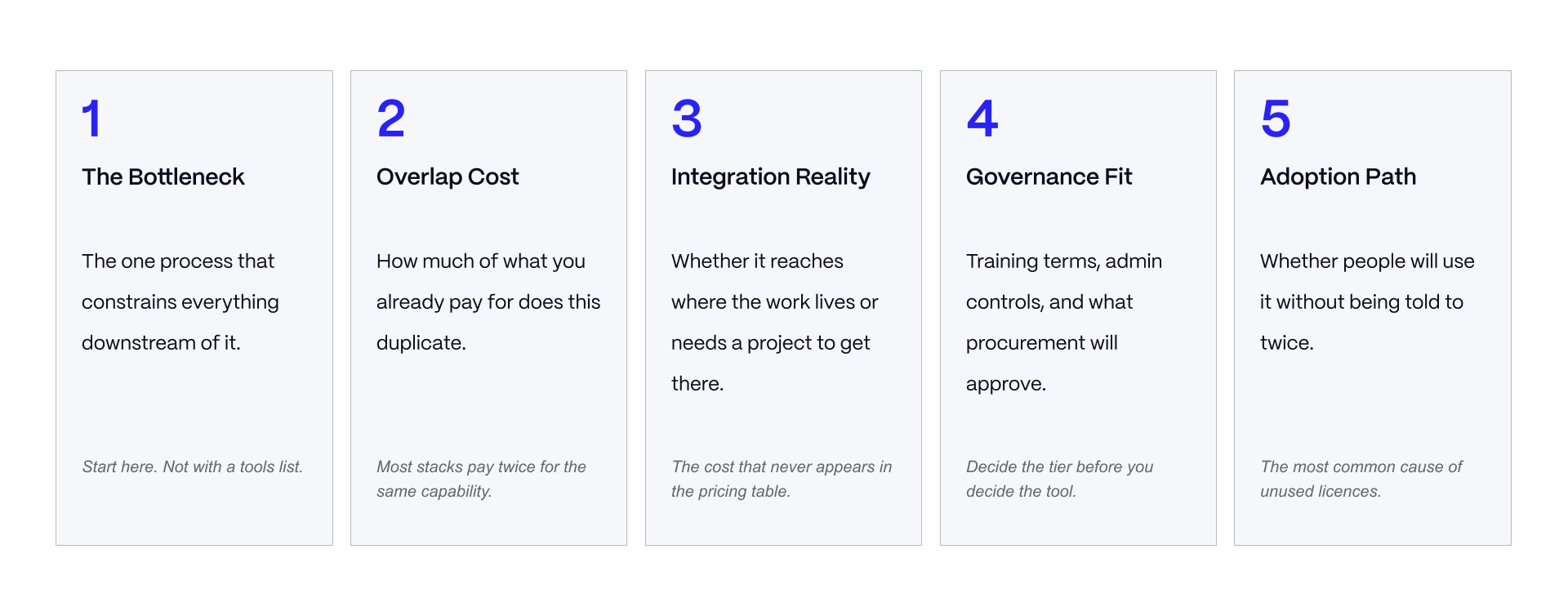
Every recommendation throughout this guide is built around the same evaluation criteria: bottleneck, overlap cost, integration reality, governance fit, and adoption path.
The first criterion is also the reason most AI roundups provide limited strategic value. They begin by reviewing products instead of identifying the operational constraint those products are meant to remove. Without understanding the bottleneck, software selection becomes essentially feature comparison.
The remaining four questions help determine whether a tool deserves place in the stack. Does it replace existing capability or duplicate it? Can it integrate into current workflows without introducing unnecessary complexity? Does it align with governance requirements? And can the organization realistically adopt it at scale?
These five questions form the decision framework used throughout the rest of this guide and across the AI companies we work with, where long-term value comes from building connected AI systems rather than accumulating disconnected tools.
The Category Map
A useful AI stack should make it easier to decide where investment belongs, not give you another catalogue of software to evaluate. The category map below connects the four layers to the specific jobs they perform and the specialist Veza Digital guides covering each category. Start with the bottleneck identified in Section 1, find the corresponding layer, and use the map to go deeper where necessary.
How to Use This Page
This page is deliberately designed as a map rather than a destination.
You should identify the constraint that currently limits your team, and move directly to the corresponding layer.
If research and decision-making are slow, start with Thinking. If production is the constraint currently limiting your team and move directly into the corresponding layer. If work is being completed but operations remain manual, investigate Running. If you have plenty of activity but limited visibility into what is working, start with Seeing.
The detailed tool comparisons live in the specialist guides linked below. This page has a different job: showing you where each category belongs, how pieces fit together, and where your stack has genuine gaps rather than opportunities to add more software.
The Map
The map should be read horizontally from business job to category to specialist guide, as opposed to a shopping list. Each category has one home in the stack, even when individual platforms are able to perform jobs across multiple layers.
Four additional Veza guides take an audience-based rather than category-based view of the stack: Best AI Tools for B2B Marketing, Best AI Tools for Startups, Top AI Tools for Marketing Success, and Best AI Tools for Entrepreneurs. These intentionally sit across multiple layers rather than just a single category.
Where the Gaps Are
The map also reveals where Veza’s coverage, and arguably the wider market’s attention, is uneven.
Building currently contains six specialist guides covering everything from coding to video generation. Running has only two, focused on AI agents and project management. The AI conversation remains heavily weighted toward visible outputs that are easy to demonstrate, such as a generated landing page or presentation.
Operational improvements are less visible, but potentially more valuable. Connecting systems, automating repetitive workflows, and orchestrating work between teams rarely produces an impressive demo. It can remove more friction from an organization.
This makes the Running layer one of the most crucial areas to examine when auditing an established AI stack, and we’ll return to that imbalance in Section 4.
The Thinking and Building Layers
Thinking and Building are where the majority of organizations begin adopting AI because the value is instantly visible. One layer accelerates research and decision-making, while the other accelerates production. They are also where duplication can accumulate the fastest. The objective, therefore, is not to find a tool for every possible task, but instead to standardize selectively around the workloads that genuinely constrain.
Thinking
The Thinking layer covers AI assistants and research tools used to find information, interrogate ideas, synthesize sources, and support decision-making. It’s often where organizations concentrate their AI license spend, which makes an ineffective company-wide standard particularly expensive.
Selection should start with dominant workload as opposed to feature comparisons. A team primarily using AI for everyday drafting, analysis, and problem-solving has different requirements from one conducting source-heavy market or competitive research. In many organizations, the correct answer will therefore be two tools routed according to task rather than one platform mandated for everything.
Teams evaluating general-purpose assistants can use our Best AI Chatbots guide, while the Best AI Search Engines guide covers research-oriented platforms in greater depth. For companies choosing between individual assistants, Grok vs ChatGPT provides a dedicated head-to-head comparison.
The important decision at stack level is not which individual model wins. It’s whether the workload justifies another Thinking tool when an existing platform already performs the same job.
Building
Building is the largest layer because AI can now produce almost every type of marketing and digital asset. Code, interfaces, landing pages, presentations, and video all sit here.
Across these categories, the most useful selection metric comes with editing time after generation. Producing something in thirty seconds means very little if it takes a specialist three hours to make it usable.
For software production, the Best AI Coding Tools guide examines development workflows, while Best AI Landing Page Generators covers tools designed to accelerate page creation. Teams incorporating AI into product and interface workflows can go deeper with Best AI Tools for UX Design.
The same principle applies to other creative output. Best AI Presentation Tools covers presentation production, while Best AI Video Editors and Best AI Video Generation Tools separate two fundamentally different video workflows: improving existing footage and generating new content.
Whatever the format, effective AI content strategy should define where generated output genuinely reduces production effort before another tool enters the workflow.
What Most Teams Over-Buy Here
Thinking and Building are particularly vulnerable to tool sprawl due to their outputs being more visible. A faster research task, generated landing page, or AI-produced video creates an obvious demonstration of value, making another subscription relatively simple to justify.
Vendor-published research from Larridin reports that enterprises average 23 AI tools, while only 38% have a complete inventory of the AI tools operating across their organization. Intuit’s 2026 Enterprise Technology Benchmark provides a stronger consolidation signal: 73% of surveyed senior business and finance leaders identified technology-stack consolidation as the fastest route to a healthier bottom line.
The practical implication is simple. If you’re purchasing another Thinking or Building platform without first auditing existing capability, there’s a good chance you’re buying a second version of something you already own.
That duplication is one of the hidden costs of AI: individually defensible purchasing decisions can collectively create an expensive, fragmented stack.
The Running and Seeing Layers
Thinking and Building create capability. Running and Seeing determine whether that capability becomes part of a functioning business system. These layers connect tools to workflows, automate repeatable work, and show whether AI investment actually produces results. They tend to receive less attention because their value is less obvious, but this makes them an essential part of the AI stack at scale.
Running
The Running layer covers AI agents, automation, orchestration, and project management. The role is to connect capabilities across the stack and reduce the amount of manual work necessary to move from one task to the next.
This makes its value fundamentally different from Building. A video generator creates assets you can see. An effective automation might eliminate three handoffs, two status meetings, and hours of repetitive administration every week. The return is measured primarily in work removed rather than artefacts produced.
Our Best AI Agents guide goes deeper into platforms designed to execute and orchestrate workflows, while Best AI Project Management Tools examines how AI is changing planning, coordination, and operational execution.
The challenge is that eliminated work is harder to demonstrate than generated output. This makes Running difficult to justify internally, and easy to underfund, even when automation and orchestration could remove a larger operational bottleneck as opposed to another production tool.
Seeing
Seeing is the measurement layer. It helps inform teams what is happening across analytics, search performance, AI visibility, and other channels, allowing the rest of the stack to improve based on evidence.
The Best B2B AI Analytics Tools and Best AI SEO Tools guides cover broader performance and search measurements. As discovery shifts toward AI-generated answers, the Best LLM Optimization Tools 2026 and Best AI Overview Monitoring Tools 2026 guides address the emerging challenge of understanding how brands appear across LLMs and AI-powered search experiences.
This is where Veza’s specialist capabilities align the most directly. An AI search visibility audit establishes where and how a brand appears across AI discovery environments, while answer engine optimization and broader AI search visibility strategies turn those findings into action. AI-powered CRO applies the same measurement-first principle to conversion performance.
Why These Two Are Under-Funded
The imbalance between the four layers reveals a broader issue with enterprise AI adoption. Organizations are investing heavily in visible capabilities while underinvesting in the infrastructure required to connect and measure them.
Salesforce’s 2026 Connectivity Benchmark found that only 27% of the average enterprise application estate is integrated, while 50% of AI agents already operate in isolation. The same research found that the overwhelming majority of IT leaders believe successful AI agent deployment depends on better integration of data.
Organizations can keep adding assistants, generators, and specialist models, but eventually their value drops if the tools can’t access the right data, trigger downstream processes, or provide evidence of what has actually improved. Running creates connective tissue, while Seeing closes the feedback loop.
For enterprise teams, this makes investment sequencing crucial. Once core Thinking and Building capabilities are established, another tool might only create marginal improvement comparatively.
For a lot of established B2B SaaS stacks, the next dollar has more potential in Running and Seeing than in Thinking or Building. These layers are sometimes neglected because their best output is invisible, with fewer manual processes, fewer disconnected systems, fewer wasted subscriptions, and fewer decisions made with no evidence.
What the Evidence Says About Your Stack
The four-layer model shows where AI tools belong. The research shows why managing those layers matters. Across enterprise surveys, the same pattern emerges: organizations are adopting AI faster than they can inventory, integrate, and confidently govern it. That shifts the priority from acquiring more capability toward understanding what’s already running and extracting more value from it.
How Many Tools Organizations Actually Run
AI stacks are already larger than many organizations realize.
Salesforce’s 2026 Connectivity Benchmark surveyed 1,050 IT leaders and found that enterprises currently operate an average of 12 AI agents, with that number projected to increase by 67% within two years.
Vendor-published research from Larridin paints an even broader picture. Its State of Enterprise AI 2026 reports an average of 23 AI tools per enterprise, but only 38% of organizations maintain a complete inventory of the AI tools that operate across the business.
The second statistic matters more than the first, as an organization cannot rationalize an AI stack that it is unable to accurately inventory.
Without this visibility, procurement teams struggle to identify duplicate functionality, security teams can’t govern usage with any degree of consistency, and business leaders can’t determine whether another subscription fills a capability gap, or replicates something.
It is here that understanding the hidden costs of AI becomes an integral part of stack management. Software spend is the only visible cost. Duplication, fragmented ownership, inconsistent governance, and unused functionality can turn an affordable collection of subscriptions into something more expensive.
Integrations, Not Capability, Is the Constraint
The more pertinent question is what happens once these tools have been purchased.
Salesforce’s findings paint a picture that becomes immediately clear: AI capability itself is widespread, and is improving quickly. The scarce resource here lies in the connectivity between the models, business applications, organizational data, and operational workflows. Buying a more capable model won’t impact much if it can’t effectively access information or systems required to do the job.
This reframes AI procurement. The question now becomes what stacks connect to, what data they can access, whether those connections can be governed, and what integration burden adoption creates.
For enterprise teams, integration architecture becomes a core part of the AI investment decision.
The Trust and Utilization Gap
Adoption creates another cost that is easy to remove from AI budgets, and that is verification.
The 2025 Stack Overflow Developer Survey gathered responses from more than 49,000 developers across 177 countries. 46% said they distrusted the accuracy of AI tools compared to 33% who trusted them, and only 3% reported highly trusting their accuracy.
That doesn’t mean AI tools are ineffective, but instead suggests that utility can drive adoption even with limited confidence.
For stack owners, this is an important distinction. Every Building tool has a downstream review cost. Generated code needs to be tested, content has to be fact-checked, creative output needs reviewing, and research has to have source verification.
This means that human verification capacity is an integral part of the total AI ownership cost. If a tool doubles production but it results in an equivalent review bottleneck, the stack has moved the constraint instead of removing it entirely.
Auditing Before Buying
Once an AI stack reaches a certain size, procurement needs to begin with subtraction instead of addition. Before evaluating another problem, teams need to understand what they already own, where capabilities overlap, what employees actually use, and which business constraint stays unresolved. A structured stack audit turns those questions into evidence, making the next big buying decision considerably easier.
Stack Audit Checklist
The purpose of an AI stack audit is not to create a longer software inventory. It is to determine which tools have earned their place and where genuine capability gaps remain.
For each platform currently deployed, the audit needs to answer a consistent set of questions, such as, What bottleneck was the tool purchased to remove? What existing capabilities does it overlap with? How many intended users actually use it every week? What systems and data does it integrate with? Who owns governance? What measurable outcome has improved since adoption? And what would happen if it disappeared tomorrow.
Questions 2 and 3 tend to produce the most uncomfortable findings. Capability overlap exposes how often different teams have purchased versions of the same functionality, while weekly utilization reveals the difference between licenses provisioned and software genuinely adopted.
Don’t rely on internal surveys for the latter. People routinely overestimate their use of software, especially when it comes to tools they requested themselves. Pull actual login, seat utilization, workflow, or API usage data wherever the platform makes it available.
The objective here is to leave every tool with one of three outcomes: keep, consolidate, or remove. Only after that process should organizations create a fourth category: buy.
Anti-Patterns
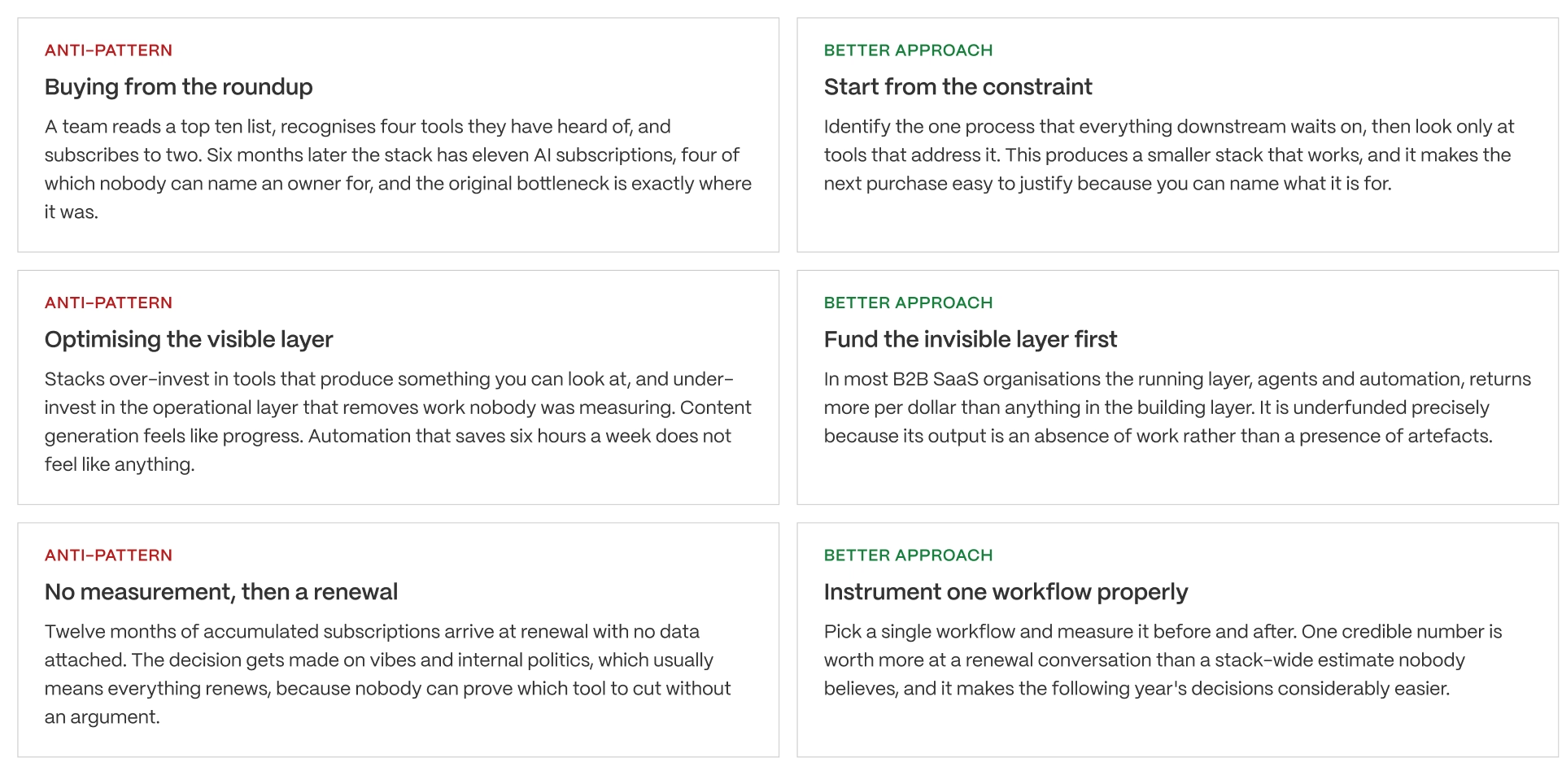
Three patterns repeatedly turn AI adoption into tool sprawl.
The first is buying from the roundup. A team sees a highly ranked platform, evaluates the features it provides, and purchases it without originally establishing whether it solves the existing bottleneck. The majority of articles in this category unintentionally encourage this behavior by starting with products as opposed to organizational constraints.
A more productive approach would be to identify the bottleneck first, and then evaluate tools only once existing capability can’t resolve it.
The second is optimizing the visible layer. Organizations continue investing in generators and assistants because their outputs are easy to demonstrate, with integration, orchestration, governance, and measurement remaining underdeveloped. Be sure to audit all four layers before you decide where additional investment should belong.
The third is arriving at renewal with a lack of measurement. If nobody agrees what success should look like at the procurement stage, renewal then becomes a question of sentiment, not performance.
Every new AI purchase should therefore begin with its renewal criteria already defined. If you can’t state what evidence justifies paying for it again in 12 months, the buying decision is not finished.
Decision by Bottleneck
DECISION BY BOTTLENECK
Use this as a starting point, not a binding answer. The five-point framework is the real evaluation tool. Your bottleneck determines which layer to fund next.
BOTTLENECK 1: CONTENT THROUGHPUT
- Profile: the marketing team cannot produce enough, or cannot produce it fast enough
- Layer to fund: building
- What to look at: conversational assistants for drafting, content and SEO tooling for production and optimisation
- Watch for: the review bottleneck moving rather than disappearing. Generation throughput rises immediately and editorial capacity does not, so the constraint relocates to the editor unless you plan for it.
The verdict: fund generation and editorial capacity together or you have moved the problem rather than solved it.
BOTTLENECK 2: ENGINEERING VELOCITY
- Profile: the roadmap is constrained by how fast the team can ship
- Layer to fund: building
- What to look at: coding assistants and code editors, chosen on how much your team will delegate before reviewing
- Watch for: review capacity, which is the constraint that appears about a month after adoption and looks like success until it does not.
The verdict: size the review process before adopting a tool designed to generate more code for it.
BOTTLENECK 3: OPERATIONAL DRAG
- Profile: skilled people spending hours on work that follows rules
- Layer to fund: running
- What to look at: agents, cross-app automation, project and task management
- Watch for: nothing, honestly. This is the highest-return and most under-funded layer in most B2B SaaS stacks, and the reason is that its output is an absence of work rather than something you can show anyone.
The verdict: if this is your bottleneck you are in the fortunate position of having the clearest return available.
BOTTLENECK 4: DECISION LATENCY
- Profile: the business cannot see what is happening fast enough to act
- Layer to fund: seeing
- What to look at: analytics, sales intelligence, and AI search visibility monitoring
- Watch for: buying a dashboard when the actual problem is that nobody owns the decision the dashboard would inform.
The verdict: check whether the constraint is visibility or ownership before buying visibility.
BOTTLENECK 5: NOBODY AGREES WHAT THE BOTTLENECK IS
- Profile: three leaders, three answers, a stack that grows in every direction at once
- Layer to fund: none, yet
- What to look at: the audit checklist above, run properly, before any purchase
- Watch for: the temptation to buy something while the question is unresolved, which is how stacks reach eleven subscriptions with four owners.
The verdict: the most common situation and the one where buying anything is the wrong move.
PRINCIPLE
Most articles in this category hand you a ranked list of tools and leave the hard part to you. The hard part is not knowing what exists. It is knowing which of the four layers is currently costing you most, and resisting the purchase that feels productive while the answer is still unclear. A stack assembled from roundups grows in every direction. A stack assembled from a bottleneck grows in one, which is the only direction that returns anything.
Once your audit is completed, the next investment needs to focus on following the constraint that it helps expose.
If content throughput limits growth, then investigate the relevant Build capabilities before you add tools elsewhere. If engineering velocity is the constraint, be sure to prioritize development workflows and measure the reduction in time required to ship production-ready work.
If operational drag is impacting capacity, the answer lies in Running through automation, agents, or orchestration. Decision latency instead points toward Thinking or Seeing, depending on whether the problem lies in accessing information or understanding performance.
The fifth bottleneck might be the most important: nobody agrees what the bottleneck is. This situation requires you to establish the constraint, baseline current performance, and agree on what improvement would look like before procurement starts.
For scaling teams, this discipline becomes more important because poorly defined purchases introduce more integration, governance, and adoption obligation. A broader AI optimization strategy needs to be to focus on matching investment and business constraints as opposed to maximizing the volume of AI capability available.
The research is consistent and slightly uncomfortable. Organisations are running more AI tools than they can inventory, half their agents cannot reach the data they need, and very few can say at renewal what any of it returned. Buying another subscription does not fix that. We work with B2B SaaS teams on the layer underneath the tool list: which bottleneck is actually costing you, what the current stack is duplicating, and how to measure whether the next thing you buy works. If your AI spend has grown faster than your ability to explain it, that is the conversation to have.
FAQs
What are the best AI productivity tools for a B2B SaaS team?
That depends entirely on which layer of your stack is constraining you. Tools that help a content team produce more will not help an operations team drowning in manual process. Identify the bottleneck first, then look only at tools addressing it. This page maps the categories and routes to a detailed guide for each.
How many AI tools does the average company use?
Salesforce research covering 1,050 IT leaders found enterprises run an average of twelve AI agents, with a projected sixty seven percent increase within two years. Vendor-published research puts the broader AI tool count at around twenty three per enterprise, with fewer than four in ten organisations maintaining a complete inventory of what is running.
Should we consolidate our AI tools?
Probably. Intuit's survey of 2,000 senior US leaders found seventy three percent identify consolidating the tech stack and reducing sprawl as the fastest route to a healthier bottom line. Start by listing every AI subscription against the job it does, which surfaces duplication immediately and usually uncomfortably.
How do I audit our AI stack?
List every subscription and the primary job it performs, pull actual usage data rather than asking people, identify which capabilities are duplicated, and rank everything by what would break if it disappeared tomorrow. The bottom third of that ranking is your answer. The audit checklist on this page covers it in ten questions.
Why is our AI investment not returning much?
Frequently because the tools cannot reach the data they need. Salesforce found only around a quarter of the average enterprise application estate is integrated and half of deployed AI agents operate in isolation, while ninety six percent of leaders say agent success depends on integration. Capability is rarely the constraint. Connective tissue usually is.
Which layer of the AI stack should we invest in first?
The one containing your current bottleneck. In most B2B SaaS organisations that is the running layer, agents and automation, because its return is measured in work removed rather than output produced, which makes it easy to under-fund. If you cannot identify a single bottleneck, that is the finding and you should not buy anything yet.
Do we need a separate tool for every category on this page?
No, and assembling one is how stacks reach twenty subscriptions with four owners. Several categories overlap, general assistants cover parts of several, and most organisations need depth in one or two layers rather than coverage across all four. Buy for the bottleneck, not for the taxonomy.
Should developers trust AI tool output?
Not without review. Stack Overflow's survey of more than 49,000 developers found more actively distrust AI tool accuracy than trust it, forty six percent against thirty three, with only three percent reporting high trust. That reflects adoption driven by utility rather than confidence, and it means review capacity is part of every tool's real cost.
How do we measure whether an AI tool is working?
Pick one workflow and measure it before and after. One credible number from a single instrumented process is worth more at a renewal conversation than a stack-wide estimate nobody believes. Most organisations cannot answer this question at renewal, which is why almost everything renews by default.
How often should we review our AI stack?
Quarterly is reasonable given how fast this category moves, and annually is too slow. Pricing, packaging and capability all changed repeatedly during 2026 across the major vendors. A short quarterly review that asks what you would cut first is more useful than a thorough annual one that arrives after the renewals.