
AI-Powered CRO:
Convert the Traffic AI Sends You
AI visitors arrive on your site having already done their comparison research inside ChatGPT. They know what you do. They know your competitors. They are ready to act. But your landing page starts with "What is [product category]?" and asks them to fill out a 7-field form. You just sent a mid-funnel buyer back to step one.
Veza Digital optimizes B2B websites for conversion from AI-referred traffic: ChatGPT, Perplexity, AI Overviews, AI Mode, Gemini, and Copilot. We redesign landing pages, trust signals, personalization, and conversion funnels for how AI visitors actually behave, not how Google visitors behave.
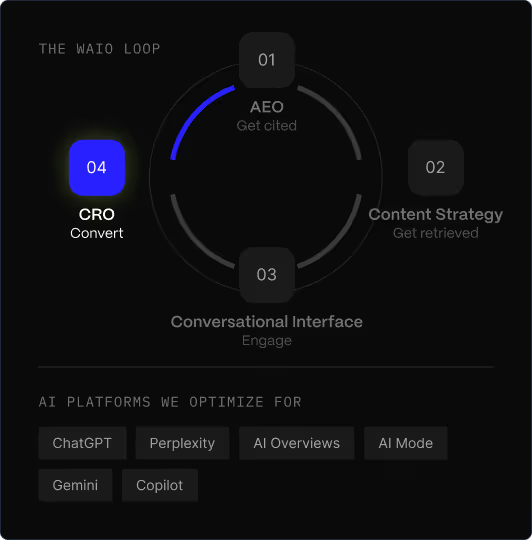
AI-Powered CRO closes the WAIO loop. AEO gets you cited. Content strategy gets you retrieved. Conversational interface engages. CRO converts the visitors AI sends.

Webflow's ChatGPT traffic converts at 24% vs 4% from Google (Growth Unhinged, November 2025). The difference is how they built for it.
Your Traffic Is Declining. Your Best Traffic Is Growing.

Aggregate Organic Traffic

Declining. AI Overviews answer before anyone clicks.

AI-Referred Traffic Quality

Higher intent. Higher conversion. Growing fast.
Your aggregate organic traffic is declining. AI Overviews answer questions before anyone clicks. Zero-click searches are rising. Leadership is asking what happened to the pipeline.
Here is the reframe. Webflow's VP of Growth, Josh Grant, said it directly: lower-value, lower-intent traffic went down, but higher-quality traffic is growing even as the aggregate declines. Their ChatGPT traffic converts at 24%. Google non-brand converts at 4%. 10% of all Webflow signups now come from AI. Two-thirds of AI-referred users convert within 7 days. The aggregate number declined, but the pipeline got stronger (Growth Unhinged, November 2025).
But this does not happen automatically. Amsive studied 54 websites and found no statistically significant difference between AI and organic conversion rates overall (p=0.794). Huge variance across sites. The sites that see the Webflow-level results are the ones designed for AI visitor behavior. The rest see no benefit at all (Amsive, September 2025).
The behavior difference is real. A Google searcher clicks 5-6 links doing comparison research. A ChatGPT user gets that bundled in one answer. By the time they click to your site, they are not browsing. They are evaluating. Seer Interactive found ChatGPT visitors view 2.3 pages per session vs 1.2 for organic, and convert at 15.9% compared to Google's 1.76% (Seer Interactive, October 2025).
If your site treats all traffic the same, you are optimizing for the declining channel and ignoring the growing one.
What We Optimize
Four conversion layers. Each targets the behavioral difference between AI-referred visitors and traditional search visitors.
Dynamic Personalization by Traffic Source
Your landing pages assume Google visitors who need education. AI visitors already know what you do because the AI told them. They need validation and action, not a 101 guide.
We redesign for AI-referred visitors: proof upfront (case studies, metrics, trust signals above fold), simplified CTAs (fewer form fields, immediate value), content that validates what the AI said rather than repeating it. Skip "What is [product category]?" and go straight to "Here is why we are the right choice and here is how to start."
Seer Interactive found different LLMs drive different page behaviors. ChatGPT conversions happen on solution pages and contact forms. Gemini conversions happen on tools and calculators. Landing page design should account for which AI sent the visitor (Seer Interactive, October 2025).
Trust Signals for AI-Referred Visitors
AI visitors arrive pre-sold. The AI already recommended you. But they need to validate that recommendation. If your site does not confirm what the AI said, trust breaks. Worse: if the AI described your service inaccurately, the visitor arrives expecting the wrong thing.
We design confirmation messaging ("Yes, we do exactly what ChatGPT described"), specific proof that matches the AI's recommendation context, social proof from the same use case the AI surfaced, and correction patterns for when AI gets it wrong ("We are often recommended for X, but we actually specialize in Y. Here is why that is even better for you.").
This is a CRO problem nobody is solving yet. Google visitors self-select based on search results and meta descriptions they chose to click. AI visitors are sent by a third party's recommendation. The trust dynamics are completely different.
Dynamic Personalization by Traffic Source
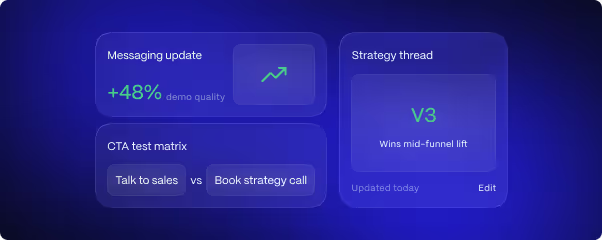
AI visitors and Google visitors land on the same page with the same experience. Different context, same conversion path. That is a waste.
We design referral-based content adaptation. AI visitors see validation content (proof confirming what AI told them). Google visitors see educational content. Different hero copy, CTAs, and social proof sequencing based on traffic source.
On Webflow, we implement this using Webflow Optimize, which includes AI-powered audience targeting and variant delivery built directly into the platform. Optimize's machine learning allocates traffic to the highest-converting variant per visitor segment, meaning AI-referred visitors can automatically receive a different experience than Google visitors without manual rules. For more advanced personalization beyond what Optimize handles natively, we layer in tools like Mutiny or Pathmonk, or build custom referral detection scripts.
Shorter Funnels for Compressed Buyer Journeys
Standard 5-7 step B2B funnels assume 30-90 day consideration cycles. AI visitors compress this to 7 days (Webflow data, Growth Unhinged). If your funnel is built for 90 days and the visitor is ready in 7, every step you add is friction.
We redesign: skip educational steps, move straight to proof and action. Single-step forms instead of multi-step qualification. Pricing visible earlier. Demo booking without requiring a discovery call first. Shorten the path from "I was recommended to you" to "I am a customer."
SaaS Hero's 2026 benchmarks show single-goal landing pages with one CTA reach 13.5% conversion compared to 10.5% for pages with multiple CTAs. For AI traffic that already knows what it wants, fewer options means higher conversion.
How It Works
AEO, Content, Interface, CRO is Step 4 of the WAIO loop

AI Traffic Audit
Set up GA4 custom channel grouping to isolate ChatGPT, Perplexity, Gemini, Claude, Copilot, and AI Mode referrals. Measure current AI traffic volume, conversion rate vs organic, and page behavior. Add self-reported attribution. Establish baseline. Start with a free AEO audit.
Behavior Analysis
Heatmaps, session recordings, and funnel analysis segmented by AI vs organic. Where do AI visitors drop off? What do they engage with? Where is the experience mismatched to their intent?
Optimize and Test
Landing page redesign for AI visitors. Trust signal optimization. Dynamic personalization by referral source. Shortened funnels. A/B testing and multivariate experiments through Webflow Optimize, with AI-powered variant delivery that automatically serves the highest-converting experience per visitor segment. Every change measured against AI traffic conversion specifically.
Monitor and Scale
Monthly reporting: AI traffic volume by source, conversion rate per AI platform, funnel performance, personalization impact. AI-referred sessions grew 527% YoY across 19 GA4 properties (Previsible AI Traffic Report, August 2025). As AI traffic grows, the optimization compounds.
Results
Webflow: ChatGPT converts at 24% vs Google at 4%. 10% of signups from AI. Two-thirds convert within 7 days.
Growth Unhinged, November 2025
Seer Interactive: ChatGPT 15.9% conversion rate, 2.3 pages per session. Different LLMs, different behaviors.
Seer Interactive, October 2025
Indoor mapping software: 2,000% increase in sales calls after ChatGPT citation. AI compresses the buyer journey: comparison research done before the click.
Steve Toth, CXL, October 2025
AI-referred sessions grew 527% YoY across 19 GA4 properties. AI visitors worth 4.4x more by conversion rate.
Previsible AI Traffic Report, August 2025; Semrush, June 2025
Got Questions?
Does AI traffic actually convert better?
It depends entirely on your site. Webflow sees 6x higher conversion from ChatGPT. Amsive studied 54 sites and found no significant difference overall. The pattern: sites designed for AI visitor behavior convert dramatically better. Sites that treat AI traffic the same as Google traffic see no benefit. The variable is your conversion experience, not the traffic source.
Our organic traffic is declining. Should we be worried?
Maybe not. Webflow's VP of Growth: lower-value, lower-intent traffic went down while higher-quality AI traffic grew. Aggregate traffic is misleading without source quality metrics. If AI traffic is growing and converting better while generic informational traffic declines, your pipeline may be improving even as the topline number drops. You need to measure them separately to know.
How is this different from your Webflow CRO service?
Webflow CRO covers traditional CRO for all traffic: A/B testing, funnel analysis, UX improvements. AI-Powered CRO specifically optimizes for AI-referred visitors: source segmentation, dynamic personalization by referral, trust signal optimization, compressed funnel design. Different traffic behavior, different approach.
We cannot tell how much AI traffic we get. Can you help?
Yes, that is Step 1. Most GA4 setups lump AI traffic into organic or referral. We implement custom channel grouping with regex patterns to isolate ChatGPT, Perplexity, Gemini, Claude, Copilot, and AI Mode referrals. Plus self-reported attribution to capture the 60-70% of AI influence invisible in referral data. ProductiveShop found AI traffic is under 1% of sessions for most SaaS, growing 40-45% month over month (ProductiveShop, 2026 quarterly reports).
How do you measure success?
Monthly reporting: conversion rate by AI source (ChatGPT vs Perplexity vs AI Mode), AI traffic volume trend, funnel drop-off by source, pages per session, time to conversion, personalization impact. Named tools: GA4 custom channels, heatmaps, session recordings. Self-reported attribution field tracking. Not proprietary dashboards.
Why do AI visitors behave differently from Google visitors?
AI compresses the buyer journey. A Google searcher clicks 5-6 links doing comparison research. A ChatGPT user gets that bundled in one answer. By the time they click through, they have done the research phase inside the AI. They arrive evaluating, not researching. Seer Interactive found ChatGPT visitors view 2.3 pages per session and convert at 15.9% vs 1.76% from Google.
What happens when AI tells a prospect something wrong about us?
This is a unique CRO problem. AI might describe your service inaccurately. The visitor arrives expecting something you do not offer. We design landing page patterns that confirm what AI got right and correct what it got wrong: "We are often recommended for X. Here is what we actually specialize in and why that is better for your use case." Turning AI misrepresentation into a conversion opportunity.
Do we need separate landing pages for AI traffic?
Not necessarily. Dynamic personalization can adapt a single page based on referral source. AI visitors see proof and action upfront. Google visitors see education first. Same URL, different experience. Webflow Optimize handles this natively with AI-powered audience targeting and variant delivery. For high-volume AI sources, dedicated landing pages can be tested as separate variants within the same Optimize experiment.
We barely get any AI traffic yet. Should we start with CRO?
No. Start with AEO to generate the traffic first. AI-Powered CRO optimizes traffic you already receive. If ChatGPT does not cite you and you do not appear in AI Overviews, CRO alone will not help. Get cited first, then optimize conversion. See our AEO services.
We invested in AEO but pipeline didn't improve. Why?
Citations without conversion optimization equals visibility without revenue. Getting cited sends visitors to your site. But if your landing pages, funnels, and trust signals are designed for Google traffic, those AI visitors bounce or convert at the same rate as everyone else. CRO is the missing link between getting cited and getting customers.
How much does this cost?
AI content strategy is delivered as part of a broader AEO engagement. The scope depends on your existing content, technical foundation, AI visibility, and the work required to improve your presence across AI search and answer engines.
We define the engagement based on your specific requirements and provide a clear scope before you commit. Start with an AEO audit or book a call to discuss what makes sense for your business.
How quickly do we see results?
Attribution setup: 1-2 weeks. Baseline: 2-3 weeks. First A/B tests: 4-6 weeks. AI traffic is growing rapidly, so optimization compounds. Short conversion windows help: Webflow's AI-referred users convert within 7 days. You do not wait 90 days for the pipeline to reflect changes.
Do we need to be on Webflow?
CRO principles are platform-agnostic. But A/B testing and dynamic personalization are Webflow-first. Webflow Optimize gives us native AI-powered testing, audience segmentation, and variant delivery directly in the platform, no third-party code required. For other platforms: we deliver strategy, test specs, and personalization rules. Your team implements. Webflow clients get end-to-end. See Webflow agency services.
Get Started
Start with a free AEO audit. We measure your current AI traffic, how it converts vs organic, and where the biggest conversion gaps are 5 business days.