.jpg)
Abstract
The majority of the “best AI sales tools” lists fail for similar reasons - they compare completely different categories of software as though they’re meant to solve the same problem. A forecasting platform is evaluated beside an AI SDR, a meeting assistant beside a sales intelligence database, and a CRM beside a conversation intelligence tool. The result is a ranking that generates clicks but offers precious little guidance for revenue leaders looking to build a real sales stack.
This guide approaches the category differently. Instead of ranking tools in a single list, we organize them by where they operate in the pipeline: prospecting and lead intelligence, outreach and sales engagement, conversation intelligence, deal management and forecasting, and autonomous AI SDR agents. We then map those categories to company stage, from early stage startups to enterprise revenue organizations.
Along the way, we identify the tools we tested but didn’t recommend, explain the hidden integration and operational costs that pricing pages rarely mention, and provide a practical framework for selecting the right tool combination. We also examine how AI sales platforms connect to the website and conversion infrastructure that feeds them, because pipeline performance is dependent upon both systems working together.
Why Most AI Sales Tool Lists Lead B2B SaaS Buyers in the Wrong Direction
The AI sales software market has matured quickly, but the way the majority of tools are compared has not. Search results are dominated by vendor-led rankings, affiliate roundups, and category lists that treat fundamentally different products as direct competitors. For B2B SaaS revenue leaders, this is something that creates a buying problem: the tools are real, but the decision framework is often missing.
The Vendor-Bias Problem in Every AI Sales Tool Roundup
Most of the top ranking “best AI sales tools” articles are written by companies that also sell AI sales tools. Gong recommends Gong, ZoomInfo recommends ZoomInfo, Cognism recommends Cognism, and Salesforge recommends Salesforge. This is not unethical, it’s just how content marketing works. The list itself is part of the conversion funnel.
The challenge for buyers here is that vendor-led rankings rarely start with the question, What problem are you actually attempting to solve? Instead, they begin with the products that publishers are looking to showcase.
This matters because AI sales software is an unusually broad category. CRM-native AI, conversation intelligence, forecasting platforms, AI SDR agents, sales engagement tools, and prospecting databases now appear in the same lists despite serving entirely different workflows.
Veza Digital doesn’t sell an AI sales platform. Instead, we build Webflow websites and digital experiences for B2B SaaS companies, and we’ve watched these tools get adopted across marketing, SDR, AE, and RevOps teams. This creates a different editorial incentive. Instead of trying to place a product, we’re identifying where each of the categories creates measurable value, where it doesn’t, and which tools introduce unnecessary complexity into proceedings.
Why Pipeline Stage Beats Popularity When You Are Picking Tools
Many buying teams assume they need the most popular AI sales tool, but in reality, they need the tool that addresses pipeline bottleneck.
Apollo and Gong are both regularly cited as being among the best sales tools available on the market. But, it’s important to note that both solve entirely different problems. Apollo operates at the top of the funnel, through prospecting, contact data, and outbound execution. Alternatively, Gong operates in the middle and lower funnel by analyzing conversations, identifying deal risk, and improving coaching. Buying both to solve the same problem ends up creating overlap as opposed to efficiency.
The same issue appears throughout the category. AI SDR agents, sales engagement platforms, meeting assistants, forecasting systems, and revenue intelligence platforms are often grouped together despite serving different stages of the revenue process.
This guide organizes the market around three practical groupings:
- Top of funnel: prospecting, outreach, lead intelligence, and autonomous AI SDR agents.
- Mid-funnel: conversion intelligence, coaching, and call analysis.
- Bottom of funnel: deal management, forecasting, and revenue intelligence.
Each stage has different evaluation criteria, implementation costs, and success metrics. The same framework applies across the broader AI tools for B2B marketing ecosystem. The majority of effective teams identify workflow constraints, select categories designed to solve it, and evaluate vendors within that category.
Throughout this article, our editorial filter remains straightforward: AI needs to be central to the product’s existing value proposition, rather than a recently added feature designed to satisfy market demand.
How We Evaluated These AI Sales Tools: The Criteria, the Cuts, and the Caveats
The AI sales software market has expanded so fast that category definitions have blurred. CRM vendors, conversation intelligence platforms, AI SDR agents, prospecting databases, and forecasting tools all compete for space on the same “best AI sales tools” lists, despite the fact that they solve different problems. To avoid creating another popularity content, we applied a consistent editorial framework before any tool was considered for inclusion.
The Five Criteria We Used to Filter the Long List
The first criterion was straightforward: AI had to be central to the value proposition of a product, rather than an additional feature added to existing software. For instance, Clay’s enrichment workflows are heavily reliant on AI-driven enrichment and workflow logic. By contrast, many legacy platforms now include AI-generated summaries or recommendations that don’t adjust how the product works.
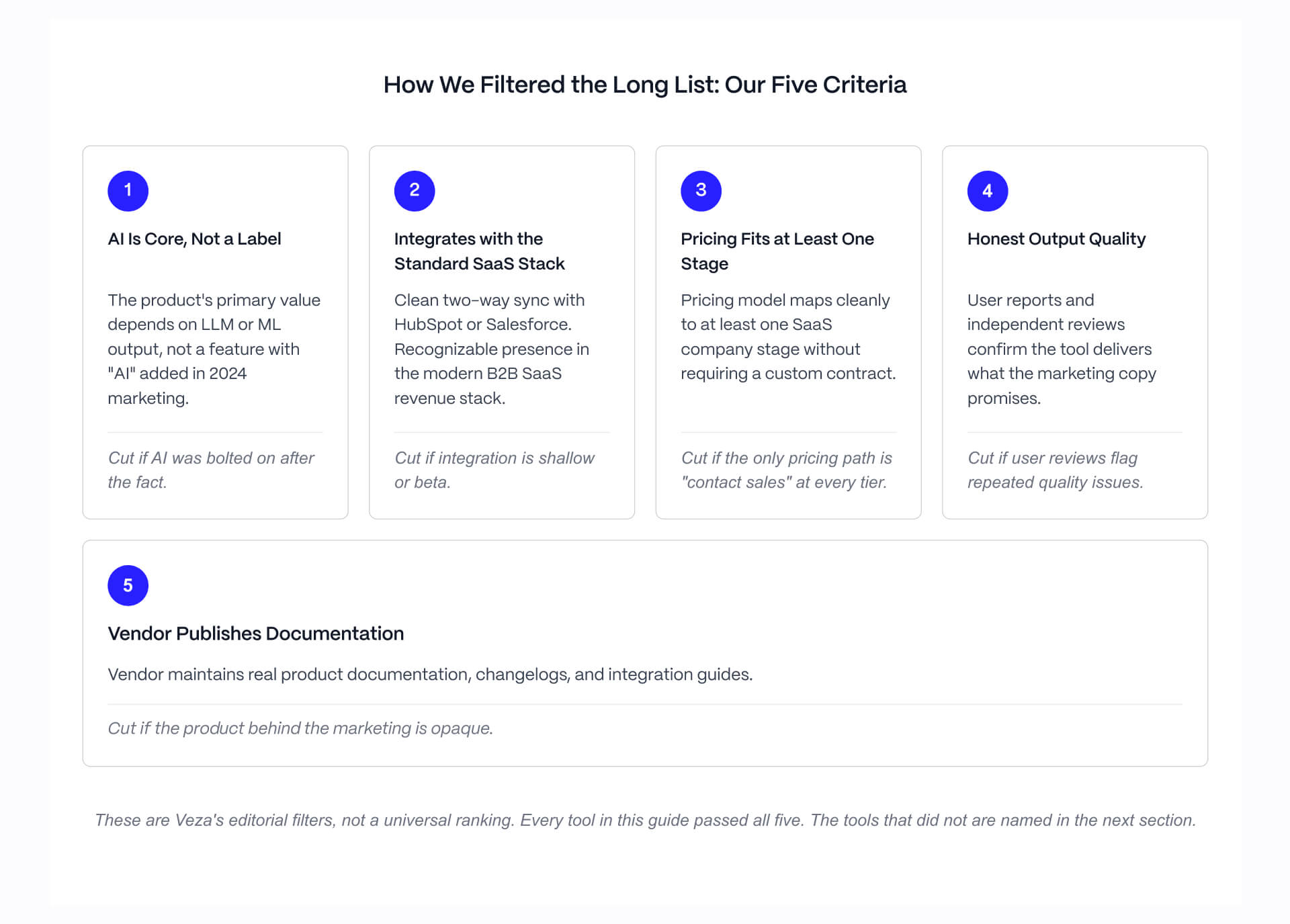
Second, every tool had to fit into the standard B2B SaaS revenue stack. For the majority of companies, that means Salesforce or HubSpot as the CRM, a prospecting layer like Apollo or ZoomInfo, conversation intelligence through Gong or Chorus, and Slack as the operational workflow layer. Strong standalone functionality matters, but weak integrations create friction that compounds over time.
Third, pricing had to align with at least one realistic SaaS growth stage. A platform could be excellent, but if the economics only function for enterprise buyers, it’s not a practical recommendation for seed-stage or Series A companies.
Fourth, output quality had to be defensible. We relied on independent user feedback, platform reviews, public case studies, and observations from real-world adoption across B2B SaaS revenue teams. Vendor-claimed performance metrics are identified as such throughout the article.
Finally, vendors needed to demonstrate product maturity through public documentation, implementation resources, and integration guides. A polished landing page is not enough. Buyers need evidence that a product can be deployed, maintained, integrated successfully after the contract is signed.
Tools We Tested and Did Not Recommend (and the Specific Reason for Each Cut)
Not every product evaluated for this guide made the final shortlist.
Drift remains a widely recognized conversational marketing platform, but its AI capabilities often feel more layered onto a legacy chatbot architecture than rebuilt around modern AI-native workflows.
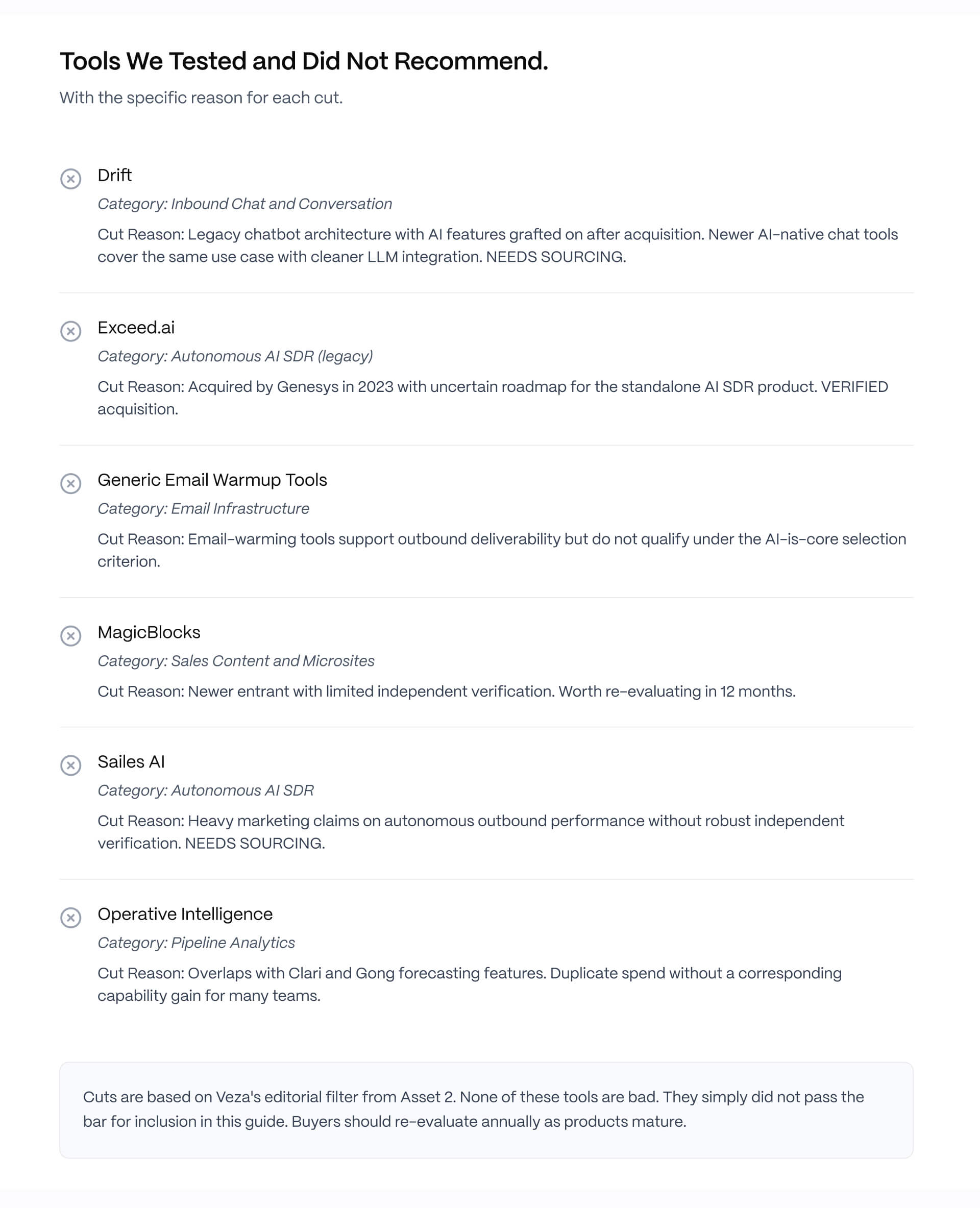
Exceed.ai presents a different challenge. The company was acquired by Genesys in 2023, which creates uncertainty surrounding the long-term roadmap of the standalone product.
Generic email warm-up platforms were also excluded. These products can be valuable for outbound infrastructure and deliverability, but they don’t satisfy the editorial requirement established in Section 1 that AI must be central to the product’s value.
MagicBlocks falls into a newer category that remains difficult to evaluate confidently. Independent verification of performance claims is limited, making a broad recommendation challenging to defend today.
We also excluded several first-generation autonomous SDR products launched before 2024. The category has evolved considerably, with platforms such as 11x, Artisan, and Regie.ai introducing considerably more capable agentic workflows. Buyers need to evaluate the current generation rather than relying on assumptions formed by earlier products.
The Integration Tax No Vendor Shows on the Pricing Page
The subscription price is rarely the true cost of adoption. The larger expense is often the operational work required to make a platform work better.
For a lot of organizations, implementation involves CRM synchronization, field mapping, workflow configuration, reporting alignment, user training, and ongoing governance.
This is where many AI sales tool purchases fail. Having a compelling demo creates a sense of urgency, budget is approved, and software is deployed. The underlying CRM data, attribution model, routing logic, and reporting structure are never fully prepared. Adoption stalls, usage concentrates among a small group of power users, and renewal arrives before the organization has generated the evidence required to justify expansion.
The practical buying framework is simple: tooling cost + integration cost = the real year-one investment. Revenue leaders budgeting for both tend to see value sooner, while those who only budget for the subscription often spend the first year figuring out what the pricing page left out.
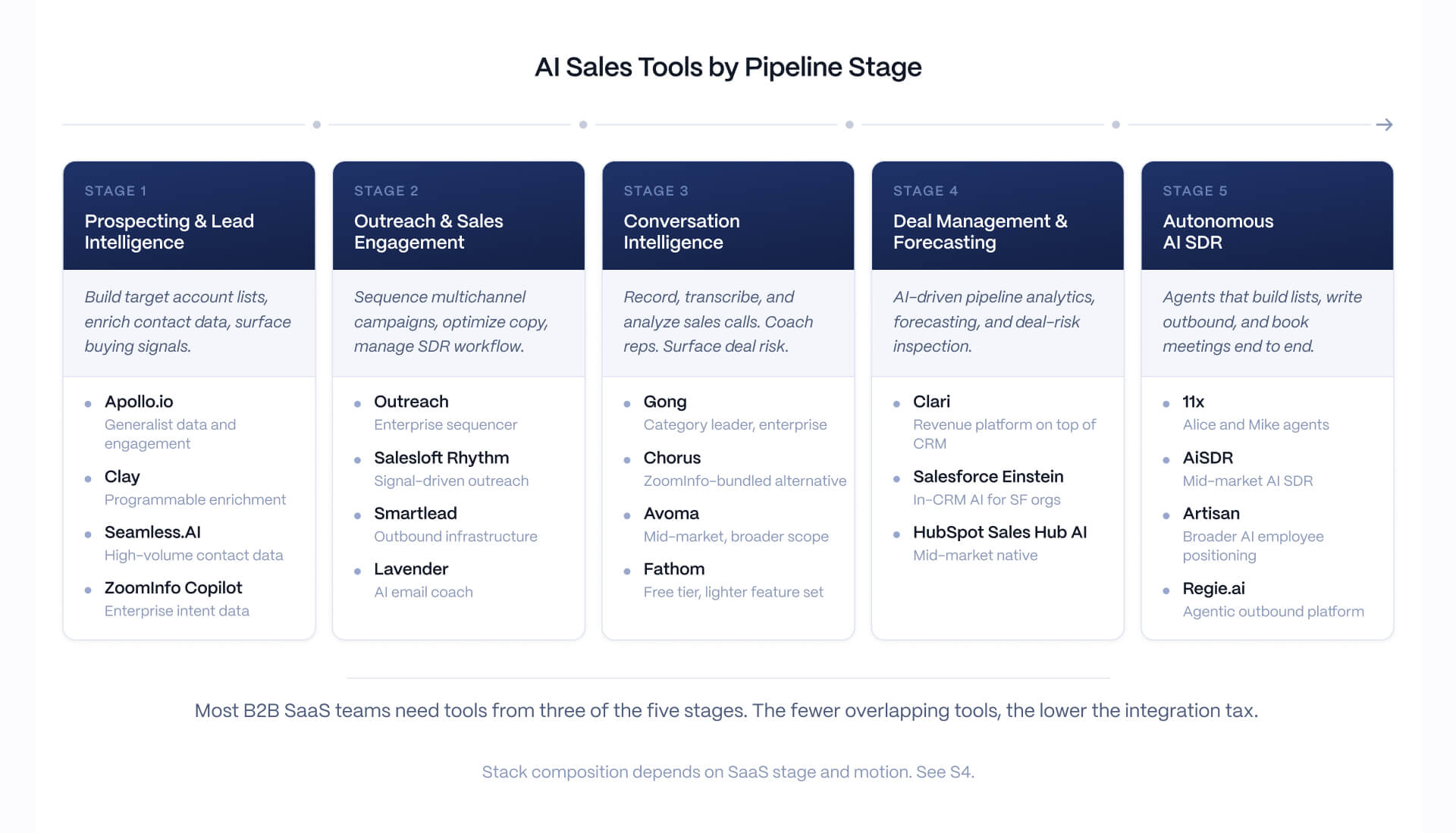
The Best AI Sales Tools by Pipeline Stage
The biggest mistake many buyers make when trying to evaluate AI sales software lies in treating the category as a single market when it’s anything but. The tools responsible for running outbound campaigns, finding prospects, coaching sales reps, and forecasting revenue each solve different problems. Comparing them directly creates the problem where popularity replaces buying logic.
Instead, we recommend evaluating AI sales tools according to the stage of the revenue pipeline they influence. This framework aligns with the way B2B SaaS revenue teams actually operate, avoiding duplication that creates software overlap and doesn’t work to improve outcomes.
Top of Funnel: Prospecting, Outreach, and Autonomous AI SDRs
Top-of-funnel tools exist to create pipeline. This category has three distinctive subgroups: prospecting and lead intelligence, outreach and sales engagement, and autonomous AI SDR agents.
For prospecting and lead intelligence, Apollo is the strongest all-in-one recommendation for seed through Series B companies. The combination of contract data, outbound sequencing, and AI-assisted workflow functionality helps small revenue teams to consolidate several functions into one platform. Clay often becomes more worthwhile once a team has exhausted Apollo’s native data and needs custom enrichment workflows. The majority of seed-stage companies should not buy Clay.
Seamless.AI occupies the value end of the market, offering large contact volumes for a much lower price, while ZoomInfo remains the enterprise standard for organizations seeking scale, intent signals, account intelligence, and dedicated data operations support.
Outreach and sales engagement platforms represent the second layer of top-of-funnel execution. Outreach remains the enterprise-grade sequencer, offering deep workflow automation and reporting capabilities for mature revenue teams. Salesloft Rhythm takes a different approach by focusing on signal-driven prioritization, helping sellers determine the actions that matter the most.
Smartlead occupies a different position within the stack. Rather than functioning as a complete sales engagement platform, it acts as outbound infrastructure, supporting domain management, deliverability monitoring, and large-scale sending operations. Lavender is best viewed as a productivity layer as opposed to platform replacement, helping individual reps improve email quality via AI-assisted coaching.
One recurring pattern across B2B SaaS revenue teams comes in the form of duplicate investment in enterprise sequencers. Purchasing Outreach and Salesloft simultaneously rarely produces incremental value in proportion to the cost. Organizations need to choose a single system of engagement and optimize around it.
The final category is autonomous AI SDR agents. Platforms like 11x, AiSDR, Artisan, and Regie.ai represent the newest generation of software designed to automate prospect identification, personalization, outreach, and meeting booking.
The category is advancing rapidly, but buyers should approach it cautiously. Product capabilities have evolved over the last twelve months, which makes historical comparisons challenging. Our recommendation is straightforward: pilot before annual commitment. Any deployment should include a 90-day evaluation period, documented success criteria, and a contractual exit path if performance fails to meet expectations.
For readers looking to evaluate the broader autonomous software landscape, our guide to AI agents provides additional context on where agentic systems are headed beyond sales workflows.
Mid-Funnel: Conversation Intelligence and Coaching
Conversion intelligence tools operate after the pipeline has been created. Their role is to capture customer interactions, surface coaching opportunities, identify deal risk, and improve forecasting confidence.
Gong is the category leader and the strongest enterprise recommendation. The platform’s depth of analytics, coaching workflows, and revenue intelligence capabilities make it highly effective for Series B and larger organizations that already possess dedicated RevOps resources.
For companies that are already committed to the ZoomInfo ecosystem, Chorus provides a logical alternative. The value proposition is less about outperforming Gong and more about consolidating tooling within existing commercial relationships.
Avoma is typically the strongest fit for product-led and mid-market organizations because they extend beyond sales conversations into customer success and post-sales workflows. For companies where expansion and retention matter as much as acquisition, that broader coverage can prove invaluable.
Fathom continues to disrupt the category from the bottom up. For founder-led sales teams and early-stage startups, the platform covers most meeting recording, transcription, note-taking, and summary requirements without complexity or the cost associated with enterprise conversation intelligence systems.
As a practical buyer framework: choose Gong if budget and RevOps maturity exist, Avoma for broader cross-functional coverage, Chorus for ZoomInfo-centric organizations, and Fathom for early-stage teams. Purchasing Gong and Avoma simultaneously is often duplicate spend unless there’s a clearly defined operational requirement.
Conversation intelligence overlaps with inbound engagement categories, although buyers need to avoid confusing these products with AI chatbots, which solve a different website-side conversion problem.
Bottom of Funnel: Deal Management and Revenue Forecasting
Bottom-of-funnel AI sales software focuses on forecasting, pipeline inspection, and revenue predictability, as opposed to pipeline generation. Inbound qualification tools such as AI chatbots help to determine which conversations enter the pipeline in the first place.
Clari remains the benchmark for dedicated revenue operations teams. Rather than replacing the CRM, it sits on top of it, providing forecasting, deal inspection, and revenue visibility capabilities that many organizations struggle to build natively.
Salesforce Einstein represents the CRM-native option for organizations already committed to the Salesforce ecosystem. The value lies in extending existing workflows as opposed to introducing additional platforms. As with CRM-native AI products, adoption success is largely reliant on CRM data quality and process discipline.
HubSpot Sales Hub is similar for companies running a revenue stack inside HubSpot. AI functionality works well as part of a broader CRM decision.
The majority of buyers have a relatively simple. Clari fits mature revenue operations teams that require dedicated forecasting layers. Salesforce Einstein is perfect for those companies already invested in Salesforce. HubSpot Sales Hub fits companies that operate inside the HubSpot ecosystem. CRM-native AI needs to be evaluated as part of the CRM strategy itself, not as a separate AI purchase. Teams evaluating the broader platform decision can also review our comparison of Webflow vs HubSpot.
How to Match AI Sales Tools to Your SaaS Company Stage
The best AI sales stack for seed-stage companies is typically wrong for Series C revenue businesses. The sales complexity, budget, team size, and operational maturity of an organization all influence which tools create leverage, and which are expensive distractions.
The goal here is not to build the largest possible stack, but the smallest stack will remove bottlenecks.
Pre-Seed and Seed: The Minimum Viable AI Sales Stack
Pre-seed and seed-stage B2B SaaS companies tend to operate with founder-led sales or a team of 1-3 SDRs. At this point in the process, simplicity is more important than sophistication.
The recommended starting stack is Apollo for basic sequencing, coupled with Fathom for call recording, transcription, and meeting summaries. These tools work together with the majority of early-stage sales workflows, without having to introduce considerable operational overhead.
One of the most common mistakes early teams make is to buy enterprise software, because larger competitors use it. This means a small team running Gong, Outreach, and enrichment tools winds up paying for capacity it can’t utilize.
The architectural process here is simple: make sure you keep the stack thin until repeatable inbound or outbound acquisition is proven. Founders need to remain close to customer conversations, objection patterns, and pipeline development before they automate large portions of the sales process.
For a lot of early-stage teams, Apollo and Fathom cover around 80% of sales workflow requirements, while also preserving flexibility and budget.
Apollo pricing:
- Free
- Basic - $49
- Professional - $79
- Organization - $119
Fathom pricing:
- Free
- Team - $15
- Business - $25
Series A and B: Building a Repeatable Pipeline Without Bloat
Series A and Series B companies tend to operate with dedicated SDR and AE functions, improving sales leadership, and the beginnings of a formal RevOps capability.
At this stage in the process, specialization becomes more sensible. A lot of teams graduate from an all-in-one approach toward a stack that’s built around a dedicated prospecting platform like Apollo or Clay, dedicated sales engagement platforms like Outreach or Salesforce, conversation intelligence through Avoma or Chorus, and either HubSpot or Salesforce as the CRM foundation.
The challenge is no longer generating the initial pipeline. The challenge comes with trying to build a repeatable process that scales without creating operational complexity.
The most common mistake that occurs at this state is tool accumulation. A platform gets purchased for a specific campaign, while another is added for a different initiative, and neither replaces the current workflow. Over time, overlapping functionality creates cost, administrative burden, and adoption challenges.
A Series B organization running Clay for enrichment, Outreach for sales engagement, Avoma for conversation intelligence, and HubSpot as the CRM has a coherent architecture. The same organization paying for Gong alongside Avoma might be introducing duplicate functionality without getting proportional value.
The practical recommendation here is to audit the stack quarterly, identify overlap, and retire tools that no longer serve a distinct purpose. Teams need to avoid deploying Salesforce Einstein unless Salesforce is already the system of record, as the integration assumptions behind the product don’t translate cleanly into non-Salesforce environments.
Series C and Above: AI Sales Tool Consolidation and Replacement
Series C and larger B2B SaaS companies typically operate mature revenue organizations with dedicated RevOps, sales enablement, forecasting processes, and established CRM governance.
At this stage of the process, the challenge lies in being able to determine which tools need to be replaced, consolidated, and upgraded.
The majority of enterprise revenue teams already have prospecting, sequencing, CRM, and reporting systems in place. The AI opportunity is integrating fresher capabilities into this environment, and reducing complexity as much as possible.
Common additions include Gong for enterprise-scale conversation intelligence, Clari as a dedicated forecasting and revenue inspection layer, ZoomInfo Copilot for intent and account intelligence, and tightly scoped pilots of autonomous AI SDR platforms.
The largest risk is allowing AI purchases to stack on top of existing contracts instead of replacing them. Each new category needs to be evaluated alongside the legacy tools it’s going to displace.
Series D companies adopting Salesloft Rhythm need to have clear plans for retiring overlapping sequencing software, as opposed to running both concurrently. At the same time, autonomous AI SDR deployments should start as controlled pilots, as opposed to full-scale rollouts.
This remains one of the fastest-moving categories on the market. Any autonomous SDR initiative needs to include a definitive evaluation period, documented success metrics, and a contractual exit path well before commitments are signed.
The AI Sales Tool Decision Framework
The AI sales software market is crowded, and the majority of buying mistakes tend to occur before implementation. Teams buy software because their competitors use it, because of an impressive demo, or because a new AI feature might solve a problem. However, a better approach is to evaluate every purchase using a small set of questions that push alignment between tool, team, and revenue bottleneck.
The 5-Question Checklist Before You Buy Any AI Sales Tool
Before committing to a contract, each AI tool needs to pass five important tests.
Question 1: Which stage of the pipeline does the tool serve, and where is the biggest performance gap found? If conversion rate or deal progression is a sticking point, adding another prospecting platform won’t fix it. If pipeline creation is the bottleneck, a forecasting platform won’t generate demand.
Question 2: Does the tool fit your current company stage and team size? Founder-led sales motion doesn’t need enterprise conversation intelligence platforms. Similarly, a mature revenue organization outgrows entry-level tooling.
Question 3: Does the platform integrate with the existing CRM in a friction-free way? Adoption can stall before value occurs if implementation complexity exceeds operational capacity.
Question 4: Can a team meet the 90-day adoption cost? Elements including workflow changes, setup, data cleanup, training, and reported configuration all need the kind of attention and time many teams overlook.
Question 5: Is there a documented exit path if the tool underperforms? Annual contracts without defined evaluation criteria are among the fastest routes to shelfware.
The most successful purchases are able to pass all five questions, but many purchases will fail Question 4 or 5.
How AI Sales Tools and Your Website Conversion Infrastructure Need to Work Together
AI sales tools operate downstream of the website. Apollo merely sequences the leads to website captures. Gong is only able to analyze the conversations prospects agree to have, while Clari only forecasts the pipeline that moves from website visit to CRM record.
This is why the highest-performing revenue teams treat the website and sales stack as one single system. Marketing owns acquisition, RevOps owns pipeline management, but both are reliant on the same conversion infrastructure. The handoff between website visitor and qualified opportunity can result in significant pipeline leaks.
For examples of websites designed to support this process, check out our guide to SaaS landing page examples, and our list of the best B2B SaaS websites. These examples reveal the importance of conversion, qualification, and lead routing decisions in inspiring and influencing the events of the later sales process.
At Veza Digital, we build Webflow websites for B2B SaaS enterprises, and regularly see teams adding new tools and addressing conversion issues. Underperforming sales stacks tend to be symptoms of landing pages that don’t match intent, forms that collect insufficient qualification data, or attribution systems that break between the marketing and sales stages.
Before adding another AI sales platform, be sure to evaluate whether the website is creating the quality and volume of opportunity the stack demands. Teams looking to explore AI landing page generators should view them as part of a larger conversion system, rather than a replacement for strategy, information architecture, or CRM integration.
Having a sales stack in place, but still having to deal with soft pipeline means the issue is likely to be with the website. Learn more about Veza Digital’s approach as a Webflow agency, and explore our work to understand how we help conversion-focused websites support downstream sales performance.
The AI sales stack only performs as well as the website feeding it.
Picking the right AI sales tools matters. So does the website that captures the leads those tools work on, the landing pages that match the ads driving traffic, and the attribution that lets revenue operations see what is actually working. VezaDigital builds Webflow websites for B2B SaaS companies, and has shipped the website side of the AI sales loop for teams running every category of tool in this article. If your sales stack is in place but pipeline is soft, the website is usually the next place to look. If your team is rebuilding both at once, we can help map the strategy.
FAQs
What is the best AI sales tool for B2B SaaS in 2026?
There is no single best AI sales tool. The right tool depends on the pipeline stage you are trying to improve and your SaaS company stage. For prospecting, Apollo.io fits seed through Series B and ZoomInfo Copilot fits Series C and above. For outreach, Outreach or Salesloft for established teams and Apollo's native sequencing for early teams. For conversation intelligence, Fathom for early stage, Avoma for mid-market, Gong for enterprise. Match the tool to the stage where pipeline is actually leaking, not to popularity.
Which AI sales tool should I buy first?
Buy your first prospecting tool. Almost every B2B SaaS revenue motion starts with the ability to build target account lists and reach the right contacts at the right time. Apollo.io is the strongest first AI sales tool for most seed through Series B teams: it combines prospecting and basic sequencing in one product at a price point that scales. Add a conversation intelligence tool second, once the team is running enough calls to make recordings useful. Do not buy a deal management tool until the pipeline has enough deals to justify forecasting infrastructure.
Are autonomous AI SDR agents worth the cost?
It depends on what you are replacing. If you are replacing an empty headcount, an AI SDR pilot can produce pipeline at a cost-per-meeting that beats hiring a junior SDR. If you are replacing an experienced SDR who already books meetings at scale, the math is harder. Every autonomous AI SDR adoption should run as a 90-day pilot with documented success criteria and a clean kill-switch in the contract. 11x, AiSDR, Artisan, and Regie.ai are the current leading options. VENDOR-CLAIMED on all reply-rate and meetings-booked numbers, verify in pilot.
How much should a B2B SaaS team budget for AI sales tools?
Seed stage: under $500 per month total (Apollo plus Fathom covers most needs). Series A to B: $3,000 to $15,000 per month total across prospecting, outreach, conversation intelligence, and CRM. Series C and above: $20,000 to $100,000-plus per month total across the full revenue stack including enterprise data and forecasting. NEEDS SOURCING for specific bands, verify against Veza client engagements and analyst reports before publication. Integration cost typically exceeds first-year subscription, budget for it.
What is the difference between AI sales tools and a CRM?
A CRM (Salesforce, HubSpot) is the system of record for accounts, contacts, deals, and activity. AI sales tools sit alongside or on top of the CRM and perform specific pipeline functions: prospecting (Apollo, Clay), outreach (Outreach, Salesloft), conversation intelligence (Gong, Fathom), deal management and forecasting (Clari). Modern CRMs include native AI features (Einstein, HubSpot AI), but those features are part of the CRM decision rather than a separate product category. The stack pattern: CRM plus three to five specialized AI sales tools wired into it.
Do AI sales tools replace SDRs?
Not in 2026. Autonomous AI SDR agents (11x, Artisan, Regie.ai, AiSDR) can handle list-building, personalized outbound, and meeting booking for narrow ICPs, and they can replace headcount you have not yet hired. They do not consistently replace experienced human SDRs at scale. The honest framing: AI SDR tools are useful in specific scenarios (replacing an empty seat, scaling a tested motion, expanding into a new segment) and not useful in others (replacing an experienced SDR with established account relationships). Pilot before annual commitment. VENDOR-CLAIMED on all replacement claims.
What is the integration tax for an AI sales tool?
The integration tax is the cost of getting an AI sales tool actually working inside your existing stack: CRM data hygiene, field mapping, system-of-record decisions, training and rollout across SDRs and AEs, dashboard build-out, and ongoing maintenance. For a typical enterprise AI sales tool, this is 2 to 6 weeks of RevOps time plus 2 to 4 weeks of training. Annual integration cost often exceeds first-year subscription cost. Vendors do not show this on the pricing page. Plan for it before purchase, or expect the tool to sit underused.
Can AI sales tools improve my pipeline if my website is underperforming?
No, not durably. AI sales tools live downstream of the website. They can sequence the leads the website captures and analyze the calls those leads agree to take, but they cannot create demand that the website fails to capture. If the website is converting poorly, fixing landing pages, forms, and attribution usually delivers more pipeline than adding another AI sales tool. AI sales tools and website conversion infrastructure are one connected system, not two separate problems.
Which AI sales tools work with HubSpot?
Most modern AI sales tools integrate with HubSpot natively or via standard webhook and API patterns. Apollo, Outreach, Salesloft, Gong, Chorus, Avoma, Fathom, and Clari all publish HubSpot integrations. HubSpot also ships its own native AI sales features (Sales Hub with AI). For teams running HubSpot as the CRM core, the cleanest stack is HubSpot plus one prospecting tool, one sequencer, one conversation intelligence tool, and HubSpot's native forecasting features. Verify each integration depth at the vendor site before purchase.
How do I choose between AI sales tools that look similar?
Most overlap happens at the conversation intelligence layer (Gong vs Chorus vs Avoma) and the outreach layer (Outreach vs Salesloft). Decide based on three factors: SaaS company stage (Gong for Series B-plus with RevOps capacity, Avoma for mid-market, Fathom for seed), existing stack integration (Chorus pairs with ZoomInfo, HubSpot AI pairs with HubSpot CRM), and contract terms (which vendor offers the cleanest 90-day kill-switch). When two tools look similar, the decision usually comes down to integration depth and contract flexibility, not feature parity.