.jpg)
AI Overview monitoring in 2026 has split into two distinct paths. The first consists of SEO Suite Extensions, which includes platforms such as Ahrefs Brand Radar, Semrush AI Toolkit, Conductor, AccuRanker, and SE Ranking that have incorporated AI Overview monitoring into mature SEO workflows.
The second consists of AI-Native Specialists, and platforms such as Profound, Otterly.ai, and Peec.ai. that are purpose-built to understand how AI search engines cite, recommend, and surface content.
Most organizations approach this decision from the wrong angle. Instead of asking how deeply they need to understand AI-generated answers, they simply whichever monitoring capability is already inside the existing SEO platform, but this doesn’t optimize insight.
Most established SEO platforms can deliver appearance monitoring, but citation tracking is more valuable. Understanding the sources AI selects, why those sources are trusted, and how citation patterns evolve across AI platforms requires a fresh level of analysis.
This guide reframes AI Overview monitoring around tracking depth as opposed to vendor familiarity. We apply a five-point evaluation framework, examine eight leading platforms across both monitoring paths, and recommend the right architecture for different team profiles. The strategic decision is selecting the monitoring depth your business needs.
Two Paths to AI Overview Monitoring
The AI Overview monitoring market appears crowded at first glance, but beneath the surface it divides into two fundamentally different approaches. In much the same way as a medical diagnosis, one path provides you with an X-ray that confirms something exists, while the other provides an MRI that explains what is happening. Both of these are valuable, but they answer different questions. Being able to understand this distinction is essential for making the most informed procurement decision possible.
The Category Split (SEO Suite Extensions vs AI-Native Specialists)
The AI Overview monitoring market as developed along two clear paths:
Path A consists of established SEO platforms that have expanded into AI search visibility. Ahrefs Brand Radar, Semrush AI Toolkit, Conductor, AccuRanker, and SE Ranking all began as mature SEO products before layering AI Overview monitoring onto broader search workflows. Their greatest strength is integration. Organizations already invested in these platforms can extend existing reporting without introducing another specialist vendor.
Path B follows a different philosophy. Platforms such as Profound, Otterly.ai, and Peec.ai were designed specifically to monitor AI-generated answers, citations, and answer-engine behavior. Instead of treating AI Overview monitoring as another SEO feature, they treat this as a new category of search intelligence.
This distinction mirrors the AEO foundation this article builds on, where optimisation and measurement work together rather than competing with one another. It also aligns with the terminology and category structure, which separates SEO, AEO, GEO, and LLM optimization into complementary disciplines as opposed to interchangeable labels.
This creates an imbalance between the two that needs to be addressed. Five mature vendors currently represent the SEO Suite Extension category, while only three AI-native specialists have established themselves as consistent practitioner recommendations.
This asymmetry reflects market maturity rather than product quality. Traditional SEO platforms have had years to evolve into AI visibility, where purpose-built AI monitoring remains an emerging category.
The strategic decision here becomes choosing which monitoring philosophy is most suited to the questions your organization needs answers to.
The Depth Question - Appearance vs Citation Tracking
If Path A and Path B represent two different monitoring architectures, the real procurement decision comes down to tracking depth.
Imagine a Formula One team preparing for a Grand Prix. Every engineer can see the speedometer, but championship teams win because they analyze the telemetry. One tells you how fast the car is traveling, while the other explains why it is performing that way, and where a competitive edge can be found.
AI Overview monitoring follows the same principle.
Appearance monitoring answers straightforward operational questions. Does an AI Overview appear for a target keyword? Does your brand appear within it? Has that visibility changed over time?
Citation tracking goes considerably deeper. Which websites are consistently cited? Which competitors dominate citation share? How do source selections change between prompts, industries, countries, or AI platforms?
Treating these disciplines as interchangeable often leads organizations to buy the wrong platform. Appearance monitoring has quickly become table stakes. Citation intelligence remains the strategic capability that differentiates specialist AI monitoring platforms from broader SEO suites.
The Five-Point Framework for Choosing an AI Overview Monitoring Tool
Instead of comparing feature lists, each platform in this guide is assessed against the same procurement criteria.
Tracking Depth Fit - This assesses whether your platform’s monitoring capabilities match the insight levels your business needs.
Platform Coverage - This evaluates how well each tool is able to measure and monitor Google AI Overviews alongside the broader AI search ecosystem.
Stack Integration Fit - This measures how naturally the platform complements existing SEO, analytics, and reporting workflows.
Data Accuracy - This considers the consistency, reliability, and usefulness of monitoring data for real decision-making.
Cost Trajectory examines how pricing evolves as monitoring requirements scale across prompts, brands, markets, and teams.
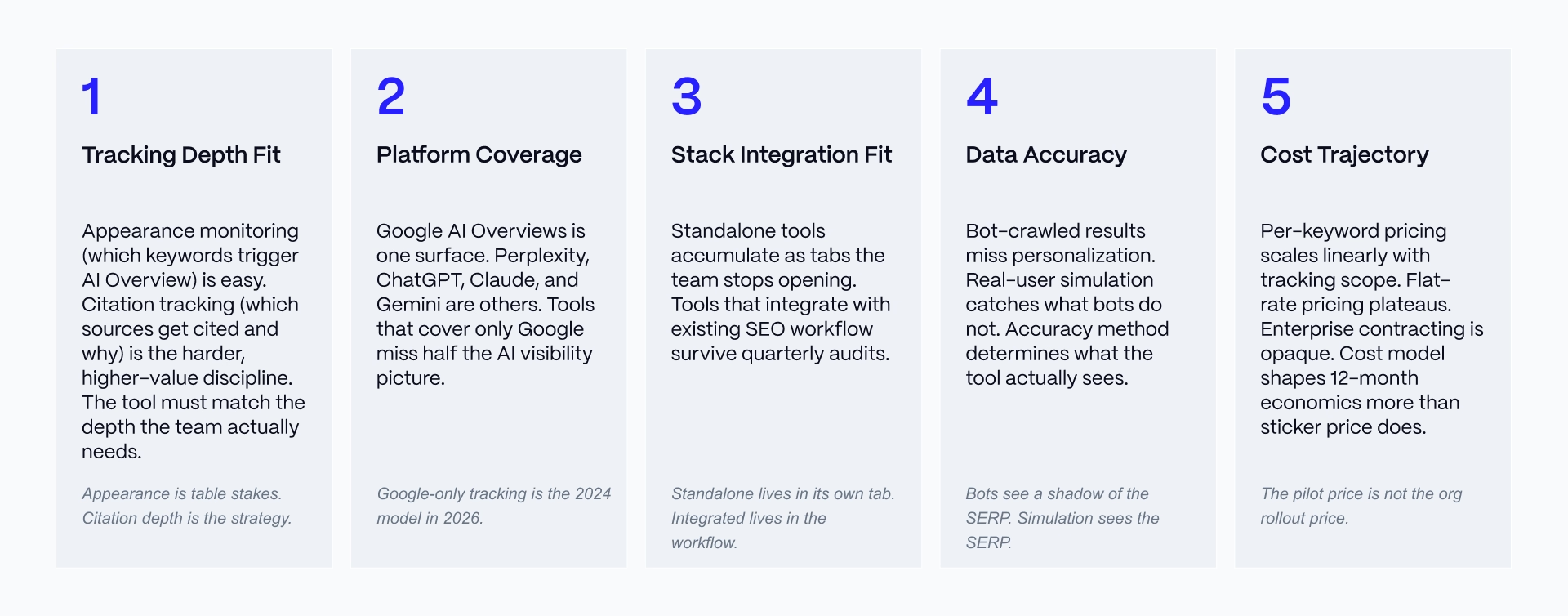
These five dimensions are closely aligned with the strategic AI visibility framework, where monitoring is a crucial part of the broader AI search strategy, as opposed to an isolated software purchase. This reflects Veza’s Answer Engine Optimization capability, where AI visibility is improved through an ongoing feedback loop between measurement and optimization.
CTA: The best AI Overview monitoring platform is the one that delivers the exact level of monitoring depth that your AI search strategy requires.
Path A - Enterprise SEO Suite Extensions (Ahrefs, Semrush, Conductor)
SEO Suite Extensions represent the most familiar route into AI Overview monitoring because they build on platforms many businesses already use. Instead of introducing a new specialist workflow, they extend existing SEO reporting with AI visibility metrics, allowing teams to monitor traditional organic search and AI-generated answers from the same platform.
This simplicity is a major advantage, and the question surrounds whether this also delivers the monitoring depth your organization needs.
Ahrefs Brand Radar - Enterprise SEO Suite Extension
Ahrefs Brand Radar is arguably the strongest example of AI Overview monitoring integrated into a mature SEO platform. Instead of treating AI visibility as a standalone discipline, it extends Ahrefs’ existing search intelligence ecosystem with citation tracking, AI visibility reporting, and competitive benchmarking across multiple AI platforms.
Its greatest strength is workflow continuity. Organizations already standardized on Ahrefs can evaluate AI Overview performance alongside backlink intelligence, keyword rankings, organic visibility, and competitive research without having to introduce another reporting platform. Brand Radar delivers stronger citation analysis than many competing SEO suite extensions, making it particularly valuable for teams that want deeper AI insight while also remaining inside an existing SEO workflow.
The limitations reflect the realities of an integrated platform. Brand Radar remains tied to Ahrefs’ subscription structure, with feature availability varying by plan. Teams seeking highly specialized prompt analytics or enterprise-grade AI monitoring workflows might eventually reach the limits of what integrated SEO platforms are designed to deliver.
For organizations already invested in Ahrefs, Brand Radar complements adjacent AI SEO tools, creating a broader AI search workflow without requiring additional procurement.
Pricing: Lite - $129/month
Verdict: Brand Radar is the strongest SEO suite extension for organizations already committed to Ahrefs, especially when integrated workflow matters more than adopting a dedicated AI monitoring platform.
Semrush AI Toolkit - Enterprise SEO Suite Extension
Semrush AI Toolkit approaches AI Overview monitoring from a broader marketing perspective. Instead of existing as a standalone monitoring product, it integrates AI visibility into the wider Semrush ecosystem, allowing SEO, content, and digital marketing teams to evaluate AI search performance alongside established keyword research and content optimization.
This is arguably its greatest strength, with companies already relying on Semrush able to incorporate AI monitoring into existing content planning and marketing workflows without changing how they operate. AI Overview visibility becomes another layer or search intelligence instead of an isolated reporting exercise.
The trade-off lies in monitoring depth. While Semrush continues expanding its AI capabilities, some citation-analysis features are less comprehensive than those on the strongest purpose-built monitoring platforms. Feature availability can also vary between subscription tiers, making decisions close to licensing.
Pricing: Base - $99/month
Verdict: Semrush AI Toolkit is the strongest SEO suite extension for organizations already operating within the Semrush ecosystem.
Conductor - Enterprise SEO Platform
Conductor has an entirely different position within Path A. Instead of targeting individual practitioners or mid-market SEO teams, it’s designed for enterprise organizations managing AI visibility across multiple brands, business units, and large-scale content operations.
The greatest strengths here lie with governance, workflow management, and executive reporting. AI Overview monitoring becomes part of a broader enterprise search intelligence programme, which is supported by robust reporting, collaboration features, and operational controls.
These enterprise capabilities inevitably influence procurement. Conductor follows an enterprise contracting model with bespoke pricing, while its breadth introduces a learning curve that can be difficult for smaller businesses to justify. Teams looking for AI Overview visibility alone may not make full use of the wider platform.
Pricing: Sign up for access
Verdict: Conductor is the strongest of the Path A recommendations for enterprise organizations where governance, reporting, and operational scale take on greater strategic importance.
Path A Continued - AccuRanker, SE Ranking, and When Path A Hits Its Ceiling
Not every organization evaluating AI Overview monitoring needs to have an enterprise SEO platform. Mid-market SEO teams, agencies, and growing B2B companies often prioritize transparent pricing, straightforward deployment, and strong operational workflows over enterprise governance. AccuRanker and SE Ranking represent this segment well, showing that Path A extends beyond the largest SEO suites.
AccuRanker - Rank Tracker Specialist with AI Overview Detection
AccuRanker approaches AI Overview monitoring from the perspective of a specialist rank tracker. Rather than building a comprehensive AI visibility platform from the ground up, it extends its market-leading keyword tracking capabilities with AI Overview detection and AI search visibility features.
Its greatest strength remains ranking intelligence. Organizations that rely on AccuRanker for large-scale keyword tracking can incorporate AI Overview visibility without disrupting established reporting workflows. Pricing transparency and a strong reputation for ranking accuracy strengthen its position among SEO practitioners managing performance at keyword level.
The trade-off comes with architectural origins. AccuRanker’s AI capabilities are rooted in rank tracking, meaning citation analysis, prompt intelligence, and broader AI search workflows are less developed than those from dedicated AI monitoring platforms. Organizations tracking thousands of keywords need to evaluate how the per-keyword pricing model scales over time.
Pricing: Professional - $224/month
Verdict: AccuRanker is the leading Path A recommendation for organizations seeking the best-in-class rank tracking with capable AI Overview monitoring layered in a mature workflow.
SE Ranking - Mid-Market SEO Suite
SE Rankings brings AI Overview monitoring to organizations looking for a cost-effective SEO platform without the complexity or procurement overhead of enterprise software. Its AI visibility capabilities complement a broader suite covering keyword tracking, technical SEO, competitor research, and reporting, making it especially attractive for agencies and growing in-house SEO teams.
Its primary advantage is value. Teams gain broad SEO functionality together with AI Overview monitoring through transparent subscription tiers, allowing organizations to expand AI reporting without fundamentally changing existing workflows or budgets.
Its limitations mirror those of many mid-market platforms. AI monitoring continues to evolve rapidly, and while SE Ranking provides useful visibility into AI search performance, its citation intelligence and workflow depth remain less mature than enterprise SEO suites or purpose-built AI-native specialists. AI functionality also varies by subscription and add-on availability.
Pricing: Essential - $52/month
Verdict: SE Ranking is the strongest mid-market Path A platform for organizations seeking balanced SEO capability with practical AI Overview monitoring at an accessible price point.
When Path A Hits Its Ceiling
Path A succeeds due to the fact that it makes AI Overview monitoring easy to adopt. Existing workflows stay intact, and organizations avoid introducing another specialist platform into the marketing technology stack. This simplicity also defines its natural ceiling.
The majority of SEO Suite Extensions excel at appearance monitoring but offer comparatively less depth when analyzing citation behavior across multiple AI platforms. They do a great job of answering questions such as, “Did my brand appear?”
However, long-term, organizations want to answer more strategic questions, like “Why did AI select those sources?” and “How does citation behavior differ from Google AI Overviews, ChatGPT, Gemini, and Perplexity?”
These become the questions that drive procurement, Path B deserves serious evaluation. At that point, the objective is building dedicated AI search intelligence. Organizations looking to make this transition also need to consider the AI SEO optimization companion, because monitoring alone identifies opportunities, while optimization determines whether future AI answers change in your favor.
Path B - AI-Native Enterprise Specialists (Profound)
If Path A extends traditional SEO platforms into AI search, Path B begins from the opposite direction. These platforms assume AI-generated answers are not simply another SERP feature, but they are a new search environment that needs its own monitoring architecture.
The result is a far different philosophy, as AI-native specialists explain why particular sources are trusted, cited, and repeated across multiple answer engines.
Profound - AI-Native Enterprise Citation Depth Leader
Profound represents the benchmark against which enterprise AI-native monitoring platforms get measured. It was purpose-built to understand the way in which answer engines construct responses and establish trust across ChatGPT, Google AI Overviews. Claude, Gemini, and Perplexity.
Citation depth is the greatest strength here. Consider AI monitoring like looking at an iceberg. Traditional SEO platforms only show the visible tip - whether your business appears inside AI-generated answers. Conversely, Profound is designed to analyze everything beneath the surface, determining why particular sources are selected, and which authority signals answer engines favor. It also explores the way in which these citation patterns differ across platforms.
That difference becomes hugely valuable for enterprise AEO programs. Profound enables SEO and content teams to analyze citation share, benchmark source selection against the competition, identifying recurring authority signals, and translating those insights into content strategy. Executive reporting and multi-platform monitoring are native capabilities, as opposed to features that are added later.
Profound follows an enterprise procurement model and introduces concepts such as citation intelligence and prompt analysis that might be unfamiliar to teams approaching AI search through a traditional SEO lens. Organizations seeking more basic AI Overview reporting will struggle to justify the investment.
Pricing: Starter - $99/month
Verdict: Profound is the category leader for enterprise organizations where citation intelligence is a strategic priority.
Why Enterprise AI-Native Looks Different from SEO Suite AI Features
The difference between Path A and Path B lies in product philosophy.
SEO Suite Extensions start with established SEO workflows before layering AI visibility onto them. AI-native specialists reverse that logic, beginning with citation intelligence and building the entire platform around understanding how answer engines construct responses across multiple platforms.
This is a distinction that becomes clear in reporting depth, prompt analysis, competitive citation benchmarking, and workflow design. An SEO suite can tell you that your brand appeared in an AI Overview, but an AI-native specialist explains which sources were cited, why they were selected, how competitors compare, and where future optimization opportunities exist.
This is a deeper analytical layer that aligns more closely with LLM optimization practices for SaaS, where improving AI visibility depends on understanding the way language models evaluate authority. The specialist premium is justified when those insights directly influence content investment and long-term AI search performance.
When Enterprise AI-Native Specialists Win
Enterprise AI-native platforms justify their premium when organizations move beyond measuring visibility and begin managing AI search as a strategic capability.
They continue to outperform SEO Suite Extensions when four conditions exist:
- Citation depth is more valuable than appearance monitoring.
- Multiple AI platforms need constant monitoring.
- Citation intelligence informs content strategy and AEO execution.
- Executive teams need competitive reporting on citation share and AI visibility trends.
A useful way of being able to think about the procurement decision to consider the medical analogy from earlier. An X-ray is fine when you just need confirmation something exits, while MRIs are essential when treatment depends on understanding what is going on below the surface.
When none of these conditions are applicable, Path A is the most pragmatic choice due to the fact that integrated workflows and procurement simplicity outweigh the benefits of specialist monitoring. This helps shift the investment from buying another SEO tool to building an AI search intelligence capability for enterprise businesses.
Path B Continued - Otterly.ai, Peec.ai, and When Combining Paths Wins
Enterprise AI-native platforms aren’t the only route into deeper citation intelligence. Because AI search monitoring has matured, a strong number of mid-market specialists have emerged. This has given growing B2B businesses and in-house SEO teams access to AI-native workflows without procurement overhead.
Otterly.ai - MId-Market AI-Native Specialist
Otterly.ai brings AI-native citation tracking to organizations that need deeper AI search insight without having to commit to an enterprise platform. Purpose-built for monitoring AI-generated answers across multiple platforms, it combines citation analysis, prompt tracking, and competitive visibility into a workflow that’s accessible to smaller SEO teams.
The greatest strength here is balance. Otterly.ai provides genuine citation intelligence at transparent price points, making it the natural choice for organizations that have outgrown appearance monitoring. Multiple-platform monitoring also provides greater strategic depth than most SEO Suite Extensions, along with historical reporting, and competitive citation analysis.
Enterprise scale is where the trade-off is most noticeable. Reporting and monitoring capabilities continue to evolve at a rapid rate, but things like workflow depth, governance, and executive reporting are less comprehensive. Those organizations managing multiple brands need to carefully assess whether the features are right for its long-term operational needs.
Pricing: Lite Plan - $29/month
Verdict: Otterly.ai is the strongest mid-market AI-native specialist for organizations seeking meaningful citation intelligence without having to make enterprise-level investments.
Peec.ai - Emerging AI-Native Specialist
Peec.ai represents the newest generation of AI-native monitoring platforms, built around the assumption that AI search visibility deserves dedicated measurement as opposed to incremental SEO reporting. There’s a focus on prompt tracking and citation analysis, which makes it highly attractive for companies experimenting with AEO and AI search optimization.
The primary advantage is development velocity. Peec is an emerging platform continuing to expand its AI search capabilities at a rapid pace, as well as introducing new monitoring features and platform integrations that reflect the changing AI search landscape. This agility can become a competitive advantage for companies prioritizing innovation.
The corresponding trade-off here comes with maturity. Enterprise buyers should evaluate reporting depth, governance capabilities, product roadmap, and long-term vendor stability alongside technical functionality. In an emerging category, selecting a platform means assessing capabilities in the present, as well as the future trajectory.
Pricing: Starter - $95/month
Verdict: Peec.ai is an emerging AI-native specialist with a strong roadmap, making it a highly attractive option for businesses adopting rapidly evolving technology.
When Combining Paths Wins
Ultimately, choosing between Path A and Path B is the wrong procurement question. The SEO function needs operational visibility into rankings, AI Overview appearances, and search performance within established workflows. Content and AEO teams require citation intelligence that helps explain why answer engines favor certain sources over others, and how that behavior changes across platforms.
Forcing both teams onto a single platform can create compromise as opposed to efficiency. A more effective approach is combining an SEO Suite Extension such as Ahrefs Brand Radar or Semrush AI Toolkit with an AI-native specialist such as Profound or Otterly.ai. A single platform manages operational SEO performance, while the other provides strategic citation intelligence.
CTA: The strongest AI search programs combine both pathways, giving each team the level of monitoring their business decisions need.
Audit, Anti-Patterns, and Decision by Team Profile
Choosing an AI Overview monitoring platform needs to be approached like a procurement exercise. Features are crucial, but long-term success is dependent upon whether a platform can answer strategic business questions 12 months down the line.
The 10-Question Pre-Purchase Evaluation
The most successful team assess AI Overview monitoring platforms as structured pilot programs rather than as vendor demonstrations. Well-designed proof of concept needs to reveal whether a platform delivers workflow compatibility, delivers monitoring depth, and reports quality.
The first three questions determine the platform’s monitoring architecture, and help determine the value of each subsequent report.
Questions four through six assess operational fi, and competitive tracking capabilities. Platforms that are technically strong can still be a poor investment if they can’t be naturally incorporated into existing reporting.
The final four questions examine long-term viability, which includes factors such as pricing scalability, vendor direction, and customer references.
Interestingly, questions 3, 5, and 9 are the ones most commonly missed or overlooked by the procurement teams. Detection methodology, workflow integration, and vendor trajectory are key factors that determine if a platform remains valuable after implementation.
Companies seeking an independent assessment before entering procurement should consider making full use of an AI search visibility audit service to identify monitoring requirements before software selection starts.
Anti-Patterns and Better Approaches
The AI Overview monitoring market is evolving rapidly, and many organizations are making decisions based on assumptions from traditional SEO software, which can lead to poor outcomes.
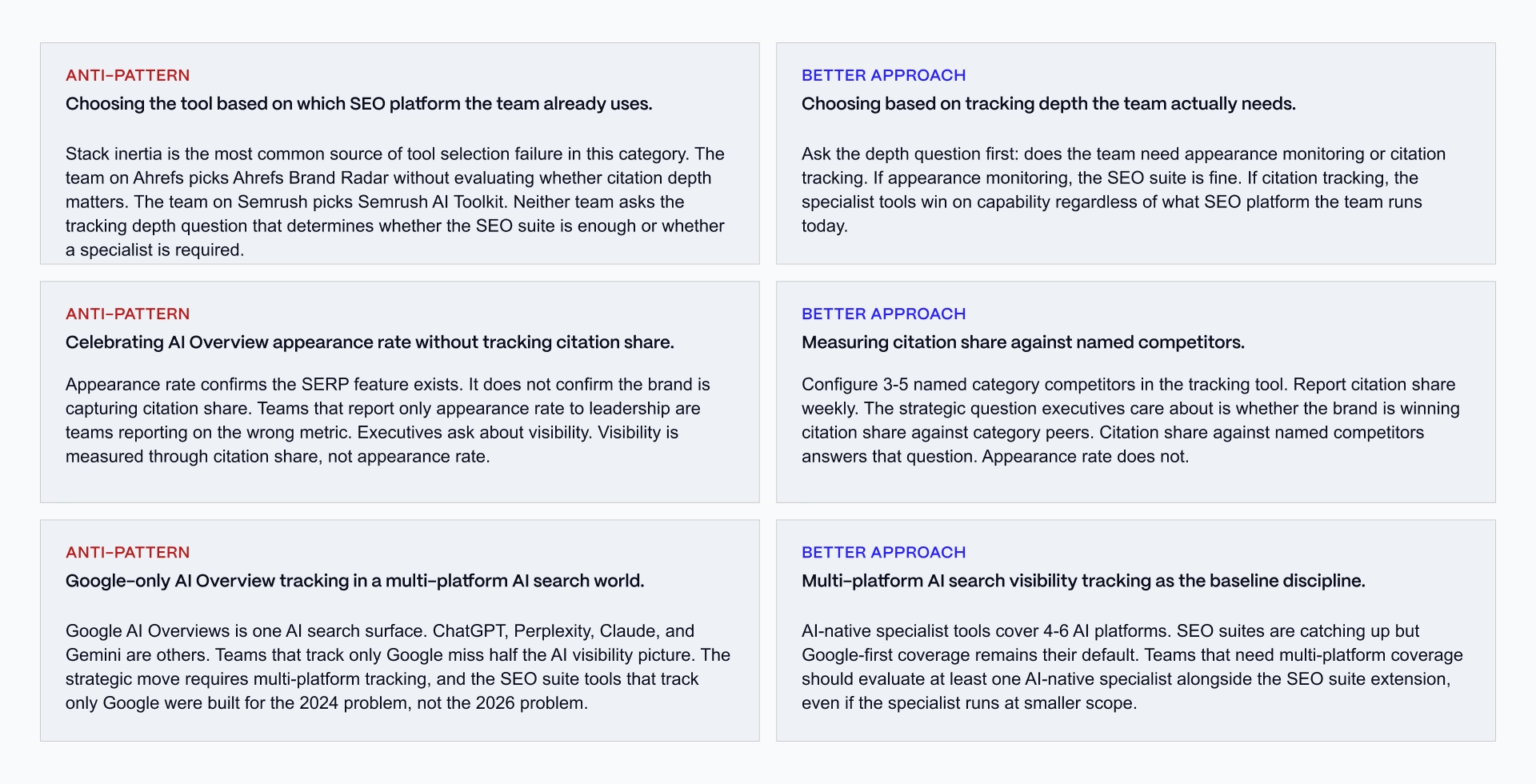
The first anti-pattern is stack-inertia selection. Procurement is simpler, but the organization doesn’t assess whether the available monitoring depth supports its AI search strategy. Making the choice based on monitoring requirements instead of vendor familiarity regularly leads to far better outcomes overall.
The second anti-pattern is reporting only appearance rates. Knowing if a brand appears in AI-generated answers can be useful, but understanding citation share is crucial for competitive advantage. Measuring the reasons why visibility changes is the most valuable step you can take.
The third anti-pattern is focused exclusively on Google AI Overviews. While Google is important, more and more organizations are appearing across LLMs such as Claude, Perplexity, ChatGPT, and Gemini. Multi-platform monitoring requires a baseline for a more accurate assessment of AI visibility.
These anti-patterns endure because they represent the path or least resistance for procurement. Better approaches require slightly more investment, but generate greater strategic insight.
Decision by Team Profile
No single monitoring platform is objectively best. The right choices are dependent entirely on your team’s objectives and operational workflows.
DECISION BY TEAM PROFILE
Use this as a starting point, not a binding answer. The five-point framework
(Asset 1) is the real evaluation. The team profile recommendation gets the
team to the right posture.
PROFILE 1: ENTERPRISE SEO TEAM ALREADY ON MATURE SEO SUITE
- Context: 3-15 person in-house SEO team, established Ahrefs or Semrush
contract, AI Overview tracking as one workflow among many
- Top constraint: procurement complexity of adding another vendor,
workflow fragmentation risk, budget cycle timing
- Top use cases: keyword-level appearance monitoring, competitive
tracking, content prioritization based on AI Overview presence
- Recommended posture: Enterprise SEO Team Extending Suite (Posture 1)
- Featured tools: Ahrefs Brand Radar, Semrush AI Toolkit, or Conductor
if enterprise SEO platform already in use
- Why: procurement simplicity and workflow integration win at this
profile. The SEO suite covers appearance monitoring adequately. If
citation depth becomes a priority later, an AI-native specialist can
layer on top.
The verdict: extend the existing SEO suite. Do not add a specialist tool
until the appearance-vs-citation depth question forces the decision.
PROFILE 2: ENTERPRISE MARKETING TEAM NEEDING CITATION DEPTH
- Context: brand marketing or content strategy team with executive-level
interest in AI search visibility as a strategic layer, budget authority
for specialist tools
- Top constraint: reporting depth expectations from executive stakeholders,
multi-platform coverage requirements, content strategy application
- Top use cases: citation share tracking, competitive intelligence,
content strategy input, executive share-of-voice reporting
- Recommended posture: Enterprise Marketing Team on AI-Native Specialist
(Posture 2)
- Featured tools: Profound (with Ahrefs or Semrush running in parallel
for the SEO team's operational workflow)
- Why: citation depth is the strategic layer. AI-native specialists cover
more platforms and produce citation reporting the SEO suites do not.
The marketing team's questions require the specialist's data model.
The verdict: adopt an AI-native specialist alongside the existing SEO
suite. Run in parallel. Report through both layers.
PROFILE 3: MID-MARKET SEO TEAM ON CONSOLIDATED SUITE
- Context: 1-5 person SEO team, tighter budget, AI Overview tracking as
one of several workflows, no dedicated content strategy team
- Top constraint: cost, tool consolidation, learning curve across a
smaller team
- Top use cases: appearance monitoring, keyword-level prioritization,
lightweight competitor tracking
- Recommended posture: Mid-Market SEO Team on Consolidated Suite (Posture 3)
- Featured tools: AccuRanker, SE Ranking
- Why: cost-effective SEO suites with adequate AI Overview features win
at mid-market scale. The team's constraints do not justify specialist
tool complexity or cost.
The verdict: pick the SEO suite that already fits the team's rank tracking
and keyword research workflows. Layer AI Overview tracking on top of the
existing subscription.
PROFILE 4: AI-FIRST TEAM ON SPECIALIST STACK
- Context: agency or brand where AI search visibility is the primary
strategic layer, not a subset of SEO work; team built around AEO as
the core discipline
- Top constraint: capability depth across AI platforms, competitive
positioning against category peers, client reporting requirements
- Top use cases: multi-platform citation tracking, competitive AEO
intelligence, client-facing reporting, content strategy inputs at
citation-level detail
- Recommended posture: AI-First Team on Specialist Stack (Posture 4)
- Featured tools: Otterly.ai and Peec.ai at mid-market scale, Profound at
enterprise scale. SEO suite optional and often absent from primary stack.
- Why: AI-native tools deliver the depth AEO-native work requires. SEO
suites are secondary or absent at this profile. The team's positioning
depends on capability specialists provide.
The verdict: build the stack around AI-native specialists. Add SEO suite
only if traditional SEO work is meaningful client scope. For AEO-native
engagements, the specialist stack is the primary work environment.
CROSS-PROFILE: WHEN COMBINING PATHS WINS
- Profile: any enterprise organization where both SEO and content strategy
teams need AI Overview monitoring but for different reasons
- Top constraint: budget for parallel tools, workflow coordination across
teams
- Recommendation: run one SEO Suite Extension (Ahrefs or Semrush) for the
SEO team's operational workflow, plus one AI-Native Specialist (Profound
at enterprise scale, Otterly.ai at mid-market scale) for the content
strategy team's citation depth work
- Why: the two teams answer different strategic questions. Forcing them
onto one tool undermines both. Running both paths in parallel produces
more strategic value than either path alone.
The verdict: at enterprise scale, combining paths is frequently the right
answer. The cost of running two tools is smaller than the strategic cost
of one team getting inadequate depth.
PRINCIPLE
AI Overview monitoring in 2026 is a category with real strategic depth
where most teams choose based on stack inertia rather than tracking depth
fit. The five-point framework, the two-paths reframe, and the four postures
are the instruments that produce a defensible decision. The strategic
question is not which tool to pick. The strategic question is which depth
the team needs to operate at, and which posture serves that depth best.
Enterprise SEO teams extending established workflows will typically get the best results from Ahrefs Brand Radar or Semrush AI Toolkit, where AI monitoring integrates into broad SEO operations.
Enterprise marketing teams that treat AI search as a strategic capability need to evaluate Profound, especially when citation intelligence, executive reporting and multi-platform governance become priorities.
Mid-market SEO teams that thrive on procurement simplicity will find AccuRanker and SE Ranking the leading options. Organizations focused on citation intelligence should shortlist Otterly.ai and Peec.ai.
Larger scale organizations should combine both paths for the strongest long-term architectural results. SEO teams keep managing operational search performance, while AI-native specialists provide citation intelligence that shapes future optimization. This reflects Veza’s Answer Engine Optimization capability, where continuous measurement and optimization operate as a single feedback loop.
AI Overview monitoring is not one problem. It is a category with two paths. Choose based on depth need, not stack inertia.
SEO Suite Extensions win on procurement simplicity and integrated workflow. AI-Native Specialists win on citation depth and multi-platform coverage. Most SEO teams choose based on which platform they already run. That is stack inertia. The strategic move is choosing based on tracking depth need. Appearance monitoring is table stakes. Citation depth is the layer that separates 2026 leaders from 2024 laggards. Veza Digital runs Answer Engine Optimization for B2B SaaS and enterprise brands, and the tool selection question sits inside the broader AEO program design. If you are scoping AI search visibility infrastructure for 2026, we should talk.
Talk to our team about AI search visibility
See how Veza runs AEO for B2B SaaS clients
FAQs
What are the best AI Overview monitoring tools in 2026?
The AI Overview monitoring category splits into two paths. Path A: SEO Suite Extensions (Ahrefs Brand Radar, Semrush AI Toolkit, Conductor, AccuRanker, SE Ranking). Path B: AI-Native Specialists (Profound, Otterly.ai, Peec.ai). The right tool depends on whether the team needs appearance monitoring (SEO suites are fine) or citation depth (specialists win). Choose based on tracking depth need, not stack inertia.
What is the difference between appearance monitoring and citation tracking?
Appearance monitoring answers 'does an AI Overview appear for this keyword.' It is easy to implement and any SEO suite handles it. Citation tracking answers 'which sources get cited within the AI Overview, and how often.' It is harder to implement and requires parsing AI Overview content. Citation tracking is the higher-value discipline. Teams that celebrate appearance rate without tracking citation share are reporting on the wrong metric.
Do I need a dedicated AI Overview tracker or can my SEO tool handle it?
SEO Suite Extensions like Ahrefs Brand Radar and Semrush AI Toolkit handle appearance monitoring adequately. AI-Native Specialists like Profound, Otterly.ai, and Peec.ai are required when citation depth or multi-platform coverage (beyond Google) is a strategic priority. Teams that need appearance monitoring stay with the SEO suite. Teams that need citation depth adopt an AI-native specialist alongside the SEO stack.
How much does an AI Overview monitoring tool cost?
Pricing varies by path and scale. SEO Suite Extensions typically run $50-$500 per month at mid-market scale, bundled with existing SEO platform subscriptions. AI-Native Specialists typically run $200-$5,000 per month depending on scope and platform coverage. Profound at enterprise scale is pricing-on-request. Otterly.ai and Peec.ai offer transparent tier pricing at mid-market. Enterprise SEO platforms like Conductor are enterprise-contracting only.
Which is better, Profound or Otterly.ai?
Profound wins on citation depth at enterprise scale with strongest multi-platform coverage in the category. Otterly.ai wins on cost-to-value at mid-market scale. Enterprise brands with executive-level AI visibility programs typically justify the Profound premium. Mid-market brands typically find Otterly.ai adequate. The choice depends on team scale, budget, and whether citation depth needs to satisfy enterprise-grade reporting requirements.
Can Ahrefs track AI Overviews?
Yes. Ahrefs Brand Radar tracks AI Overview appearance and multi-platform AI search citations. It is bundled with higher Ahrefs subscription tiers. Brand Radar delivers stronger citation tracking than most SEO suite extensions and is often the strongest Path A choice for teams already on Ahrefs. Teams needing enterprise-grade citation depth may still layer an AI-native specialist on top.
What platforms should AI Overview monitoring cover?
Multi-platform coverage is the 2026 baseline. Google AI Overviews is one AI search surface. ChatGPT, Perplexity, Claude, and Gemini are others. Tools that cover only Google miss half the AI visibility picture. AI-Native Specialists typically cover 4-6 platforms natively. SEO Suite Extensions are catching up but Google-first coverage remains their default. Multi-platform coverage should be a primary evaluation criterion.
How accurate are AI Overview monitoring tools?
Accuracy varies by detection method. Bot-crawled results miss personalization and geographic variation. Real-user simulation catches what bots miss. Both methods have limits. Verify accuracy during pilot by comparing tool results to manual SERP checks across 20 tracked keywords. Discrepancies reveal the detection method's limits. Vendor claims of high accuracy require verification against production data, not curated demo data.
Should I combine an SEO suite with an AI-native specialist tool?
Yes, at enterprise scale where both SEO and content strategy teams need AI Overview monitoring for different reasons. Run an SEO Suite Extension (Ahrefs Brand Radar or Semrush AI Toolkit) for the SEO team's operational workflow. Run an AI-Native Specialist (Profound or Otterly.ai) for the content strategy team's citation depth work. The cost of running both is smaller than the strategic cost of one team getting inadequate depth.
What is the best AI Overview tracker for small businesses?
For small businesses and mid-market brands, SE Ranking or AccuRanker deliver cost-effective SEO suite coverage with adequate AI Overview features. If citation depth is a priority even at mid-market scale, Otterly.ai delivers AI-native specialist capability without enterprise pricing. Peec.ai is worth evaluating as an emerging specialist. Small business selection typically prioritizes cost-effectiveness over comprehensive multi-platform coverage.
