.jpeg)
The most common thing that you will see from content marketing agencies is that they create a listicle with their agency listed in the top 2 or 3 positions. This list is different, and agencies are ranked alphabetically. This allows all content marketing agencies here to have equal opportunity and to not get preferential treatment, including us.
How To Read This List, Including This One
We Are On It
Our agency offers content marketing services; that's why we are listed too. However, since the list is in alphabetical order, we do not favor our own agency and don't suggest that we are the best choice. Review our agency as you would review any other on the list.
This is the third agency list we carefully designed and published in this type of format, following our guide to B2B SaaS marketing agencies. The best way to consider this list is to look at each individual participant in terms of what we know about them, not as an opinion.
You'll also see the process we use to determine and categorize agencies based on how well we can confirm their methods. Additionally, we have listed some general discussion questions that may assist our readers in solidifying their decision.
After going over the criteria, we recommend treating all agencies the same. If, after comparing all of them, you feel that another agency would be a better fit for you than we are, then you should contact them.
How The Rest Of The Category Works
The two highest ranked entries from the ten top-ranked listings are self-listings: "Grow and Convert", in first place, and "Omniscient Digital", in fifth. Both agencies publish content relevant to readers, as well as maintaining their position through listing.
According to both companies, their respective listings provide an evaluation framework rather than recommendations. "Grow and Convert" states it has not worked with the other agencies listed above and cannot recommend them. "Omniscient" identifies itself as being included in the list and provides three separate categories. Both agencies deserve credit for this approach.
An expanded view of all results displays several similar dynamics. "Thrive" lists itself at first place using a proprietary rating system with a score of 97/100, while "SeoProfy" also lists itself at first place. In addition to these two self-ranking entries, there are three directories (Semrush’s agency directory, Clutch, and The Manifest) that either sell placements, or base their rankings off the number of reviews received. It does not mean that each individual entry is maliciously placed. Each has a legitimate interest, a company providing services to customers will have a natural desire to reference itself, while a paid-for-directory listing has an incentive to promote those who pay for placement within their listing. For this reason, the next section discusses what a potential buyer may do to validate independently what we present here.
What You Can Actually Verify Before Signing
A buyer can verify four things before signing anything. The first is whether the agency publicly discloses its methodology, as a concrete approach provides a basis for evaluation and subsequent accountability. The second is whether they publish their prices or at least state a price range during the initial conversation. The third is whether their case studies showcase the sales pipeline and revenue, or merely stop at traffic and impression data. The fourth is whether they agree to a short trial period with predefined key performance indicators (KPIs), which is the most cost-effective way to verify the other three points.
A buyer cannot determine whether case studies are truly representative. Agencies publish their best work, and a page showing excellent results reveals little about how common such outcomes actually are. Because of this limitation, a trial period and a practical demonstration of the attribution process, discussed later in this article, carry more weight than any case study page. A three-month collaboration with the agency on your specific projects reveals more than their portfolio ever could.
Fourteen Agencies
The Comparison Table
The table list of all agencies is alphabetical. A V next to a price means the agency publishes it. A T means the figure comes from a third party such as Clutch or an aggregator, so it is an estimate and not a quote. Founding years marked with a tilde come from secondary listings and should be confirmed against each agency's own About page.
Five notes on how to read it:
- The list is intentionally arranged in alphabetical order. We are included on this list, and any other ordering would imply a ranking we could not justify.
- Veza Digital is our agency. Apply the criteria from this article to us exactly as you would to any other agency listed here.
- "Grow and Convert" deserves credit for stating that it cannot vouch for the other agencies it lists. This is a more specific and useful form of disclosure than what most categories offer.
- Founding years marked with a tilde are approximate; please verify them before relying on them.
- Each "V" and "T" mark reflects a verification performed for this article. Prices in this category change frequently, so please check current figures with each agency.
Seven Agencies, A To G
Animalz
Animalz is a remote-first content agency founded in New York in 2015 by former lawyers, neuroscientists, and researchers who transitioned into content marketing. Their programs combine original research, rigorous methodologies, and AI-assisted processes, while their services include establishing clients as thought leaders, producing research reports, creating LinkedIn content, and optimizing for SEO and AEO. This approach is particularly well-suited to software companies that prioritize establishing a credible stance over producing content in high volumes.
- Named clients: Google, Amazon, Airtable, Atlassian, Ramp, Intercom. Its published case studies also include Amplitude, Preply, Unit21, and Parabol.
- Pricing: Not published. Third-party sources put the floor near $8,000 a month (T).
- Limitation: It publishes an editorial philosophy rather than a documented framework, so a buyer has less to evaluate before a first call. Its case-study results, such as 5x organic traffic in 12 months for SupportLogic, are self-reported.
Campfire Labs
Campfire Labs is a remote-first agency founded around 2019 that specializes in creating narrative-driven content for B2B SaaS companies. This approach builds content around storytelling and product positioning, making it a great fit for companies that prioritize a distinctive voice over broad keyword coverage.
- Named clients: None named in the material reviewed.
- Pricing: Not published. Contact the agency.
- Limitation: With neither pricing nor named clients available, a buyer depends on the sales conversation for both, so ask for references and a price range early.
Column Five
Column Five is a remote-first American agency, founded around 2009, that integrates editorial content, data visualization, and motion design. Its key strength lies in its visual production capabilities, making it well-suited for teams whose content relies equally on charts, research, and video as it does on written articles. The agency also provides some of the pricing benchmarks listed below, which are derived from its published materials and research conducted among more than 350 companies.
- Named clients: GitHub, Okta, Snowflake, Redis, Vercel.
- Pricing: $5,000 to $50,000 a month (V).
- Limitation: The published range spans a tenfold gap, so it narrows very little until scope is defined.
Directive
Directive is a performance marketing agency based in Irvine, California, serving B2B SaaS and technology companies, with a founding year given as 2013 or 2014 depending on the source. Content sits alongside paid media, SEO, PR, creative, and revenue operations in its service mix. It says its content briefs account for AI Overviews and that it tracks AI visibility through its own Stratos platform. That breadth suits teams that want one partner across several channels in place of a content specialist.
- Named clients: Sumo Logic, Commusoft, Invoca, CIMS, Cirrus Insight, Medallia.
- Pricing: $6,500 a month (V).
- Limitation: Content is one part of a broader performance offering, so its content practice is less narrowly focused than that of agencies built around content alone. Ask who would staff your account.
Foundation
Foundation is a remote agency based in Canada, founded around 2017, that takes a distribution-first approach to content. Distribution-first means promotion is planned alongside production, so each piece is written with a plan for where it will be seen, which addresses a common weakness of programs that publish and then wait.
- Named clients: Not consistently published.
- Pricing: Not published. Contact the agency.
- Limitation: Clients and pricing are not consistently public, so claims about distribution results need to be checked through references on a call.
Grizzle
Grizzle is a remote UK agency, founded around 2015, that combines SaaS content marketing with digital PR. The pairing gives a content program a route to third-party coverage as well as owned publishing, which matters for buyers who want links and mentions as well as articles.
- Named clients: Not consistently published.
- Pricing: Not published. Contact the agency.
- Limitation: The public material leaves clients and pricing to the sales conversation, so ask for SaaS references with a sales cycle similar to yours.
Grow and Convert
Grow and Convert receives the most space in this group because it holds the top position for this search and publishes the strongest evaluation framework on the page. It is a remote US agency, founded around 2015. Its approach, which it calls Pain Point SEO and has described publicly since 2018, targets bottom-of-funnel queries where a buyer is already comparing solutions. Its writing process starts with interviews that draw product expertise out of the client's own people, which addresses one of the most common weaknesses in outsourced content. It also built Traqer.ai, an AI visibility tool it includes free for clients.
- Named clients: Patreon, ServiceTitan, Leadfeeder, Yelp.
- Pricing: $10,000 a month (V).
- Limitation: It ranks itself first on its own list, though it states plainly that it has not worked with the other agencies it names.
Eight Agencies, M To V
Minuttia
Minuttia is a remote EU agency, founded around 2019, that works with traction-stage SaaS companies on content, SEO, and answer engine optimization. It has built its own tool for tracking citations in ChatGPT, Gemini, and Perplexity, which means AI visibility is measured as well as targeted. The narrow focus on SaaS at one growth stage shapes its playbook around a specific kind of buyer.
- Named clients: MarkUp.io, MarineTraffic, Meilisearch.
- Pricing: From $4,000 (V).
- Limitation: Larger organizations fall outside its core fit, and its measurement relies largely on its own tooling, with no independent audit.
Omniscient Digital
Omniscient Digital is based in Austin, Texas, and was founded around 2019. Its leadership has in-house SEO, growth, and content experience at software companies, which shapes how it runs engagements. It earns the most detail in this group because it combines SEO, generative engine optimization, and digital PR in one program, and because it sets pipeline attribution before production begins. That order matters, since the team agrees on how success will be measured before any content exists to argue over. Its published Convert case study reports 81 percent growth in LLM visibility and 140 percent growth in citations. Those figures are vendor-published and have not been independently audited.
- Named clients: Smartling, Convert, Jasper, Order.co.
- Pricing: $10,000 a month (V).
- Limitation: Its results are self-reported, as with every agency on this list.
Optimist
Optimist is a remote consultancy, founded around 2017, that combines SEO and AEO strategy for B2B technology companies, from Series A startups to larger organizations. Its CORE framework gives each engagement a defined structure covering AI-search analysis, roadmaps, content, technical work, and ongoing tracking. It also publishes more service detail than most agencies here, which makes its approach easier to evaluate before contact.
- Named clients: Semrush, Glide, PostSig, ZoomInfo, Superhuman, Stampli.
- Pricing: Around $2,500 a month for a startup tier (T).
- Limitation: The pricing figure comes from a third party and may not reflect current rates.
RevenueZen
RevenueZen is a remote US agency, founded around 2017, that combines content, LinkedIn, and SEO. The LinkedIn component extends content into a channel where B2B buyers are active, so the program covers distribution as well as production.
- Named clients: Not consistently published.
- Pricing: Not published. Contact the agency.
- Limitation: Public detail on clients and pricing is limited, so both need to be requested directly.
Siege Media
Siege Media is an SEO-led content agency founded in 2012, with design handled in-house, and it cites Inc. 5000 recognition six years running. Its work spans content marketing, digital PR, and generative engine optimization across SaaS, fintech, e-commerce, and other industries, and it has published around 80 case studies. Sources disagree on its headquarters, with one reporting Austin and others California, so it is listed here as remote.
- Named clients: Zendesk, Zoom, Mentimeter, and Grow Therapy appear in its published case studies.
- Pricing: Not published. Aggregators put it at roughly $8,000 to $10,000 a month (T).
- Limitation: Its work covers many industries beyond SaaS, so ask how much SaaS-specific experience the assigned team has.
Skale
Skale is a remote EU agency, founded around 2020, focused on SEO and GEO for SaaS revenue. Positioning around revenue points to a program judged on pipeline contribution and not on traffic alone, though a buyer should confirm how that is measured.
- Named clients: SaaS companies, without individual names in the material reviewed.
- Pricing: From roughly $4,000 a month (V).
- Limitation: With a founding year near 2020, it has a shorter track record than most agencies listed here.
Ten Speed
Ten Speed is a remote US agency, founded around 2021, that produces SEO content for SaaS companies. Its founders built the content engine at Sprout Social before starting the agency, so the pitch rests on in-house operating experience more than on agency history.
- Named clients: None named beyond the founders' Sprout Social background.
- Pricing: Not published. Contact the agency.
- Limitation: It has the shortest history on the list, so the founders' background is the main proof a buyer has to evaluate.
Veza Digital (our agency)
Veza Digital is a Belgrade and US agency, founded in 2019, that combines content strategy with Webflow design, SEO, and AEO for B2B SaaS companies.
- Results: See our case studies.
- Pricing: Custom.
- Limitation: Content work comes alongside web design, so we suit teams where the site is part of the problem.
If you are choosing by specialism, our lists of SaaS SEO agencies, SaaS web design agencies, and Webflow agencies cover those categories in more depth.
Methodology Or Case Studies
The Fifth Factor
Grow and Convert's evaluation framework is the best on this search result, and it is worth reusing. It asks four questions. What is your goal from content? Does the agency have a process for expressing your product expertise? Does it promote what it produces? Does it publish detailed case studies? Together they cover goals, process, distribution, and proof, which is most of what a buyer needs to compare.
A fifth question sits underneath those four: does a published methodology exist that you can argue with before you sign. The distinction matters commercially because a published method gives you something to evaluate in advance and a standard to hold the agency to afterwards, while a case study can only be trusted or not. Neither is disqualifying. The difference is that knowing which one you are buying changes the questions you ask on the first call.
The Three Tiers
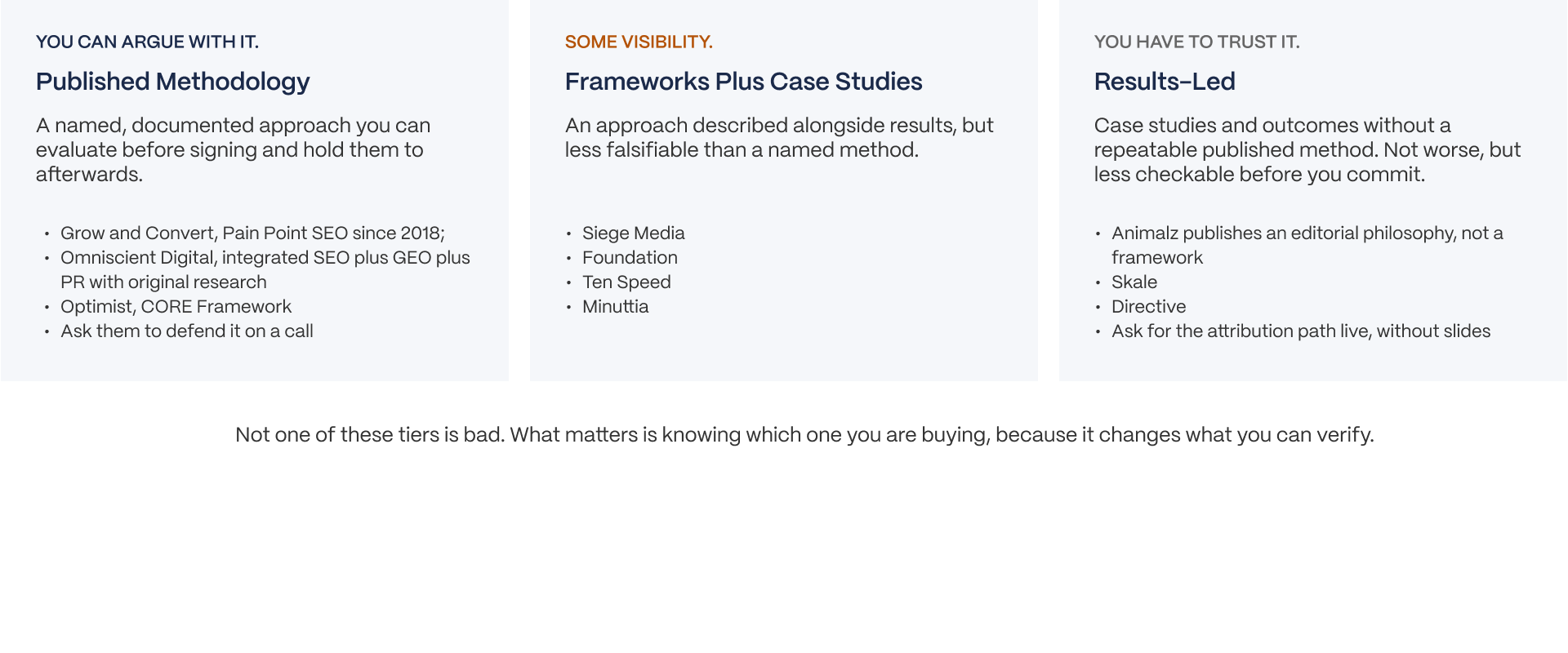
The agencies with enough public material to classify fall into three groups. Grow and Convert, Omniscient Digital, and Optimist publish named approaches: Pain Point SEO, an integrated SEO, GEO, and PR program with original research, and the CORE framework. A buyer can ask any of them to defend the method, which is the test of whether it holds up.
Siege Media, Foundation, Ten Speed, and Minuttia describe an approach alongside their results, which gives some visibility into how they work without a named framework to argue with. Animalz, Skale, and Directive lead with results and, in Animalz's case, an editorial philosophy, which are less falsifiable before you commit. The remaining agencies publish too little to classify, and a buyer should ask them directly.
None of these tiers is better than the others as a matter of quality. A results-led agency may do excellent work. The tiers describe how much you can verify before paying, which is the variable a buyer controls.
What A Methodology Looks Like When It Is Real
A real methodology is specific enough to be wrong, which is what separates it from a positioning statement. Grow and Convert's interview-based process for capturing product expertise is one example, because a buyer can ask to see how the interviews work and judge whether they would produce useful material. Omniscient's practice of setting pipeline attribution before production begins is another, since it commits the agency to a measurement plan it cannot adjust after the results arrive. Optimist's CORE framework is a third, because a named structure gives a buyer something to test against their own situation.
A statement such as "we create content that drives growth" fails that test. Nothing in it could turn out to be false, so nothing in it tells a buyer anything. When an agency describes its approach, the useful follow-up is to ask how a result would prove the approach wrong.
What It Costs
The Benchmarks
Every starting price in this category is a floor, not a quote. Scope, article volume, and whether strategy and distribution are included move the final number a long way. A 2026 survey of more than 350 businesses cited by Column Five puts the average B2B retainer between $5,001 and $10,000 a month. The table in this section groups common scopes with their published ranges and the source of each.
Production-only engagements of two to four posts a month sit at the low end, around $2,000 to $5,000 a month. Strategic content partnerships run from $5,000 to $15,000, and full-stack content operations run from $15,000 to $50,000 or more. Most of these figures come from vendors describing their own pricing, so treat them as orientation and not as market data.
Why Most Of The Market Publishes Nothing
Six of the agencies here publish a price, and the rest do not. The reason is mostly practical. Scope varies enormously between engagements, and a published floor invites comparison on price alone, which favors agencies that quote the lowest scope and disadvantages those that include strategy.
The buyer's counter is that an agency unwilling to give a range on a first call is showing how the relationship will go. A range does not commit the agency to a quote, and it saves both sides a meeting if the budgets do not match. Agencies that publish prices do not need to hide behind scope uncertainty, and agencies that will not discuss figures at all leave the buyer negotiating without any reference point.
What Changes The Number
Five variables move a quote. The first is articles per month, which drives production cost directly. The second is whether strategy is included or whether the agency produces against your brief. The third is whether distribution and PR are part of the engagement. The fourth is whether design is done in-house. The fifth is whether the agency captures expertise through interviews with your team, which adds time to every piece.
Grow and Convert and Omniscient both publish $10,000 a month, and they deliver differently shaped work for it. One builds around interview-led bottom-of-funnel content, and the other combines SEO, generative engine optimization, and digital PR. Identical prices can hide very different scopes, which is why comparing price without comparing deliverables misleads.
What Changed With AI Search
Everyone Added AEO
Nearly every agency on this list added answer engine optimization or generative engine optimization during 2025 and 2026. The adoption data behind that shift is traceable. Semrush, citing Statista, reports that 13 million US adults used generative AI as a primary search tool in 2023, with a projection above 90 million by 2027. That is a forecast and not a measurement, so it supports the direction of travel without fixing a size.
Our guide to AEO and GEO agencies covers whether these services differ from traditional SEO, and what the independent evidence says about whether they work.
Who Measures Citations Rather Than Traffic
Almost every agency that offers AEO reports on traffic, because traffic is easy to measure and familiar to buyers. Citation movement, meaning whether a brand appears in AI-generated answers, is harder to track and rarer to see. Omniscient reports 81 percent growth in LLM visibility and 140 percent growth in citations for Convert. Those figures are vendor-published, and they are still notable because most agencies have nothing citation-shaped to show at all. Grow and Convert built Traqer.ai for AI visibility and includes it free for clients.
The practical test for any agency is whether it can show citation data from a current client, not a traffic chart. A traffic chart cannot distinguish a content program that earns AI citations from one that only holds its search rankings, and the two now behave differently.
The Independent Finding That Changes The Question

Moz analyzed nearly 40,000 queries in February 2026 and found that 88 percent of the sources cited in Google AI Mode do not appear in the organic results for the same query. Only 12 percent match top-ten URLs. An agency that measures only rankings is therefore measuring a different surface from the one that produces citations, so strong rankings tell a buyer little about AI visibility.
Claims about optimization techniques need the same care. The Princeton research behind generative engine optimization reported visibility gains of over 40 percent from some techniques, but the same paper found that the identical technique cut a rank-1 page's visibility by 30.3 percent while lifting a rank-5 page by 115.1 percent, and it was tested on a simulated engine and not on live ones. The effect depends on where a page already sits, so a headline figure without that detail overstates what a buyer can expect.
Choosing
Six Questions
Six questions expose most weak agencies on a first call. The first asks what proportion of the work is AI-generated, since "all of it" and "none of it" are both usually untrue, and a good answer describes where AI is used and where it is not. The second asks who owns the content and whether your data trains any model, and both answers belong in writing. The third asks to see a citation number that moved, because rankings are the wrong proof now that most AI citations come from outside the top results.
The fourth asks the agency to walk through the attribution path for a past engagement live, without slides. An agency with real history can do this, and one that needs a deck has built the story for the pitch. The fifth asks whether it will accept a three-month trial with defined KPIs, which is the cheapest risk reduction available to a buyer. The sixth asks what the cancellation clause is, since long lock-ins combined with vague deliverables put all the risk on the buyer.
Red Flags
Several patterns suggest an agency will not hold up. Copy where a competitor's name could be swapped in without anyone noticing points to a template, and an identical voice across every article suggests the work is not being shaped around your product. Word-count padding raises cost without adding information. Resistance to questions about AI usage usually means the answer would not be welcome. Case studies that lead with impressions or social shares and not pipeline show what the agency prefers to be judged on. Keyword sprinkling presented as SEO strategy deserves a mention too, and Grow and Convert deserves credit for naming it on the page that ranks first.
For a broader view of what to look for in a partner, see our guides to choosing a growth partner and how an agency supports B2B growth.
The Honest Close
Every list of best content marketing agencies is written by someone selling content marketing, including this one. What an agency can offer in place of a ranking is a set of criteria a reader can apply to anyone, including the author. Ask for the methodology, ask for a citation number that moved, and ask for a three-month trial. If the answer after applying them is not Veza, the article worked correctly. If you want to start with us, our content strategy services page explains how we work.
Closing
If the answer is not us, the article worked correctly.
Every list of best content marketing agencies is written by someone selling content marketing, and this one is no exception. What we can offer in place of a ranking is a set of criteria you can apply to anyone on that list, including us. Ask for the methodology, ask for a citation number that moved, and ask for a three-month trial. If another agency answers those better, hire them. If you want to ask us, we are here.
Work With Veza - See Our Case Studies
FAQs
What does a content marketing agency actually do?
Strategy, production, distribution and measurement, in varying proportions. The proportion is the whole question. Production-only shops write what you brief. Strategic partners decide what to write and why. Full-stack agencies add distribution and PR. Ask which of the four you are buying, because the same monthly fee buys very different shapes.
How much does a B2B content marketing agency cost?
From roughly $2,000 a month for production only to $50,000 and above for full-stack operations, with a 2026 survey of over 350 businesses putting the average retainer between $5,001 and $10,000. Every published starting price is a floor. Six of the fourteen agencies on this list publish a number and eight do not.
What is the best content marketing agency?
The one whose published methodology you can argue with before signing, whose case studies show pipeline rather than traffic, and who will accept a three-month trial. This list is alphabetical because we are on it and any ranking we produced would be an advertisement. Apply the six questions in the article to anyone, including us.
How do I evaluate a content marketing agency?
Start with Grow and Convert's four factors, which are the best on this SERP: what is your goal, do they have a process for capturing product expertise, do they promote what they produce, and do they have detailed case studies. Then add a fifth: is there a published methodology you can evaluate before you buy.
What are red flags when hiring a content agency?
Copy you could put a competitor's name on. Identical voice across articles. Word-count padding. Refusal to say how much is AI-generated. Case studies that lead with impressions or shares. Keyword sprinkling presented as SEO. And any guarantee of specific rankings, which nobody can deliver.
Should I hire an agency or build in-house?
Depends on whether the constraint is capacity or capability. If your team knows what to write and cannot produce enough, a production shop solves it cheaply. If nobody knows what to write, you need strategy, and strategy is what the $10,000-plus retainers are actually for. Buying production to solve a strategy problem is the most common expensive mistake.
How is AI search changing content agencies?
Nearly every agency added AEO or GEO in 2025 and 2026. The useful question is whether they measure citations rather than rankings, because Moz found 88 percent of Google AI Mode citations are not in the organic SERP for the same query. Very few agencies can show a citation number that moved. Ask for one.
How long before content marketing shows results?
Longer than the pitch suggests and shorter than the pessimists claim. Bottom-of-funnel content aimed at high-intent queries can produce leads within a quarter. Top-of-funnel authority content takes two to four quarters to compound. An agency giving you one number for both is not distinguishing between them.
Is Veza Digital on this list?
Yes, and it is disclosed at the top rather than buried here. We sell content strategy alongside Webflow design and development, which makes us a candidate for our own list. That is why it is alphabetical, and why the six evaluation questions apply to us as much as to anyone.
What is the difference between a content marketing agency and a content creation company?
A content creation company produces what you brief, and you own the strategy. A content marketing agency owns the strategy, or shares it, and produces against it. The price difference is roughly the gap between $2,000 and $10,000 a month, and the difference in outcome is whether anyone decided what to write and why.