.jpeg)
Most B2B marketing teams don’t need more AI tools for content. Even if the offer is wide, what they really need comes to selecting fewer tools that are going to be arranged better. In practice, the average B2B marketing team is roughly paying twice as much, but doesn’t use everything.
The question that comes up is: how to create an AI content production stack that marketing teams are actually going to use?
We organized this article to help you answer this question. The core idea is that the content stack should be built around five stages of production. When you use different tools for each stage, their overlap will be visible only if you use the same tool in one stage.
At the end, you will learn how to determine whether the stack will work for your team, why tools were never a problem, and how to run an audit to figure out what to cancel.
Stage One: Your Problem Is Sprawl, Not Scarcity
The Sprawl Pattern
Let’s use two marketing teams working with the same budget.
One team runs 11 different subscriptions, but only uses 4 of them regularly. The other team has 5 tools, each for a different job.
The difference between teams isn’t the budget, but how they use tools they are paying for. Here is when sprawl builds up slowly. Teams often purchase one tool for a certain campaign, and forget about it. Later, they add a second tool that does the same job as the first.
This causes two costs:
- Direct cost of paying for a tool that nobody is using
- Scattering brand voice and source materials across multiple tools
The second cost is harder to notice, and it brings workflows that aren’t running smoothly with a constant juggling between tools.
Why Category-Based Tool Lists Make It Worse
Most articles about AI tools are categorized. For example, there are "writing tools" and "video tools", and this is how vendors typically organize their products.
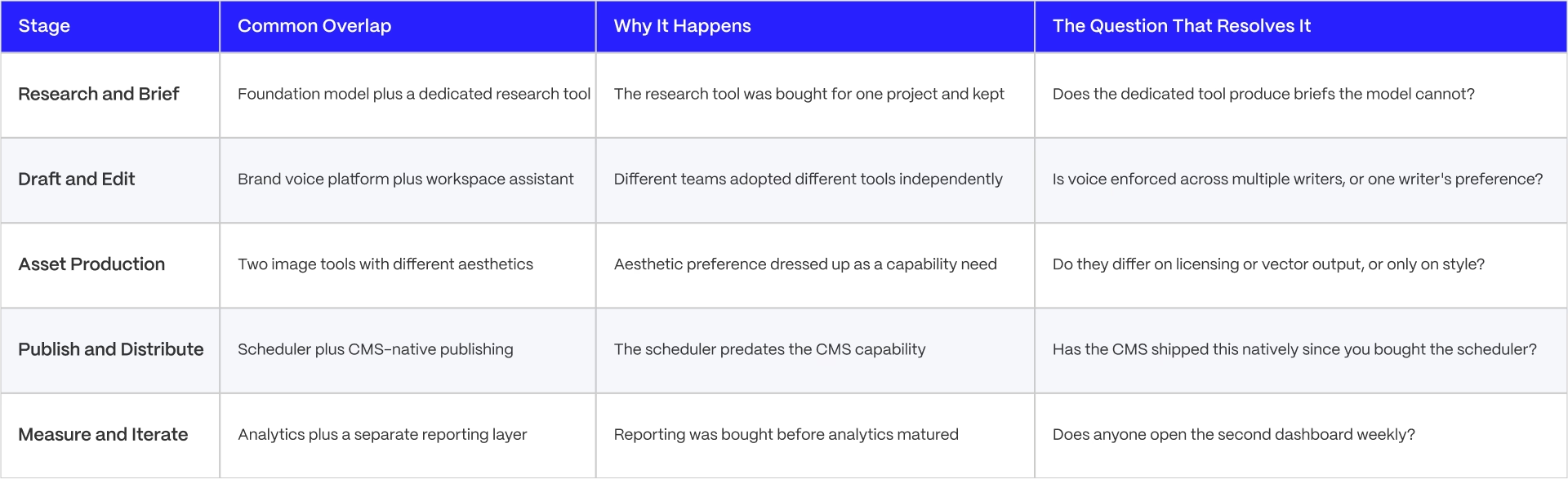
However, when organizing by category, overlap is hidden. There may be two tools with identical functionality, but if we place each tool in its respective section on the list, it appears as though one tool will be used for every task. This can make redundancy invisible.
Organizing your AI tools by production stage makes it easy to identify overlap among tools. A writing tool developed specifically for creating content and a native AI assistant within your workspace are very likely to provide similar functions during the draft stage. If both tools have the capability to perform the same function at the same time during the drafting process, then one of those tools is probably redundant.
This connects to the broader question of stack design across a B2B marketing team, which we cover in our AI tools for B2B marketing guide.
The Five-Stage Production Model
That is the structure that this article operates on. All content teams will move through these five stages.
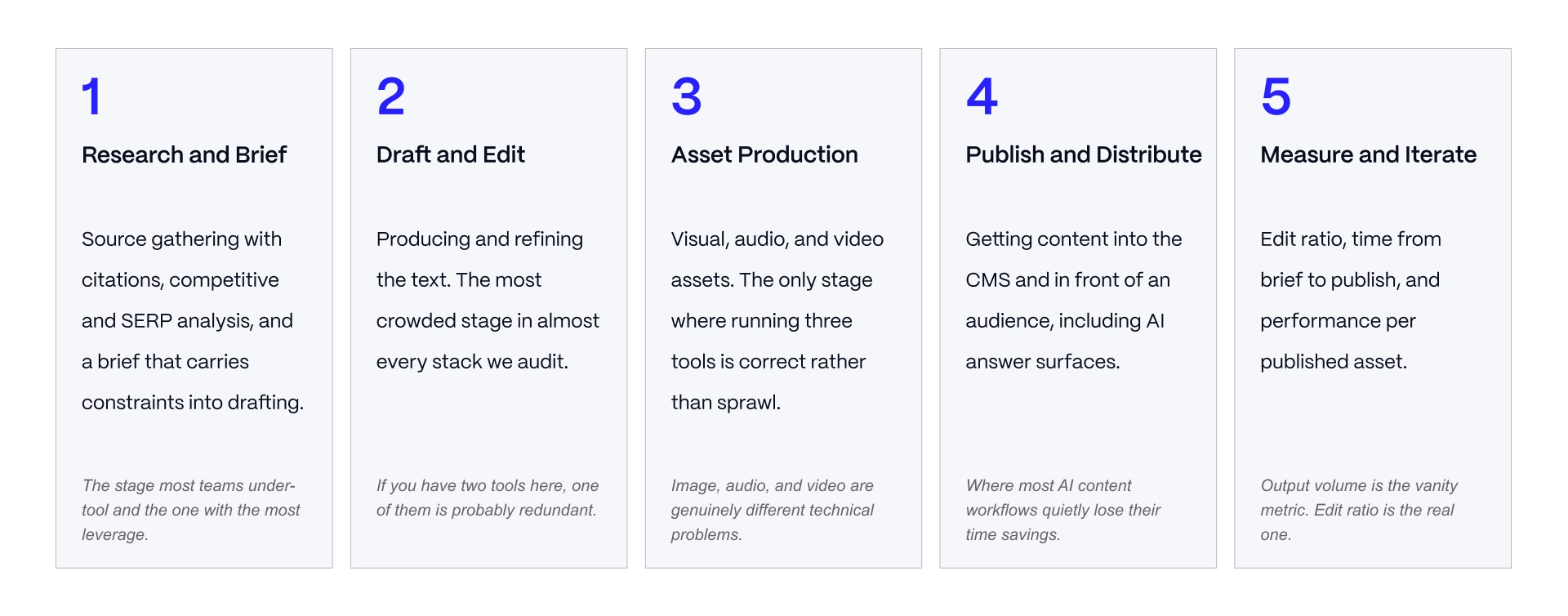
Research and Brief
This is where all your research happens, and the brief you create will guide the work done in every other stage.
Draft and Edit
In this stage, writing happens, along with a first editing phase before publishing.
Asset Production
Here you create images, audio, and video to go with the written content.
Publish and Distribute
This is where finished content goes live and reaches an audience.
Measure and Iterate
This is where you check what worked and adjust the next round of content.
Here is the rule that runs through the rest of this article: each stage should have one main tool. Only add a second tool when the stage genuinely splits into two different jobs. Anything beyond that is a candidate for cancellation.
This same discipline applies to other parts of your tech stack. See our AI coding tools guide for how the same framework plays out there.
Building a content operation that scales past the tooling? Work with Veza Digital.
Stage Two: Research, Brief, and Draft
What the Research and Brief Stage Requires
This is the stage most teams under-invest in, and it carries the highest leverage of any stage. A weak brief cannot be fixed later by a better drafting tool.
The brief stage needs three things: source gathering with citations, competitive and search analysis, and a brief that carries its constraints all the way into the draft.
Foundation models handle most of this work well on their own. For teams under a certain size, a dedicated research tool is rarely worth the extra subscription.
Search Visibility Belongs in the Brief, Not the Edit
Search visibility and SEO requirements should shape the brief, not get bolted on after the draft is done. Trying to retrofit a finished draft to hit a keyword or topic set produces weaker content than briefing for it from the start.
Writesonic and the visibility-tracking tools handle this category. For the full comparison, see our AI SEO tools guide. We keep this section short on purpose, since that article already covers the tools in depth.
The Draft Stage and Where Overlap Hides
The draft stage is the most crowded part of the stack, and it is where most cancellation opportunities sit.
There are three types of tools here: the dedicated brand-voice platform, the workspace-native writing assistant, and the general foundation model.
The rule is simple: most teams need only one of these three, not two. A dedicated brand-voice platform earns its cost only when you need enforced brand voice across multiple writers producing content at volume. It is not worth it just to get better output for a single writer.
Jasper falls into this category.
See our full review of AI marketing tools.
Stage Three: Asset Production
The Stage That Justifies Specialist Tools
Text drafting has reached a point where one good tool is enough for most teams. Asset production has not reached that point, because image, audio, and video are three genuinely different technical problems.
This is the one stage in the stack where running three separate tools is the right call, not a sign of sprawl. We want to be clear about that up front, so the consolidation argument in this article does not read as a rule with no exceptions.
Visual Assets and Brand Consistency
At the stack level, the goal for visual assets is not finding the single best image tool. It is keeping images consistent across a high volume of output, with a license that will pass a client's legal review.
For more on how visual assets fit into a broader design process, see our piece on AI in design workflows.
One governance point belongs here rather than in the governance section further down: any generated visual asset needs to carry provenance metadata (a record of how it was made) all the way through your publishing pipeline.
Audio and Video Without Re-Reviewing the Tools
This section carries the highest risk of overlapping with our existing coverage, so we are keeping it short on purpose.
At the stack level, video and audio production splits into three approaches: transcript-led editing, avatar-led production at scale, and generative creative work. Most B2B teams need one of these three, not all three.
Descript, Synthesia, Runway, and ElevenLabs each fit into one of these categories. For the full comparison, including pricing and features, see our AI video generation tools guide. We are not repeating pricing or feature comparisons here, since that article already covers them and keeps them current.
Stage Four: Publish, Distribute, and Measure
The Publishing Layer Is Where Stacks Break
This is the handoff problem. Content that was produced across four different tools eventually has to land in a content management system, and this is where most AI content workflows lose the time they saved earlier. The final assembly step is still manual for most teams.
A publishing layer that actually works with an AI workflow needs three things: a structured content model, API access, and an asset pipeline that does not strip out metadata or bloat file sizes.
For more on choosing a publishing platform built for this, see AI website builders.
Distribution and AI Search Visibility
Distribution has changed. A growing share of how people find content now happens inside AI-generated answers, not through traditional search result links. That makes tracking whether your brand gets cited in those answers a distribution metric, not just an SEO detail.
At the stack level, visibility-tracking tools have one job: telling you whether your brand shows up in AI answers for the search terms that matter to you.
For the full picture on this category, see AI search engines.
Measurement and Orchestration
This is the stage most teams skip entirely.
Here is what to measure for a content program that uses AI: not output volume. Volume is a vanity metric. Track time from brief to publish, the edit ratio (how much of the AI draft survives the editing process), and performance per published piece of content.
On top of measurement sits orchestration, which is where project management tooling fits into a content stack. See our AI project management tools guide.
The rule here: a stack without an orchestration layer is just a pile of tools. It is not a stack.
Stage Five: Voice, Governance, and the Review Bottleneck
These are the three constraints that decide whether your stack actually ships content.
Brand Voice Is Process, Not a Feature
Turn brand voice from a checkbox into a real process. Start by converting your style guide into rules a tool can actually follow, meaning concrete rules and banned words or phrases, not vague adjectives like "professional" or "friendly." Adjectives like that do not give a tool anything usable.
Decide which stage enforces voice. It should be the draft stage, not the edit stage. If you wait until edit to catch voice drift, you end up rewriting the whole piece.
Build a drift check: a periodic review where you sample published content and compare it against your style guide.
Governance and What Stalls Enterprise Rollouts
This section covers the questions with the highest business stakes in this entire article.
Before you deploy any AI content tool at a company that sells into enterprise customers, you need answers to six questions:
- Is customer data excluded from the vendor's model training?
- Does the vendor hold SOC 2 Type II certification?
- What happens to prompts that contain unreleased product information?
- Who owns the content the tool generates?
- What disclosure requirement applies to content that AI helped create?
- What is the vendor's data retention policy?
A marketing lead who cannot answer these six questions will not get approval to deploy the stack, no matter how good the output is. The right time to get these answers is before the pilot starts, not after.
The Review Bottleneck Nobody Plans For
This is where AI content programs fail.
Generation capacity scales the moment you buy a subscription. Editorial review capacity does not scale at all, because it depends on people with limited time.
Teams that triple their draft output without adding any review capacity end up shipping worse content, faster. Then they blame the AI, when the real problem is the process.
The practical rule: decide on an edit ratio you consider acceptable. Measure that ratio during your pilot. Size your review capacity to match the volume of content you actually plan to publish. If review capacity cannot keep up, the answer is to publish less, not to edit faster.
Stage Six: Design Your Stack, Then Cancel the Rest
The Twelve-Point Stack Audit
Run this as a budget review, not a reading exercise. List every AI tool your team currently pays for. Place each one into exactly one production stage. Any stage holding more than one tool is a consolidation candidate, unless you have a deliberate reason for the split.
The result of this audit is a cancellation list. That is the deliverable most articles on this topic never give you.
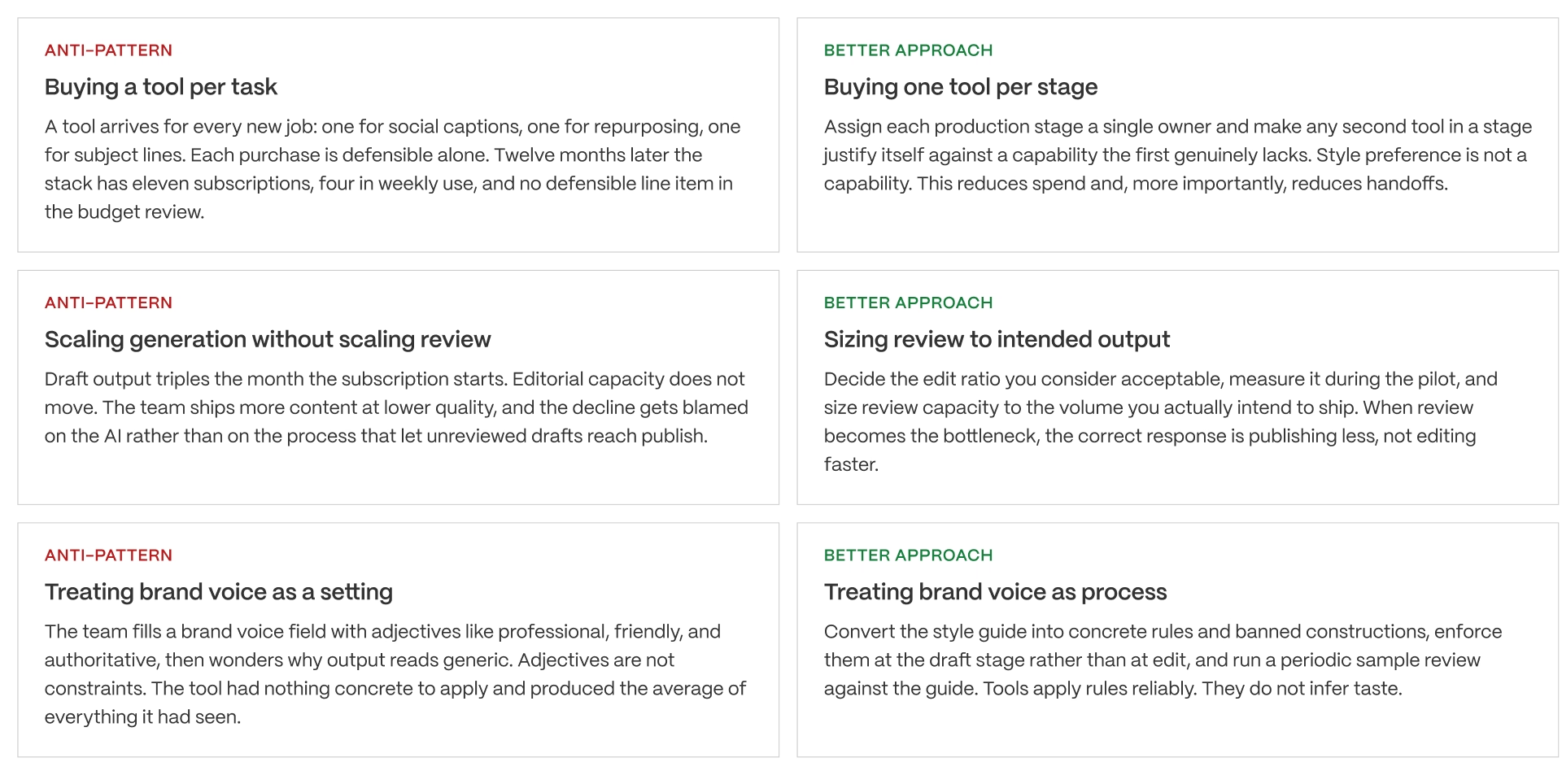
Four Anti-Patterns in AI Content Stacks
Watch for these four mistakes:
- Buying a tool per task instead of per stage - Buy tools to fill a stage in your production process, not to solve a one-off task.
- Scaling generation without scaling review - If you increase how much content you produce, increase your review capacity at the same time.
- Treating brand voice as a setting instead of a process - A brand voice feature in a tool is not enough on its own. It needs a process behind it.
- Piloting real client or pre-launch material on free tiers - Free tiers often come with retention terms that were not built for sensitive material. Check the terms before you pilot, not after.
Stack Design by Team Size
Here are four reference stacks, based on team size.
Solo marketer or founder: a small tool count, focused on covering the core stages without much specialization.
Small team (two to five people): a slightly larger tool count, with clearer stage ownership starting to matter.
Mid-size marketing organization: more tools, with priority on stage ownership and orchestration.
Enterprise with governance requirements: the tool count is similar to the mid-size stack. What changes is not capability. It is governance posture.
The number of tools you need rises much more slowly than your headcount does. An enterprise stack does not need dramatically more tools than a mid-size one. It needs stronger governance answers.
If you are extending your stack into the wider go-to-market process, see our AI sales tools guide.
STACK DESIGN BY TEAM SIZE
Use this as a starting point, not a binding answer. The five-stage model is the real tool. These reference stacks get you to the right shape. Note how slowly the tool count rises relative to headcount: that is the point of the exercise.
TEAM 1: SOLO MARKETER OR FOUNDER
- Profile: One person owning the entire content operation
- Tool count: 2 to 3
- Stage priorities: Draft and Edit, then Asset Production
- Shape: One foundation model covering research, brief, and draft. One design or image tool. Publish natively in the CMS.
- Why: At this size, every additional tool is a context switch you personally pay for. Breadth beats depth because there is nobody to hand off to.
The verdict: Resist specialist tools until a specific job fails twice.
TEAM 2: SMALL TEAM, TWO TO FIVE PEOPLE
- Profile: A content lead plus writers or a designer, shipping weekly
- Tool count: 4 to 5
- Stage priorities: Draft and Edit, Asset Production, then Measure
- Shape: One drafting tool with shared voice settings. One image tool. One video or audio tool if that format is genuinely in the plan. One lightweight orchestration layer.
- Why: This is the size where brand voice starts drifting because more than one person is writing, and where a shared drafting tool earns its cost for consistency rather than for output quality.
The verdict: Buy for consistency, not for speed. Speed is not your constraint yet.
TEAM 3: MID-SIZE MARKETING ORGANIZATION
- Profile: Six to twenty people, multiple content lines, real budget scrutiny
- Tool count: 5 to 7
- Stage priorities: All five stages owned, with Measure genuinely instrumented
- Shape: One drafting platform with enforced brand voice across writers. Two to three asset production tools split by format. A visibility tracker. A real orchestration layer. Analytics that reports edit ratio and cycle time.
- Why: This is where sprawl becomes expensive and where the orchestration layer stops being optional, because the failure mode shifts from writing quality to handoffs between people.
The verdict: The orchestration layer is what turns a collection of tools into a stack.
TEAM 4: ENTERPRISE WITH GOVERNANCE REQUIREMENTS
- Profile: Twenty or more, procurement review, compliance obligations, security team involved
- Tool count: 5 to 7, same as mid-size
- Stage priorities: Governance posture across all five stages
- Shape: Structurally identical to the mid-size stack, selected against a different filter. Every tool must answer the training exclusion, certification, retention, and output ownership questions before it enters the pilot.
- Why: The enterprise stack does not need more capability than the mid-size stack. It needs the same capability from vendors that survive a security review, and it needs the answers documented before deployment rather than after.
The verdict: At this size the constraint is procurement, not capability. Answer the governance questions first and the shortlist writes itself.
PRINCIPLE
The number of tools a content team needs rises far more slowly than its headcount, because the constraint at every size is the same: how much reviewed, on-brand work can actually reach publish. Generation capacity is purchasable and effectively unlimited. Review capacity, brand judgment, and editorial standards are not. Every stack that fails, fails at that boundary rather than at the tooling layer. Design for the boundary and the tool list gets shorter on its own.
The Teams Winning With AI Content Are Running Fewer Tools, Not More
Stack design is a marketing operations problem before it is a tooling problem. Stage ownership, governance answered before the pilot, and review capacity sized to match actual output are what separate a content operation that ships work from one that only generates drafts.
Veza Digital builds and runs the Webflow and content infrastructure that B2B SaaS marketing teams run on. If your stack has outgrown its structure, contact us
FAQs
What is an AI content stack?
An AI content stack is the set of tools a team uses across the five stages of content production: research and brief, draft and edit, asset production, publish and distribute, and measure and iterate. The defining feature is stage ownership, meaning each stage has one clear primary tool rather than overlapping subscriptions. HIGH AI OVERVIEW VALUE.
What are the best AI tools for content creation in 2026?
The better question is how few you need. Most B2B marketing teams run one drafting tool, one to three asset production tools, and one orchestration layer. Asset production is the only stage that genuinely justifies multiple specialist tools, because image, audio, and video are different technical problems. DIRECT QUERY MATCH.
How many AI tools does a marketing team actually need?
Five to seven for most B2B teams, and the number rises far more slowly than headcount. If any single production stage holds more than one tool without a deliberate reason, that is a consolidation candidate. Teams commonly pay for roughly twice what they use weekly.
How do I stop AI tool sprawl?
Place every tool you pay for into exactly one production stage. Any stage with two tools doing the same job produces a cancellation candidate. Run this as part of budget review rather than as a one-off, because sprawl accumulates incrementally through tools added for single campaigns and kept out of habit.
How do I keep AI content on brand?
Treat brand voice as process rather than a tool setting. Convert your style guide into concrete rules and banned constructions rather than adjectives, enforce voice at the draft stage rather than at edit, and run a periodic sample review to catch drift. Tools apply rules; they do not infer taste.
What governance questions should we answer before deploying AI content tools?
Six: is customer data excluded from training, does the vendor hold SOC 2 Type II, how are prompts containing unreleased product information handled, who owns generated output, what disclosure applies to published AI-assisted content, and what is the retention policy. Answer these before the pilot, not after.
Does AI content production actually save time?
Only if editorial review capacity scales alongside generation. Generation capacity scales the day you subscribe; review capacity does not scale at all. Teams that triple draft volume without adding review ship worse content faster. Measure time from brief to publish rather than drafts produced.
Should we use one AI platform or several specialist tools?
One primary tool per production stage, with specialists only where the stage genuinely splits. Asset production is the main legitimate exception. A single platform covering every stage usually trades depth for convenience, which is acceptable for small teams and rarely acceptable at volume.
Can we use free AI tool tiers for client or pre-launch work?
Usually not safely. Several free tiers retain rights to reproduce your generations and make outputs public by default, which is disqualifying for unreleased product information or client material. Pilot on non-sensitive work, and read the retention terms before the pilot rather than at legal review.
What should we measure for an AI-assisted content program?
Three things: time from brief to publish, edit ratio meaning how much of the draft survives review, and performance per published asset. Output volume is the vanity metric and the one most likely to rise while quality falls. Edit ratio is the leading indicator of whether the stack works.