TL;DR
Webflow Source is a new platform where marketing teams and AI agents can collaborate on their shipped code. Webflow announced it at Webflow Conf on 2nd September 2026. It is currently in a limited research preview. Webflow is inviting select agency partners and customers to apply in phases. No pricing has been announced, and you can apply here. From a marketing perspective, we’d advise against planning any migration. Instead, prepare your current Webflow site to enable collaboration with agents. This will help with Webflow MCP now and Webflow Source in the future. You’ll want a clean design system, structured CMS, documented brand/content guidelines, clearly defined roles, and one well-tested agent workflow. This article will explain what it is, what it isn’t, who should apply, and how to prepare. We’ll update this page as the preview opens.
What Is Webflow Source? The Platform Announced at Webflow Conf 2026
Webflow Source was announced on 2nd September 2026 at Webflow Conf in Boston. Webflow Source is a new, composable by default platform for modern marketing teams to collaborate with their AI agents to drive business growth. It combines your codebase, CMS, hosting and marketing tools into one place. Webflow describe it as "putting code at the centre of everything you ship."
The announcement is part of a series of announcements made during the conference. Webflow have also launched Campaigns, Assets, updates to their answer engine optimisation tools and Webflow MCP 2.1. All of these are aimed at enabling teams to collaborate with their AI agents using structured and governed content.
However, Webflow Source is the biggest announcement and is currently only available in a research preview. This is the key thing to remember as a marketing leader. You can find more information in Webflow’s announcement post and update page.
How Marketing Teams and AI Agents Work in Source: Views and Custom Views
Webflow Source provides each member of your team with a View. This is a workspace that is tailored to their role. You can also create custom views for different roles within your team. Each agent will have a view based on their role. Comments can be turned into agent tasks. It connects to your codebase and existing stack. This could include sites built in Webflow.
Note: As this is a research preview, the language used may change. This is to show you the direction Webflow are heading in. The key thing to note is that it is a single workspace for humans and agents.
What Source by Webflow Is Not
- Webflow Source is not generally available. It is currently in a limited research preview. Webflow are inviting select agency partners and customers to apply in phases.
- No pricing has been announced, and as of 17th November 2026 there is no release date. Anyone stating a price or release date is guessing.
- Webflow Source is a product name, not open source. This often causes confusion in search results.
- Webflow Source isn’t a prompt-based website generator. Webflow describes it as a tool to enable governed collaboration on your code.
- It’s not a forced migration of your site. Webflow Source is described as connecting to your existing stack, and could include sites built in Webflow.
Note: This applies to Webflow Source at this stage of its development.
Source vs the Webflow Designer, Webflow Cloud and AI Coding Tools
These four tools are at different points in the development process so comparing them can be misleading.
Webflow Designer is available now. Webflow Cloud is where your apps are hosted. You can find more information in our Webflow Cloud guide. Webflow Source is a research preview to enable teams to collaborate with agents on their code.
AI Coding tools are generic tools that can be used to write code for any project. They don’t connect to your website platform CMS, hosting or governed processes. There is concern in the community that you will have to leave Webflow to use AI coding tools.
Webflow Source is their solution to this. However, it is a research preview with no pricing or release date. No team should be planning any migration. The reasons you would want to stay on Webflow are the same as before. You have a visual process for marketers, structured CMS & no need for an engineering team for hosting. The reasons you would want to look elsewhere are specific to your needs. The fact it is a research preview doesn’t change this. Use the table below to see where it fits in. It is worth checking back as Webflow publish more.
Research Preview Status: Who Can Get In, and What It Costs
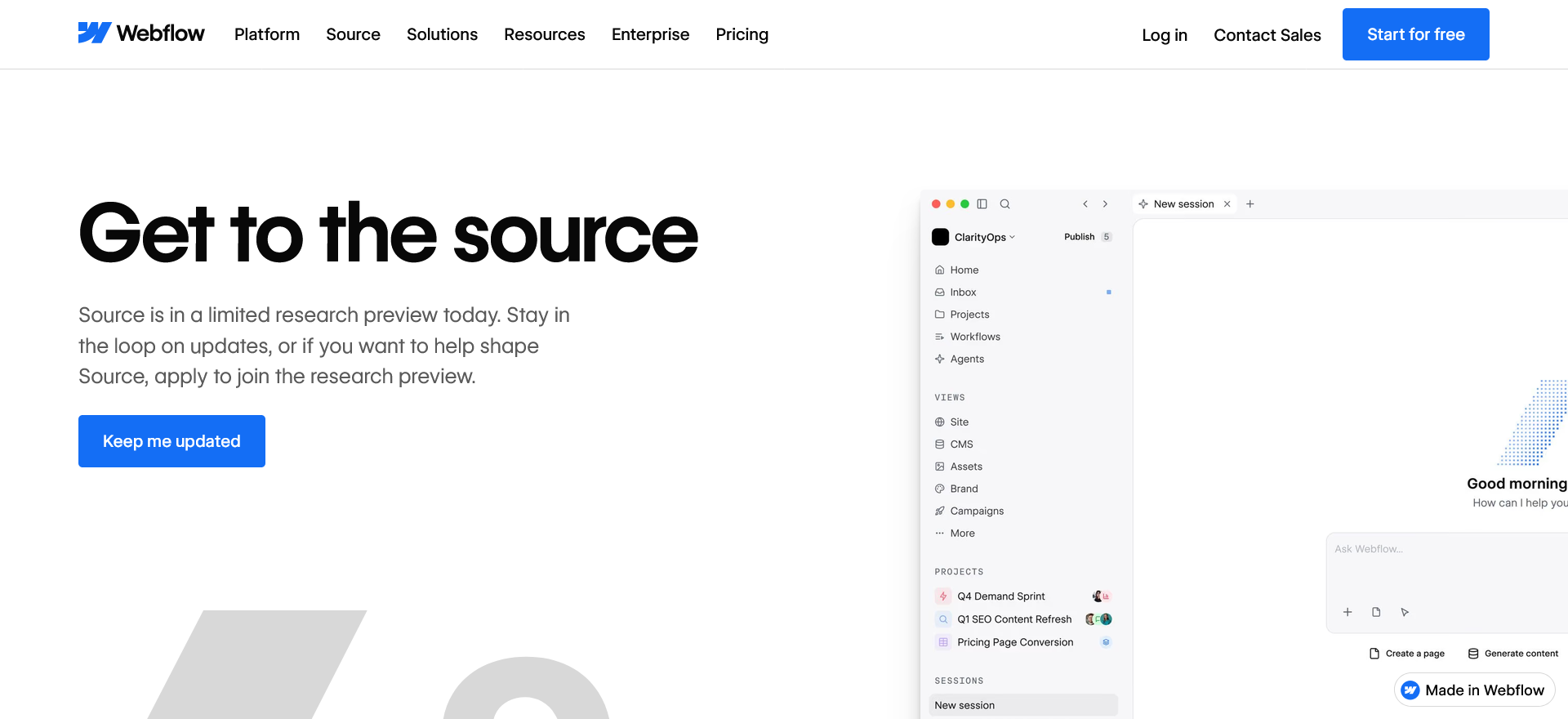
Webflow Source application form
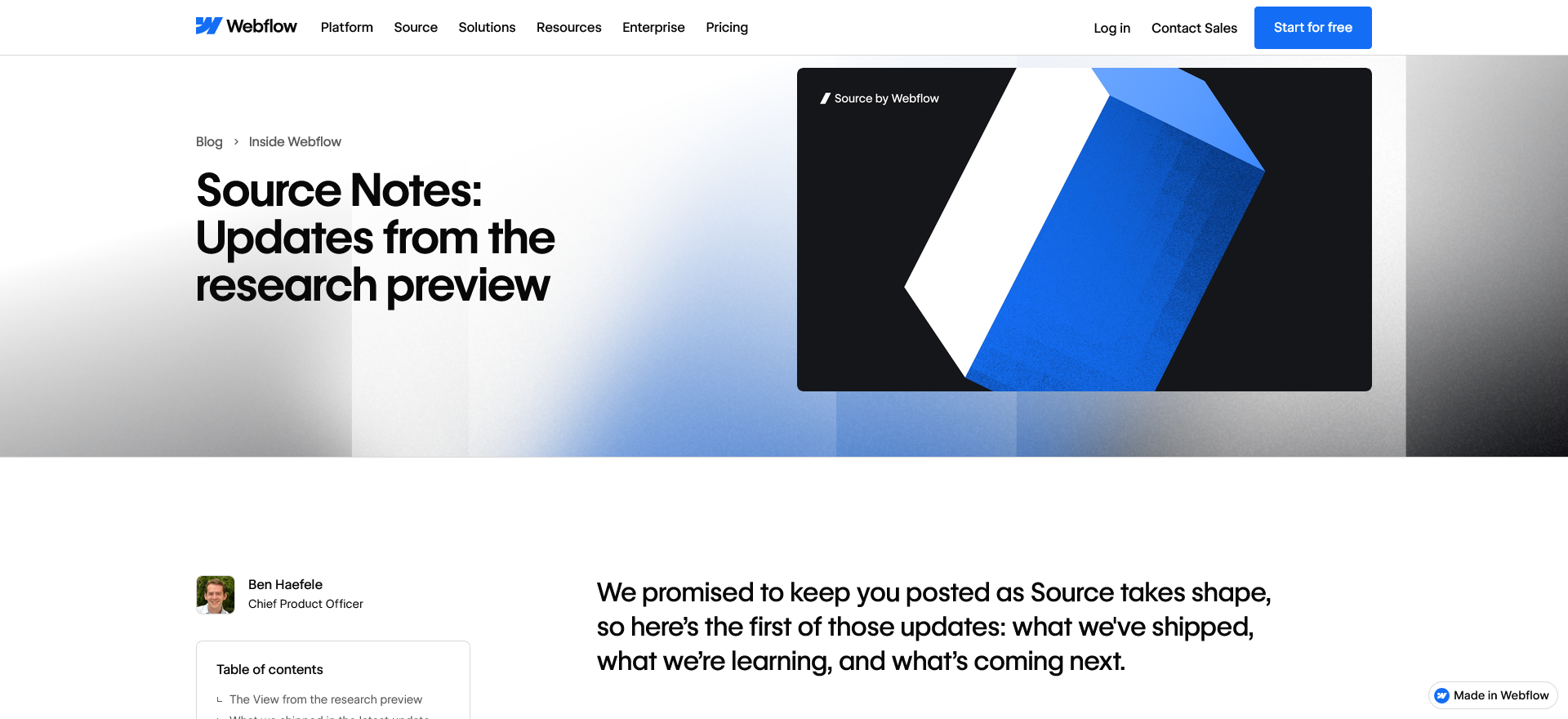
The latest Source Notes post
As of 17th November 2026, Webflow Source is in a limited research preview. Webflow are inviting select agency partners and customers to apply in phases over the next few months. Teams can apply using the form here. Phased enrollment means most teams will not get access soon, and there is no public timetable for wider access.
This means most teams won’t get access soon. No public timeline has been published. No Pricing No official pricing has been published. Any numbers you see elsewhere are not from Webflow. The best way to keep up to date with the research preview is to look at Source Notes, where Webflow publishes research-preview updates. Read the latest one before acting on anything in this article, because the status can change faster than articles do. The tracker above shows the current status with its date and is updated when Webflow changes it.
What Marketing Leaders Should Do This Quarter
The first decision is whether to apply. Webflow is enrolling select agency partners and customers, so the teams most likely to benefit are enterprise teams with a design system and a codebase, and agencies that build for them. Teams without either will get more from waiting and preparing, since a preview built around code and agents assumes a foundation that many marketing teams have not built yet. Applying costs little, but no application changes what is worth doing this quarter.
What is worth doing is preparing the current Webflow site, because the same work pays off with Webflow MCP today. MCP 2.0, released on 21 July 2026 on all site plans, gives agents design-system and CMS context, supports Agent Instructions, enforces roles with granular access, and includes analytics. Branches and site activity log endpoints are available on Enterprise, and versions 2.1 and 2.2 followed on 21 September and 15 October.
Five items make a site ready. A clean design system, with variables, classes, and components, gives agents context they can use today. A structured CMS with clear fields lets agents run bulk CMS work through MCP. Written brand and content rules feed Agent Instructions, which Webflow AI and third-party agents use. Roles defined for people and agents matter because MCP enforces roles and granular access per site, collection, page, and locale. And one governed agent workflow, tested end to end with human approval, shows where a team's process needs work before it scales.
We build and test these workflows with clients, and our guide on how we build with agents describes the approach. As a Premium Certified Enterprise Webflow Partner, Veza presented on Webflow's own webinar, "Building AI workflows with Webflow MCP 2.0," on 26 August 2026, and ran an MCP masterclass for the Veza Agency Network on 28 April 2026. To work through the five items on your own site, use our Webflow MCP Readiness Checklist.
How Source Connects to Your Webflow Site and Webflow MCP Today
Webflow says Source connects to the stack a team already uses, including sites built in Webflow. That statement comes from the current product page and should be rechecked as the preview moves. If it holds, a team that prepares its Webflow site now will have less to change when access opens, because the groundwork is the same.
Webflow MCP is the part teams can use today. It lets AI agents work with a Webflow site under defined roles and access, and it is where a team learns how its own workflows behave with agents. Teams that wait for Source to start will start later, with no experience of how governed agent work behaves on their own site. Teams that use MCP now will have a tested workflow, written rules, and defined roles ready when Source reaches them.
The sensible sequence is to prepare the site, run one governed workflow, and apply to the preview if the team fits. The checklist covers the first two steps.
Closing
Source is coming. The work that gets you ready pays off today.
Make your current Webflow site ready for agents: a clean design system, a structured CMS, written rules, defined roles, and one tested workflow.
Get the Webflow MCP Readiness Checklist → https://vezadigital.com/webflow-mcp
FAQ
Is Webflow Source free?
No price has been published. Webflow has announced no pricing for Source as of 9 November 2026, and it is a limited research preview. For current plan prices on the platform itself, see our guide to Webflow pricing.
When will Source by Webflow be available?
Webflow has not announced a release date. Source is a limited research preview, and Webflow is enrolling select agency partners and customers in phases over the coming months. Follow Webflow's Source Notes for updates.
Do I have to migrate my Webflow site to Source?
Webflow has not said so. Source is a research preview, and Webflow's product page says it connects to the stack a team already uses, including sites built in Webflow. Recheck that wording as the preview develops.
Does Source replace the Webflow Designer?
Webflow has not described it that way. The Designer is available today for visual building, and Source is a research preview for teams and agents working on code. Check Webflow's own pages for the current position.
Is Source a headless CMS?
Webflow calls it composable by default, bringing together the codebase, the CMS, hosting, and marketing tools in one platform. That is Webflow's own description, and it does not use the term headless CMS for Source.
Does Source work with my existing code?
Webflow says Source connects to the codebase and stack a team already uses. Because it is a research preview, check the product page for the current wording before relying on it.
Is Webflow open source?
No. Source is a product name from Webflow, and the platform itself is not open source.
Is Webflow still used in 2026?
Yes. Teams continue to build and run sites on Webflow, and Webflow's 2026 conference announced new products and updates. The platform is active and still being developed.