TL;DR
Semrush and Ahrefs remain the two leading SEO platforms in 2026, but the better choice depends on how your team is able to utilize search data and how much AI visibility tracking is required.
Our comparison examines both tools using the same B2B SaaS domain, linear.app, in the US database. The October 2026 data revealed substantial differences in reported backlinks, organic keywords and estimated traffic, illustrating how differently the two platforms measure SEO performance. Neither platform should automatically be considered more accurate, as each uses its own database and methodology.
Semrush's One Starter provides 50 tracked prompts daily at a monthly rate of $199. Ahrefs Lite provides 150 prompt checks for $129/month, and Brand Radar AI is available from $199/month for companies seeking broader research options. Furthermore, Semrush offers a wider marketing toolkit, while Ahrefs remains the stand out choice for keyword and competitor research.
Our verdict: Semrush for B2B marketing teams wanting SEO and AI visibility in one subscription; Ahrefs for content-led and link-building teams prioritizing research.
Semrush vs Ahrefs in 2026: Where Each Tool Stands Now
Semrush and Ahrefs have evolved beyond traditional SEO software. Both now offer AI visibility features, research tools and integrations that make their data useful beyond the SEO department. However, their approaches remain different.
Semrush was acquired by Adobe in April, 2026, bringing it into Adobe's wider customer experience, and reflecting the importance of brand visibility across AI-powered search. For B2B SaaS buyers, the decision needs to be based on features, reporting capabilities, and costs, rather than making integration assumptions.
Semrush One combines SEO and AI visibility tracking. The Starter plan costs $199/month and includes 50 prompts which are tracked daily, alongside keyword research, Position Tracking, Site Audit, and competitor analysis. Pro+ boosts AI tracking to 100 daily prompts, adding capabilities such as historical SEO data and content optimization. Your teams can also utilize Semrush's SEO plan, from $139/month, which includes basic AI search tracking, making it particularly relevant for marketing teams that need to report on both AI-generated answers, and search rankings.
Ahrefs provides a lower entry point, with a $29 Starter plan providing limited access to core SEO research features. Lite will cost $129/month, and includes 150 monthly AI prompt checks, while Standard and Advanced tiers will increase these allowances to 300 and 600 respectively.
Brand Radar AI adds research into how brands appear across larger databases, and will cost around $199/month. Keywords Explorer, Site Explorer, and backlink analysis remain integral for content and SEO teams.
Both platforms now support Model Context Protocol (MCP) integrations. These allow teams to bring SEO data into compatible AI assistants and automate parts of their research and reporting workflows. Ahrefs includes MCP access from Lite upwards, while Semrush offers it through eligible Semrush One and SEO subscriptions. Access limits still depend on the plan.
Ultimately, both belong among the leading SEO tools. The difference comes with whether your B2B SaaS team needs a broader marketing platform or a research environment built primarily around organic search.
Ahrefs and Semrush On the Same Domain: Our Data Check
Comparing feature lists tells you what SEO tools claim to offer. Comparing their data for the same website reveals how differently they measure performance.
How We Ran the Test
We selected linear.app, a B2B SaaS platform for product development teams. This is a useful example because it operates in a competitive software category where organic search, content and backlinks contribute to visibility.
Both tools were configured to analyze the US market. The comparison covers five metrics: domain authority, referring domains, backlinks, organic keywords and estimated monthly organic traffic.
The figures were collected through Ahrefs and Semrush APIs on October 19 and 20, 2026, using the US database for linear.app. Because the reports were generated on consecutive days rather than simultaneously, minor differences might reflect changes in the underlying databases. Both platforms use different crawling, indexing and estimation methodologies, so their figures need to be treated as comparative snapshots rather than definitive measurements.
For transparency, Veza uses both Ahrefs and Semrush for client work, but receives no affiliate income from either platform.
What the SEO Data Showed: Backlink Index and Keyword Counts
The preliminary results reveal substantial differences, especially when it comes to organic keyword coverage and estimated traffic.
Source: Ahrefs and Semrush API data, October 19-20, 2026. Figures reflect each platform’s database at the time of collection and have not been independently verified against their live interfaces.
Referring domains: Ahrefs identified 16,423 referring domains, compared with Semrush’s 21,293. That is approximately 30% more in Semrush, but it fails to establish which tool is more accurate.
Each platform operates its own backlink index, using different crawlers, discovery schedules and rules for counting links. A domain appearing in one database but not another does not necessarily mean an error.
Backlinks: Ahrefs reported 298,536 backlinks, while Semrush recorded 480,433. The difference is larger than for referring domains, illustrating why raw backlink totals should not be treated as a definitive measure of link-building success.
Organic keywords: This was where the biggest discrepancy was noted. Ahrefs reported 355 US organic keywords, against 9,309 in Semrush, more than 26 times as many.
Keyword databases vary in size, and tools might apply different ranking-position thresholds, filters and reporting scopes. Until those settings are aligned, we can’t attribute the entire gap to database coverage.
Estimated organic traffic: Ahrefs estimated 11,247 monthly US visits, compared with Semrush’s 102,318. Neither figure represents actual website analytics. Both are estimates based on keyword rankings, search volumes and assumptions about CTR.
Authority metrics: Ahrefs assigned Linear a Domain Rating of 85, while Semrush reported an Authority Score of 50. These aren’t competing measurements on an identical scale. Each uses a proprietary calculation, so numbers can’t be directly compared.
The practical lesson for B2B SaaS teams is to use one platform consistently for performance reporting.
Compare month-on-month keyword visibility, referring domains and estimated traffic within the same tool. Switching between databases can make performance appear to rise or fall when nothing meaningful has actually changed.
For board reporting, avoid combining Ahrefs Domain Rating with Semrush Authority Score or presenting estimated traffic as actual visits.
Both platforms provide useful directional SEO data. That value comes from interpreting their trends consistently, not declaring whichever reports the higher number the winner.
AI Visibility: Brand Radar vs the AI Visibility Toolkit
For B2B SaaS marketing leaders in 2026, AI visibility tracking can be the deciding factor when choosing between Semrush and Ahrefs.
What Ahrefs Tracks
Ahrefs approaches AI visibility through two capabilities: tracking selected prompts and researching brand appearances across a far greater dataset.
Its paid SEO plans include tracked AI prompt checks, starting with 150 per month on Lite ($129), 300 on Standard ($249), and 600 on Advanced ($449). Tracked prompts update daily, allowing teams to monitor whether their brand appears in AI-generated answers over time.
However, a prompt check represents one query on one AI platform in one location. This means the included allowances can disappear quickly when monitoring several products, competitors or geographic markets.
For broader research, Ahrefs offers Brand Radar AI, starting at $199 per month. Ahrefs says its database contains more than 492 million organic prompts, allowing teams to investigate brand visibility without relying exclusively on prompts they’ve configured themselves.
This is particularly useful for B2B SaaS companies exploring which questions trigger competitor mentions, where their own brand appears and which topics offer opportunities to improve visibility.
Brand Radar AI is available independently of a paid Ahrefs SEO subscription, making it an option for teams primarily interested in AI search research.
Custom prompt tracking packages start at $50 per month, providing another route for businesses that want to monitor specific questions without purchasing the broader research capability.
The advantage: Ahrefs offers extensive AI visibility research through Brand Radar, alongside configurable prompt monitoring.
The limitation: The included monthly checks are relatively modest. Teams monitoring multiple products or markets might require additional allowances or a separate subscription.
What Semrush Tracks
Semrush takes a more integrated approach, combining traditional SEO reporting with AI visibility tracking across its subscription plans.
Its $139 monthly SEO plan includes AI search performance tracking, AI sentiment analysis, visibility reporting and custom prompt monitoring.
Semrush One adds larger daily tracking allowances. Starter ($199/month) includes 50 tracked prompts daily for one domain, while Pro+ ($299/month) increases that allowance to 100. Advanced offers unlimited daily prompts, with pricing available through sales.
The platform identifies Google Search, ChatGPT, Perplexity, Gemini and additional AI search environments in its visibility offering. This allows marketing teams to examine brand appearances alongside their existing organic search performance.
Starter includes up to 300 AI visibility reports daily and an AI-ready site audit. The latter is particularly relevant for teams investigating whether technical website issues could impact discoverability in AI-powered search.
For B2B SaaS marketing leaders, the advantage lies in having SEO and AI visibility reporting within one platform, rather than managing separate subscriptions and reporting workflows.
However, Starter’s one-domain allowance can be restrictive for businesses managing multiple products or websites. Advanced is also custom-priced, making the total cost less transparent.
AI visibility reports should also be considered alongside actual website performance. Our guide explains how to measure AI traffic reaching your site.
The advantage: Semrush combines daily AI prompt tracking with established SEO reporting.
The limitation: Domain restrictions and custom enterprise pricing may complicate adoption for larger teams.
Important: Ahrefs counts individual prompt checks across platforms and locations, while Semrush quotes daily tracked prompts. These are different units, so the allowances can’t be directly compared.
For teams that need more specialised monitoring, our guide to AI brand visibility tools covers dedicated platforms.
Ultimately, tracking AI visibility and improving it are different challenges. A platform reports where your brand appears in AI-generated answers, but your website content, structure and authority influence whether AI systems cite it.
That is the distinction behind WAIO, Veza’s framework for building Webflow websites around AI search visibility.
Explore how our answer engine optimization services help B2B SaaS brands move past monitoring AI visibility to improving it.
Key Features Compared
Beyond AI visibility, Semrush and Ahrefs differ in how they support everyday SEO work. Keyword research, technical audits, rank tracking and content optimization all influence which platform delivers greater value for a B2B SaaS marketing team.
The comparison below is focused on practical workflows and plan limitations rather than feature counts alone.
Keyword Research: Keyword Magic Tool vs Keywords Explorer
Both platforms offer extensive keyword research capabilities, but they differ in how they help B2B SaaS teams evaluate opportunities.
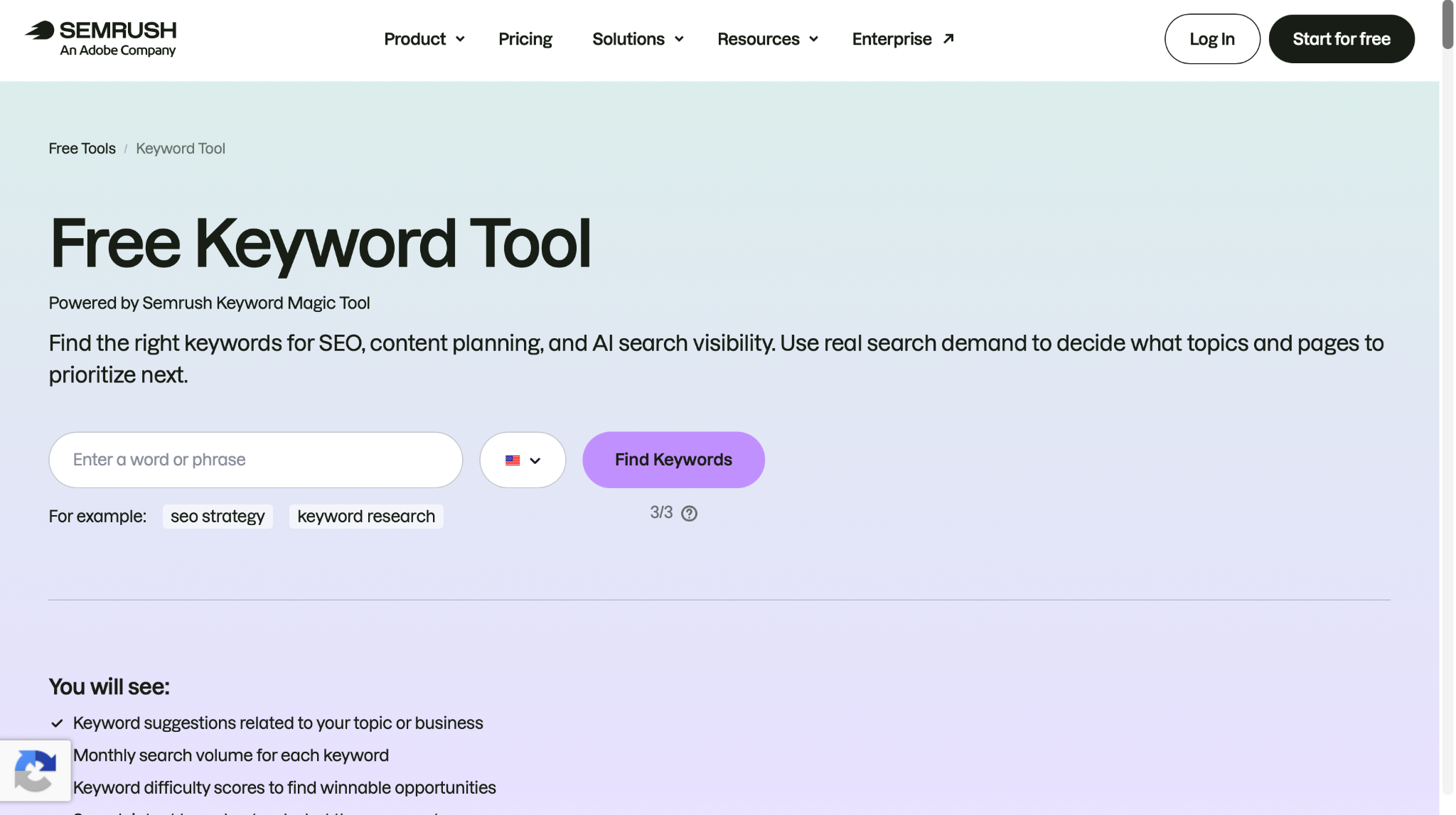
Semrush’s Keyword Magic Tool generates related keywords from a seed term, with filters for search volume, keyword difficulty, search intent and question-based queries. For a term like ‘product analytics,’ marketers can separate informational searches from commercial opportunities and identify topics suited to different stages of the buying journey.
Its intent labels are useful when building a content strategy. Rather than prioritizing keywords solely by volume, teams can distinguish educational topics from searches that suggest buyers are evaluating software.
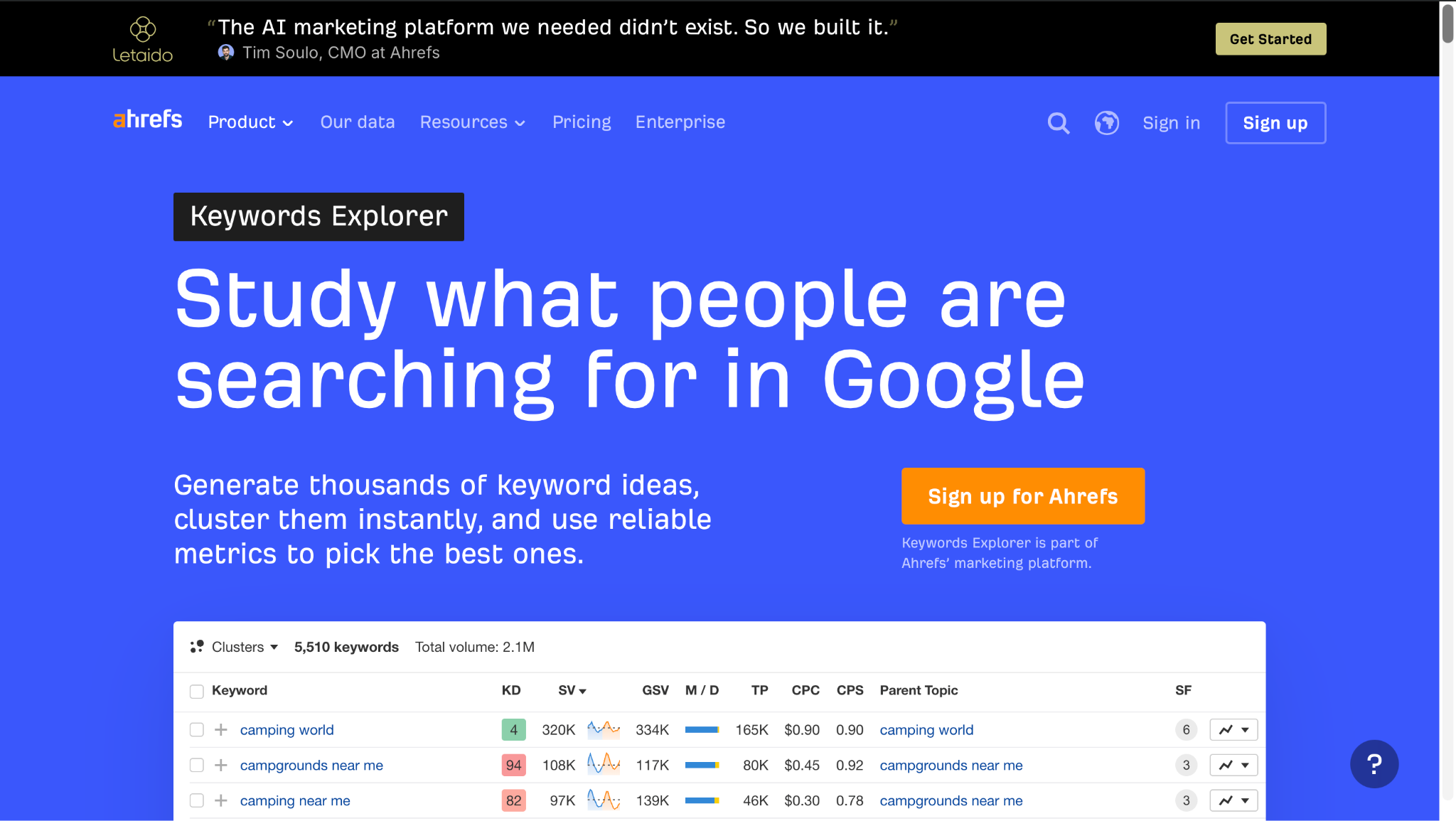
Ahrefs’ Keywords Explorer provides similar keyword suggestions, search volume estimates and difficulty scores. However, it adds two particularly useful metrics: Traffic Potential and Clicks.
Traffic Potential estimates the organic traffic available to the top-ranking page for a parent topic, including visits from other keywords that page ranks for. Clicks helps marketers understand whether searches generate visits, rather than simply appearing in search volume estimates.
These distinctions are crucial for B2B SaaS companies targeting competitive keywords with relatively low search volumes but significant commercial value.
Ahrefs also offers AI-assisted keyword suggestions and search intent analysis on eligible plans.
Without a controlled interface test, neither platform can be declared the more comprehensive source of keyword suggestions. However, their workflows suggest different strengths.
Winner: Ahrefs for evaluating traffic opportunities; Semrush for intent-led keyword organization. Overall winner pending the same-keyword test.
Site Audits and Technical SEO
Both platforms identify technical SEO problems, but their audit capabilities are different in scale, prioritization and ongoing monitoring.
Semrush Site Audit examines issues affecting crawlability, indexability, internal linking, structured data and website performance. Its reports group findings by severity, helping teams prioritize errors before warnings and less urgent notices.
Semrush also markets an AI-ready site audit, extending technical analysis to factors relevant to AI-powered search. For B2B SaaS teams, this creates a connection between conventional SEO maintenance and emerging AI visibility requirements.
Ahrefs Site Audit similarly identifies technical issues, including broken links, redirect problems, duplicate content and Core Web Vitals-related performance concerns.
Lite includes 100,000 monthly crawl credits, with 500,000 on Standard and 1.5 million on Advanced. The Lite plan also limits individual projects to 25,000 pages.
Ahrefs offers scheduled audits, while its Project Boost add-ons introduce always-on crawling and faster identification of changes. Always-on auditing is therefore not a standard feature of every subscription.
Semrush provides scheduled crawling and configurable audit settings, although its page limits vary by plan.
For smaller SaaS websites, either platform can provide sufficient technical coverage. Larger documentation libraries, multilingual sites and rapidly changing websites make crawl allowances and monitoring frequency more important.
Our guide to website audit tools examines the broader options.
Winner: Semrush for integrated technical and AI-readiness reporting; Ahrefs for teams prioritizing expanded continuous monitoring.
Rank Tracking
Rank tracking presents one of the clearest differences between the two platforms.
Semrush provides daily keyword position updates, with 500 tracked keywords on its SEO and Semrush One Starter plans, increasing to 1,500 on Pro+.
Ahrefs offers larger keyword allowances at comparable entry tiers. Lite supports 750 tracked keywords, Standard increases this to 2,000 and Advanced provides 5,000.
However, Ahrefs’ standard Rank Tracker updates weekly across these plans, compared with Semrush’s daily reporting.
For B2B SaaS marketing teams monitoring product launches, major content updates or changes in competitive rankings, daily data provides earlier visibility into movements.
It can also support faster investigation when important commercial pages lose positions, particularly when reporting has several stakeholders involved.
However, the difference matters less for teams reviewing SEO performance weekly or monthly. Organic rankings fluctuate, and daily changes do not always justify immediate action.
Ahrefs’ larger keyword allowances might be more valuable for companies looking to track extensive keyword priorities across several product categories.
Teams should also consider device, location and competitor-tracking requirements rather than evaluating update frequency in isolation.
Winner: Semrush, for daily tracking and more timely reporting.
Content Marketing and Local SEO
Semrush extends beyond keyword research into content planning and broader marketing operations.
Semrush One Pro+ includes content optimization capabilities, which allow teams to connect keyword research with recommendations for improving pages and targeting relevant searches.
This is crucial for B2B SaaS marketing departments that manage content production as well as organic search performance. It is particularly useful when multiple stakeholders need a consistent workflow.
Ahrefs adopts a more research-focused approach to content marketing. Content Explorer identifies successful content, while analyzing competing pages and uncovering possibilities for link-building. But it’s worth noting that access begins at Standard rather than Lite.
Its Content Kit, starting at $99/month, adds AI Content Helper and AI Content Grader. These tools support content creation and optimization, but the subscription increases the overall cost for teams wanting a complete content workflow.
For teams comparing a wider range of optimization products, our guide to the best AI SEO tools covers additional options. Local SEO is another area where the platforms differ.
Semrush provides a Local Toolkit covering capabilities such as business listing management, local visibility and reputation monitoring. Ahrefs offers GBP Monitor in beta for monitoring Google Business Profiles.
However, local SEO is unlikely to determine the purchase for most B2B SaaS companies. Businesses that are selling nationally or internationally generally place greater emphasis on product-related searches, competitive research and content performance.
It becomes more relevant for SaaS providers targeting specific geographic markets or serving businesses across locations.
Winner: Semrush, for its broader content marketing and local SEO capabilities.
Pricing: What a B2B Marketing Team Actually Pays
AI tracking allowances, historical data, additional users and reporting requirements can contribute to considerable cost increases for B2B SaaS teams using Ahrefs and Semrush.
Both platforms have complex pricing structures when multiple marketers require access, but both also offer entry-level subscriptions.
Ahrefs begins at $29/month for Starter tier, but Lite, at $129/month, is the logical entry point for long-term SEO research. Semrush has a standalone SEO plan that starts at $139/month, while the One Starter plan costs $199 and combines SEO with AI visibility tracking.
Both vendors’ prices typically cover a single user, and additional seats are charged separately. This means that the difference between team and individual subscriptions matters considerably.
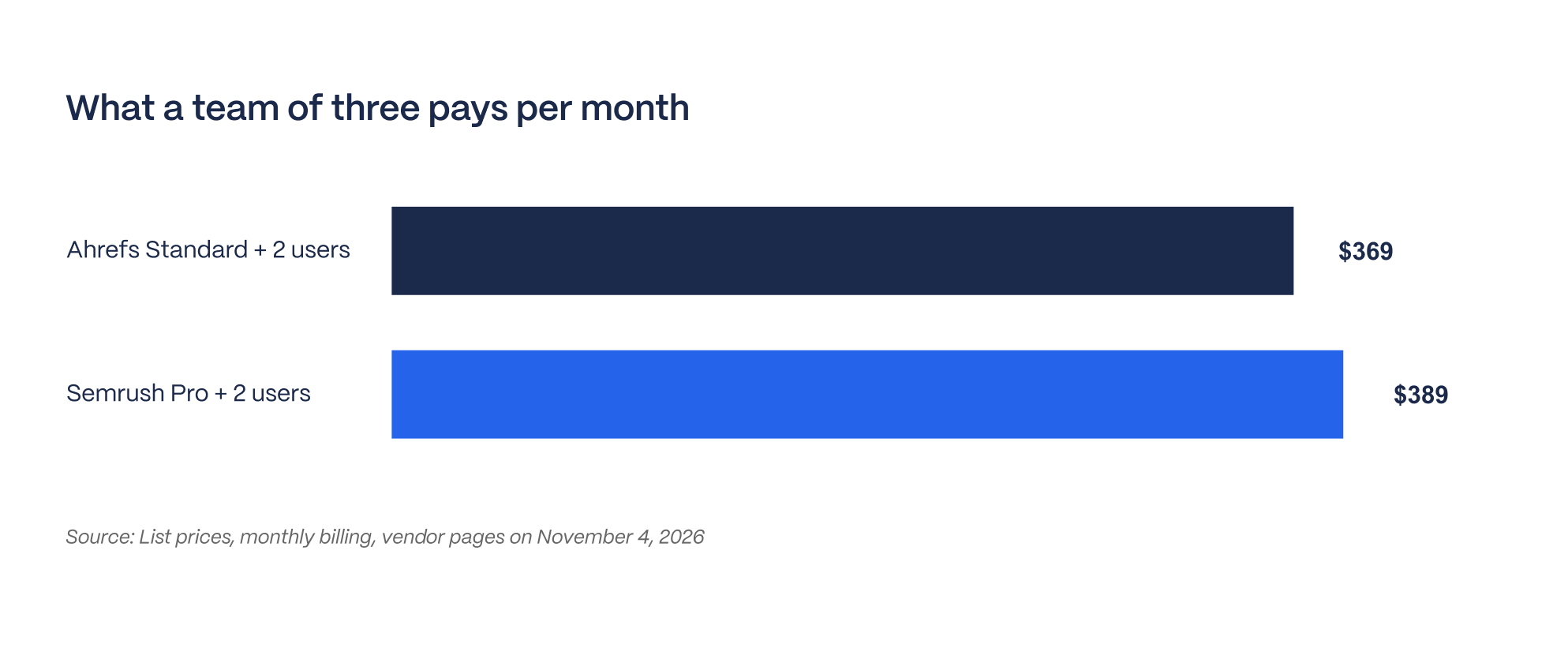
Ahrefs Standard costs $249/month, and you can add additional users for $60 per user. This means a three-person team would pay $369/month.
Semrush One Pro+ costs $299/month, with additional SEO seats weighing in at $80 each. A three-person team in this case, therefore, pays $459/month. However, if the additional users also require access to the AI Visibility Toolkit, this will cost an additional $99/user, boosting the total to $657/month.
When it comes to AI tracking, Ahrefs Lite allows for 150 prompt checks per month, while Semrush’s One Starter includes 50. But these allowances are d differently, so it’s misleading to compare them directly.
Historical data and integrations also have an impact on value. Ahrefs provides six months of historical data on Lite, two years on Standard, and five years on Advanced. Semrush provides historical SEO data from Pro+, and access depends on subscription and toolkit.
Both vendors provide enterprise options, with Ahrefs Enterprise starting at $1,499/month, and an annual commitment, while Semrush Advanced has custom pricing.
Further costs may be incurred from the marketing departments producing export limits, recurring reports, add-ons, and user permissions. Read our guide to SEO reporting tools to find out what to consider.
You need to account for your team's requirements in addition to the subscription when you make your decision. Ahrefs is more economical for research-heavy teams, while Semrush can justify higher cost when its integrated SEO and AI visibility reporting take the place of separate tools.
Semrush or Ahrefs: The Verdict by Team
Making a definitive decision between Semrush and Ahrefs is entirely dependent on what your team needs, as well as the SEO research and AI visibility capabilities that are a priority for you.
For the majority of in-house B2B SaaS marketing teams, Semrush One is the leading choice thanks to its SEO research capabilities, as well as daily rank tracking and AI visibility monitoring all within a single subscription.
If your team focus is on content or link building, Ahrefs remains the stand out option. Content Explorer, Keywords Explorer, and Site Explorer give extensive research capabilities, and Brand Radar gives a separate layer of AI visibility research.
A domain comparison also demonstrates why neither platform needs to be treated as the definitive source of SEO performance data. The differences in reported keywords, backlinks and estimated traffic aren’t indicative of one tool being better, but rather a reflection of distinct methodologies.
Ultimately, the right investment is the one that best suits your team’s day to day needs and workflows.
Can You Use Both Semrush and Ahrefs?
Of course, this is common for many agencies. Veza uses both platforms for its client work because the different datasets and research capabilities complement one another.
Agencies managing several B2B SaaS accounts, combining tools can provide fresh perspectives on competitors, backlink profiles, and keyword opportunities. It also allows specialists to choose the right platform for research tasks.
But, for a single in-house marketing team, it is rarely necessary to subscribe to both.
The combined cost of Ahrefs Standard (249/month)andSemrushOneStarter(199/month) is already around $450/month before any additional seats and other add-ons might be included.
For businesses exploring more affordable options, our Ahrefs Alternatives guide examines other SEO research options,
Before You Choose, Establish Your AI Visibility Baseline
Neither of the platforms are able to improve AI visibility simply by measuring it. Keeping track of brand mentions and citations is really important, but underlying website content and structure is what determines where improvements are required.
B2B SaaS companies that aren’t sure how they fare in AI-generated search results should check out Veza’s AI Search Visibility Audit to help identify visibility gaps before committing to a monitoring platform.
The final verdict: Semrush is the go-to choice for integrated SEO and visibility reporting. For deeper research-led workflow and competitor analysis, Ahrefs leads the way. Choose both only when the additional research value makes the cost worthwhile.
FAQs
Is Semrush or Ahrefs better for AI visibility tracking?
Semrush includes more tracked prompts in its entry plans; Ahrefs offers a larger prompt database for research through Brand Radar AI.
Which is more accurate, Semrush or Ahrefs?
Neither in absolute terms. In our check their keyword counts for one domain were more than 20 times apart. Report trends from one tool.
Is Semrush better value than Ahrefs?
At entry level Ahrefs is cheaper; with AI visibility included, Semrush One Starter at $199 bundles more prompts.
What are the cons of Ahrefs?
Weekly rank tracking, small included AI prompt checks, and add-ons (Content Kit, Report Builder) that raise the price.
Is there anything better than Semrush?
Depends on the job; link the Ahrefs Alternatives article once live.
Can Semrush be trusted?
A public company until Adobe completed its acquisition in April 2026; its data are estimates, like every SEO tool's.
What is Semrush's Authority Score, and how is it different from Domain Rating?
Two different scales from two different link indexes. In our check the same domain scored 85 (DR) and 50 (Authority Score).
Does Semrush do keyword research?
Yes, through the Keyword Magic Tool, with search intent labels and keyword difficulty.
Can you use Semrush and Ahrefs together?
Yes, and many agencies do; one in-house team rarely needs both.
Which is better, Moz or Semrush?
Two sentences: Semrush for breadth and AI visibility, Moz for authority metrics. Link the Moz vs Semrush article once live.