TL;DR
Choosing between Ahrefs and Moz depends on what your goals are for your team. Ahrefs is one of the most popular SEO tools with a large range of features, including a vast backlink index, keyword explorer, content explorer, AI prompts & API. All available for just $129 a month, or $29 to begin with. Moz is a more affordable and basic tool starting from $49/month with features like Domain Authority and Link Explorer. Clarify the metrics you want to track and report, and the amount of research required to gather the data. In this article, we looked into the Domain Rating of 10 popular B2B SaaS domains. Most were ranked highly, from 91-93. However, referring domains varied quite significantly (almost x7). Pick one tool and run with it. Our conclusion would be to choose Ahrefs for deep research into content, links, and AI search. Moz Pro is a great option for smaller teams wanting to report on authority metrics. We have checked the prices on both tools' websites.
Ahrefs vs Moz at a Glance: Key Differences in 2026
Ahrefs provides a detailed report with tools like Keywords Explorer and Content Explorer, both available on the Standard plan. Ahrefs provides a long list of backlinks and constantly updates them, making it the second most active checker. The best thing about Ahrefs for many teams is the use of API and MCP on all plans. Moz Pro is a much simpler option, offering a package with key features such as keyword finder, link checker and ranking tracker.
Domain Rating vs Domain Authority: Domain Analysis You Can Report
How Each Score Works
Domain Rating and Domain Authority provide a score to indicate how strong a website is based on its backlinks. Ahrefs provides a score (out of 100) to indicate how strong a website's backlinks are. Moz gives a similar metric - Domain Authority with a score from 1-100. It is a prediction of how well it will rank.
However, these scores are not important for Google. They are just a guess from other companies, and Google will not look at them when deciding which sites to rank at the top of the list. Google has its own method.
Also, the scores cannot be compared between tools. A score of 70 on one tool is not the same as another. Each has a different way of searching, counting links and updating, so they are unique. Your score will likely change depending on the tool you use. It is not a good idea to mention the score without mentioning the tool you used, as it can cause confusion.
Our Check: What Domain Rating Hides on Ten B2B SaaS Domains
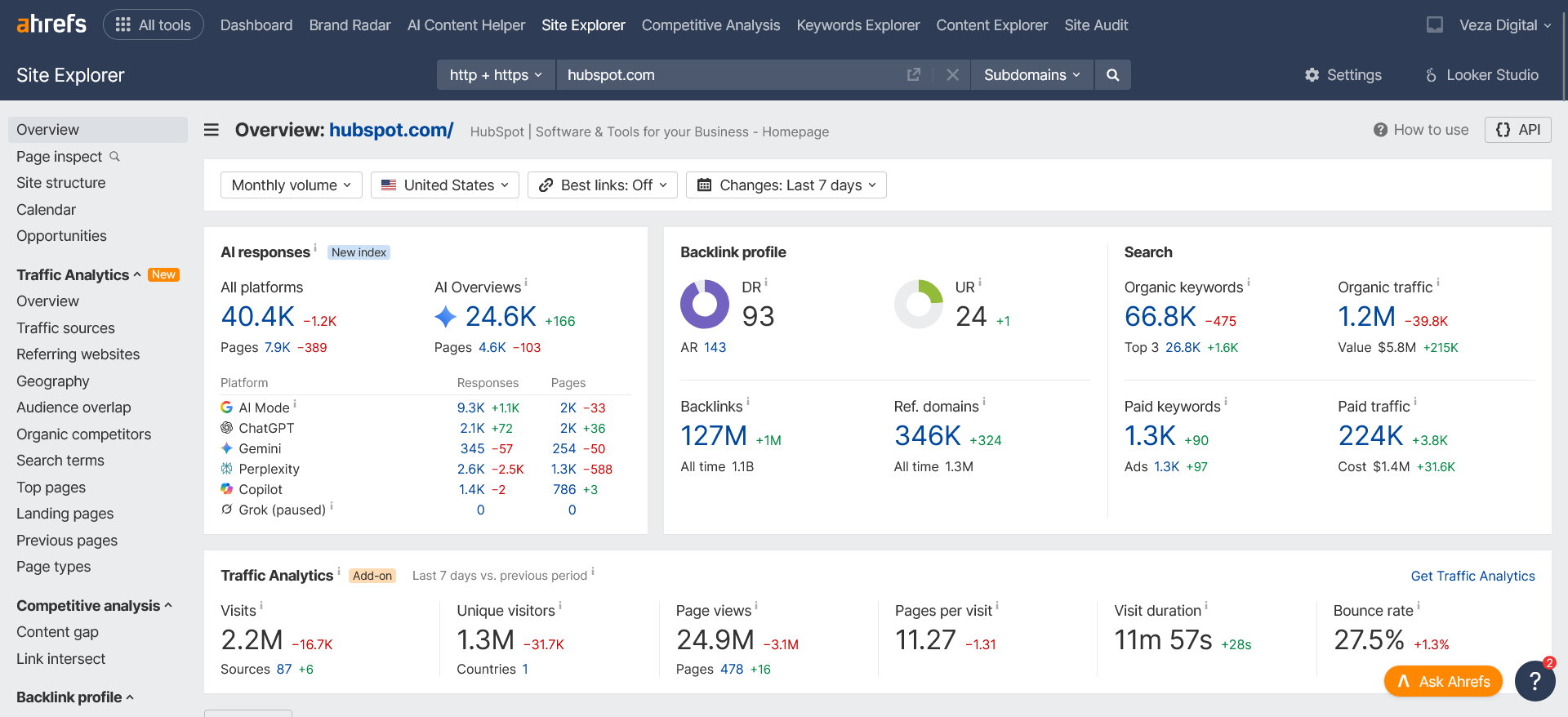
Ahrefs Site Explorer overview for HubSpot
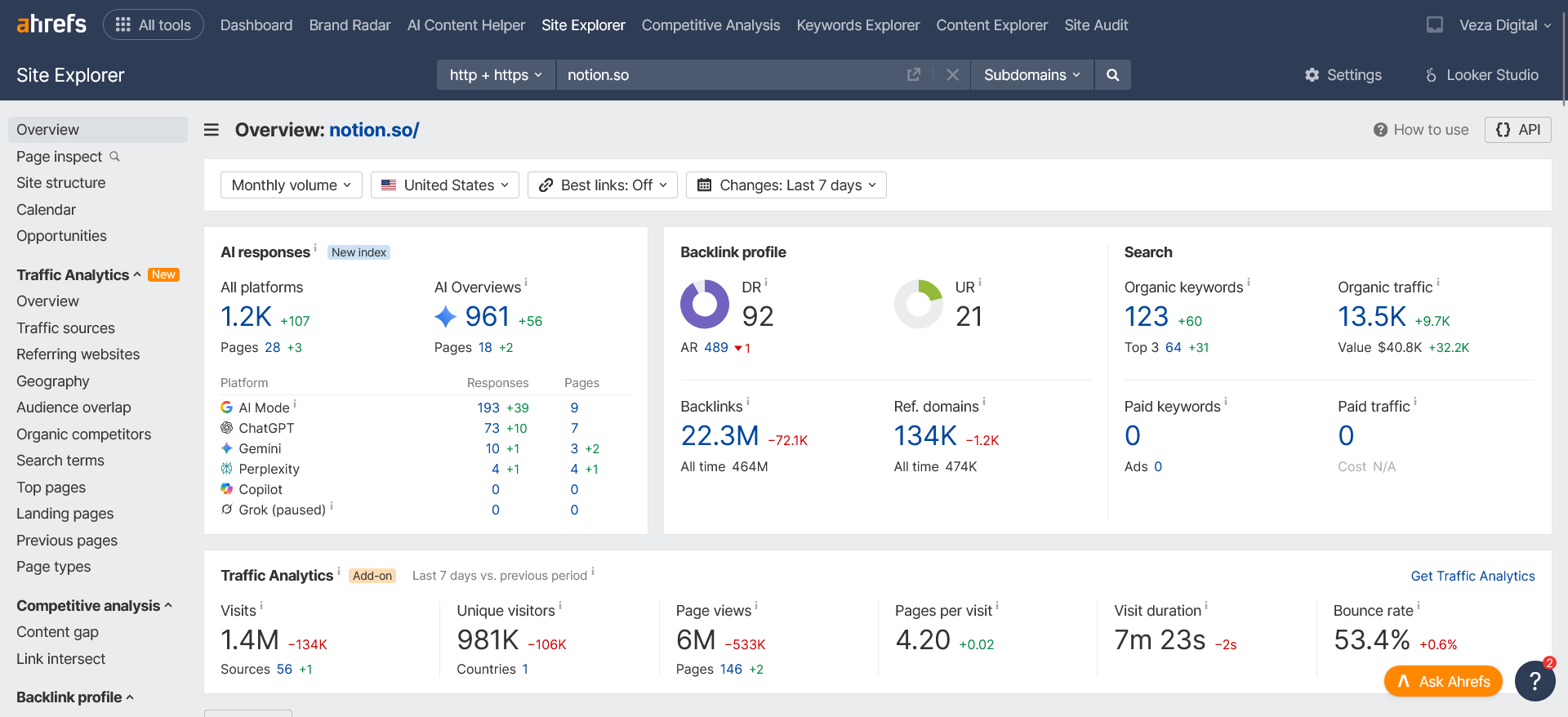
Ahrefs Site Explorer overview for Notion
Below is an overview of the 2 domains from Ahrefs Site Explorer. We looked into 10 B2B SaaS websites on 29 th October 2026.
Using Ahrefs, we looked into the Domain Rating of these domains and how many sites are linking to it. Many popular companies such as HubSpot, Notion, Webflow, Figma, Asana, Airtable, monday.com & Intercom have Domain Ratings ranging from 91-93.
However, the number of referring domains varies significantly.
Intercom has around 51,185 referring domains. HubSpot has 349,049 referring domains- almost 7 times more than Intercom. This is an interesting difference, as HubSpot clearly has a stronger online presence. Linear had a decent score of 85 and 16,812 other websites linking to it.
Gong was close behind with a score of 83 and 15,299 referring domains. When you look into larger websites, the Domain Rating does not provide much insight. The top-rated sites will all be grouped together at the top end of the scale.
It is more helpful to look into the number of domains linking to it and how the score has changed. Moz Domain Authority works in a similar way. It is a relative score, so you need to be careful with how you use it. We cannot provide Domain Authority numbers as we cannot access Moz data. Keep it simple by choosing a Domain Authority that your team already looks into and see how it performs over time (quarter to quarter).
Keyword Research and Competitor Research
Keyword Research Features: Keywords Explorer vs Moz Keyword Explorer
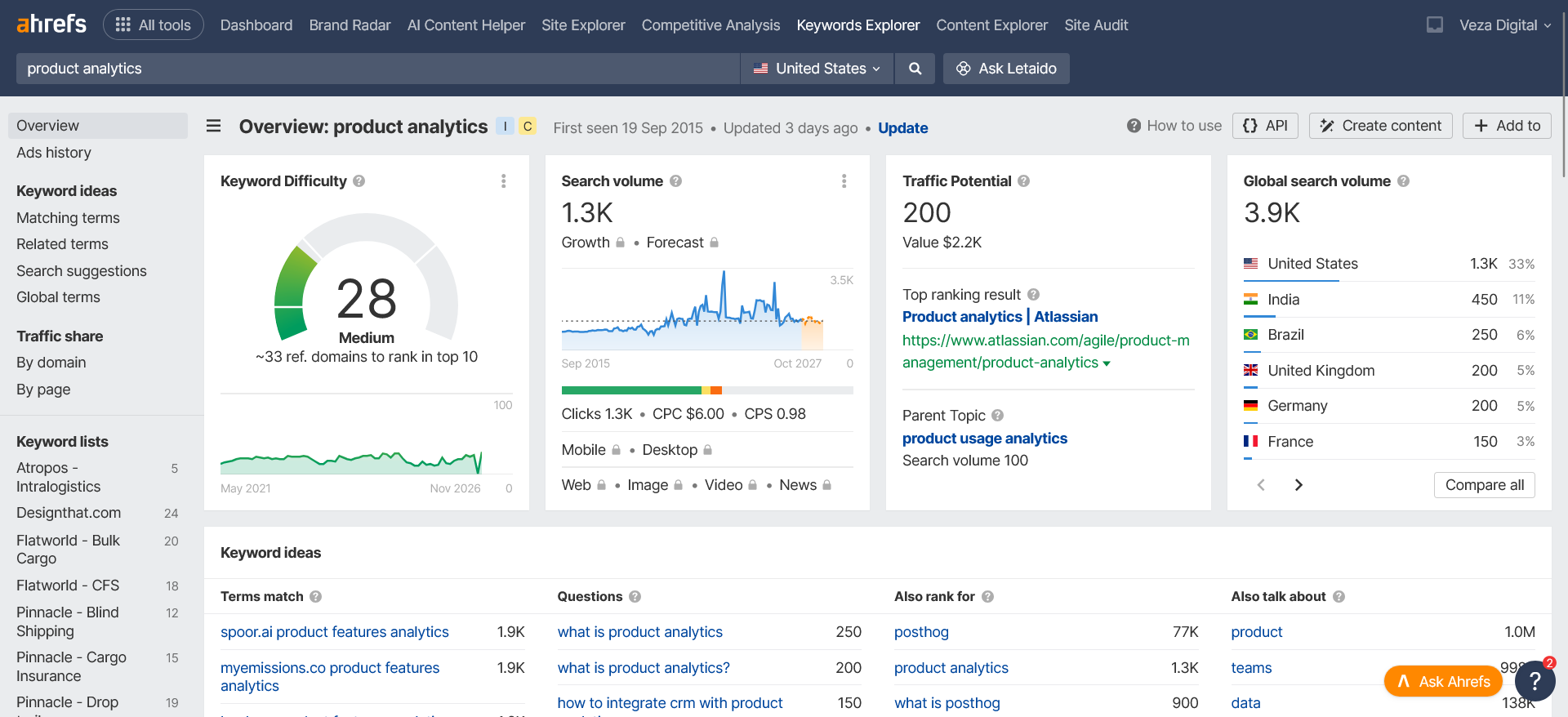
Ahrefs Keywords Explorer for the seed keyword "product analytics"
Ahrefs Keywords Explorer is a handy tool that helps you come up with keyword ideas and provides some really useful info. With it, you can see how often people search for a particular keyword, how tough it is to get a good ranking, what people are actually looking for when they search, and even estimate how much traffic you might get.
What's really important for companies making content about a topic is how much traffic it can get. This tool helps you decide if a topic is worth making a whole page about, because it shows you how many people might visit your site for that topic, not just for one specific word or phrase. It's a big deal for teams planning their content, because it helps them pick which topics are worth spending time and effort on.
Moz Keyword Explorer is a handy tool for coming up with keyword ideas and figuring out how tough it is to get a good ranking. We haven't had a chance to try it out yet, so we can't compare its numbers to Ahrefs.
One thing that's clear, though, is that Ahrefs has a lot more features. If you take a closer look at what each tool can do, Ahrefs seems to have more to offer. We're still wondering how accurate Moz's difficulty scores are and how its volume data stacks up against Ahrefs, but the big difference is in the features they offer.
Edge on documented features: Ahrefs.
Competitor Analysis
Ahrefs has three tools to help with competitor research. First, there's Site Explorer, which gives you a rundown of a competitor's organic keywords, backlinks, and top-performing pages. Second, Content Gap shows you the keywords your competitors are ranking for that you're not. With Traffic Analytics, you can estimate how much traffic a site is getting and where it's coming from.
These tools work together to help you figure out who your competitors are, what they're ranking for, and what you're missing out on.
When it comes to competitor research, Moz Pro has its own set of tools, which are outlined on their website. However, we didn't put these tools to the test, so we can't compare them to Ahrefs in this article.
If you're a B2B team looking to choose a competitor research tool, you should start by thinking about what you need the tool to do - for example, can it help you identify gaps in your keywords, links, or content? Then, make sure the tool you choose can actually deliver on those needs.
Edge on documented features: Ahrefs, with the caveat that Moz's tools were not tested.
Backlink Analysis: Site Explorer vs Link Explorer
When it comes to link analysis, these two tools are pretty similar in what they do, but that's what makes them tough to compare.
Ahrefs Site Explorer gives you a rundown of referring domains, backlinks, anchor text, and link history. It also claims to have the second most active crawler on the web, although that's based on their own numbers, not an outside assessment. Moz Link Explorer looks at backlink profiles and uses that info to calculate the Domain Authority score.
For backlink reports, two key factors come into play: index size and freshness. These essentially determine how comprehensive the report is. We didn't directly compare the two indexes, so we can't say for sure which one is more thorough. Without access to Moz, it's tough to tell which tool can find more links for a given site.
The descriptions provided by the vendors about their crawlers don't give us a clear answer either. If you're serious about link data, it's a good idea to test both tools with a few domains during a trial period and see what each one turns up.
When you look at the ten-domain check, you can see how one score doesn't tell the whole story. No matter what index you use, looking at referring domains gives you a clearer idea of what's going on than just a single authority number. So, when a link or PR team is deciding between tools, they should pay more attention to the details and history of the backlink report rather than just focusing on the main metric. This gives a better understanding of what's really happening.
Edge on documented features: Ahrefs for depth, though not verified against Moz hands-on.
AI Search Visibility and MCP: Brand Radar vs Moz AI Explorer
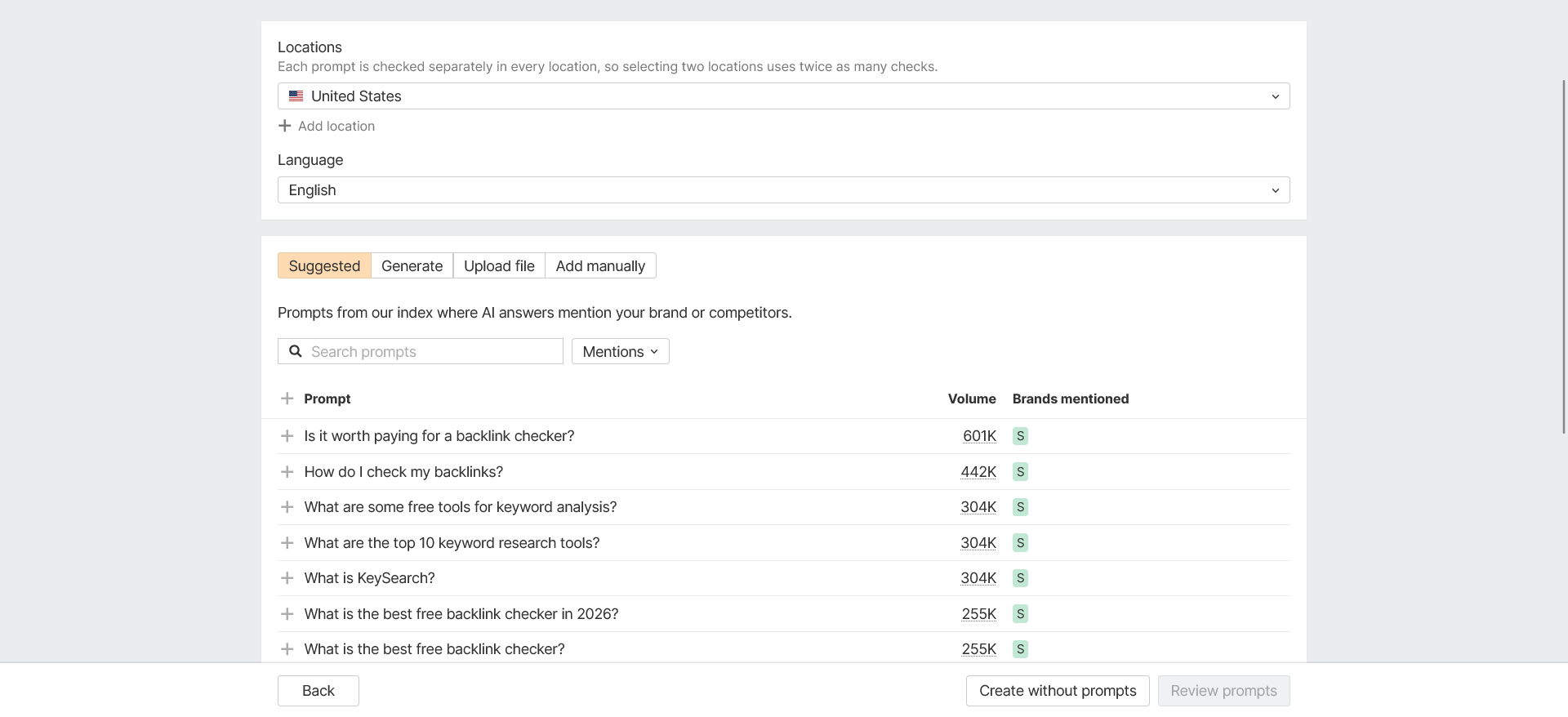
Ahrefs tracked AI prompts
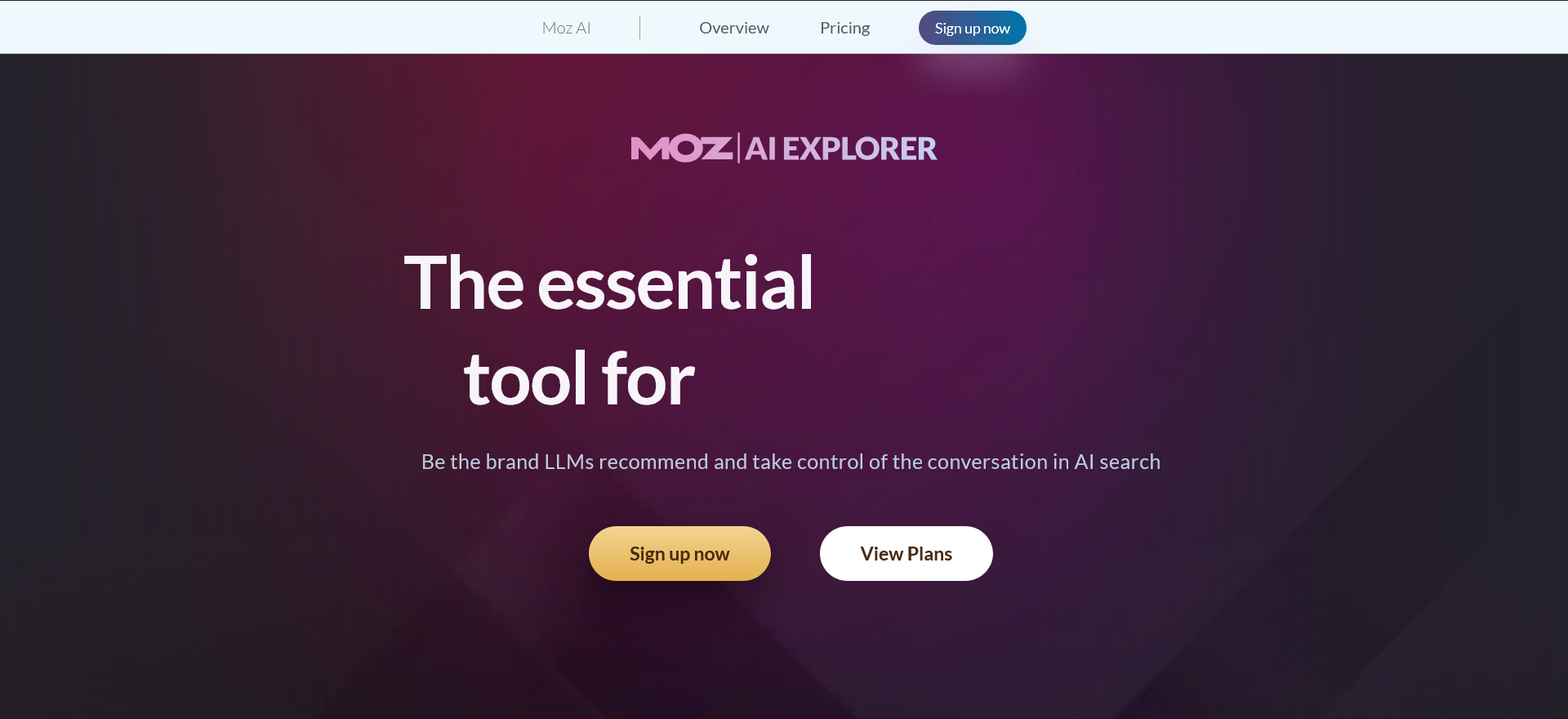
Moz AI Explorer's public product page
Both vendors now sell AI visibility tracking, and the differences are concrete. Ahrefs includes tracked AI prompt checks in each paid plan: 150 on Lite, 300 on Standard, and 600 on Advanced. It sells Brand Radar AI from $199 a month, with custom prompt packages at $50, $100, and $250 a month, and it offers API and MCP access on all paid plans. MCP, the Model Context Protocol, lets AI assistants query the tool's data directly, which matters to teams building their own AI workflows on SEO data.
Moz offers Moz AI Explorer, with 150 or 300 tracked prompts by plan, updated weekly. Extra prompts cost $50 per 100, and extra AI visibility dashboards cost $20 each. The Moz API is a separate product, and Moz's pricing page offers no MCP. Ahrefs updates its tracked checks daily, against Moz's weekly cadence, which is the clearest difference between the two for AI tracking. Ahrefs also counts checks, and Moz counts prompts, so compare the cost per update and not the headline number.
Our guides to AI SEO tools and AI brand visibility tools cover a wider set of options.
Tracking shows where you stand. It does not earn the result. Whether AI answers cite a brand depends on the site, which needs to be readable, extractable, and trustworthy to the systems that cite it, and that is what WAIO, Veza's methodology for Webflow sites, is built for. As published in our Concordium case study, LLM sessions grew 363 percent, verified in GA4, and that is our own client result and not an industry benchmark. If you want help with the work, our answer engine optimization service covers it.
Content Explorer, Rank Tracking and Site Audits
Content Explorer is an Ahrefs feature that lets a team search a large index of web pages by topic, sorted by traffic, links, or social shares. It is available on Ahrefs Standard and above, so teams on Lite do not get it. For content-led teams, it is a research tool for finding what already performs in a topic, and it is a common reason to move up from Lite.
Rank tracking on Ahrefs updates weekly, and the plan sets how many keywords you can track: 750 on Lite, 2,000 on Standard, and 5,000 on Advanced. Site audits run on crawl credits, and Lite includes 100,000. Those limits shape which team a plan fits. A site with many thousands of pages can use up 100,000 credits quickly if it crawls often.
Moz Pro includes keyword rank tracking and site crawling too, with its own limits listed on moz.com. We did not verify Moz's tracking frequency or crawl limits for this article, so check its current pricing page before comparing the two at your scale. For a view across auditing options, our guide to website audit tools compares the field.
Edge on documented features: Ahrefs for Content Explorer, which Moz Pro was not confirmed to match.
Ahrefs vs Moz Pricing
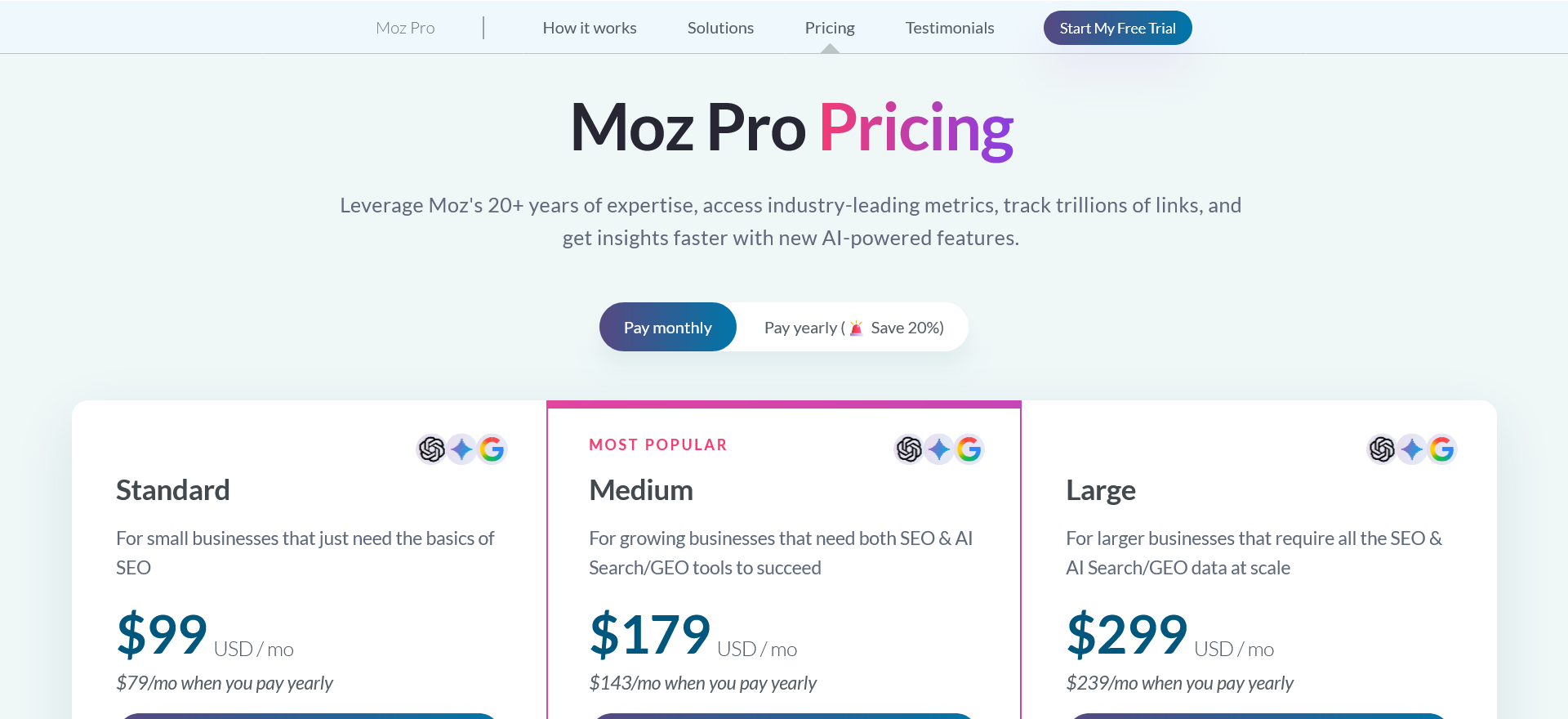
Moz's pricing page
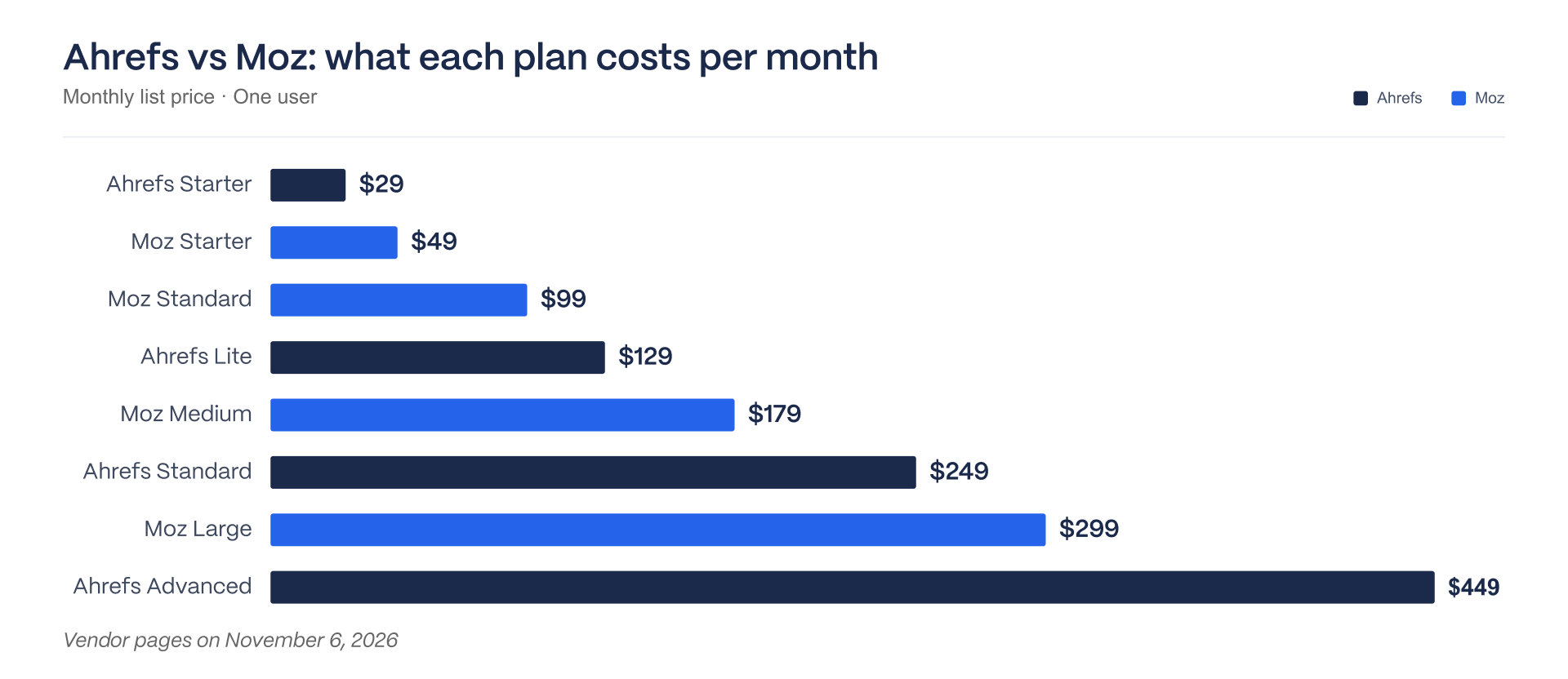
Prices below were verified on each vendor's own page, with Ahrefs on 29 October 2026 and Moz Pro on 29 October 2026 for Starter, yearly prices, and AI Explorer, and on 20 October 2026 for monthly prices.
Ahrefs runs on a ladder: Starting at $29 a month, Lite at $129, Standard at $249, Advanced at $449, and Enterprise at $1,499 a month with an annual commitment. Ahrefs Free covers limited data for a site you own. Moz Pro costs $49 a month for Starter, which covers one site, then $99 for Standard, $179 for Medium, and $299 for Large, or $79, $143, and $239 a month billed yearly.
Comparing at similar tiers is more useful than comparing at the entry point. Moz Standard at $99 sits below Ahrefs Lite at $129, and Moz Medium at $179 falls between Ahrefs Lite and Standard. Moz Large at $299 sits between Ahrefs Standard and Advanced. The question at each point is what the extra money buys, and the answer differs by tool: Ahrefs adds tracked keywords, AI checks, and Content Explorer as the plan rises, while Moz adds capacity.
Seats change the math. Ahrefs charges $40, $60, $80, or $100 a month for each extra user depending on the plan. We could not verify Moz's seat prices, so check them before costing a team. Reporting add-ons also add cost, and our guide to SEO reporting tools covers what teams use to report upward.
Ahrefs or Moz: The Verdict by Team
No overall winner follows from this comparison, because the two tools serve different teams. A content-led team doing deep keyword and topic research fits Ahrefs, because Keywords Explorer, Content Explorer, and traffic potential are built for that work. A link or PR team fits Ahrefs too, for the depth and history of its backlink reporting. A lean team that reports authority to leadership fits Moz Pro, with Domain Authority, a lower entry price, and a simpler interface.
For tracking AI visibility on a budget, the choice is between Ahrefs Lite at 150 checks updated daily and Moz Pro at 150 tracked prompts updated weekly, and the cost per update decides it. A team building AI workflows on SEO data fits Ahrefs, since API and MCP access come with every paid plan and Moz sells its API separately. Teams with the budget can run both, using Ahrefs for research and Moz for authority reporting.
One caveat applies to every verdict about Moz: it rests on Moz's public pages and not on hands-on testing. If you want to know where you stand in AI answers before choosing a tool, an AI search visibility audit is a useful first step.
Closing
DR and DA measure your links. AI search reads your site.
We run SEO and AEO for B2B SaaS teams with Ahrefs every week, and every site we build ships on WAIO, our methodology for being read and cited by AI systems. Start with where you stand today.
Work With Veza
FAQs
What are Moz and Ahrefs?
Two SEO platforms: Ahrefs for research depth, Moz Pro for simpler authority-led SEO.
Is Ahrefs more accurate than Moz?
Neither is accurate in absolute terms; they use different indexes and scores. Compare trends inside one tool.
What are some free alternatives to Ahrefs?
Ahrefs Free, Google Search Console, Bing Webmaster Tools. Link Ahrefs Alternatives once live.
What are the top 5 tools for SEO?
Name a short set and link /post/seo-tools.
Can you use Ahrefs and Moz together?
Yes: research in Ahrefs, authority reporting in Moz, if the budget allows both.
Is Moz good enough for a B2B marketing team?
For authority reporting and basic tracking, yes; for deep research, Ahrefs.
Is Domain Authority a Google ranking factor?
No. Domain Authority and Domain Rating are third-party estimates.