TL;DR
Generative AI is already inside most B2B marketing teams, and the value is not. The CMO Survey's spring 2026 edition found AI involved in 24.2 percent of marketing activities, and Gartner's 2026 CMO Spend Survey found CMOs putting 15.3 percent of their budgets into AI initiatives, yet only 30 percent of CMOs describe their AI readiness as mature. The gap is rarely the tools. It is the operating model: who owns AI work, where a human checks it, what the budget buys, and how results are measured. This guide is for B2B SaaS marketing leaders who have to answer those questions. It covers where generative AI pays in B2B marketing and where it creates risk, three operating models and the roles each needs, how to budget and measure it, and the rules that now apply: the EU AI Act's disclosure duties from 2 August 2026, the FTC's ban on AI-generated fake reviews, and Google's policy on scaled AI content. It ends with the part most strategies miss. Your buyers use generative AI too, so your brand has to show up in its answers.
Generative AI in Marketing in 2026: Where B2B Teams Stand

Companies are investing heavily in artificial intelligence for marketing, but they're not seeing the results they expected. A survey by Duke's Fuqua School of Business and Deloitte found that AI is now used in almost a quarter of all marketing activities, up from just over 13% a couple of years ago.
We’re not talking about just a few companies - over 73.9% of businesses are using AI to create content. Gartner's 2026 CMO Spend Survey found that marketing leaders are putting a big chunk of their budgets into AI, with an average of 15.3% of their spending going towards AI initiatives. In fact, 70% of them say that having good AI leadership is a top priority for the year. But here's the thing: only 30% of companies say they're actually ready to use AI effectively. It seems like businesses are buying and using AI tools left and right, but they're not really sure what they're getting out of it.
They're spending all this money, but they can't say for sure what the return on investment is. For scope, this guide treats generative AI as the technology that creates text, images, audio, video, and code, and leaves the definition of AI marketing to our guide on what AI marketing is.
Generative AI is a whole different ball game compared to the predictive analytics that marketers have been using for years. You see, predictive analytics and machine learning are all about scoring and forecasting - think lead scoring or next-best-channel models. But Generative AI is all about creating content from scratch.
That's where things get interesting, because these two technologies have different people in charge, different risks involved, and different ways of going off the rails. Most of the time, guidance on these topics gets mixed up, but this one is going to focus on the generative side of things.
B2B marketing is different from consumer marketing in many ways. For one, the sales process takes a lot longer and involves more people. When you're selling to a business, you're not just dealing with one person, you're dealing with a whole team of people who have to agree on a purchase.
This means that what you say as a marketer is really important, because the sales team has to back it up. If you make a mistake, it can cause problems for months, not just a day like it might with a consumer brand. Plus, review sites play a big role in helping businesses decide who to buy from, so you need to make sure you're paying attention to those.
All of this means that the advice you read about marketing might not apply to B2B sales, because the rules are different.
Where Generative AI Pays in B2B Marketing, and Where It Costs You
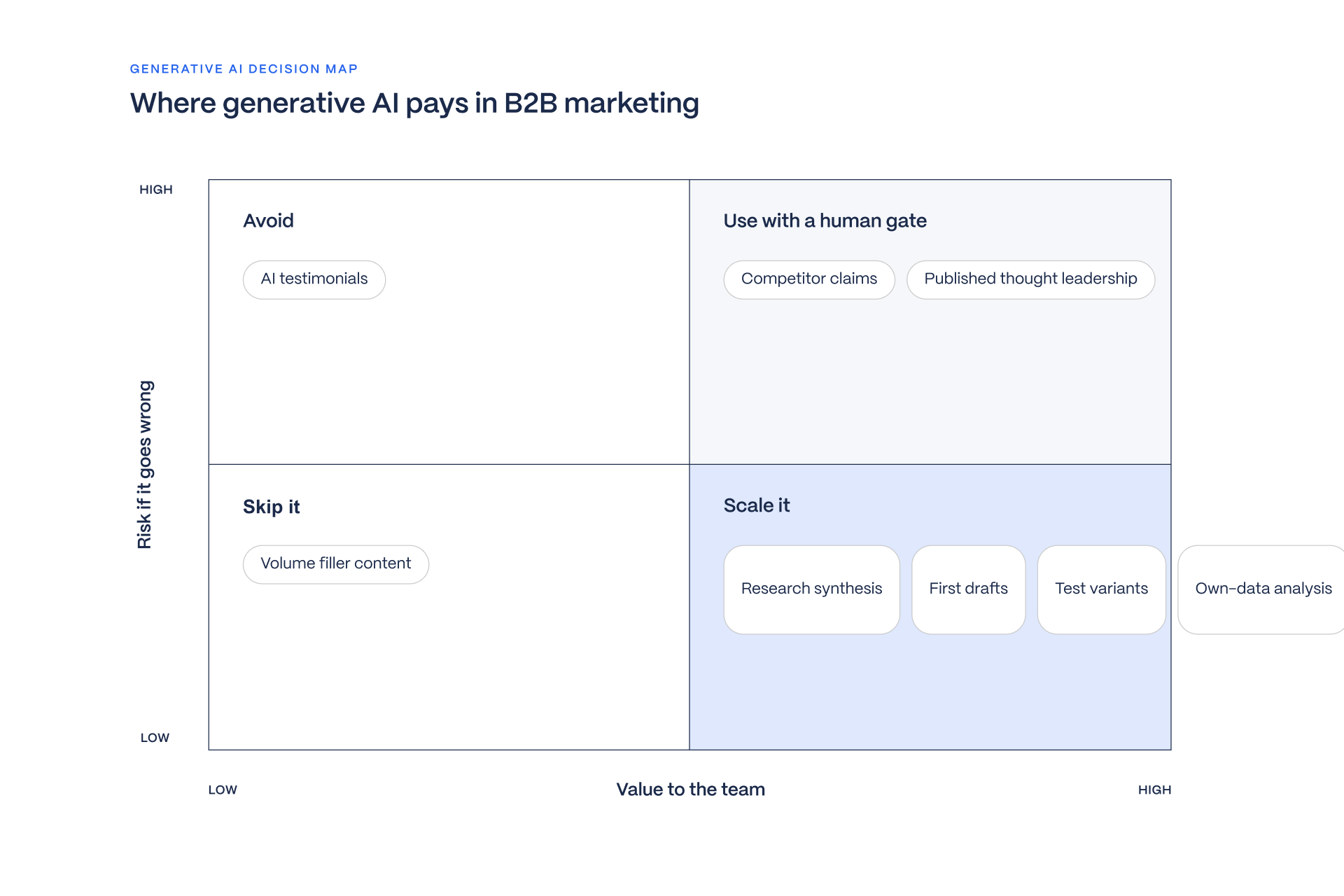
Having a list of things to do isn't as helpful as finding a way to prioritize tasks. The key is to figure out how much each task matters to the team and how bad it would be if something goes wrong. When you think about it, tasks can be grouped into four main categories based on this.
The first group is pretty safe and valuable: we're talking about summarizing research, creating initial drafts based on the information you provide, trying out different versions, and analyzing your own data. These tasks are built on stuff the team already knows and trusts, and someone always reviews the output before it's shared. This is where most teams should begin and grow, because if something goes wrong, it's not a big deal and you'll still save time.
The second group is a big deal because it's high stakes and high risk. If you're putting your name on something without having it reviewed, that's a problem. Same with talking about competitors or using automation to deal with customers. The reason it's so important is that these tasks are what actually reach the people buying from you. But the danger is that if something or off-message gets to a buyer without being checked, it can cause trouble. That's why these tasks need a human to approve them every time.
The third group isn't very valuable, it's basically a bunch of content that you can find anywhere else. Making this kind of content is easy on the wallet, which can be tempting, but Google doesn't like it when people churn out a lot of similar stuff, so what seems like a cost saver can actually cause issues with search results.
There's another type of content that doesn't really fit with what a B2B team should be doing, and that's writing fake testimonials and reviews using AI. This is something that's not really their job, and we'll get into why that is in the risk section. For tactics inside the first group, see our guide to practical AI marketing strategies. For hands-on prompting, our ChatGPT for marketing guide covers it. Tool choices are covered in our roundup of AI tools for B2B marketing, which keeps this guide focused on how to run the work.
The Operating Model: Who Owns Generative AI in Marketing
Central, Embedded or Hybrid
There are three main ways companies can run their AI operations. One way is to have a central team, usually led by an AI expert, that controls everything - the tools, the rules, and most of the work. Another way is to let each marketing team do its own thing with AI, using their own tools and methods. Then there's a mix of both, where the company sets some overall rules from the top, but lets the individual teams handle the day-to-day work with AI.
For small to medium-sized B2B SaaS marketing teams, a hybrid approach works well. If you put all the work in one central group, they might not fully understand each marketing channel, so they can't effectively judge the results.
Usually, teams of this size can't afford to have a dedicated central team. On the other hand, if each team does its own thing, you get a different problem: each team creates its own way of doing things, chooses its own tools, and decides how to review their work. This means the quality of work and the risks involved can vary a lot across the department.
A hybrid model solves this by keeping the things that need to be consistent, like data rules and disclosure policies, in one place, and letting the teams that have the specific knowledge handle the parts that need it.
Roles, Review Points, Data Quality and Data Analysis
When it comes to managing tasks, you need at least three key people to get the job done.
First, there's the owner who makes sure everything meets the standards and keeps the shared prompt library up to date. Then, you have the reviewer who gives the thumbs up to anything that's about to be published. Lastly, the data owner decides what information can be shared with which tool.
In smaller teams, one person might take on two of these roles, but it's essential to clearly define each role, because if nobody's in charge, things can easily fall through the cracks.
Review points are just as important as the roles people play. You should always review things before they get published, before they reach the customer, and before you say anything about a competitor. Each point checks for a different kind of mistake, so if you skip one, you're leaving a hole that the others won't fill.
The quality of your data is what limits how good everything else can be. For example, artificial intelligence that can generate things is only as good as the data and information it's given, and having good control over your data decides what you can and can't do with it. If you put bad information into a system, you'll get bad results - like if you give a model notes that don't make sense, it will give you output that doesn't make sense. If you put customer information into a tool that's not meant for that, you can create a problem that can't be fixed later on.
Agents in the Marketing Workflow
Agents are the future - they can handle lots of tasks on their own, like researching, writing, checking for quality, and publishing, all without someone telling them what to do at each step. It's kind of like how we work, but with more at stake because a lot can happen between checks. Think of an agent like a new employee - give it a clear job, only the information it needs, and someone to review what it comes up with. We've written about how we build with agents, if you want to learn more about our approach.
Teams that want help setting up this model can look at our AI content strategy service.
Budget and Campaign Performance: What to Fund and How to Measure

Gartner's 15.3 percent is just a standard to compare with, not a goal to aim for. It's based on what the average marketing leader is spending, according to their survey. But that doesn't mean it's right for your team. If you have a small team creating content and a big sales team, you might need to spend less. On the other hand, if your company relies heavily on content, you might need to spend more. Use this number to see if your own spending is way off from the average, and then think about why that is.
When you're thinking about what to invest in, it's not just about buying licenses. There are other expenses that teams often overlook, like getting data ready, training, and reviewing. These costs can actually be more than what you pay for the subscription. If a team purchases a tool but doesn't take the time to review it, they're basically buying into a risk without any protection. We've written about the hidden costs of AI, which explains where these extra costs come up.
To really know if your work is making a difference, you need to track the outcomes you're trying to change. Sure, how quickly you can publish something and how much it costs are important for efficiency, but only if the quality is good.
So, someone needs to decide what quality means and check that it's being met. Looking at how well a campaign does and how it affects potential buyers shows if your work is having an impact. Just measuring how much you produce isn't very helpful, because making more of something doesn't mean it's actually helping. If a team focuses on making a lot of content, they'll just keep making more, which can lead to a bigger problem with too much content that isn't very good.
The Risks, and the Rules That Now Apply
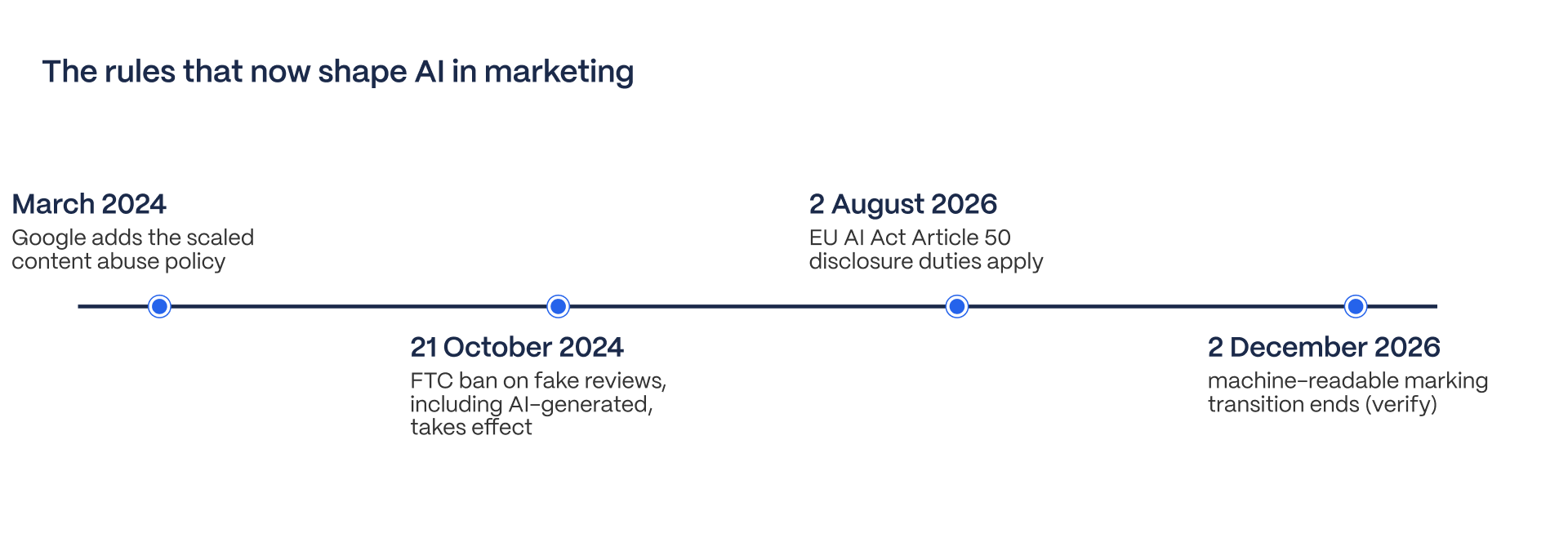
Three rules now shape how marketers use generative AI, and each has a date. Google's scaled content abuse policy has applied since March 2024. The FTC's ban on fake reviews, including AI-generated ones, took effect on 21 October 2024. The EU AI Act's disclosure duties under Article 50 apply from 2 August 2026. The sections below describe what each rule says and what a B2B marketing team does about it. They are a summary of the rules, not legal advice, so confirm how they apply to your business with counsel.
AI Generated Content: Accuracy, Brand and Search Risk
The first risk is accuracy. Generative AI produces invented facts and statistics with confidence, and in B2B, where buyers are technical and skeptical, a single wrong number damages trust in everything around it. The second is claims about competitors that sales cannot defend. The third is brand drift, where content produced at speed slowly stops sounding like the company.
Google's position on AI content is clear. Using generative AI is allowed and useful for research and structure. Generating many pages without adding value may violate its scaled content abuse policy, introduced in March 2024, and sharing how content was created can help readers. The rule targets the pattern and not the tool, so a reviewed, useful page made with AI is treated like any other. See Google's guidance on generative AI content.
The controls follow from the risks: a source on every number, human sign-off before publishing, and no bulk generation of pages whose only purpose is volume.
Disclosure: The EU AI Act From 2 August 2026
Article 50 of the EU AI Act sets transparency duties that apply from 2 August 2026, and the European Commission has published guidelines, a voluntary Code of Practice, and optional EU icons to help organizations comply. Three of its provisions matter to marketers who publish in the EU. Deployers must disclose deepfakes, meaning synthetic image, audio, or video content that depicts real people or places.
AI-generated text published to inform the public on matters of public interest must be disclosed, unless it went through human review or editorial control and someone holds editorial responsibility for it. Providers must mark synthetic content in machine-readable form.
In practice, an AI-generated video or voice of a real person, such as a digital double of your CEO, needs a label. A blog post that a person has reviewed and taken responsibility for usually does not.
Whether a fully invented avatar counts as a deepfake depends on whether it could pass as a real person, which is a question the Commission's guidelines address. Detailed fines and transition dates should be confirmed against the Commission's own materials before anyone quotes them.
Reviews, Testimonials and Customer Data
The FTC announced its final rule on fake reviews on 14 August 2024, and it took effect on 21 October 2024. The rule bans fake reviews and testimonials, explicitly including AI-generated ones, as well as insider reviews without disclosure and fake social media indicators. It also lets the FTC seek civil penalties against knowing violators.
For a B2B team, the practical rules are short. Never draft reviews for customers with AI. Never invent case study quotes. Disclose reviews written by insiders. Each of these protects both the company and the credibility of its proof, which buyers weigh heavily.
Customer data needs its own policy. Decide what can go into which AI tool, and prefer business plans whose terms state that they do not train on your data by default. Read those terms directly, since they differ across vendors and plans.
Your Buyers Use Generative AI Too: Customer Experience in AI Answers
Everything above concerns how marketing teams use generative AI. Buyers use it as well, and that changes the strategy. B2B buyers now research vendors in AI assistants, and The CMO Survey puts the share of companies already doing generative engine optimization at 41.5 percent. A buyer's first impression of your company may be an AI-generated summary, and customer experience now starts there, before anyone reaches your site.
Whether your brand appears in those answers is mostly a website job. AI systems cite pages they can read, extract, and trust, and a site that fails those basics gives them little to cite, however good the marketing team's own use of AI is. That is the work of answer engine optimization and of WAIO, the methodology every Veza site is built on. As published on our Concordium case study, LLM sessions grew 363 percent, verified in GA4. That figure is our own client result and not an industry benchmark.
Measuring the effect is a separate task. Our guide to measuring AI traffic covers how to see what AI answers send to your site. A strategy that improves the team's productivity and ignores how buyers meet the brand in AI answers is half a strategy, and the second half is the one buyers can see.
Closing
Most teams have the tools. Few have the operating model.
We help B2B SaaS marketing teams run generative AI with clear ownership, review points, and measurement, and we build websites AI systems can read and cite, on WAIO, our methodology for AI search.
Work With Veza
FAQs
What is generative AI in marketing?
AI that creates text, images, audio or video for marketing work. One sentence, then link /post/what-is-ai-marketing.
How is generative AI used in B2B marketing?
Research, drafting, variants, analysis and personalization, with a human gate. Link the AI Marketing Use Cases article once live.
What are the four types of generative AI?
By output: text, image, audio and video (code is often added as a fifth). Keep it short.
What are the risks of generative AI in marketing?
Invented facts, brand drift, search penalties for scaled low-value pages, disclosure duties and fake-review rules, and customer data in prompts.
Do we have to label AI-generated marketing content?
In the EU, deepfakes yes from 2 August 2026; reviewed text with editorial responsibility usually not. Check with counsel.
Does Google penalize AI-generated content?
No; it penalizes scaled pages that add no value, however they were made.
How much should a marketing team spend on AI?
Gartner's 2026 average is 15.3% of the marketing budget; use it as a benchmark, and fund review time, not just licenses.
Should we build an AI center of excellence?
For most B2B SaaS teams, a hybrid: central standards, embedded execution.