.jpeg)
AI brand visibility tools promise to tell you whether and how often your brand is mentioned in popular AI search engines such as ChatGPT, Google AI, and others. But there’s a simple catch - ask AI the same question twice, and you can get two different answers.
This makes data harder to judge, regardless of how popular the tools are. While most of the articles recommend the top AI brand visibility tools, none of them mention this. As a result, marketing teams spend weeks figuring things out while their subscription runs.
This article won’t do the work for you, but it will help you choose faster. Before you opt for a tool, you need to know how each of them collects data, how often it runs each prompt, and what the numbers you get are telling you.
We also prepared five questions you can ask your team before you buy a tool, what each vendor publicly discloses, and what data it includes from our own site.
Read the byline before the ranking
Who writes the comparisons in this category
If you start research on the best AI brand visibility tools, you’ll notice the pattern very fast. Frase ranks Frase first. Profound ranks Profound first. Semrush, Adobe, SE Ranking, Ubersuggest, Rankability, Brainlabs, and Rankscale…each of them reviews a category that includes their own product.
This is how marketing works, and there’s nothing particularly wrong about it. But for a reader looking to get the best solution for their brand, these articles act more as ads with shared methodology. Zapier and Marketer Milk roundups are closest to neutral, but they stay shallow on some parts.
Veza Digital doesn’t sell a tool in this category. We evaluate each based on our experience with clients' work. We do answer engine optimisation, and no vendor listed below is a competitor.
If you’re new in this category, we recommend reading SEO, GEO, AEO and LLM optimisation compared and the AI visibility pyramid articles that cover some of the fundamental terms for AI search.
What this article is and is not
This evaluation is from the perspective of a buyer using vendor-provided information, independent research, and Search Console data collected by Veza. It wasn’t an in-person or hands-on review.
We were unable to use most of these products; therefore, we are not going to provide performance rankings for those products that we could not test. We will clearly identify what we evaluated and what we didn’t before providing any recommendations.
See AI companies we work with for the client context this framework comes from.
The five questions that decide it
Before you buy any tool in this category, run through the next five questions. This can speed the process up because answering doesn’t requiring testing each tool before decision.
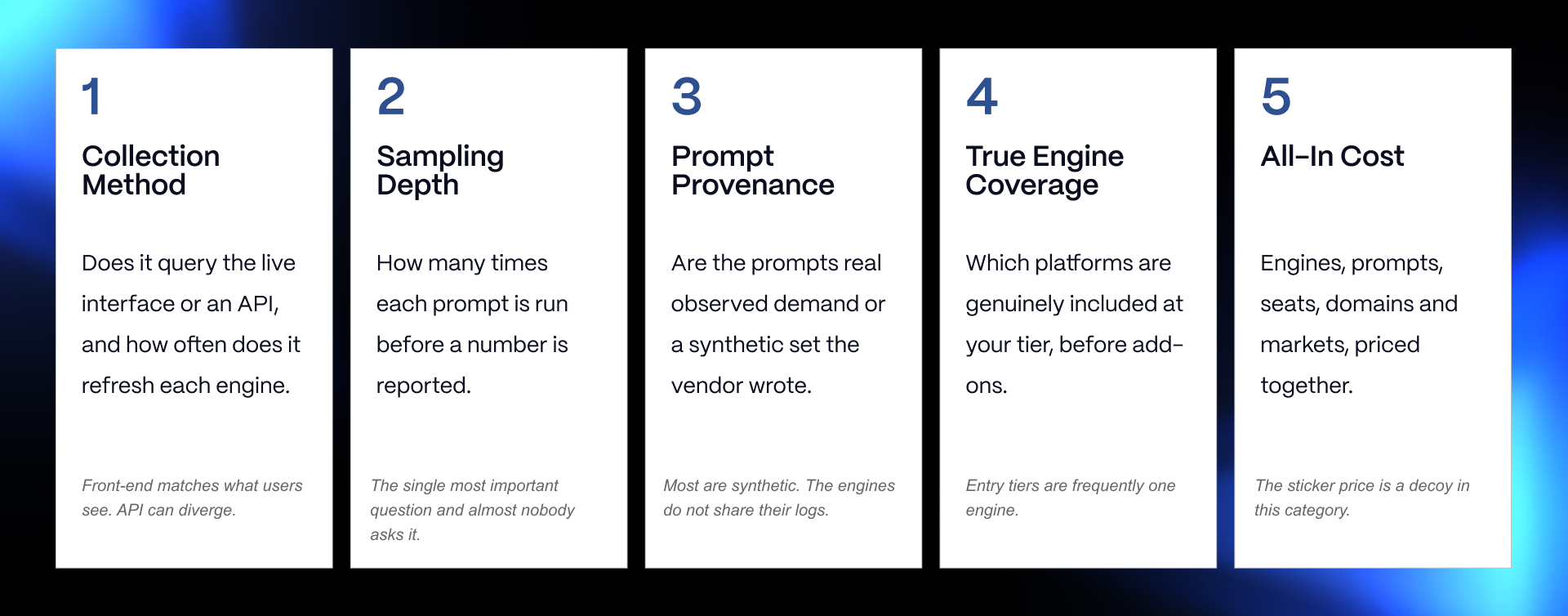
- How is the data collected - live queries, cached responses, or a mix?
- How deep is the sampling - one run per prompt, or dozens?
- Where do the prompts come from - vendor-written lists, or observed demand?
- Which engines are actually included at your price tier, not the marketing page's full list?
- What's the real monthly cost once seats, domains and markets are counted?
How these tools actually generate their numbers
Nobody has the engines' logs
The entire category is defined by the fact that the companies don't publish what exactly users are asking on their AI platforms. This means that OpenAI, Google and Anthropic don't collect or report what users are typing into their AI systems. As such, nearly all "visibility scores" being sold within this industry are created from lists of prompts written by the vendors selling these products and have no relationship to actual demand.
There are some vendors that claim they can provide demand signals (Profound, Evertune, Semrush and Ahrefs are just a few). These are provided by clickstream panels, keyword indexes or proprietary data sources rather than the engines themselves.
While this is a valid methodology, it does not show an understanding of what your buyer was typing into chatbots like ChatGPT last Tuesday.
The same prompt gives different answers
This is the finding that should reset how anyone reads an AI visibility score.
Rand Fishkin of SparkToro and Patrick O'Donnell of Gumshoe.ai ran a study between November and December 2025: 600 volunteers, 12 prompts, 2,961 total runs across ChatGPT, Claude and Google's AI. Each prompt ran 60 to 100 times per platform.
The result: the odds of getting the same recommendation list twice from the same prompt were under 1 in 100. The odds of getting the same list in the same order were closer to 1 in 1,000. Fishkin's own framing is blunt - these are probability engines built to generate a unique answer every time, not a search index returning a stable rank.
One caveat worth stating plainly, since the study earns it: the specific brands that appear were far more stable than their order. The top names in each category - Sony, Bose and Apple for headphones, for example - showed up in the majority of runs regardless of phrasing.
So "does my brand show up at all" is a more answerable question than "what position am I in." A vendor selling you a precise rank number, from a single run per prompt, is selling noise with a decimal point on it.
Evertune's approach - sampling each prompt roughly a hundred times before reporting anything - is the closest thing to a methodological answer to this problem currently on the market. Ask any vendor how many times they actually run each prompt before they hand you a number.
Front end or API, and how often
The mechanics matter more than most pitch decks admit. Some tools query the live chat interface through browser automation, which is closer to what an actual user sees.
Others hit the API, which can return different results than the consumer product. Refresh cadence varies too - daily for a vendor's flagship engine, sometimes closer to monthly for the rest of the list on their site.
The practical instruction: ask per engine, not in general. "We refresh daily" usually means one engine refreshes daily and the other four on the pricing page refresh far less often. A blended answer to that question is the answer of a vendor who doesn't want you to notice which of their numbers are stale.
For a deeper look at how agents actually surface and cite content, see optimising for AI search agents.
The tool landscape
The table
Three notes the reader needs.
One. The Owner column is not filler. It is the column that lets you assess every other article you will read on this topic, including the ones ranking above this one. Nearly all of them are published by a company in this table.
Two. Entry prices in this category are decoys. The real cost is engines, prompts, seats, domains and markets multiplied together. A ninety nine dollar tier that covers one engine and twenty five prompts is not comparable to a ninety five dollar tier covering three engines and fifty.
Three. Several vendors do not publish pricing at all. Where that is the case this table says so rather than estimating. Slate could not be verified as a distinct product in this category during research and has been omitted rather than included on secondhand mention.
Public pricing changes fast in this category, and several vendors don't publish figures at all - Adobe and Peec AI among them, both quoting after a demo call. Where a number below is a range, treat it as directional, not a quote you can hold a sales rep to.
Verify directly before you budget against it.
- Otterly.ai starts around $29/month (Lite), rising to roughly $189 and $489 on its Standard and Premium tiers.
- Profound's Starter plan runs about $99/month, billed annually, and covers ChatGPT only with a 50-prompt cap - its Growth tier moves into the $399–$499 range.
- Peec AI's public figures land near €89 to €199/month depending on source and haven't stayed consistent across independent write-ups this year, which is itself a signal to verify before you commit.
- AthenaHQ's self-serve tier runs near $295/month.
- Semrush and Ahrefs both fold AI visibility into existing suites - Semrush's add-on starts near $99, Ahrefs' Brand Radar full-access tier runs closer to £560/month at the top end.
- Rankscale's entry tier sits around $20 to $99 depending on credits included.
None of this is a recommendation. It's what's published, as of research for this piece, and you should re-check it the week you buy.
What entry tiers actually include
Entry prices in this category are decoys, and that's not a criticism - it's how the pricing is built. Engines, prompts, seats, domains and markets are separate multipliers stacked on top of the sticker price.
A $99 tier that covers one engine and 50 prompts is not a cheaper version of a $399 tier covering five engines and 500 prompts. It's a different product wearing a lower number.
Per-domain pricing is the specific trap for anyone managing more than one brand. A tool priced "per domain" at $99 is a materially different cost structure than one offering true multi-brand access on the same tier - the gap compounds with every additional client or subsidiary you add.
If you're an agency or you run a portfolio, read the fine print on domain limits before you read anything else on the pricing page.
Several vendors publish no pricing at all.
That's not this article failing to do its homework. It's the category's standard sales motion for anything above entry level, and a buyer should expect a demo call, not a checkout button, once they're past the cheapest tier.
What separates the serious ones
From published information alone - not from testing - a few things distinguish the more credible vendors from the dashboards.
Disclosed sampling depth is one: does the vendor say, in writing, how many times it runs each prompt?
Citation source attribution is another - does the tool show which third-party pages are earning the citations that mention your brand, or just a count of mentions with no source trail?
Genuine multi-brand architecture, rather than per-domain billing dressed up as a feature, is a third. Whether the tool tells you what to change, or only tells you that something is wrong, is the difference between a diagnostic and a dashboard.
For related tools in the broader optimisation stack, our LLM optimisation tools guide and AI SEO tools cover the categories this one sits next to.
What your own data already shows
Search Console now reports AI, partially
Google launched dedicated Search Generative AI performance reports inside Search Console on 3 June 2026, covering impressions for AI Overviews, AI Mode and generative features in Discover, broken out by URL, country, device and date. The rollout was staged - UK first - and as of 31 August 2026 Google says it has reached all sites worldwide.
The limitations matter as much as the launch.
The report is interface-only: it isn't exposed through the Search Analytics API or a BigQuery export, so you can't pull it into your usual reporting stack. It shows no clicks, no click-through rate, and no query data - you can see that a page got impressions inside an AI answer, not what anyone asked to get there.
Google has said more metrics are coming, without a date attached to that promise. One mechanical detail worth knowing: Google's own documentation notes that a follow-up question inside AI Mode counts as a new query, with its own impression and position, not a continuation of the first.
So a free, partial baseline exists inside a tool most teams already have open. Most teams haven't gone looking for it.
What AI traffic looks like in practice
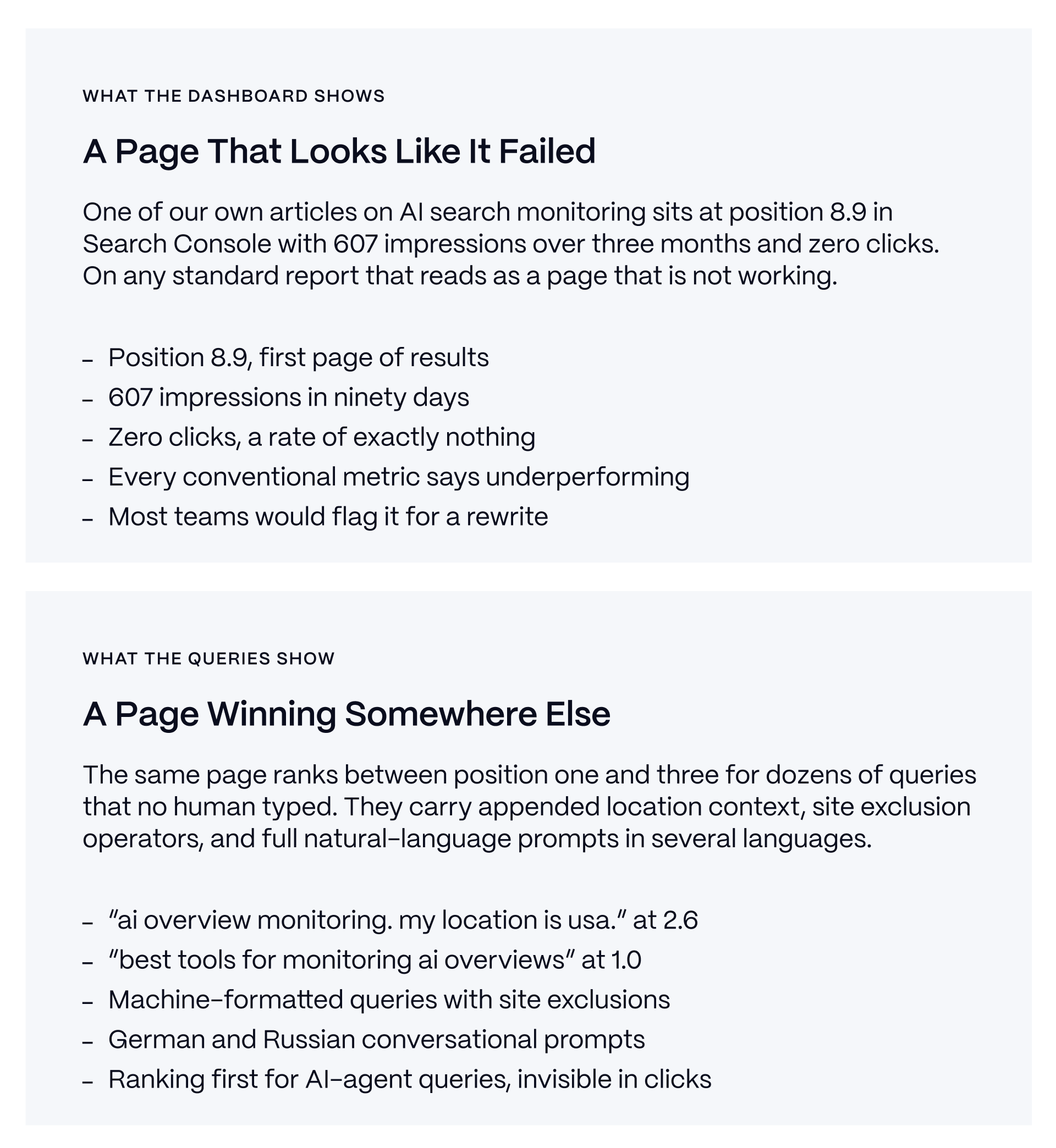
Here's the clearest illustration we have, and it's our own.
One of Veza's articles on AI search monitoring - our guide to AI Overview monitoring tools - sits at an average position of 8.9 in Search Console, with 607 impressions over three months and zero clicks. On a standard performance report, that reads as a page that isn't working.
The same page ranks between position one and three for dozens of queries no human typed: strings with location context appended automatically, site-exclusion operators, and full natural-language prompts in German and Russian.
Those aren't search terms a person entered in a search box. They're queries an assistant generated on a user's behalf, and Google is logging the resulting impression against the page it pulled from.
Independent practitioner analysis backs the pattern. Research from Suganthan Mohanadasan, re-verified in September 2026, found that a majority of impressions in some accounts carry no query string at all, because conversational-style prompts are unusual enough for Google to anonymise them for privacy reasons before they reach standard reporting.
Why this breaks conventional reporting
The conclusion the data supports, and no further than that: AI visibility and click performance have separated as outcomes. A page can rank first for dozens of AI-driven queries and still show up as a failure in every conventional report, because the answer got delivered inside the assistant instead of on the page itself.
That has a direct consequence for how you build dashboards. A reporting line that blends citation activity with click traffic will mislead in both directions at once. It will flag genuinely high-performing pages as broken, because the report only sees the missing clicks.
It will credit ordinary organic traffic to a page that AI visibility had nothing to do with, because the two signals sit in the same column. If your reporting can't separate them, it's telling you a story that isn't true in either direction.
This is the point where most teams need outside eyes on the numbers - that's what our AI search visibility audit does, and it's worth a look if your own reporting has started producing results you don't quite believe.
What to ask before you buy
The vendor questions checklist
- How many times do you run each prompt before reporting a number?
- Are your prompts vendor-written or drawn from observed user demand?
- Do you query the live chat interface, an API, or a cache - and how does that differ per engine?
- What's your actual refresh cadence, broken out by engine, not blended?
- Do you show which third-party pages are earning citations, or just a mention count?
- Is pricing per domain, per brand, or genuinely multi-brand on our tier?
- Which engines are included at the tier we'd actually pay for, not the top of your pricing page?
- Can you export raw data, or are we locked into your dashboard's framing?
- What did version one of your methodology get wrong, and what changed?
- Who else on the market are you willing to name as doing this well?
Questions one and three - sampling depth and prompt provenance - do the most work.
A vendor who answers them clearly, in writing, without redirecting to a sales call, is treating the non-determinism problem as real.
A vendor who can't or won't is selling a single roll of the dice with a decimal point attached to it.
Which metrics mean something
Some numbers in this category are worth watching. Per-engine appearance rate, reported separately rather than blended into one score, tells you where you're actually strong or weak.
Share of voice against named competitors is meaningful if the competitor set is one you chose, not one the vendor assumed.
Citation source attribution - which third-party pages are earning the mentions - tells you what to go fix. Sentiment and accuracy of the mention matters more than raw frequency. Prompt coverage tied to real commercial intent, not generic category terms, is worth paying for.
On the other hand, some numbers aren't.
A single blended visibility score with no stated methodology behind it is closer to a mood ring than a metric. Mention counts from an unrepeated prompt run are, per the SparkToro data above, close to random. Estimated reach presented as a measured fact is a claim no vendor in this category can currently back with engine-side data, because none of them have the logs.
The free baseline most teams skip
Before spending anything, a team can combine Search Console's generative AI reports with manually asking the major assistants the ten or so questions their actual buyers ask. That's not a monitoring system, and this article isn't going to pretend it is. But it's enough to answer one real question: does a problem exist here at all.
The truth: Some teams that run this baseline will find out they don't have a visibility problem worth a $300-a-month tool yet. An article that never admits that possibility is selling something, whether or not it says so.
Establishing that baseline honestly, and reading it without either panic or denial, is exactly the kind of work answer engine optimisation covers - not because we need you to hire us, but because most teams get the interpretation wrong on the first pass, not the data collection.
Choosing
What the category gets wrong
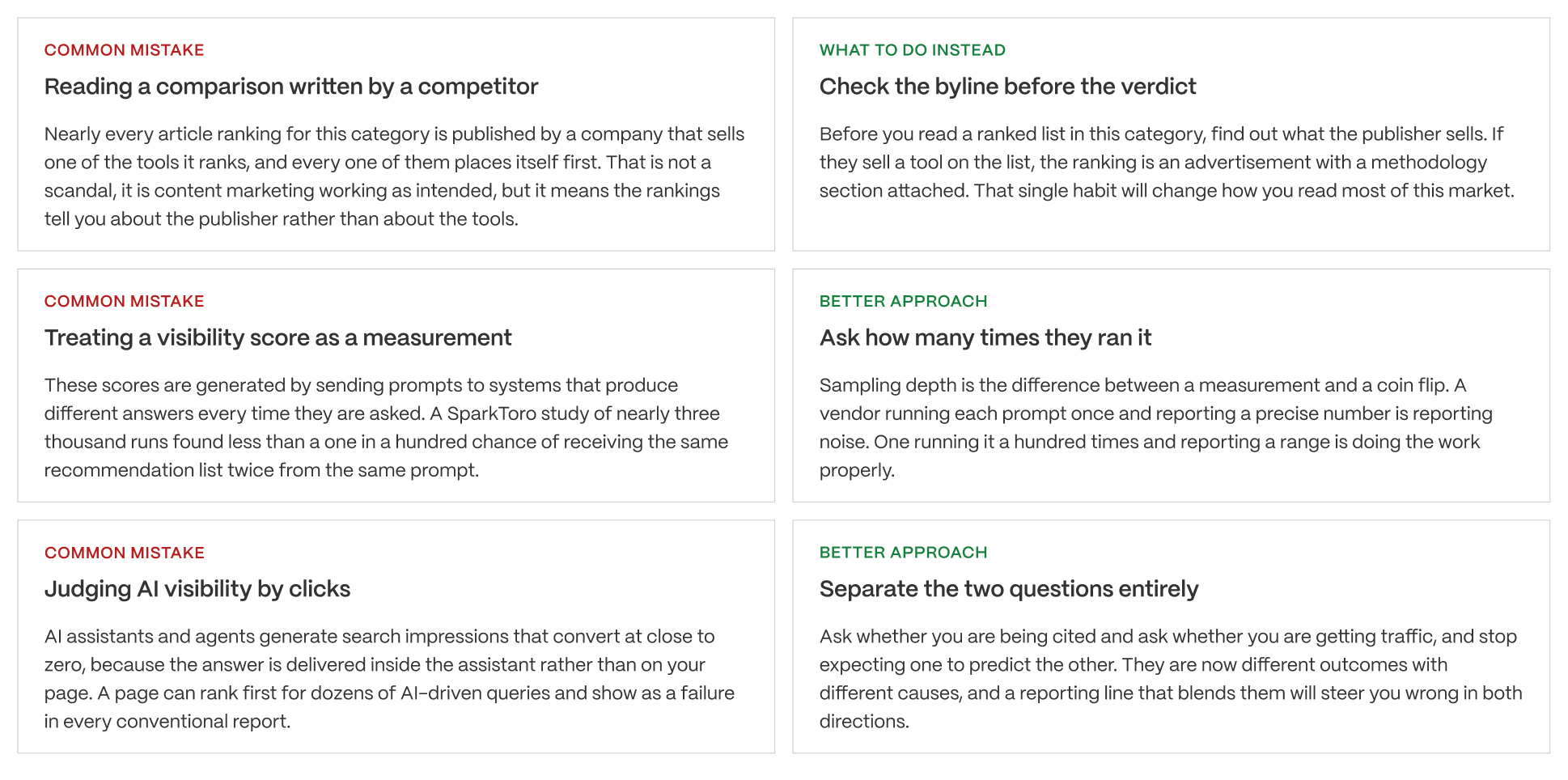
Three habits show up across nearly every article and every pitch deck in this space.
The first is reading a comparison written by a competitor and mistaking it for an evaluation - true of most of the articles ranking above this one for the term that brought you here.
The second is treating a visibility score as a measurement, when the SparkToro data says most of those scores are closer to a single noisy sample.
The third is judging AI visibility by clicks, which the Search Console data above shows is often the wrong lens entirely.
Decision by buyer type
Use this as a starting point, not a binding answer. We have not run these tools on client work and this is not a hands-on review. It is the shortlist logic a buyer can apply from published information plus the questions in the checklist above.
BUYER TYPE 1: SINGLE BRAND, FIRST TIME BUYING
- Profile: one domain, wants to know whether the brand appears at all, no existing baseline
- What matters: cost of finding out, breadth of engines, not being locked in
- Where to start: the low entry tiers, Otterly or ZipTie territory, at under a hundred a month
- Why: the first purchase is diagnostic rather than operational. You are establishing whether there is a problem worth solving, and paying enterprise rates to answer that question is premature.
The verdict: buy the cheapest credible answer first, then buy properly once you know what you are looking at.
BUYER TYPE 2: AGENCY OR MULTI-BRAND PORTFOLIO
- Profile: several client brands, needs reporting, cannot pay per domain
- What matters: multi-client architecture, per-domain economics, white-label or client-facing reporting
- Where to start: tools with genuine agency plans rather than per-domain pricing
- Why: per-domain pricing is the trap in this category. A tool at ninety nine dollars per domain is a different product economically from one with multi-brand access on every tier, and the difference compounds with every client you add.
The verdict: the pricing model matters more than the feature list once you pass about five brands.
BUYER TYPE 3: ENTERPRISE WITH A PROCUREMENT PROCESS
- Profile: security review, compliance requirements, existing marketing stack
- What matters: certifications on the AI product specifically, data handling, integration with what you already run
- Where to start: the enterprise tier of a platform you already own, before evaluating point solutions
- Why: if you already run Semrush, Ahrefs or Adobe, the incremental cost and the procurement friction of their AI module are both lower than onboarding a new vendor. That is not an argument that it is the better tool. It is an argument that it is the faster answer.
The verdict: start with the incumbent, then justify the point solution against it rather than in isolation.
BUYER TYPE 4: THE TEAM THAT NEEDS TO ACT, NOT JUST WATCH
- Profile: has already established there is a visibility gap and needs to close it
- What matters: citation source attribution, content workflow, whether the tool tells you what to change
- Where to start: tools that combine monitoring with content work rather than pure dashboards
- Why: a monitoring tool tells you that you are absent from an answer. It does not tell you which third-party page earned the citation instead, and that is the actionable fact. Pure dashboards produce reports that nobody can act on.
The verdict: monitoring without attribution is a subscription to bad news.
CROSS-TYPE: THE HONEST BASELINE
- Profile: everyone, before spending anything
- What matters: knowing what you can see for free
- Where to start: Google Search Console's generative AI reports, launched June 2026, plus manual prompting of the major assistants
- Why: Search Console now reports AI Overviews and AI Mode impressions in the interface, though not through the API or with the queries attached. Combined with manually asking the assistants the ten questions your buyers ask, that is a free baseline. It is not a monitoring system, but it will tell you whether you have a problem.
The verdict: establish the baseline before buying the dashboard. Some teams discover they do not need one yet.
PRINCIPLE
We have not tested these tools and this article does not pretend to have. What we can tell you is how the category measures things, what the measurements are worth, and which questions expose the difference between a serious vendor and a dashboard. In a market where nearly every published comparison is written by a competitor, an evaluation framework from someone selling nothing may be more useful than another ranked list.
Single brand, first tool
Start with the free baseline. If it shows a real gap, an entry tier from a vendor that answers the sampling and provenance questions is enough to start. Don't buy enterprise depth you don't have a team to use.
Agency or multi-brand portfolio
Per-domain pricing is the number that decides this for you, not the feature list. Confirm genuine multi-brand access before anything else, and check whether client-facing reporting exists at your tier.
Enterprise with a procurement process
You're buying a vendor relationship as much as a dashboard. Weight methodology transparency and export access over engine count - the marketing page's "9+ engines" claim usually collapses to two or three that update daily once you check.
The team that needs to act, not just watch. A tool that tells you a citation gap exists without telling you what content would close it is half a product. Prioritise the ones with a stated path from finding to fix - our AEO audit and AI optimisation work exist for exactly this gap, whether or not a dashboard sits underneath it.
Everyone, regardless of size. Run the free baseline first. It costs nothing but an afternoon, and it's the only step every team on this list skips.
What we would do
Establish the free baseline first - Search Console's generative AI reports plus manual prompting. If it shows a genuine gap, shortlist on sampling depth and citation attribution, not engine count.
Ask the ten questions above and read the silences as answers.
Buy the smallest credible tier and expand once you know what you're actually looking at, not before. The principle underneath all of it: in a market where nearly every published comparison is written by a competitor, an evaluation framework from someone selling nothing in the category may be worth more than one more ranked list.
We analyze the dashboards you already have
The hard part of AI visibility isn't buying a tool. It's knowing what the numbers mean when a page ranks first in an AI answer and shows zero clicks in your reporting - and knowing which of those numbers should actually change what you spend next quarter.
We work with B2B SaaS teams on that layer: establishing a baseline, reading it honestly, and building the content that earns citations rather than the dashboard that counts them. If your AI visibility reporting is telling you something you don't quite believe, that's the conversation worth having.
FAQs
What is the best AI visibility tool?
There is no honest single answer, and be direct about why. These tools differ most on sampling depth, prompt provenance and engine coverage, and the right one depends on whether you manage one brand or twenty. Be aware that most published rankings for this question are written by companies that sell one of the tools they rank.
How much do AI visibility tools cost?
Entry tiers run from roughly twenty nine to ninety nine dollars a month, but that figure is a decoy. Engines, prompts, seats, domains and markets are separate multipliers, and per-domain pricing becomes punishing above a handful of brands. Several vendors publish no pricing at all and quote after a demo.
Are AI visibility scores accurate?
They are less precise than they appear. A SparkToro study across nearly three thousand runs found the same prompt returns the same recommendation list less than one time in a hundred. A tool running each prompt once and reporting a precise score is reporting noise. Ask any vendor how many times they run each prompt.
How do these tools know what people ask AI?
Mostly they do not. The AI platforms do not publish their query logs, so most prompt sets are written by the vendor rather than observed. Vendors claiming real demand data derive it from clickstream, panels or keyword indexes. That is a legitimate approach and it is not the same as knowing what users asked.
Can I track AI visibility for free?
Partially. Google Search Console launched generative AI performance reports in June 2026 covering AI Overviews and AI Mode impressions, though the data is interface-only and does not include the queries. Combined with manually prompting the major assistants, that gives you a baseline good enough to establish whether you have a problem.
Why does my page rank in AI search but get no clicks?
Because the answer is delivered inside the assistant rather than on your page. We see this on our own site: an article sitting at position 8.9 with hundreds of impressions and zero clicks, while ranking first for dozens of agent-generated queries. AI visibility and click performance are now separate outcomes.
Do I need a dedicated tool or can I use Semrush or Ahrefs?
If you already run one of them, start there. Semrush and Ahrefs both ship AI visibility modules, and the incremental cost plus procurement friction are lower than onboarding a new vendor. That is not an argument they are better. It is an argument they are the faster answer to justify a point solution against.
What should an agency look for specifically?
Pricing model before feature list. Per-domain pricing is the trap: a tool at ninety nine dollars per domain is economically a different product from one with multi-brand access on every tier, and the gap compounds with each client. Also check whether client-facing or white-label reporting exists at your tier.
Which AI engines should I track?
Start with the ones your buyers use rather than the longest list. Most tools cover ChatGPT, Google AI Overviews and AI Mode, and Perplexity at entry level, with Claude, Gemini, Copilot and Grok as paid additions. Confirm which are genuinely included at your tier, because entry tiers are sometimes a single engine.
Has Veza tested these tools?
No, and the article says so. This is a buyer's evaluation framework built from vendor documentation, independent research and our own Search Console data, not a hands-on review. We sell AEO services and no tool in this category, which is why we can rank them by evaluation criteria rather than by commercial interest.