TL;DR
Most rebranding examples relate to consumer brands, such as Airbnb, Dunkin', or Old Spice. But in the B2B sector, the rebranding process works differently. Purchasing decisions are not made by an individual reacting to how a logo looks, but rather by an entire team that thoroughly evaluates your website, product, and contracts. This article includes ten examples of B2B rebranding, categorized by the nature of the changes implemented. Three companies changed their names because they outgrew the scope of their original products: in 2024, Zoom dropped the word "Video" from its name; in 2025, Grammarly became Superhuman (while retaining "Grammarly" as the product name); and in 2021, Square changed its name to Block. Two companies refreshed their identities or shifted their positioning without losing the value they had already built. Specifically, Slack’s logo change in 2019, and the brand refresh of Semrush in 2020, followed by its pivot toward artificial intelligence in 2026. Four examples illustrate what happens to a brand following an acquisition, ranging from the transition of Clearbit into HubSpot’s "Breeze Intelligence" brand, to the complete phasing out of the Drift brand by Salesloft. One example, the 2020 icon redesign for the Google Workspace suite, was unsuccessful. Since no public data regarding the impact of these changes is available, we evaluated each case based on what was altered, what was retained, and how the change was communicated. Each example concludes with advice on what to look for on a company’s website; in the B2B sector, this is precisely where customers verify whether a brand’s new narrative is truly grounded in reality.
What Counts As A Rebrand In B2B
Five Kinds Of B2B Rebrand, From Brand Refresh To Absorption
There are five types of changes that fall under "rebranding". However, they are not interchangeable, and each has its own purpose.
- "Refreshing" the brand (brand refresh) changes the appearance of the brand itself and its visual identity.
- Repositioning changes the way the company defines its identity and presents itself.
- Changing the name of the company is not so common and implies changing its legal name.
- A parent-brand rename results in the new name being used for many different products.
- Absorption in rebranding means retiring an acquired brand into the buyer's.
Why is it important for the B2B sector to know these differences? Because each type of the mentioned changes requires a different approach, budget, as well as a different scope of work on the website. "Refreshing" can start on the homepage and gradually spread to other pages. In absorption, the company should answer the question customers are most likely to ask: What happened to the product we bought? Teams still working out what they stand for will find more help in our guides to differentiating a B2B brand and building a B2B SaaS brand, which cover building a brand and not changing one.
How These Ten Rebranding Examples Were Chosen
When we created this list, we used three criteria. All examples relate to business between B2B companies, all dates are taken from official announcements and documents of the companies themselves, and all can be checked today.
If a company did not meet any of these three conditions, we excluded it from the list. This way we eliminated most of the consumer-oriented brands that normally dominate this type of lists.
None of these companies have published how the rebranding has worked for them, so none of the examples on the list claim to have achieved a specific result. Also, keep in mind that the public reaction is one thing, and the outcome of the rebranding is another.
For example, when Slack changed its logo, it brought immediate negative reaction; Google Workspace icons also faced criticism. However, negative reactions, as well as positive ones, don’t show whether the rebranding was successful. For this reason, the examples in the list show the basic information - what was changed, what was kept, and how it was all communicated.
Renames That Changed The Brand Story
Zoom Becomes Zoom Communications (2024)
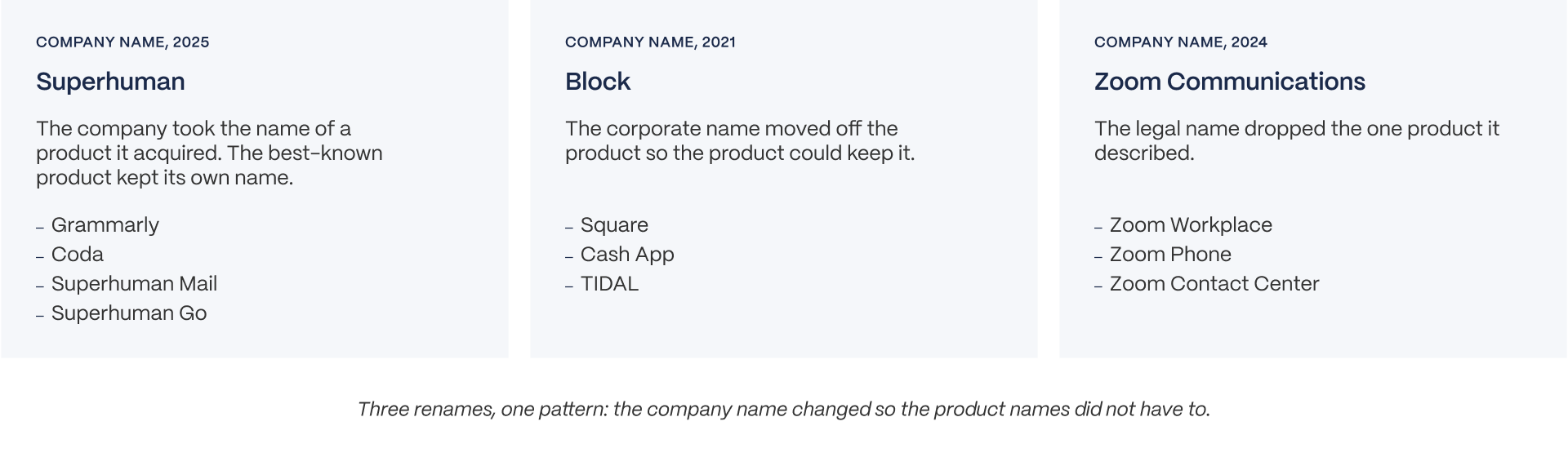
On 25 November 2024, Zoom changed its legal name from Zoom Video Communications, Inc. to Zoom Communications, Inc. The company described itself as an AI-first work platform for human connection and called the move Zoom 2.0. The reasoning is visible in the portfolio: by then Zoom sold phone, contact center, and docs products, and had acquired Workvivo, so "Video" described only part of what it sold.
The Zoom name and the product brands stayed. Not everyone agreed with the logic, since Creative Bloq questioned the decision to trade the company's best-known feature for an AI-era label. The lesson is that a legal rename is cheap, while changing what buyers believe the product is takes the website, the product naming, and the sales story moving together. On the website: open Zoom's homepage and see whether it leads with meetings or with the AI platform.
Grammarly Becomes Superhuman (2025)
On 29 October 2025, Grammarly renamed the company Superhuman. The new parent brought together Grammarly, Coda, Superhuman Mail, and a new product called Superhuman Go. The Grammarly product kept its name, and existing customers kept their plans. Acquisitions had turned one product into a suite, so a company name tied to a single product no longer fit.
The market supplied the lesson. Headlines read the news as Grammarly disappearing, and Vice published a piece explaining that only the company name had changed. When a parent changes and the product does not, the first sentence of the announcement, the website, and the product should all say what is not changing. That protects existing customers from having to work it out themselves. On the website: compare how grammarly.com and superhuman.com divide the story today.
Square Becomes Block (2021)
Block announced the change on 1 December 2021, with the legal change following on or about 10 December. The corporate name moved to Block, so the Square brand could belong to the seller business it was built for. Cash App and TIDAL kept their own brands, and the company made no organizational changes.
The move belongs on a B2B list because Square sells to businesses. It separated the corporate story, aimed at investors and recruits, from the product brand, aimed at buyers. The pattern generalizes: if a company's name is also its flagship product's name, the day it launches a second product is the day the name starts to cost something. On the website: check whether the corporate site and the seller site still live on separate domains.
A New Look That Kept The Brand Identity
Slack's New Logo (2019)
On 16 January 2019, Slack introduced a new logo designed with Michael Bierut at Pentagram. The old mark used 11 colors at an 18-degree tilt, and Slack said it was easy to get wrong. The new one used four colors and held up at every size. Reaction was loud and immediate, but reaction and result are separate things, and no published data shows what the change returned.
The useful detail for B2B teams is the order of the rollout. Slack's announcement listed the website first among the places the new identity would appear, followed by advertising and then the product. That sequence points to the lesson: a refresh should fix a system problem, meaning consistency across every surface, and not a taste problem. The name and the hash-sign idea stayed. On the website: look at how the new color palette is applied across Slack's marketing pages.
Semrush, Twice (2020 And 2026)
Semrush rebranded twice in six years, and the two changes did different jobs. In December 2020, it launched a new logo that kept and modernized the fireball mark, added a custom font and a new palette, and standardized the name from SEMrush to Semrush. The redesign started on the homepage and then spread to every page and product.
On 12 March 2026, Semrush announced a new brand identity positioning it as an intelligence platform for visibility in AI search, rolling out across its digital properties from March 2026. That shift concerns what the company says it is, and it extends to how teams track visibility in AI search.
The first rebrand fixed how Semrush looked, and only the second changed the story that every page had to tell. The name stayed through both. On the website: check how the homepage describes the product today and whether the product pages follow.
When An Acquired Brand Is Retired
In martech, four well-known brands disappeared into an acquirer's name between 2024 and 2026, and each left customers, contracts, and search demand behind. Acquisitions get a generic line about merging brands on most rebranding lists. In B2B the details matter more, because customers have contracts that name the old product.
Clearbit Becomes Breeze Intelligence
Clearbit, a data brand, became Breeze Intelligence inside HubSpot's Breeze AI, and standalone Clearbit was sunset on 30 April 2025. When an acquirer renames a product, existing customers need a migration path and a page that answers "what happened to Clearbit", because that is the question they will search for.
Our guide to lead generation tools covers what Clearbit became. On the website: see where clearbit.com redirects today.
Drift Folds Into Salesloft
Drift helped define conversational marketing. Salesloft and Clari announced its sunset on 6 March 2026, according to our lead generation research. Retiring a category-defining name gives up the search demand that name built, so the decision about what the old domain does should be made before the sunset date and not after.
Our lead generation tools guide covers the details. On the website: check where drift.com sends visitors.
Terminus Merges Into DemandScience
Terminus merged into DemandScience on 12 November 2024. Several sources say Terminus was acquired by GTM Partners, which is wrong: Terminus Capital Partners is an unrelated firm, and the similar names cause the mix-up. A merger rebrand lands on customers mid-contract, so renewal paperwork and the website need the same explanation. Our guide to ABM platforms covers the category. On the website: check whether the Terminus product name survives.
RollWorks Becomes AdRoll ABM
RollWorks, a NextRoll brand, became AdRoll ABM in August 2025, folding a product brand into its parent's name. Sub-brands are cheap to launch and expensive to retire, so the decision about whether a new product earns its own name deserves care at the start.
The ABM platforms guide covers where the product sits now. On the website: check where rollworks.com redirects.
A Rebrand That Missed
Google Workspace's Icons (2020)
In October 2020, G Suite became Google Workspace, and every app icon moved to the same four Google colors. TechCrunch called the result a whiff, a Salesforce UX lead described it as consistency over clarity, and an unofficial browser extension appeared to bring the old icons back. Those are reactions, but the underlying problem was practical. In a row of browser tabs at small sizes, the new icons were hard to tell apart.
The lesson is to test a brand mark where customers see it, at favicon and tab size, and not only on a brand board. It is the B2B counterpart to the consumer misses that fill other lists. On the website: open Google Workspace's product pages and check how the current icons read at small sizes.
Key Lessons From These Rebranding Examples
The Website Carries The Rebrand
The same pattern shows up across the examples. Slack and Semrush both started their rollouts on the website. Superhuman's confusion came from the company, product, and website layers not being explained together. Acquired brands lose search demand at the website level first. In B2B, the buying committee checks whether the new story is true on the homepage, the About page, and the pricing page, which is why our guides to SaaS homepage design and About page examples apply here.
When a rebrand needs a rebuilt site, our website redesign process covers the sequence. If you want the identity and the site to launch on the same day, our visual identity and branding service is built for that.
Protecting Brand Equity: A Pre-Rebrand Checklist
BEFORE YOU REBRAND
Every rebrand on this list could still be checked on a website. Plan for that first.
DECIDE THE KIND
- Refresh, repositioning, rename, parent-brand rename or absorption
- Each needs a different budget and a different announcement
KEEP WHAT CARRIES THE EQUITY
- List what buyers recognise: name, mark, colour, product names
- Keep at least one. Semrush kept its fireball in 2020
SAY WHAT IS NOT CHANGING
- First sentence of the announcement, the homepage and the product
- The Grammarly to Superhuman headlines show why
TEST AT REAL SIZES
- Favicon, browser tab, app icon, email signature, invoice
- Google Workspace's 2020 icons show why
START WITH THE WEBSITE
- Homepage, About, pricing and docs, then sales decks and product
- Slack and Semrush both led with the site
PLAN FOR THE OLD NAME
- Redirects, a page explaining the change, updated review profiles
- Acquired brands lose this first
MEASURE
- Branded search for the old and the new name
- Questions about the change in sales calls
PRINCIPLE
In B2B, a rebrand is finished when the website, the product and the sales conversation tell the same story. The logo is the first step, not the last.
A pre-rebrand checklist starts with the kind of change, because a refresh, a repositioning, a rename, a parent-brand rename, and an absorption each need a different budget and announcement. Next comes the brand equity worth keeping. List what buyers recognize, whether name, mark, color, or product names, and keep at least one. Semrush kept its fireball in 2020.
Say what is not changing in the first sentence of the announcement, the homepage, and the product, as the Grammarly to Superhuman headlines show. Test the new mark at real sizes: favicon, browser tab, app icon, email signature, and invoice. Google Workspace's 2020 icons show why. Start with the website, then sales decks and the product, since Slack and Semrush both led with the site.
Plan for the old name as well. That means redirects, a page explaining the change, and updated review profiles, and acquired brands lose this first. Our guide to the SEO risks of a migration covers the search side.
Finally, measure branded search for the old and the new name, and track questions about the change in sales calls. In B2B, a rebrand is finished when the website, the product, and the sales conversation tell the same story.
Closing
A rebrand is finished when the website tells the new story. Every rebrand on this list reached buyers through a website before it reached them anywhere else.
If you are planning a rename, a refresh, or the retirement of an acquired brand, we design the identity and rebuild the site so the two launch on the same day, and nobody has to explain the gap between them.
Work With Veza - See Our Case Studies
FAQs
What are some good examples of B2B rebranding?
Zoom dropping "Video" from its name in 2024, Grammarly renaming the company Superhuman in 2025, Square becoming Block in 2021, Slack's 2019 logo refresh, and Semrush's 2020 refresh and 2026 repositioning. Each changed something different: a legal name, a parent brand, a visual system or what the company says it is.
What is considered a rebrand?
Any change to a company's name, visual identity or positioning that changes how buyers recognise or understand it. In B2B it also covers what happens when an acquired company's brand is retired into the buyer's, which happened to four well-known martech brands between 2024 and 2026.
What is the difference between a rebrand and a brand refresh?
A brand refresh updates how a company looks, its logo, colours and type, while keeping its name and positioning. A rebrand changes the name, the positioning, or both. Slack's 2019 logo was a refresh. Zoom's 2024 name change and Semrush's 2026 move toward AI visibility were rebrands.
What are notable B2B rebrands in 2026?
Semrush launched a new brand identity in March 2026, positioning itself as an intelligence platform for AI search visibility. Salesloft sunset the Drift brand on 6 March 2026. Both show patterns that keep recurring in B2B: repositioning for AI, and retiring acquired brands.
Should a B2B company change its name or just its logo?
Change the name only when it blocks the story: when it describes one product the company has outgrown, as with Zoom's "Video", or when it is also the flagship product's name, as with Square. If the name still fits and the visuals do not, a refresh is cheaper and keeps the equity.
What happens to a brand after an acquisition?
It is kept, endorsed or absorbed. Recent martech cases were absorbed: Clearbit became HubSpot's Breeze Intelligence, Drift was sunset into Salesloft, Terminus merged into DemandScience and RollWorks became AdRoll ABM. Customers, contracts and the old name's search demand all need a plan.
How does a rebrand affect SEO?
A visual refresh rarely does. A rename or a domain change can lose the search demand built on the old name unless redirects, an explanation page and updated profiles are in place before launch. Link the rebrand and migration guide once live for the technical steps.
How do you announce a rebrand to customers?
Lead with what is not changing, then explain why the change happened, and update the website, the product and the sales materials on the same day. The Grammarly to Superhuman headlines show what happens when customers have to work out for themselves that their product still exists.