TL;DR
The B2B market has ups and downs, but at any moment, roughly 95% of the market isn't buying. Professor John Dawes of the Ehrenberg-Bass Institute described this for LinkedIn's B2B Institute in 2021, and it changes what a B2B demand generation strategy is for. Demand generation makes buyers remember you before they need you. Demand capture converts a few of them who are buying now. In practice, many B2B SaaS teams fund the second - demand capture- and call it the first. The stakes are high: 6sense's 2025 buyer research, a large vendor study, found the winning vendor was on the Day One shortlist 95% of the time, and 94% of buying groups ranked that shortlist before speaking to a seller. Buyers now build shortlists in AI chatbots and review sites, then verify on your website, where Gartner found 69 percent of B2B buyers see the site contradict the sales team. This guide covers how to create demand, how to capture it without leaking it, how to measure both, and a 90-day plan to start.
What B2B Demand Generation Actually Is
Most Of Your Market Is Not Buying
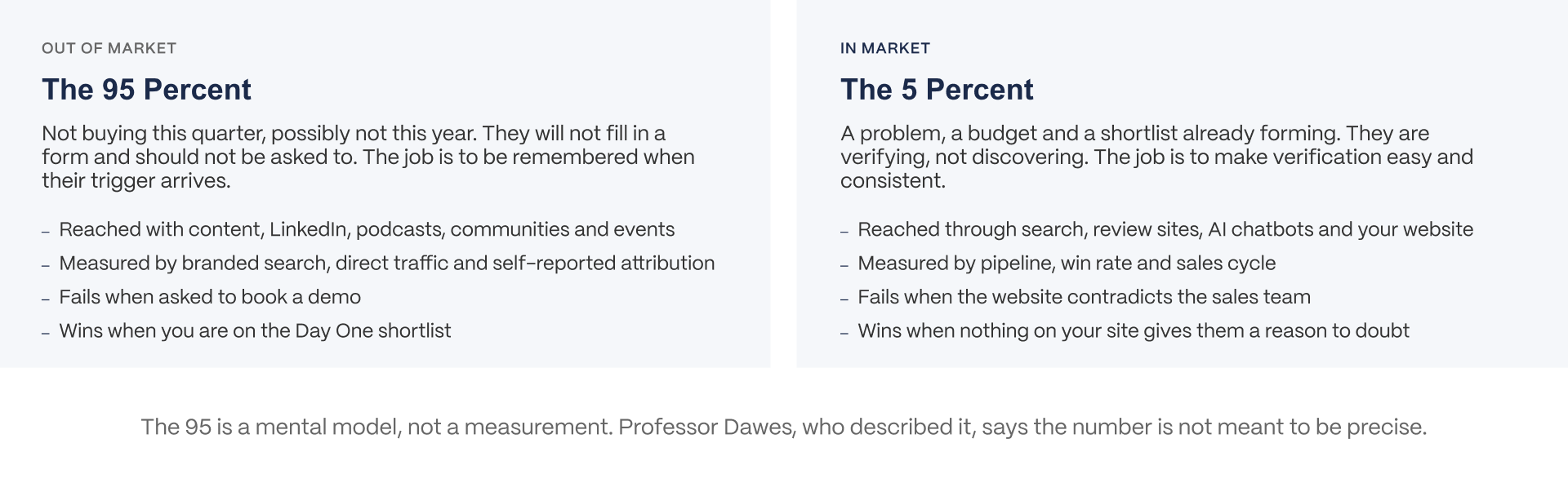
Dawes and the 95:5 rule provide a basis for determining a demand generation strategy. According to Dawes, a five-year cycle of purchasing will mean that there are approximately 20% of buyers in a given year, and 5% in a particular quarter. Dawes notes, however, that the number 95 is not intended as an exact measure. The result is that a major part of marketing's role is memory rather than persuasion since marketing cannot force buyers into the marketplace. They will come themselves if they have a requirement.
Therefore, sending a 'buy now' type of message to someone who is currently not planning to make a purchase is wasteful. On the other hand, determining success based on form fill rates during the first month of a program can be used to check whether or not you should cancel it.
Demand Generation vs Lead Generation
Lead generation creates future buyers who remember your brand, while demand capture converts those already in the market. Lead gen collects contact details from people willing to trade them. Gated content and paid ads are often used in both models. Credit FullFunnel is used for separating these three clearly.
Many teams run lead gen (gated content, MQL targets) and label it as demand gen, but a key metric is what each team is judged on. As per Cognism, the company ran both models side by side for nine months before switching over. Today, Cognism’s head of demand generation runs 90 percent demand gen and 10 percent lead gen. Our guide to lead generation tools covers the capture side in more detail.
The Shortlist Forms Before You Hear About It
The evidence for why creation matters comes from vendor research, so the source belongs next to the figures.
6Sense’s 2025 Buyers Experience Report indicated 95% of all buyers were able to include at least one vendor on the Day One Short List. Before the 2025 report, vendors were able to do so 85% of the time. Additionally, 94% of buying groups had already ranked their short list before contacting a vendor for the first time. Finally, First Contact now occurs during the buying process 61%, down from 69% prior year.
Demand Generation Campaigns For The 95 Percent
Your Target Audience Is A Buying Group
As per 6sense, the B2B SaaS buyer group is not a single persona but is made up of 10+ individuals involved in purchases that are around $250k each. The much broader view by Forrester, based on their research, The State of Business Buying, 2026, identifies an average of 13 internal stakeholders and 9 external influencers to be involved in a typical purchase.
However, when generative AI features are included in the purchase, the number of stakeholders doubles. The typical flow is:
- Define your ICP using firmographic criteria.
- Identify the roles at play within each of those target accounts.
- Place your intent data correctly: it will tell you who is actively engaged in purchasing right now, so use it as a capture tool (to determine if there is a need), not as a creation tool (to create demand).
Account targeting platforms are covered in our guide to ABM platforms.
Content Marketing And Channels That Reach People Who Are Not Looking
A list of channels is less helpful in determining what channels to use than are three key metrics (reach, duration, and specificity) to evaluate any channel that you want to reach your target audience of 95%. First, the channel needs to have broad reach. As Binet and Field noted earlier, when trying to build brands, it is far better to target as many people as possible. Second, the channel should run for an extended period so that people remember it. One-time bursts of advertising will quickly fade. Third, the channel needs to provide messages that can't be easily swapped out by a competitor.
Content planning is a subject of its own, and our content strategy services page describes how we approach it.
How To Split The Budget
Binet & Field’s B2B analysis published by the B2B Institute in 2019 using IPA effectiveness data states that the most effective split is near 46% brand building and 54% brand activation. But there are two big caveats here.
One, the best mix will vary based on category, price Point, and brand size. Two, the B2B Institute is sponsored by LinkedIn who just so happens to sell brand advertising. This is a good place to start, but an actual test is better than trying to reach a magic number.
If most of your budget has been set up to be judged off of form fills this quarter, then it is activation, regardless of what you call it. Do not try to solve this problem with an overnight flip of the ratio. Solve it by judging each job individually based on how you measure that job, which the measurement section below sets out.
Capturing Demand Without Leaking It
The Buyer Arrives Already Decided
An in-market buyer has done most of the work before your sales team hears about them. 6sense found requirements were already defined before buyers spoke to sales 83 percent of the time. Gartner's survey of 632 buyers, conducted from August to September 2024 and published in June 2025, found 61 percent prefer a rep-free buying experience and 73 percent avoid suppliers who send irrelevant outreach. Gartner also found buyers still want sellers for fit questions, so the preference is for relevance and not for silence.
The result is that the website does the selling the rep is not invited to do. The sales cycle, which puts at 10.1 months on average, down from 11.3, is mostly spent in places a vendor cannot see. What the buyer finds on the site during those months shapes the shortlist.
The Pages That Do The Capturing
An in-market buyer checks a predictable set of pages, and each one has a job. The pricing page comes first, since a missing price reads as a high price. Case studies need to come from companies like the buyer's own. The demo path should book a demo and not lead to a qualification call. Comparison and alternatives pages answer the questions buyers ask search engines and chatbots, and integrations and security pages answer the questions a reviewer raises before procurement.
Our guides cover how strong examples handle each: SaaS pricing pages, case study pages, demo pages, B2B landing pages, and trust center pages. The about page deserves attention too, because it is where buyers judge whether a vendor is a safe choice. These pages only capture demand when their facts agree with what sales says, which is the problem in the next subsection.
When Your Website Contradicts Your Sales Team
Gartner's survey found that 69 percent of B2B buyers report inconsistencies between what the website says and what sellers say. The cause is usually organizational, not technical. Marketing updates the site, sales updates the deck, and nobody owns both, so pricing, customer counts, and integration lists drift apart over time.
A buyer who spots the gap does not assume a typo. They assume the vendor is careless or evasive, and a shortlist spot you paid to earn goes to a competitor whose story holds together. The fix is one source of truth for the facts both teams use and a named owner for keeping it current, which is the subject of our piece on website governance.
When the drift has gone too far to patch, a structured website redesign process is the next step. If the pages where demand leaks are on your list, our web design services page explains how we handle them.
The AI Shortlist
Buyers Ask A Chatbot Before They Ask You

Forrester's The State of Business Buying, 2026, drawing on a Buyers' Journey Survey of nearly 18,000 buyers, found that generative AI tools were the single most cited meaningful interaction type for researching purchases, and that 94 percent of buyers use AI somewhere in the process. Buyers then validate what the tools tell them with peers, experts, and providers, so AI starts the research and does not finish it.
G2's 2025 Buyer Behavior Report points the same way. Surveying 1,169 decision-makers in April 2025, G2 found AI chatbots and review sites were the top two sources shaping shortlists, at 17 and 15 percent, and that 29 percent of buyers start with LLMs more often than with Google.
G2 sells review traffic and uses generative AI to design and analyze its own survey, so treat its figures as vendor research. Across both sources, the direction is consistent: research starts in AI, and verification ends on your site.
What Makes You Show Up In The Answer
The inputs are practical and not mysterious. Keep facts consistent across your site, your review profiles, and third-party mentions, so an AI system finds the same story everywhere. Publish comparison pages that answer the questions buyers put to chatbots. Say who you serve and what you replace. And maintain a presence on the review sites chatbots draw from.
No team can promise a citation outcome, because the platforms decide independently, and anyone who promises one is overstating what is possible.
For a wider view of the monitoring options, see our guide to AI brand visibility tools and our answer engine optimization explainer. If you want help with the work itself, our answer engine optimization service covers it.
Tracking What AI Sends You
Create a separate AI channel group in GA4, placed above Referral so that visits from chatbots are visible instead of being absorbed into generic referral traffic. The channel will undercount, because a large share of AI-originated visits arrive without a referrer and land in direct traffic. Treat the figure as a floor and not a total.
Our guide to tracking AI referral traffic covers the measured share of visits that arrive without a referrer, and our roundup of AI Overview monitoring tools covers visibility tracking, which is a separate measurement from traffic.
Demand Generation Metrics That Mean Something
Measuring Memory, Not Just Clicks
The 95 percent cannot be measured by pipeline this quarter, so measure memory instead. Four signals work together: branded search volume over time, direct traffic, share of search against competitors, and self-reported attribution, which means a required free-text "How did you hear about us?" field on the demo form.
Self-reported answers catch what software misses. Podcasts, communities, word of mouth, and conversations with AI assistants leave no click trail, so a buyer who first heard about you from a peer shows up in analytics as direct traffic or branded search. The free-text answer is often the only record of where the interest began. Our guide to SEO reporting tools covers tracking branded search.
Pipeline, Velocity And Customer Lifetime
The in-market 5 percent is measured by pipeline-related numbers: marketing-sourced pipeline, pipeline quality, win rate, sales cycle length, customer acquisition cost, CAC payback, and customer lifetime value. Benchmarks belong here only where a source exists, and the one this guide relies on is 6sense's average cycle of 10.1 months.
The rule that holds the measurement together is to judge each job on its own metric. Creation is read through memory signals, capture through pipeline and win rate, and revenue through velocity and payback. Putting all three on the same quarterly pipeline target makes the first job look like a failure while it is working, and that mismatch is how brand budgets get cut.
Attribution Without Fooling Yourself
Software attribution sees clicks. That over-credits the last touch and misses dark social and AI conversations. Self-reported attribution sees memory but produces messier data, because people forget or simplify. Neither is complete, so the decision rule is to compare them. When both agree, move the budget. When they disagree, the self-reported answer usually describes creation and the software describes capture, which tells you where each channel is working.
Attribution software is covered in our guide to marketing attribution tools, and the operations work behind clean data is the subject of our piece on marketing operations for B2B SaaS.
A 90-Day Demand Generation Strategy
Days 1 To 30: Fix Capture Before Buying Reach
THE 90-DAY DEMAND GENERATION PLAN
Fix capture first. Then create. Then measure each job on its own terms.
DAYS 1 TO 30: FOUNDATION
- Define the ICP and the roles inside the buying group
- Run the capture page audit before spending on reach
- Add a required "How did you hear about us?" field to the demo form
- Set up a separate AI channel group in GA4
The tell: if the pricing page says "contact us" and nothing else, fix that first
DAYS 31 TO 60: CREATE AND CAPTURE IN PARALLEL
- Launch one reach channel for the 95 percent and commit to it
- Fix the top three gaps from the capture audit
- Publish comparison pages for the two competitors buyers name most
- Agree a lead handoff SLA and a shared scoring model with sales
The tell: if sales cannot name the competitors, ask the last ten buyers
DAYS 61 TO 90: MEASURE, THEN SHIFT BUDGET
- Read self-reported attribution next to software attribution
- Compare branded search with day one
- Move budget toward what both measures agree on
- Set next quarter's split, starting near 46 to 54 and adjusting for your category
The tell: if every dollar went to whatever produced form fills in 30 days, you ran lead generation
PRINCIPLE
Demand generation fills the Day One shortlist. The website decides who on that shortlist wins. Fund both, judge each on its own job, and fix the capture pages before buying more reach.
Several guides on this topic use a 90-day format, so the format is not new. The order is the difference: capture comes first. Reach that lands on a leaking site is wasted, so the first month goes to the capture page audit before any new spend on creation.
The foundation work is short. Define the ideal customer profile and the roles inside the buying group. Run the audit across pricing, proof, demo path, comparison pages, and the facts shared with sales. Add the required self-reported attribution field to the demo form, and set up the AI channel in GA4 so chatbot visits are visible from the start. Each item makes the later months easier to read, since the baseline is set before anything changes.
Days 31 To 90: Create, Capture, Then Shift Budget
The second month runs creation and capture in parallel. Pick one reach channel for the 95 percent and run it consistently, because one channel held for months builds more memory than five tried briefly. Fix the top three gaps from the audit, publish comparison pages for the two competitors buyers name most often, and agree a lead handoff SLA and a shared scoring model with sales. Prospects who engaged but did not convert should get content that answers fit questions, not another meeting request.
The third month is a read, not a launch. Compare self-reported attribution with software attribution, check branded search against the day-one baseline, and move budget toward what both measures agree on. Then set next quarter's split, starting near 46 to 54 and adjusting for your category.
Who Owns It: The Demand Generation Team
Demand generation needs one named owner, with content, marketing operations, and the website team reporting into the plan. Without that owner, creation and capture drift into separate budgets with separate scorecards, and the contradictions described earlier return.
Sales needs to agree on three things: what counts as pipeline, the handoff SLA, and the competitor list. When outside help is on the table, our guide to B2B SaaS marketing agencies explains how to evaluate it, and the operations side is covered in our piece on marketing operations. The principle from the plan holds through all of it: demand generation fills the Day One shortlist, the website decides who on that shortlist wins, and both deserve funding and their own measures.
Closing
Demand generation fills the shortlist. Your website decides who wins it.
Most of the work in this guide happens before a buyer knows they are buying, and almost all of it ends on your website. If the pricing page hides the price, the case studies are from the wrong industry, or the site says something the sales deck does not, the demand you paid to create goes to whoever made verification easier. We build B2B SaaS websites, and the capture audit in this guide is the first thing we look at.
Work With Veza - See Our Case Studies
FAQs
What is demand generation?
The work that makes future buyers remember you before they need you, so you are on the shortlist when they enter the market. Because roughly 95 percent of a B2B market is not buying at any given time, demand generation is judged on memory and reach, not on how many forms are filled in this month.
What is the difference between demand generation and lead generation?
Demand generation creates future buyers who remember you. Lead generation collects contact details from people willing to trade them, usually through gated content. A third job, demand capture, converts buyers already in the market. Many teams run lead generation and call it demand generation, which shows in the metric they report: MQLs instead of pipeline.
What is a B2B demand generation strategy?
A plan that funds two jobs and judges each on its own terms: reaching the large out-of-market majority so they remember you, and capturing the in-market minority without losing them on your website. It defines the buying group, the channels, the capture pages, the metrics for each job, and the budget split between them.
What are examples of demand generation?
Educational content that answers questions before anyone is buying, podcasts, LinkedIn content from people rather than logos, communities and events. Examples of demand capture are comparison pages, pricing pages, review profiles and search ads. Gated whitepapers aimed at collecting emails are lead generation, even when they are labelled demand gen.
How do you measure demand generation?
Measure the out-of-market work by memory: branded search, direct traffic, share of search and a required "How did you hear about us?" field. Measure capture by pipeline, win rate and sales cycle. Judging both on pipeline in the same quarter undervalues the first and is how brand budgets get cut.
How should B2B SaaS split the budget between brand and demand?
Binet and Field's analysis for the B2B Institute put the most effective B2B split near 46 percent brand and 54 percent activation. The right number varies by category, price point and brand size, and the B2B Institute is funded by LinkedIn. Use it as a starting point and adjust from your own attribution data.
How long does demand generation take to work?
Capture improvements can show in the pipeline within a quarter. Creation work takes longer because buyers enter the market on their own schedule: with a five-year buying cycle, only about 5 percent of a market buys in any quarter. Expect branded search and self-reported mentions to move before pipeline does.
Why does the website matter for demand generation?
Because every route ends there. Buyers who heard about you from a podcast, a chatbot or a peer verify pricing, proof and fit on your site before talking to sales. Gartner found 69 percent of B2B buyers see inconsistencies between the website and what sellers say, which turns demand you paid for into doubt.
How is AI search changing B2B demand generation?
Shortlists now start in AI chatbots. Forrester found generative AI was the most cited research interaction in its 2025 buyer survey, and buyers then confirm the answers with peers and vendors. Being cited requires consistent facts across your site and review profiles, and comparison content that answers what buyers actually ask.
What are the best practices for B2B demand generation?
Fix the capture pages before buying more reach. Pick one channel for the out-of-market majority and run it long enough to be remembered. Keep website facts identical to the sales deck. Add self-reported attribution. Judge creation on memory and capture on pipeline, and review the budget split every quarter.