.jpeg)
HR tech website examples we found online mostly show the same thing: a gallery of screenshots pulled from different design platforms. While some of the examples belong to real companies, the other don’t. What you can find are tens of mockups, templates and concepts for HR tech.
In this article, we did something different. We found 13 real HR companies and analyzed what they did well, yet where they fall short. In the following lines, you won’t find screenshots but live website examples you can visit yourself.
Read on to see what makes an HR tech website work, and what core principles you can apply to your own website right now.
One Buyer, Everyone Uses It
The Category's Defining Problem
Here’s the fact: most tech industries sell their products differently than HR tech. The process is usually like this: the product is sold to a buyer, who is also a user. Or, the product is sold to a buyer whose users are seasoned specialists. But for the HR tech industry, things come down to selling a product to one person on behalf of everyone in the company.
In this case, the buyer is the one responsible for it. Potential risks, integrations, and compliance are in the buyer's hands.
The main difference between buyer and users is: users judge it in the first week, and often never choose it. The buyer experienced poor adoption before, so they’re looking for proof that what you offer will fit.
For more on how this fits into the wider B2B companies landscape Veza works with, see our portfolio.
The Two Readers
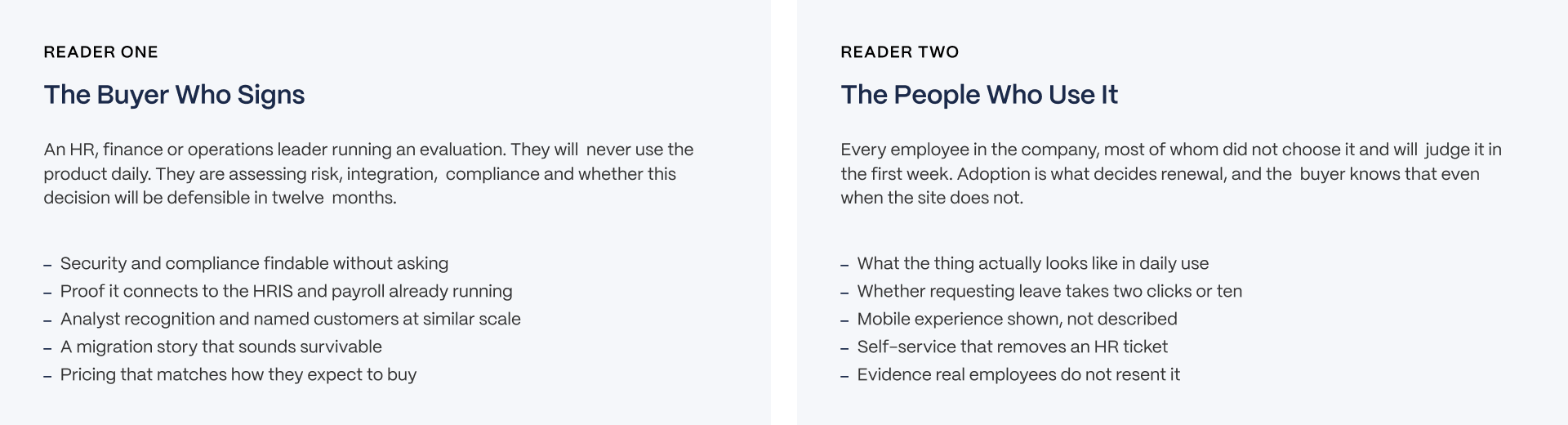
As explained, each HR tech site has two audiences. Each persona has different needs and expectations from the very same page.
Buyers often want to see:
- Security evidence that can be found without asking
- Integration proof that names specific systems instead of gesturing at 'integrations'
- Analyst recognition
- A migration story that sounds “survivable”
- Pricing that aligns with how they expect to buy
Users want to know:
- What this product looks like in daily use
- If requesting time off takes them ten clicks or two
- Evidence that real employees don't resent using it
Almost every weak website in this category is written for one of the two audiences. The same dual-audience problem shows up across SaaS homepage design.
The Five-Point Framework
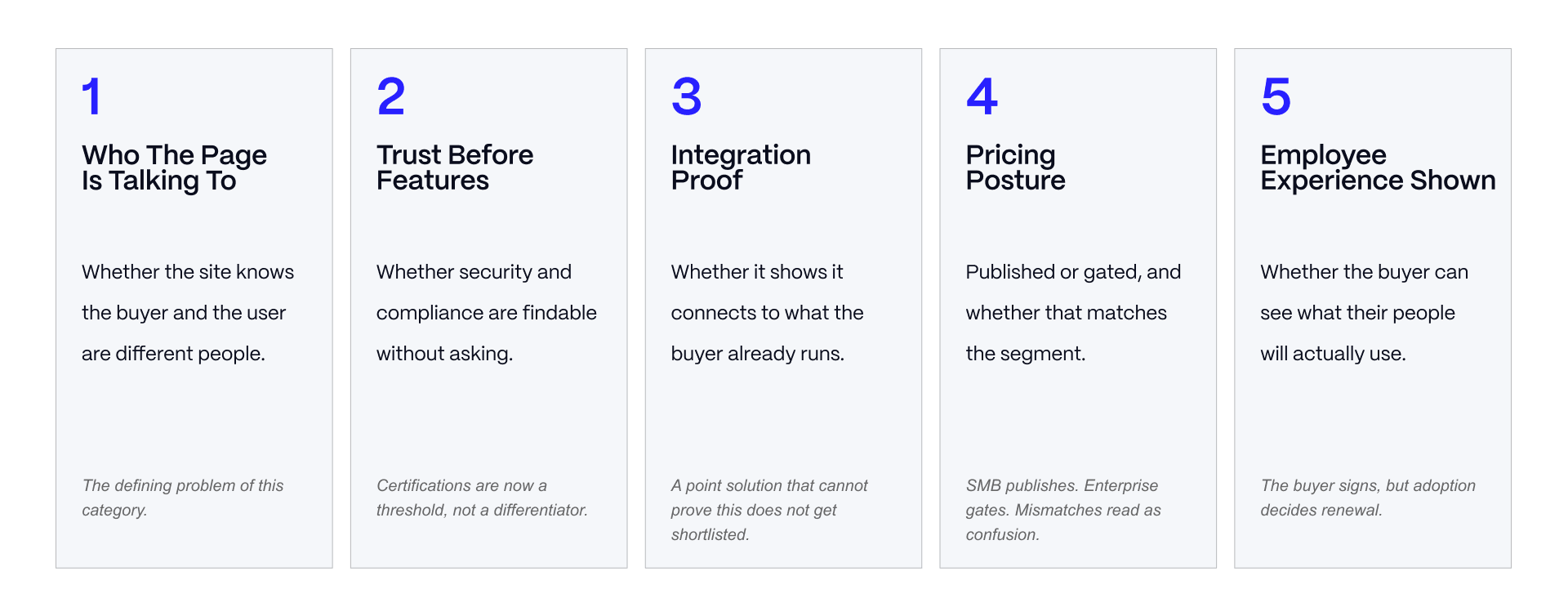
All examples in this article have been reviewed for the same five key factors:
- The audience, or who the site is speaking to (and if it is apparent immediately).
- Security and compliance indicators are presented prior to presenting the product itself.
- Proof of integration: actual system names used rather than general terms.
- A price position consistent with the target market that they are selling too.
- An employee experience demonstrated through a screenshot vs. merely described.
Only one of these five points, employee experience, is something a screenshot can show you directly. That is why a gallery of good-looking HR tech sites teaches almost nothing about how to build one.
For similar context, see our health tech website design examples, which covers a different vertical facing a related trust and compliance problem. For the broader context, see B2B SaaS websites and AI website design examples.
The Examples
How These Were Verified
For this article, we opened and confirmed thirteen companies on the day of writing. This is the key differentiator for the HR tech industry that it is for others. What makes this research different is that we share something that many of the currently top-ranked articles don’t.
What we’ve seen so far on popular design platforms like Behance and Dribbble is concept work, Webflow templates, and general ideas rather than a shipping product. Each of the websites named below is real with real daily customers and was live at the time of writing.
The Comparison Table
Sorted on the mechanics that decide HR software evaluations rather than on visual style, because the buyer and the user are looking for different things on the same page.
Every site was opened and confirmed live on 24 August 2026. State that date. This matters more in this category than most, because a large share of what ranks for HR tech website design is Behance and Dribbble concept work or Webflow templates rather than shipping products.
The Pricing published column is the clearest segment tell in the table. SMB-focused vendors publish, mid-market and enterprise gate. That is not a design decision, it is a sales model expressed as information architecture, and it is worth a paragraph rather than a bullet.
Remote is the outlier worth calling out. It is the only company in the set that markets an API, webhooks and embeds alongside its HR proposition, because it sells to platform partners as well as HR buyers. That makes it a genuine three-audience site and the most structurally interesting example here.
The clearest pattern showing across these thirteen websites is their pricing. We’ve noticed that companies with a small team as a target audience are usually transparent about the pricing. Companies with mid-market and enterprise buyers tend to hide pricing behind a demo request.
This difference reflects how their sales model works, and sometimes it’s more important than design itself. It’s one of the principles we apply to B2B companies we work with.
Remote is one of the few outliers in our article. As a result, it serves three different audiences: both buyers and employees, as well as platform partners.
Thirteen Sites, By Segment
SMB payroll and HR
Gusto
Gusto talks to you like a person, not an HR expert. The whole site is written in a warm, plain way that assumes you have never run payroll before. It also publishes its pricing right on the site, so you know what you are getting into before you talk to anyone.
Justworks
Justworks does the best job in this group of explaining what a PEO actually is. A lot of small business owners land on this site without knowing that term. Justworks walks them through it clearly instead of assuming they already understand.
Factorial
Factorial sells itself as one tool that does everything HR-related. The site backs that up with a layout that feels easy to move through, not cluttered. It reads like a product built for small teams who do not want to hire a specialist just to use it.
Mid-market HRIS
BambooHR
BambooHR owns the best line in the whole category: focus on your people, not the paperwork. That idea shows up again and again across the site, not just on the homepage. It gives the brand a clear personality that sticks with you.
HiBob
HiBob has a brand voice you can actually recognize. It carries the same personality from the homepage all the way through the rest of the site, which most competitors lose after the first scroll. That consistency makes the whole experience feel more put together.
Personio
Personio built its whole identity around being European and GDPR-first. That is a smart move, since it gives companies wary of US-based platforms a real reason to pick Personio over a bigger American competitor. The positioning feels earned, not slapped on.
Paylocity
Paylocity does the best job in this entire list of showing what the product feels like for a regular employee, not just the person who bought it. That focus on daily use is rare, and it makes the site feel more honest about who actually has to use the product.
Enterprise HCM
Workday
Workday leans hard on its reputation, pulling in analyst reports and deep case studies to build trust with big buyers. It has also started reaching down into the mid-market with Workday GO, a sign that it does not want to leave smaller deals on the table anymore.
Rippling
Rippling skips the usual features list and leads with how the product is built instead, calling it a unified employee data layer. That is an unusual choice for a homepage, but it works, since it gives a technical buyer something real to evaluate instead of a list of buzzwords.
Global employment
Deel
Deel leans on numbers. The site is full of specific proof about how many countries it covers and how it handles local compliance. For a buyer worried about hiring across borders, that kind of hard evidence does more work than a nice design ever could.
Remote
Remote is the odd one out in this list. Alongside its HR pitch, it also markets its API, webhooks, and embed tools, because it sells to software platforms that want to build HR features into their own products, not just to HR teams directly.
Oyster
Oyster leads with teaching, not selling. The site is full of free calculators and educational content, which makes sense given that a lot of its potential customers do not fully understand what they need yet. It meets people before they are ready to buy.
Point solution
Lattice
Lattice is worth calling out on its own. It started as a single-purpose tool and has since added full HRIS features, which shows exactly the pressure every point solution in this category is feeling right now: get broader, or risk getting replaced by a bigger suite.
Trust Is a First-Page Concern
Why Compliance Moved Forward
HR data is among the most sensitive information a company holds: salaries, performance records, medical leave, immigration status. Security review has moved from a late-stage formality to an early filter that decides which vendors even make it to a shortlist.
Mordor Intelligence's assessment of the category is direct on this point: cybersecurity diligence now sits at the top of vendor shortlists, and certifications that used to function as differentiators are now treated as minimum thresholds to even be considered.
There is a regulatory layer sitting on top of this too. The EU AI Act's phased enforcement began in August 2025, covering high-risk systems including recruitment and employee assessment. That brings explainability, bias testing, and audit trail obligations that HR tech sites are only beginning to signal clearly.
What Good Trust Signaling Looks Like
This is a matter of specifics, not principles. Certifications need to be reachable in a click or two and written so a non-technical reader can understand what they mean. Data residency should be stated plainly where it actually matters to the buyer.
Personio is the clearest reference case in this set. It has built an entire positioning around GDPR compliance and regional data handling, which works as a genuine differentiator against larger US-based competitors rather than functioning as a checkbox nobody reads.
Here is a useful test: count the number of clicks from your homepage to a page that lists your certifications. If it takes more than two, a procurement reviewer will assume you don't have any worth showing.
Conversion work like making compliance legible to a non-technical buyer is design work. For more on how these decisions affect conversion, see our SaaS landing page example and our approach to web design for B2B companies.
Integration as Structure
This connects directly to the trust problem. A point solution that cannot prove it connects to the buyer's existing HRIS and payroll system will not reach a shortlist at all, which makes integration messaging a structural decision rather than a decorative one.
Name the specific systems your product connects to. Generic language like "integrates with your existing tools" tells a buyer nothing, because they are checking for their specific system, by name. Remote's practice of advertising direct embedding into named HRIS platforms is the clearest example of this done well in the current set of examples.
Pricing Posture and Segment
Who Publishes and Who Gates
This is the clearest segment tell in the entire category, and it is genuinely useful to notice. SMB-focused vendors publish their pricing directly: Gusto, Justworks, and Factorial all do this. Mid-market and enterprise vendors gate pricing behind a demo request instead: BambooHR, HiBob, Rippling, Workday, and Personio all follow this pattern.
That same demo-led model shapes demo page design, since the page has to do more work before the sales conversation begins.
This isn't really a design decision. It's a sales model expressed through information architecture. The practical takeaway for anyone building one of these sites: a mismatch between your pricing posture and your actual segment reads as confusion about who you're for.
See our SaaS pricing page examples guide for more on how this plays out across B2B software generally.
The Consolidation Pressure
This category is consolidating fast, and any article on HR tech that ignores it reads as written from stale information within months. Workday acquired Paradox in October 2025 and Sana in November 2025. Dayforce was taken private by Thoma Bravo, in a deal that closed in early 2026. Paychex acquired Paycor in 2025. Remote acquired Atlas in early 2026.
The practical consequence for a point solution: the question of "why not just use the suite module" now comes up early in nearly every buyer evaluation. A site that doesn't answer this proactively is leaving the question to come up in a sales call it might lose. Lattice's decision to add HRIS capability rather than remain a point solution is this pressure made visible on a live product roadmap.
What the Research Says About Tool Count
This is a useful counterweight to the consolidation story above. Lattice's 2026 State of People Strategy Report, a survey of 1,002 HR leaders, found that high-performing HR teams run four or more tools, with top-performing teams using six or more at double the rate of average teams, even while a majority of teams report facing technology budget cutbacks.
So consolidation is clearly the direction the market is heading, and at the same time, multi-tool stacks are still where the strongest HR teams operate. That means the integration argument from the previous section matters more, not less, as the category consolidates.
Conversion rate work on B2B sites is something we help with directly. See our approach to conversion rate optimization.
The Mistakes This Category Repeats
The Anti-Patterns
Three mistakes show up repeatedly across HR tech sites, and they are worth naming directly, without contempt, since these are common mistakes made by competent teams working under real constraints.
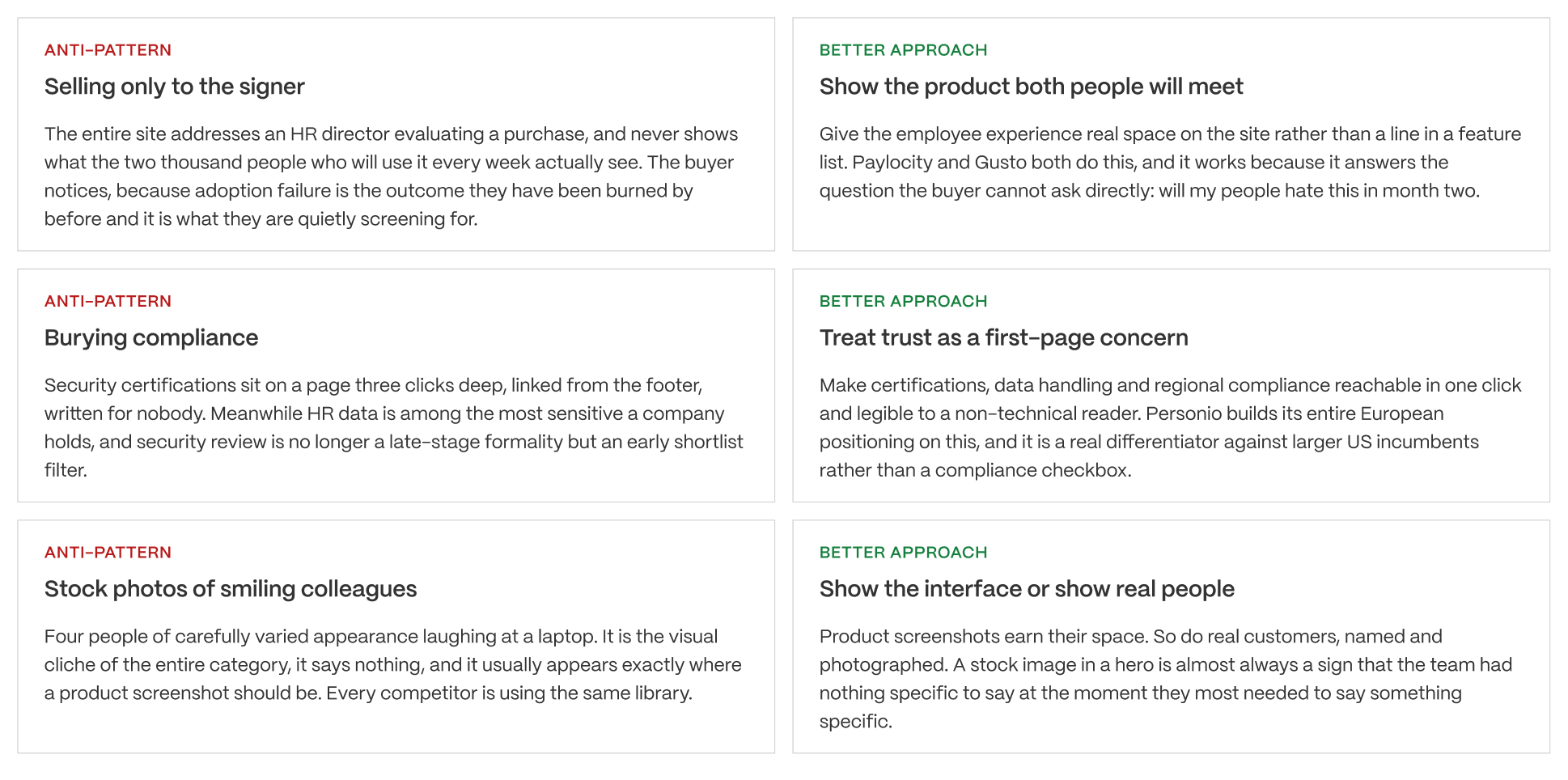
Selling only to the signer. The entire site speaks to the buyer's evaluation criteria and never once shows what the product feels like to actually use.
Burying compliance. Certifications and security information exist somewhere on the site, but take more than a click or two to find, which reads to a procurement reviewer as though there is nothing there worth finding.
Stock photos of smiling colleagues. A default visual choice that says nothing specific about the product.
Of these three, the stock photo problem is the easiest to fix, and fixing it usually exposes the second problem underneath it, since teams that lean on generic imagery often haven't built the concrete proof points that would replace it.
The Stock Photo Problem, Specifically
This deserves its own space because it has become the visual cliche of the entire category. Four people of carefully varied appearance, laughing at a laptop, placed exactly where a product screenshot should be, drawn from the same handful of stock libraries every competitor in the category also uses.
Here's a test worth running on your own site: replace every stock image with either a real product interface screenshot or a photo of a real, named customer, and see whether the page gets weaker. It rarely does.
AI Messaging That Says Nothing
This is a live problem worth flagging directly. Every vendor in this category now claims some form of AI capability, and as a result, the claim itself has mostly stopped carrying any information. The vendors who actually mean it name the specific task the AI performs.
Here's a test: remove the word "AI" from every sentence on your page. If a sentence still says something concrete and specific after that edit, it was doing real work. If the sentence collapses into vagueness, the word was decoration.
Applying This to Your Own Site
Pre-Build Evaluation Checklist
Before building or redesigning an HR tech site, run through a structured check of where the page stands on trust, integration proof, pricing clarity, and employee experience.
Seven of the ten items worth checking are invisible in a screenshot, which is exactly why a gallery of good-looking HR tech sites will not help anyone actually build one.
Decision by Segment
SMB payroll and HR, mid-market HRIS, enterprise HCM, and global employment behave as genuinely different buying categories, each with a different correct answer on pricing posture, trust signaling, and integration proof.
Layered across all four sits the point-solution question every vendor in this category now has to answer directly: why should a buyer choose a specialized tool over a module already sitting inside the suite they're consolidating toward.
DECISION BY SEGMENT
Use this as a starting point, not a binding answer. The five-point framework is the real evaluation tool. Your segment determines which of the two readers your site should weight more heavily.
SEGMENT 1: SMB PAYROLL AND HR
- Profile: selling to a founder, office manager or first HR hire at a company under two hundred people
- The buyer and the user overlap substantially, sometimes entirely
- Reference sites: Gusto, Justworks, Factorial
- What to optimise first: published pricing and a self-serve path
- Why: this buyer will not sit through a demo cycle to price a payroll product, and the person evaluating is frequently the person who will use it daily. Gusto publishes pricing and writes in a register that assumes the reader is not an HR professional, which is exactly right for the segment.
The verdict: publish pricing, let them start alone, and write for someone who did not train in HR.
SEGMENT 2: MID-MARKET HRIS
- Profile: an HR leader at a company between two hundred and two thousand people, replacing a system
- The buyer and the user are now firmly separate
- Reference sites: BambooHR, HiBob, Personio, Paylocity
- What to optimise first: the dual-audience balance and the migration story
- Why: this is where the category's defining problem bites hardest. The buyer needs to see admin capability and integration proof. The employees need to see something they will not resent. HiBob's brand personality and Paylocity's employee experience framing are both attempts at the same balance from different directions.
The verdict: the site has to reassure two people at once, and the one who signs is screening for whether the other will complain.
SEGMENT 3: ENTERPRISE HCM
- Profile: a global organisation with procurement, security review and an existing ERP relationship
- The buyer is a committee and the user base is enormous
- Reference sites: Workday, Rippling
- What to optimise first: analyst proof, compliance depth and architectural clarity
- Why: nobody buys enterprise HCM from a website, so the site's job is to survive a shortlist rather than to convert. Workday leans on analyst recognition and deep case studies. Rippling leads with its architecture, the unified data layer, which is an unusual choice and a good one because it gives a technical evaluator something concrete to assess.
The verdict: the site is a qualification document. Make it easy for a committee to defend choosing you.
SEGMENT 4: GLOBAL EMPLOYMENT AND EOR
- Profile: a company hiring across borders, evaluating employer of record and global payroll
- The buyer is finance or people ops, the constraint is compliance in jurisdictions they do not understand
- Reference sites: Deel, Remote, Oyster
- What to optimise first: country coverage as concrete proof, and compliance as the product
- Why: in this segment compliance is not a trust signal alongside the product, it is the product. Deel quantifies coverage heavily. Oyster leads with category education and free calculators because much of the market does not yet know what it needs. Remote is the structural outlier, marketing an API and embeds alongside the HR proposition because it sells to platform partners too.
The verdict: specificity about jurisdictions beats reassurance about capability.
CROSS-SEGMENT: THE POINT SOLUTION PROBLEM
- Profile: any single-function tool, performance, benefits, talent acquisition, workforce management
- The constraint: the buyer already owns a suite and the market is consolidating toward suites
- Reference site: Lattice, which added HRIS capability rather than staying a point solution
- What to optimise first: integration proof with named systems, and a clear answer to why not just use the suite module
- Why: a point solution that cannot show it connects to the incumbent HRIS does not reach a shortlist. Naming the specific systems is worth more than any amount of integration language, and answering the suite question directly is better than hoping it does not come up.
The verdict: name the systems you connect to, and answer the suite question before the buyer asks it.
PRINCIPLE
Every other B2B category sells to a buyer who is also the user, or to a buyer whose users are a handful of specialists. HR tech sells to one person on behalf of everyone in the building. That single structural fact explains most of what separates the good sites in this category from the merely attractive ones, and it is invisible in a screenshot. Design for the person who signs and the person who has to live with it, and accept that they are looking for different things on the same page.
For companies scaling through this stage, see our guide for scaling companies.
What to Do First
Start with three checks.
Count the number of clicks from your homepage to a page listing your certifications. Check whether an employee could recognize their own daily experience anywhere on your site. Name, specifically, the systems you integrate with, rather than describing integration generically.
Then hold the underlying principle in mind: design for the person who signs and the person who has to live with the product every day, and accept that they are looking for different things on the very same page.
See our B2B landing page examples and web design approach for more on how we handle this.
One Person Signs. Everyone Else Has to Use It.
HR tech sites tend to fail in a specific, repeatable way. They get built entirely for the person running the evaluation, and the buyer notices, because what they're actually screening for is whether their people will resent this decision by month two.
We design and build B2B sites that hold two audiences at once without confusing either, treating compliance, integration proof, and product evidence as design problems to solve rather than content to bolt on later. If your demo requests are healthy but your close rate isn't, the site is usually part of the answer.
What makes a good HR tech website?
One that serves two readers at once. The buyer is an HR or finance leader assessing risk, integration and compliance. The users are every employee in the company, who did not choose it and will judge it in the first week. Almost every weak site in this category is written entirely for one of them.
Should HR tech companies publish pricing?
It depends on segment, and the split is consistent. SMB-focused vendors like Gusto, Justworks and Factorial publish. Mid-market and enterprise vendors like BambooHR, HiBob, Rippling and Workday gate behind a demo. A mismatch between your posture and your segment reads as confusion about who you are for.
How prominent should security and compliance be?
One click from the homepage. HR data is among the most sensitive a company holds, and security review has moved from a late-stage formality to an early shortlist filter. Certifications that were differentiators a few years ago are now minimum thresholds, so burying them signals you may not have them.
Do we need to show the employee experience?
Yes, and give it real space rather than a feature list line. The buyer signs but adoption decides renewal, and adoption failure is the outcome they have been burned by before. Showing what an employee actually sees answers a question the buyer often cannot ask you directly.
How do we handle integration messaging?
Name the specific systems rather than saying you integrate with existing tools. A buyer is checking for their HRIS and their payroll provider by name. For a point solution this is close to disqualifying: if you cannot prove you connect to the incumbent suite, you do not reach a shortlist.
Is the HR tech market consolidating?
Heavily. Workday acquired Paradox and Sana during late 2025, Dayforce was taken private by Thoma Bravo in a deal closing early 2026, Paychex acquired Paycor, and Remote acquired Atlas. The practical consequence is that the why not just use the suite module question now arrives early in every evaluation.
Should we still be a point solution?
The market pressure says suites, the research says otherwise. Lattice's survey of 1,002 HR leaders found high-performing teams run four or more tools, with top performers using six or more at double the rate. Point solutions survive by proving integration, not by pretending consolidation is not happening.
What is the most common design mistake in HR tech?
Stock photography of smiling colleagues, usually placed exactly where a product screenshot should be. It is the visual cliche of the category, every competitor uses the same library, and it signals that the team had nothing specific to show at the moment they most needed something specific.
How should we talk about AI on our site?
Name the task it performs. Every vendor in this category now claims AI, which means the claim has stopped carrying information. Try removing the word from every sentence on your page. If a sentence still says something concrete, it was doing work. If it collapses, it was decoration.
How many examples should we study?
Two or three from your own segment. SMB payroll, mid-market HRIS, enterprise HCM and global employment behave completely differently, and comparing a self-serve payroll product to an enterprise HCM platform produces a verdict that helps nobody. Identify your segment before deciding what to copy.
A note on the market size figures
Two credible sources describe the HR technology market very differently, because they measure different scopes. S&P Global and 451 Research put the market at 94 billion dollars across seven segments, published in a February 2026 report. Mordor Intelligence projects the market growing from roughly 42 billion dollars in 2025 to 78 billion dollars by 2031. These figures are not directly comparable and should not be read as agreeing or disagreeing with each other.
A note before you act on this article
The company examples above reflect what was live and verified in late August 2026. HR tech is consolidating quickly, and a vendor's positioning, certifications, or independence can change fast in this category. Confirm any acquisition status, certification claim, or pricing detail directly against the vendor's current site before relying on it, and check for further acquisitions in this space between now and whenever you're reading this.