.jpeg)
Account-Based Marketing (ABM) is a business strategy where who you reach determines the rest. With ABM, instead of trying to reach the largest possible number of individuals, you target specific companies you want to be your clients.
We also have ABM platforms that execute this strategy through software. ABM platforms identify companies that are visiting your site and show interest. The story doesn’t end there; ABM platforms go a step further by changing your website's appearance based on who’s viewing it.
In this article, we present ten ABM platforms, list who owns them as of 2026, and outline the core features of each. We also did something that almost no other guides explain - how these platforms work behind the scenes and what the potential consequences are if you implement them incorrectly.
Who Owns What In 2026
The Consolidation, Corrected
This category has recently undergone numerous acquisitions and rebrandings; it is worth noting that two of the five articles we found ranking for this topic contain at least one inaccuracy regarding ownership. Here are the accurate details as of the time of writing:
On November 12, 2024, Terminus merged with DemandScience and now operates under the DemandScience brand. Peter Cannone remained CEO of the merged company, while former Terminus CEO Rich Howarth became CTO. It is also worth clarifying a common source of confusion: some sources state that Terminus was acquired by "GTM Partners," conflating it with Terminus Capital Partners-a completely independent private equity firm with which it shares only part of its name.
In August 2025, RollWorks became AdRoll ABM. It remained under the ownership of the same parent company, NextRoll, and the product itself - as well as your login credentials-remained unchanged; only the brand name was altered.
As of 2026, 6sense and Demandbase remain independent private companies. 6sense has approximately 1,600 employees and was named a leader in the Forrester Wave report in the first quarter of 2026. Demandbase has approximately 990 employees and has raised a total of around $429 million in capital to date, without an initial public offering (IPO) or acquisition by another company.
Another important detail-especially if you have read our article on the "trust center"-is that Clearbit was acquired by HubSpot and rebranded as Breeze Intelligence, while the standalone version of the product was discontinued on April 30, 2025. This is also relevant in this context because several ABM personalization tools rely on Clearbit for profile enrichment data.
What An ABM Platform Actually Does
An ABM platform generally performs four functions. Account identification determines which companies are visiting your website, even before someone fills out a form. Intent data tracks signals indicating which of those companies are currently ready to buy and are researching solutions like yours. Orchestration coordinates ads, emails, and sales team notifications specifically targeted at those accounts. And website personalization alters the content a visitor sees on your site based on the company they work for.
It is important to clarify a distinction people often ask about: how does ABM differ from marketing automation? Marketing automation (tools like standard email-based lead nurturing systems) works with contacts whose names you already know. ABM platforms work with accounts/companies, most of which fall into the category of anonymous visitors you have yet to identify.
One more thing needs to be clarified, as a competitor's article misinterprets this fact: LinkedIn Sales Navigator is not an ABM platform. It is a tool for finding prospects and connecting with specific individuals within the companies you are targeting. It provides information to the ABM program, but on its own, it does not identify anonymous website visitors, execute coordinated campaigns, or personalize your website.
How This List Is Organised
Bbelow are ten platforms, listed in alphabetical order, not ranked. Notably, three of the five high-ranking articles we found on this topic prioritize their own services, a pattern worth noting and approaching with a degree of skepticism.
Each of the listed examples answers the same three questions: what the platform does, what the true costs are once all expenses beyond the advertised price are factored in, and what it requires from your website to function. It is precisely this third question, which seemingly no one else in this category addresses, that serves as the primary reason for this article.
For more background on tools in this general space, see our AI tools for B2B marketing roundup.
Ten Platforms
The Comparison Table
Below are ten ABM platforms, alphabetical, with pricing marked as vendor-published (V) or a third-party procurement estimate (T), since almost nothing in this category publishes real prices.
A few notes: this runs alphabetically, not ranked. Every T marker means a procurement estimate rather than a published list price, because almost nothing in this category is published outright. The last column, what each tool needs from your site, is really the reason this article exists.
Five Platforms, 6sense To HubSpot
6sense identifies accounts visiting your site and adds intent data; paid plans start at around $50,000 annually, with a median price of $58,333 cited by Vendr. It is important to note upfront: this tool is difficult to justify for teams with fewer than approximately 50 salespeople unless there is a dedicated marketing operations function to manage it. It requires a tracking pixel on every page and, typically, a two-year contract commitment.
AdRoll ABM (formerly RollWorks) combines account identification, display advertising, and orchestration, with a starting price of around $10,000 to $12,000 per year. Key point: display ad costs are separate and mandatory (not optional), so your actual budget must include the amount you plan to spend on the ads themselves.
Bombora is primarily a source of intent data (known as Company Surge) rather than a full-fledged platform, with a starting price of approximately $25,000 to $30,000 annually. It does not perform actions directly on your site; instead, it feeds data to another ABM platform you are already using.
Demandbase One combines account intelligence, advertising, personalization, and orchestration, with a median annual price of $68,591 (based on Vendr data from 185 tracked deals). If you use their personalization module, you need to install both a tracking pixel and a client-side personalization component on your website.
HubSpot ABM integrates account targeting tools, workflows, and dashboards within the Marketing Hub Professional package, priced at $890 per month (with an annual subscription). The advantage: if you already use HubSpot, the tracking code is already present on your site, so there is no need to install anything new.
See our lead generation tools article for more on the overlap between ABM and visitor identification tools generally.
Five Platforms, Madison Logic To ZoomInfo
Madison Logic focuses on multi-channel activation and intent data, with estimated annual costs ranging from $50,000 to $100,000, although the actual minimum spend has not been publicly confirmed. It requires the installation of a tracking pixel on your website to function.
Metadata automates paid demand generation and ABM (Account-Based Marketing) campaigns simultaneously; the price is approximately $3,950 per month on an annual plan, plus a $2,500 onboarding fee. A pixel is required for attribution tracking.
Mutiny specializes in account-based website personalization; it offers a free version, a "Business" plan at $50 per month, and "Enterprise" pricing starting at $40,000 per year. This solution warrants particular attention as it bridges the gap to the next section of this article.
Mutiny is not a plugin that integrates with your site's content management system; rather, it is a client-side JavaScript snippet (a small piece of code executed in the visitor's browser) that requires a separate data enrichment agreement-typically via HubSpot Breeze Intelligence (formerly Clearbit) or 6sense-to identify the visitor. When the cost of the Mutiny license is added to that contract, realistic costs for a mid-sized company range from $170,000 to $340,000 annually, all-inclusive.
Terminus - which has operated under the DemandScience brand since a 2024 merger-offers ABM and a concept it calls "ABX" (Account-Based Experience), including advertising and chat; historically, prices have ranged from $30,000 to $100,000 per year. It requires the use of a tracking pixel and a separate budget for display advertising.
ZoomInfo Marketing combines data, intent signals, and process orchestration, with a median price of $31,875 to $33,500 per year (according to the Vendr platform). It requires its own WebSights pixel for visitor tracking, and as of June 2026, newer AI-based features are billed as a separate line item.
How Website Personalisation Is Actually Implemented
The Mutiny Snippet, Explained
Here's the detail almost every ABM listicle skips entirely, probably because the people writing those lists sell the platforms rather than build the websites they run on.
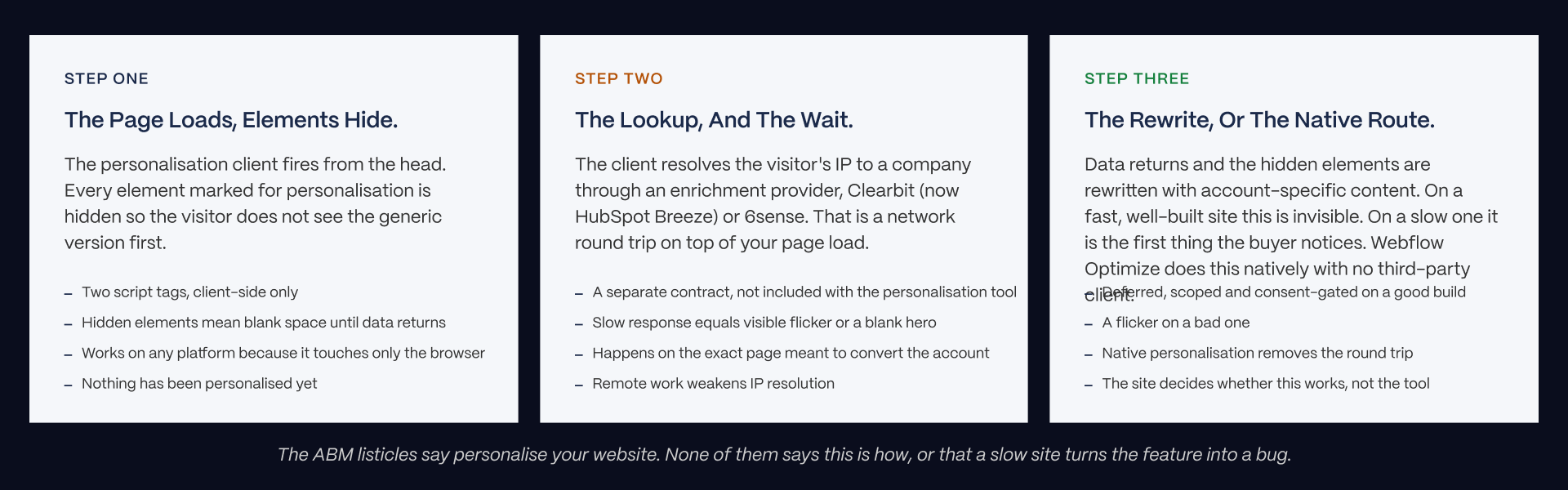
Mutiny works as a client-side JavaScript bundle, meaning code that loads and runs in the visitor's own browser, added through two script tags placed in your site's head section, hosted on Amazon S3 and delivered through a content delivery network called Fastly. Here's what happens when your page loads.
First, it hides every element on the page that's marked for personalization, so the visitor doesn't briefly see a generic version before the personalized one appears. Then, it looks up the visitor's company by matching their IP address through an enrichment provider, either HubSpot's Breeze Intelligence (formerly Clearbit) or 6sense.
That lookup is a separate network request happening on top of your page's normal load time. Once the data comes back, the hidden elements get rewritten with account-specific content.
Because this whole process is purely client-side, meaning it only touches the visitor's browser, it technically works on any website platform. But because it hides elements until the data comes back, a slow lookup produces a visible flicker, or sometimes just empty blank space, right on the exact page meant to convert your highest-value target accounts.
Worth being blunt about this: it's a web performance engineering problem wearing a marketing tool's name. For more on what gets personalized on a page like this, see our SaaS homepage design examples.
Webflow, WordPress, Or Custom
Where and how well this works depends heavily on your website platform.
On Webflow, you paste the script into Project Settings, under Custom Code, in the Head Code section, or you can skip the third-party client entirely and use Webflow's own native personalization tool instead, covered next.
On WordPress, you're typically working through a header plugin or directly editing the theme's header file, which gives you the least control over exactly when the script loads relative to everything else on the page. On a custom-built site, you get full control, placing the script directly in the HTML head with complete say over deferral, consent handling, and scope.
There's a content modeling point worth making here too. Personalization that pulls in industry-specific case studies, logos, and testimonials for different visitor types needs a genuinely clean, structured content setup behind it. Webflow's CMS collections, and most custom builds, handle that naturally.
Trying to recreate that same structure onto a typical page-builder WordPress theme is frequently where these projects stall out. See our pieces on Webflow versus WordPress and our B2B landing page examples for more.
The Native Alternative
There's a genuine alternative to the whole client-side snippet approach: Webflow Optimize, native personalization built directly into Webflow itself (it originated from Webflow's acquisition of a company called Intellimize), starting at $299 a month and scaling with your page views.
It can use firmographic data (company-level information like industry and size) to personalize for target accounts, and it can even be deployed on non-Webflow sites through a code snippet. Because there's no third-party client involved, there's no hidden-elements step and no flicker problem to solve. Webflow also offers Analyze, a cookieless analytics tool, starting at $9 a month, which is relevant if consent concerns are part of why you're considering the native route.
Here's the comparison worth sitting with. Mutiny Enterprise starts at $40,000 a year, and once you add the required enrichment contract, a realistic total lands somewhere around $170,000 to $340,000 a year for a mid-market company. Webflow Optimize, on a site that's already built on Webflow, runs roughly $3,600 a year. That gap is really the whole argument. See our enterprise Webflow delivery page if building this natively is something you're weighing.
What It Actually Costs
List Price Versus Total Cost
Here's the number almost nobody publishes upfront. The license fee you see on a pricing page is typically just one piece of the puzzle. Add implementation, dedicated headcount to run the platform, and mandatory spend on things like advertising, and your realistic first-year cost lands at two to three times the license price.
A few specifics on implementation:
6sense runs $5,000 to $50,000 with a four-to-eight-week onboarding process.
Metadata charges $2,500.
Demandbase is reportedly around $29,000.
HubSpot requires a mandatory onboarding fee of $3,000 on Professional or $7,000 on Enterprise.
On headcount, budget for a full-time RevOps administrator, typically $60,000 to $120,000 a year, to run the platform day to day. On mandatory adjacent spend: AdRoll ABM and Terminus both require a separate, dedicated display advertising budget, while Mutiny requires that separate enrichment contract mentioned earlier.
Contract Structure
Most enterprise-tier ABM platforms require annual, often multi-year contracts, frequently with automatic renewal and fairly tight windows for cancellation notice. 6sense in particular standardizes on two-year terms.
A few things worth specifically negotiating before you sign: the implementation fee itself, your seat count, any ad spend commitments baked into the contract, and the renewal notice period, meaning how far in advance you have to cancel before it auto-renews.
Worth noting: the Vendr-reported median prices throughout this article are the most defensible numbers available precisely because they come from what companies paid in real purchases, not from a vendor's own marketing page.
The Minimum Size Where It Pays Back
An ABM platform pays for itself when your average contract value is high enough to justify the cost of targeting individual accounts, and when you have a dedicated RevOps or ABM function running the program. 6sense specifically is difficult to justify for teams under roughly 50 sellers without a dedicated marketing ops person managing it.
If you're below that threshold, a more realistic starting point is HubSpot ABM inside a Marketing Hub subscription you may already have, or Webflow Optimize on a Webflow site you're already running. Both deliver a meaningful share of the personalization benefit at a fraction of the cost of the enterprise platforms.
Does ABM Actually Work
Where The Numbers Come From
Almost all the ROI data circulating about ABM comes from the people selling ABM platforms. The widely quoted figure that marketing-sourced revenue increases 208 percent from ABM-engaged accounts traces back to the Momentum ITSMA Marketing Performance Management Study from 2024, and it's frequently misattributed to ITSMA more broadly rather than that specific study.
A commonly cited figure of 60 percent higher win rates, along with an average ROI figure around 145 percent, both come from vendor and analyst materials. The widely repeated claim that 80 percent of ABM programs fail to deliver expected results traces to agency sources, including The ABM Agency, which generally names poor alignment between sales and marketing as the root cause.
None of these figures are peer-reviewed. Genuinely independent studies measuring ABM's actual pipeline impact are scarce, and that scarcity is itself worth stating directly rather than glossing over.
What The Failure Rate Actually Means
If roughly four out of five ABM programs really do fail to deliver what was expected, the more useful question is what the successful fifth did differently.
Across the sources we reviewed, the consistent answer comes down to three things: a target account list that sales and marketing both agreed on ahead of time, a clearly dedicated owner for the program, and measurement set up before the first campaign ever launches, not after.
The platform itself sits downstream of all three of those decisions; it doesn't create any of them on its own. For more on measuring the results of a program like this, see our marketing attribution tools and B2B analytics tools roundups.
The Honest Threshold
Worth repeating the payback threshold from earlier, this time in the context of the evidence itself: a high average contract value, a genuinely dedicated function running the program, and enough sellers in place to act on the signals the platform surfaces.
And here's the recommendation most vendor pages won't make themselves: if you're below that threshold, start with HubSpot ABM or Webflow Optimize on infrastructure you already have, measure the results for two full quarters, and only buy the full enterprise platform once your own pipeline data justifies it, rather than committing based on a demo and a vendor's case study.
Choosing
Decision By Situation
No single platform on this list is "the best." Here's how to narrow things down based on where you are.
DECISION BY SITUATION
No platform on this list is best. Here is how to narrow by where you are.
SITUATION 1: ALREADY ON HUBSPOT, UNDER 50 SELLERS
- What you need: HubSpot ABM inside Marketing Hub Professional
- Why: target account tools, workflows and dashboards are already in the subscription. The tracking code is already on the site.
The verdict: use what you have for two quarters before buying anything else
SITUATION 2: ALREADY ON WEBFLOW, WANT PERSONALISATION
- What you need: Webflow Optimize, from roughly 299 dollars a month
- Why: native personalisation with no third-party client, no hidden elements, no flicker, no enrichment contract. A twentieth of the Mutiny Enterprise cost.
The verdict: this is the leaner path and it is the one nobody selling ABM platforms will mention
SITUATION 3: ENTERPRISE, HIGH ACV, DEDICATED REVOPS
- What you need: 6sense or Demandbase, budgeted at two to three times the licence
- Why: this is who they are built for. The Vendr medians are 58,000 and 69,000 dollars, and the first year will cost more than that.
The verdict: negotiate implementation, seats and the renewal notice period, and assume a two-year commitment
SITUATION 4: MID-MARKET, AD-LED, WANT TO START SMALL
- What you need: AdRoll ABM, formerly RollWorks
- Why: entry around 10,000 to 12,000 dollars a year, and the ad spend is separate so you control the pace.
The verdict: the practical mid-market pilot, as long as the ad budget is in the plan
SITUATION 5: INTENT DATA ONLY, PLATFORM ALREADY CHOSEN
- What you need: Bombora as a feed into whatever you run
- Why: it is a data layer, not a platform. Entry around 25,000 to 30,000 dollars a year, annual only.
The verdict: only if the platform you have cannot already source intent
PRINCIPLE
An ABM platform personalises a website. If the website cannot carry the personalisation without flickering, and cannot be measured without a separate attribution stack, the platform will underdeliver and the vendor will call it a change management problem. Check the site first. The tool is the easy part.
Already on HubSpot, under 50 sellers
What you need is HubSpot ABM inside Marketing Hub Professional. Why: target account tools, workflows, and dashboards are already included in that subscription, and the tracking code is already on your site. Use what you already have for two quarters before considering anything else.
Already on Webflow, want personalization
What you need is Webflow Optimize, from roughly $299 a month. Why: native personalization with no third-party client, no hidden elements, no flicker, and no separate enrichment contract required. That's roughly a twentieth of what Mutiny Enterprise costs once you add in its required enrichment contract, and it's the leaner path nobody selling ABM platforms is going to mention to you.
Enterprise, high contract value, dedicated RevOps
What you need is 6sense or Demandbase, budgeted at two to three times the license fee. Why: this is genuinely who these platforms are built for. The Vendr-reported medians run $58,000 and $69,000 respectively, and your real first-year cost will exceed that. Negotiate implementation, seat count, and the renewal notice period, and go in assuming a two-year commitment.
Mid-market, ad-led, want to start small
What you need is AdRoll ABM, formerly RollWorks. Why: entry pricing around $10,000 to $12,000 a year, with ad spend kept separate so you control your own pace. This is the practical mid-market pilot option, as long as your plan accounts for the required ad budget.
Intent data only, platform already chosen
What you need is Bombora as a feed into whatever platform you're already running. Why: it's a data layer, not a full platform, with entry pricing around $25,000 to $30,000 a year on an annual contract. Only worth it if the platform you already have can't already source intent data on its own.
The underlying principle worth remembering: an ABM platform personalizes a website. If that website can't carry the personalization without flickering, and if results can't be measured without a completely separate attribution stack, the platform will underdeliver, and the vendor will usually call that a "change management problem" rather than a product one. Check the website first. The tool itself is the easy part.
Questions To Ask On The Demo
Six questions worth asking before you sign anything:
What's the realistic first-year total, including implementation, seats, and any mandatory ad spend?
What does the personalization client do to page load time, measured, not estimated? What does the tracking pixel need from your consent banner to work properly?
What's the renewal notice period?
Can you show live pipeline attribution for an actual customer at my contract value, without a slide deck?
Can we run a two-quarter pilot before committing to a two-year contract?
The Close
Back to where this article started. Most of the platforms on this list are genuinely good at what they're built to do.
What determines whether they work for you is the website they're personalizing, the measurement stack underneath the whole program, and whether your company is big enough to meaningfully act on the signals they surface.
Two of those three things get decided before you ever buy the platform. See our web design services if the website side of that equation is where you're starting.
Closing
The platform personalizes a website. Check the website first.
Every ABM platform above depends on a page it doesn't build, a measurement stack it doesn't include, and a team large enough to act on what it surfaces. Two of those three things get decided before you ever buy the platform.
We build B2B SaaS websites on Webflow, and the personalization conversation we end up having with clients usually starts with a question the platform vendor skipped entirely: can this specific site carry a personalization client without flickering on the pages meant to convert, or should that be built natively instead?
If you're already on Webflow, that answer tends to be cheaper than the demo you just sat through.
Work With Veza - See Our Case Studies
FAQ
What is an ABM platform?
Software that identifies which companies are visiting your site, scores which of them are in market using intent data, runs ads and outreach against those accounts, and optionally personalises the website for them. Marketing automation acts on known contacts. ABM platforms act on accounts, most of which are anonymous.
Which ABM platform is the best?
Depends on size and stack, and this list is alphabetical because three of the five competing lists rank themselves. Enterprise with dedicated RevOps: 6sense or Demandbase. Already on HubSpot under 50 sellers: HubSpot ABM. Already on Webflow and wanting personalisation: Webflow Optimize at a twentieth of the Mutiny cost.
How much does ABM software cost?
Two to three times the licence in year one. Vendr medians: 6sense $58,333, Demandbase $68,591. Add implementation ($5,000 to $50,000 for 6sense), a dedicated admin ($60,000 to $120,000), and mandatory ad spend for AdRoll ABM and Terminus. Almost nothing in this category is list-priced.
What happened to Terminus?
It merged into DemandScience on 12 November 2024 and now operates under the DemandScience brand, with Terminus CEO Rich Howarth becoming CTO. Some sources say it was acquired by GTM Partners, which confuses it with Terminus Capital Partners, an unrelated private equity firm. At least one ranking article still lists it as independent.
Is RollWorks still a product?
Yes, as AdRoll ABM. NextRoll folded RollWorks into the AdRoll brand in August 2025 with the product and logins unchanged. Entry pricing runs roughly $10,000 to $12,000 a year with display ad spend separate. Most lists, and Surfer's own outline, still use the old name.
How does ABM website personalisation actually work?
Usually a client-side JavaScript snippet. Mutiny hides the elements marked for personalisation on page load, resolves the visitor's IP to a company through a separate enrichment provider, then rewrites those elements. On a slow site that produces a visible flicker on the pages meant to convert. Webflow Optimize does it natively with no third-party client.
Does ABM actually work?
The honest answer is that almost all the evidence comes from vendors. The 208 percent revenue figure is from the Momentum ITSMA 2024 study. The 80 percent failure rate is from agencies. No peer-reviewed ABM pipeline study was found. What the sources agree on: it pays back with high ACV, a dedicated owner, and measurement set up before the first campaign.
What is the minimum company size for an ABM platform?
High enough contract value to justify per-account spend, and a dedicated RevOps or ABM function to run it. 6sense specifically is hard to justify under roughly 50 sellers without dedicated marketing ops. Below that, HubSpot ABM or Webflow Optimize on infrastructure you already own delivers most of the benefit.
What is the difference between ABM platforms and marketing automation?
Marketing automation works on contacts you already know: email, nurture, scoring. ABM platforms work on accounts, most of which are anonymous: identifying which companies visit, scoring intent, and running ads or personalisation against them before anyone fills in a form. Most companies need both, and they are different budgets.
Is LinkedIn Sales Navigator an ABM platform?
No. It is a prospecting tool for finding and contacting people at target accounts. It feeds an ABM programme with contacts and does not identify anonymous visitors, orchestrate campaigns or personalise a website. Some lists include it, which is a category error.
.jpg)