.jpeg)
Proptech is an industry that, just like any other - fintech or healtech has its own principles when it comes to web design. However, if you search for the term “proptech website design,” you will likely find something that won’t help you decide which way to go.
The most common results show companies like Zillow, Compass, and Sotheby's. While relevant, these are real estate brokers with their own websites, rather than companies that develop technology for the real estate sector.
In this article, we did something different. We analyzed 16 proptech websites that address many different challenges that property managers, owners, tenants, agents, lenders, and investors face. By the end of it, our target group of readers will find out how the most successful proptech websites build trust and present complex products without trying to speak to everyone at once.
This Is Not A List Of Brokerages
What You Will Find If You Search This
All the articles currently ranking for this topic focus on real estate agencies, listing portals, and agents specializing in luxury properties. The only B2B software example on the first page, a company called "Buildout", ranks tenth on a list of ten. It appears almost as an afterthought after nine examples aimed at end consumers.
This order reflects how Google interprets the term "proptech": as a synonym for real estate itself, rather than as a category of business software designed for the real estate industry.
This distinction is significant because the two groups have vastly different website requirements. A real estate agency’s homepage sells a specific lifestyle and the property listings themselves.
In contrast, the homepage of a property management platform must convince a skeptical business buyer (responsible for operations) that the software will integrate with their accounting system.
This article focuses on the latter group, encompassing property management systems, commercial real estate data, construction technology, ownership verification and financing infrastructure, and agency tools designed for software buyers rather than buyers of the properties themselves. You can see how this category fits into Veza's broader B2B work on our B2B page, our list of B2B SaaS websites worth studying, and our martech website design examples, the most recent sibling to this piece.
Why Proptech Is Harder Than Most Verticals
A proptech website often needs to simultaneously serve different property audiences who may find themselves on opposite sides of the same transaction. A lender and a borrower using the same financing platform seek different information and documentation on the same site.
This places proptech in a more challenging position compared to fintech, where a site generally needs to meet the needs of developers and compliance officers, or martech, where the buyer and the user are typically the same person. Proptech sites channel traffic for a group of stakeholders with conflicting interests; this is primarily a structural design challenge, and only secondarily a branding issue.
One competitor, Toimi, explicitly identifies this phenomenon as one of several design patterns observed in real estate websites, describing it as "role-based access points." This observation is accurate and merits further elaboration rather than mere repetition. The following section examines four companies, each of which has adopted a different approach to addressing this issue.
Four Ways To Route Six Audiences
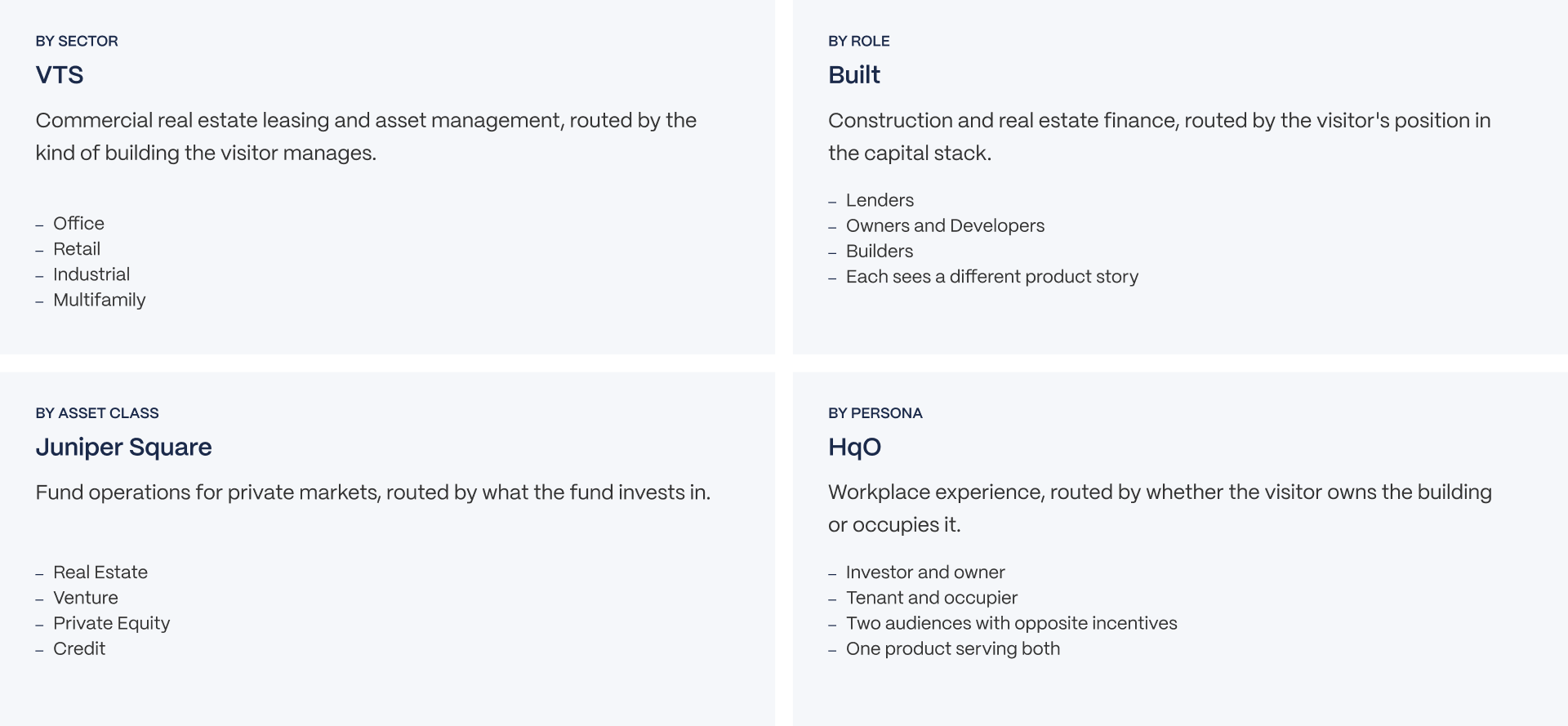
Four proptech companies, four different answers to the same routing problem, and the difference between their answers says something about how each company understands its own buyer.
VTS, a commercial real estate leasing platform, routes visitors by the kind of building they manage: office, retail, industrial, or multifamily. Built, which handles construction and real estate finance, routes by where the visitor sits in the capital stack: lenders, owners and developers, or builders, each of whom needs a different version of the product story.
Juniper Square, a fund operations platform, routes by what the fund invests in: real estate, venture, private equity, or credit. HqO, a workplace experience platform, splits its navigation between investors who own a building and tenants who occupy it, two audiences whose incentives often point in opposite directions.
None of these four approaches is objectively correct. Each one matches the axis that divides that company's customer base, which is the real lesson here: the routing structure should follow the shape of the buyer group, not a generic template borrowed from another vertical. The failure mode isn't picking the wrong axis. It's building one homepage for six audiences and hoping everyone finds what they need.
Sixteen Sites Worth Studying
The Comparison Table
The table below lists sixteen B2B proptech software companies, alphabetically rather than ranked, each loaded and checked on the date noted beneath the table.
Every entry above needs to be verified against the live site before publication, since the descriptions here come from research rather than from loading the pages directly. Buildout's details are secondhand, sourced from two other articles rather than from its own site, and need independent confirmation before this piece goes live.
Eight Sites, A To J
AppFolio builds property management software and put Realm-X, its AI assistant, at the center of its homepage when it launched the feature on September 21, 2023, rather than leading with a conventional product tour. For a public company, that's a bet that the AI story does more to differentiate the brand than a features grid would.
Built, which serves construction and real estate finance, earns the most attention in this group because its routing is the clearest version of the role-based pattern covered above. Visitors choose between lenders, owners and developers, or builders, and each path leads to a genuinely different product narrative rather than a reshuffled version of the same page. Its integration logos for Sage, Yardi, and Procore sit prominently on the page, which matters because those three names are what a construction finance buyer checks for before anything else.
Buildout builds marketing and transaction tools for commercial brokers. It's the one entry on this list that two other competitor articles also recognize as B2B software rather than a brokerage, and it's also the only company here where mentioning MLS integration makes sense, since brokerage software genuinely connects to that data. Its site shows product demos and named case studies aimed at enterprise buyers, with pricing stated openly rather than hidden behind a demo request.
Cherre sells commercial real estate data infrastructure, and it leads its homepage with a single figure: $3.3 trillion in assets under management processed through its platform. For a data company, that number functions as the whole pitch, since the scale of the data is effectively the product.
EliseAI builds AI tools for property operations and frames itself around agentic AI rather than traditional property management software categories. The company raised a $250 million Series E in August 2025 at a $2.2 billion valuation, and its homepage still needs checking for whether it reflects that figure or an older one, since a stale funding number on a company selling AI-driven software undercuts the exact thing it's trying to prove.
HqO serves workplace experience software to both building owners and the tenants who occupy their space, and it handles that split by separating investor and tenant navigation explicitly rather than hoping each group finds their own way through a shared menu.
Juniper Square runs fund operations software for private markets and puts its LP portal, the dashboard limited partners use to track their investments, directly in the hero position on its homepage. Its navigation is organized by asset class: real estate, venture, private equity, and credit, which matches how fund managers think about their own business.
Nine Sites, M To V
Matterport sells 3D digital twin technology and treats the 3D tour itself as the primary visual on its homepage, rather than a feature demonstrated after a written pitch. The company was acquired by CoStar on February 28, 2025, and any description of its current site should account for the possibility that ownership changed its direction since then.
Mews, a hospitality property management system based in Amsterdam, organizes its navigation by property type and backs that structure with an app marketplace of more than 1,000 integrations, a scale argument aimed at operators who've been burned by rigid, closed systems before.
Northspyre builds software for real estate development and organizes its site around the actual workflow stages of a development project, proving its value with project-level numbers instead of general efficiency claims.
Procore, a public construction management company, is the deliberate exception on this entire list. Where the other fifteen sites use standard SaaS visual conventions, Procore uses a custom typeface called Procore Sans and jobsite photography, giving the site a construction-industry look rather than a software-industry one. The company's rebrand, carried out with the agency Instrument, is often dated by secondhand sources that aren't independently verifiable; the more reliable reference point is Procore's own AI announcement at its Groundbreak conference in November 2024. Procore's aesthetic choice works because its buyer is a builder or site operator who trusts jobsite photography more than a dashboard screenshot, which is a useful reminder that the right visual language depends on what your specific buyer already finds credible, not on what software companies generally do.
Qualia builds title and closing software and combines role-based navigation with visible compliance badges for SOC 2, ISO, and MISMO, the last of which signals specific fluency in mortgage industry standards that a generic SaaS company wouldn't bother earning. A logo wall of title underwriters, including Fidelity National Financial, First American, and Old Republic Title, reinforces the same point: this company has been vetted by the institutions a buyer already trusts.
Snappt detects applicant fraud in rental and leasing documents, and instead of describing its forensic capability in marketing copy, its site shows actual document analysis output. Showing the thing a product does is a harder claim to fake than describing it.
Vantaca manages HOA (homeowners association) operations and proves its scale with two concrete figures: more than 550 client companies and 6.5 million managed doors, numbers that give a prospective buyer something to benchmark their own situation against.
VergeSense sells occupancy intelligence software and leads with a dollar figure, $60 million in avoided lease costs across its customer base, alongside a specific data claim of 250 million square feet analyzed. Its product visuals use anonymous shapes rather than identifiable figures, a small design choice that signals privacy awareness to a buyer who's thinking about employee monitoring concerns before they even ask about them.
VTS, a commercial real estate leasing platform, organizes navigation by sector and backs its positioning with a logo wall including Blackstone, Brookfield, JLL, and CBRE. Its AI product, VTS AI, launched on September 17, 2025, not in January 2026 as several sources report; that later date refers to a 2025 year-in-review release, which is where the confusion in the category seems to have started. Getting that date right matters if you're trying to understand which proptech companies moved early on agentic AI positioning and which followed. For more on how SaaS companies structure navigation around different buyer types, see our SaaS homepage design examples.
Proof Over Persuasion
Why Long Cycles Change What A Homepage Is For
Enterprise proptech sells to buying committees over a period of months, not to an individual making a quick decision. That changes what a homepage is for. A smaller SaaS product can afford a single, prominent self-serve signup button, because the person reading the page is often the one who decides.
A proptech platform selling to a property management company or a construction finance firm is instead writing for several people who will each scrutinize different parts of the pitch before anyone signs anything, which pushes the homepage away from conversion and toward proof: named enterprise customers, hard numbers about scale, and compliance credentials that answer objections before a sales call even starts.
This is the same dynamic covered in our look at health tech website design and fintech website design, two other verticals where the buying process runs long and skeptical, and where title and lending infrastructure sites face the same pressure.
Integrations And Data As Credibility
A proptech buyer evaluating software is usually technically literate and has likely been disappointed by a vendor's integration claims before, which means an integration logo wall does more persuasive work on this kind of site than it would on a typical B2B SaaS homepage. Built shows Sage, Yardi, and Procore. Qualia shows named title underwriters. Mews points to its 1,000-plus app marketplace.
In each case, the logo wall answers a specific, practical question the buyer already has in mind: will this plug into the systems we already depend on.
Quantified data assets serve a similar function for companies whose product is essentially information. Cherre's $3.3 trillion in processed assets and VergeSense's 250 million square feet of occupancy data aren't just impressive numbers; they're the clearest available evidence that the platform has real scale behind it, which matters more to a data buyer than a polished interface does.
Design Awards Are Not A Signal Here
A competing article on this topic raises the question of whether design awards function as a reliable quality signal for real estate websites, and leaves the question open. For B2B proptech specifically, the answer is no.
A property manager evaluating software isn't checking whether a site won an Awwwards nomination. They're checking whether it connects to their existing accounting system, which is a question an award can't answer and an integration logo can. The trust signals that move a proptech deal forward are operational, not aesthetic.
SaaS Or Real Estate
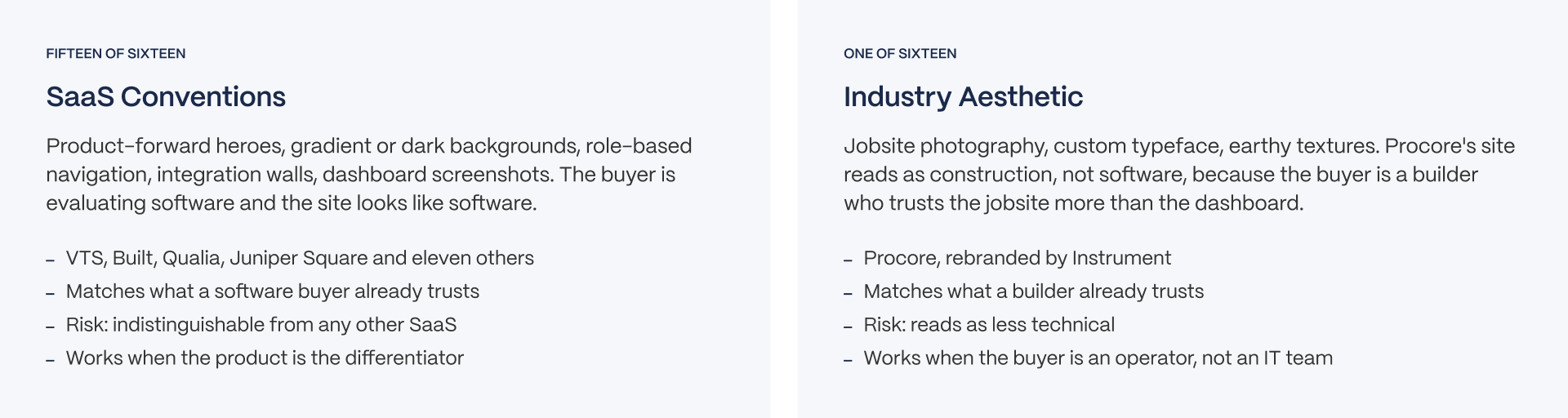
The Pattern
Fifteen of the sixteen sites studied here follow standard SaaS visual conventions: product-forward hero sections, gradient or dark backgrounds, role-based navigation, and integration logo walls. Real estate-style photography, the kind associated with brokerage sites, is the exception rather than the rule.
That consistency across fifteen independently run companies suggests a real pattern rather than a coincidence, though it's worth treating as an observation about what these companies chose, not a rule about what works best. For more on how this plays out across other enterprise categories, see our piece on enterprise website design trends.
The Exception That Explains The Rule
Procore breaks the pattern deliberately, and understanding why clarifies what the pattern is for. Its custom typeface, jobsite photography, and earthy visual textures read as construction rather than software, which fits a buyer who spends their day on a job site and responds to that imagery with more trust than they would to a dashboard screenshot.
The lesson isn't that photography outperforms product screenshots in general. It's that the right aesthetic matches whatever your specific buyer already finds credible, and for most of the companies on this list, that credibility comes from looking like serious software. For Procore, it comes from looking like it understands construction. Our devtool website design examples article makes a similar case for a different technical audience.
What We Cannot Tell You
No independent study compares SaaS-style design against industry-specific aesthetics for conversion in proptech or any adjacent category. One agency, Evoke Studio, argues that product UI outperforms building photography, but that's an agency's opinion offered without data behind it, not a finding anyone else can verify.
The honest position is to describe the pattern across these sixteen sites, name Procore as a deliberate and successful exception, and stop short of claiming either approach converts better, since no one knows that yet.
Data To Get Right
The Correction
VTS AI launched on September 17, 2025. Several sources date it to January 2026, which is the date of a separate 2025 year-in-review release rather than the original launch.
The mix-up is easy to trace once you check the original September press release directly, and it matters for anyone trying to understand the real timeline of AI adoption across this category.
The Conflicts
A handful of facts about companies on this list are genuinely unsettled, and treating them as settled would be a mistake worth avoiding.
Cherre's reported acquisition by RealPage comes from a single, unconfirmed source, so this article describes Cherre as a private company rather than stating the acquisition as fact. Built's total funding figure conflicts across different sources, so the more defensible reference point is its specific $125 million Series D round, which valued the company at $1.5 billion, rather than a cumulative total that varies depending on where you look.
A reported May 2026 launch for something called Mews OS comes from third-party coverage only and should be treated as reported rather than confirmed. Procore's rebrand date is largely agency self-attribution rather than a verifiable company announcement, which is why this article anchors Procore's recent history to its AI announcement at Groundbreak in November 2024 instead.
Buildout's details throughout this article are secondhand, drawn from two other articles rather than from Buildout's own site, which means they need independent verification before anyone treats them as settled fact.
The Live Example Of A Site Outgrowing Its Copy
EliseAI raised $250 million in a Series E round in August 2025, at a $2.2 billion valuation. Research for this article found its homepage still displaying a $140 million figure as of July 2026, nearly a year after the larger round closed.
If that's still the case when this article is read, it's a live example of a common failure in this category: a scale number that was accurate at one point quietly becoming wrong while the rest of the site keeps running. If the figure has since been corrected, the example no longer applies, but the underlying principle still does.
Every scale number on a proptech site has an expiration date attached to it whether the site shows that date or not, and the companies that date their numbers explicitly are the ones a skeptical buyer is more likely to trust.
What To Copy
The Patterns
Four habits show up across the sites that handle this category well:
They route visitors by the axis that divides their customer base, whether that's sector, role, asset class, or persona, instead of building one homepage for everyone.
They lead with the proof a skeptical technical buyer checks, which means integration logos, named customers, and quantified data rather than a generic value proposition.
They match their visual aesthetic to what their specific buyer already trusts, which is usually a SaaS look but occasionally, as Procore shows, an industry-specific one instead.
They date their scale numbers, because an undated figure on a data-driven product quietly becomes a liability the moment it goes stale.
The Anti-Patterns
The opposite failures are just as consistent. One homepage trying to serve six audiences at once, with no routing at all. Design awards treated as a trust signal for a buyer who's never heard of them and wouldn't care if they had.
Building photography borrowed from a brokerage site stapled onto a software product it doesn't match. Scale numbers left undated until they're simply wrong. Underlying all of it, a consumer real estate aesthetic applied to a B2B product, which is exactly what a marketer risks absorbing if they take inspiration from what currently ranks for this search term.
The Close
The search results for "proptech website design" are built from brokerages, and a B2B proptech marketer who takes design inspiration from them will end up with a site that looks like Compass and sells like nothing, because it was never built to answer the questions a software buyer asks.
The sixteen companies covered in this article solved a harder problem than any brokerage has to: serving six different audiences with one product, without building six separate sites to do it. That problem, and how these companies solved it, is a more useful reference point than anything a luxury brokerage's homepage can offer.
For more on what this looks like on individual pages rather than homepages, see our B2B landing page examples, and if your own site needs this kind of routing built, our web design services page covers how we approach it.
Closing
Six audiences, one homepage, and a search result full of brokerages.
A B2B proptech marketer looking for inspiration types the obvious search term and gets Compass and Sotheby's: the wrong problem, solved beautifully, by companies selling to a completely different buyer. The sixteen companies covered in this article solved the right problem instead, routing property managers, owners, lenders, tenants, brokers, and investors to the version of the product built for them, without needing six separate sites to do it.
We build B2B SaaS websites, and that routing question is usually where the design conversation should start, not where it ends up as an afterthought.
Work With Veza - See Our Case Studies
FAQ
What is a proptech website?
A website for a property technology company, which is software sold to the real estate industry rather than a real estate company's own site. Search results conflate the two, which is why this article exists. Property management platforms, CRE data companies and construction tech are proptech. Brokerages and listing portals are real estate.
What makes proptech website design different?
The audience. A single proptech site may serve property managers, owners, tenants, brokers, lenders and investors, several of whom are in the same deal. VTS routes by sector, Built by role, Juniper Square by asset class, HqO by persona. Four solutions to one structural problem no other vertical has to this degree.
Should a proptech site look like real estate or like SaaS?
Fifteen of sixteen sites studied here use SaaS conventions. Procore is the exception with jobsite photography and a custom typeface, and it works because its buyer is a builder. Match the aesthetic to what your buyer already trusts. No independent study says which converts better.
How should a proptech site handle multiple audiences?
Route them explicitly rather than blending. Pick the axis that matches your product: sector if you serve different building types, role if you serve different positions in the capital stack, asset class if you serve different fund types, persona if your users have opposing incentives. One homepage for all six fails everyone.
What trust signals matter for proptech buyers?
Operational ones. Integration logos answer whether it works with what they already run. Named enterprise customers can be called. Quantified data assets are the product for data companies. Compliance badges with scope, especially MISMO for anything touching mortgages. Design awards are not on the list.
Do proptech sites need MLS or IDX integration?
Only if the product touches listings. Brokerage software like Buildout and marketplaces do. Property management, construction finance, fund operations and occupancy analytics do not. The search results for this term assume every site needs it because they are about brokerages, which is another reason to read the results carefully.
When did VTS launch its AI products?
17 September 2025. Several sources cite January 2026, which is the date of a 2025 recap release rather than the launch. The distinction matters because it changes which proptech companies were early to agentic AI positioning and which followed.
How often should a proptech site update its scale numbers?
Every time they change, and every number should carry a date. EliseAI's homepage was reportedly still showing 140 million raised in mid-2026 after a 250 million round the previous August. A stale number on a site whose product is data undermines the pitch.
.jpg)