.jpeg)
To put together a listicle on the best marketing attribution tools in 2026, we reviewed many resources and noticed a few issues. What we found mostly is that these lists combine tools in categories that have nothing to do with each other.
For example, an attribution tool made for a Shopify store is listed right next to an enterprise-level platform based on Salesforce. The issue is that there were no notes indicating they address different needs.
To organize the information below better, we've separated the tools into four categories. For each tool, we’ve added seven points, essential to know before choosing any tool. This article is an in-depth guide on attribution tools, written primarily for marketers, growth ops and professionals looking for the right tool for their B2B SaaS companies.
How To Read Any List Of Attribution Tools
Who Writes These Lists
When researching this topic, we’ve also come to the following: eight out of ten tools that appear near the top of the search sell a product in this category. One of them went a step further and placed its tool in the first position, and spent the rest of the article comparing it to the others.
This article is different since Veza Digital does not sell attribution software. However, we use two of the 16 tools reviewed: Windsor.ai, which we run daily to import Search Console and GA4 data across six of our brand properties, and GA4, which we use as a data source within our analytics. All of the other tools reviewed come from vendor-provided documentation and dated pricing references sourced from different third-parties.
You can read more about the B2B companies we work with.
The Category Is Five Categories
Now we come to the thing where most listicles fail, leaving users confused. The issue lies in comparing and organizing tools that were never meant to compete with one another.
Better organized categories include:
- Multi-Touch Attribution Platforms - These systems will track the path that a customer has taken through their buying process and allocate the value associated with each touchpoint.
- Marketing Mix Modeling - This is based on aggregating a company’s overall spend for marketing activities. In contrast to multi-touch attribution, no individual activity is tracked.
- Data Pipelines - Data pipelines are used to move a company’s marketing data from various sources to a data warehouse or Business Intelligence tool. No value is allocated to any one activity.
- Analytics Suites - Analytics suites are reporting tools that provide information about the behaviors of visitors. However, the suite does not allocate value to specific behaviors.
- CRM-Native Attribution Systems - CRM-native attribution systems use the existing data within a company’s Customer Relationship Management system (HubSpot or Salesforce). The data is used to determine the value associated with each interaction.
The Five Questions That Decide It
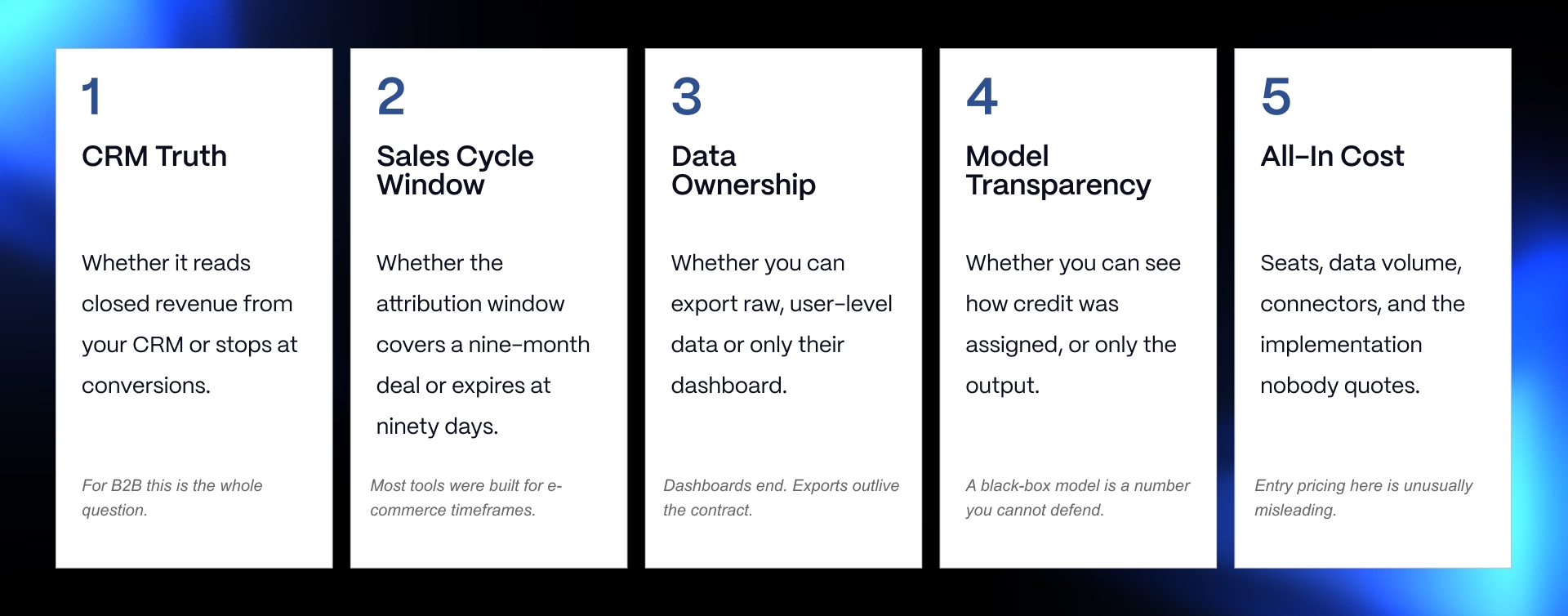
Every one of these can be answered from vendor documentation and a demo, before money changes hands. That is deliberate.
Before you get into feature comparisons, five questions will do most of the filtering for you:
- Does it read closed revenue from your CRM? If it only tracks website behavior, it can't tell you which touchpoints actually closed deals.
- Does its lookback window cover your sales cycle? A 90-day window is useless if your average deal takes six months.
- Do you own the raw data, or just the dashboard? This matters if you ever want to build your own reporting or switch tools later.
- Are the attribution models transparent, or a black box? You should be able to explain to your CFO why a channel got credit.
- What's the all-in cost, including onboarding and any per-visitor overage? The sticker price is rarely the full number.
All five can be answered before you buy anything. The CRM question tends to eliminate more tools than the other four combined, since it's the one that separates a real B2B attribution platform from an analytics tool wearing an attribution label.
Why B2B Attribution Breaks
The Window Closes Before The Deal Does
This is the specification that almost nobody publishes, and it's the single most decision-relevant number for a B2B buyer.
GA4 caps its attribution lookback at 90 days, and just 30 days for acquisition events. That's shorter than most B2B sales cycles. If your average deal takes four, six, or nine months to close, the first touchpoint that started the whole thing falls outside the window and simply isn't counted. Ruler Analytics documents this directly: touchpoints before the lookback window are excluded from attribution entirely, not estimated or discounted, just left out.
A couple of vendors handle this differently. Ruler Analytics offers an unlimited lookback window. Attribution App offers custom windows, but only on its top tier. Every other dedicated attribution tool in this article leaves its maximum window unpublished. That's not necessarily a red flag on its own, but it means you need to ask for the actual number in writing and check it against your real average sales cycle, not the vendor's default assumption.
One Deal, Thirteen People
Contact-level attribution has a structural problem on B2B deals: there's rarely just one contact.
Gartner puts the buying group for a complex B2B purchase at six to ten decision-makers, each doing their own research. Forrester's 2024 State of Business Buying report puts the average even higher, at thirteen stakeholders, with 89 percent of purchase decisions crossing more than one department. A contact-level attribution model can only credit one person's journey. Everyone else's research, the champion who found you through a blog post, the finance lead who compared pricing pages, gets left out of the picture entirely.
Salesforce has a specific version of this problem worth naming precisely. If an opportunity doesn't have a Contact Role assigned, Salesforce's native Campaign Influence reporting shows no attribution for that deal at all, and it doesn't show an error either. It just looks like the deal came from nowhere.
This is worth checking directly in your own Salesforce instance, since it's an easy thing to miss until a quarterly report doesn't add up. For more on how this connects to your broader tooling, see our piece on B2B analytics tools.
Every Platform Claims The Same Sale
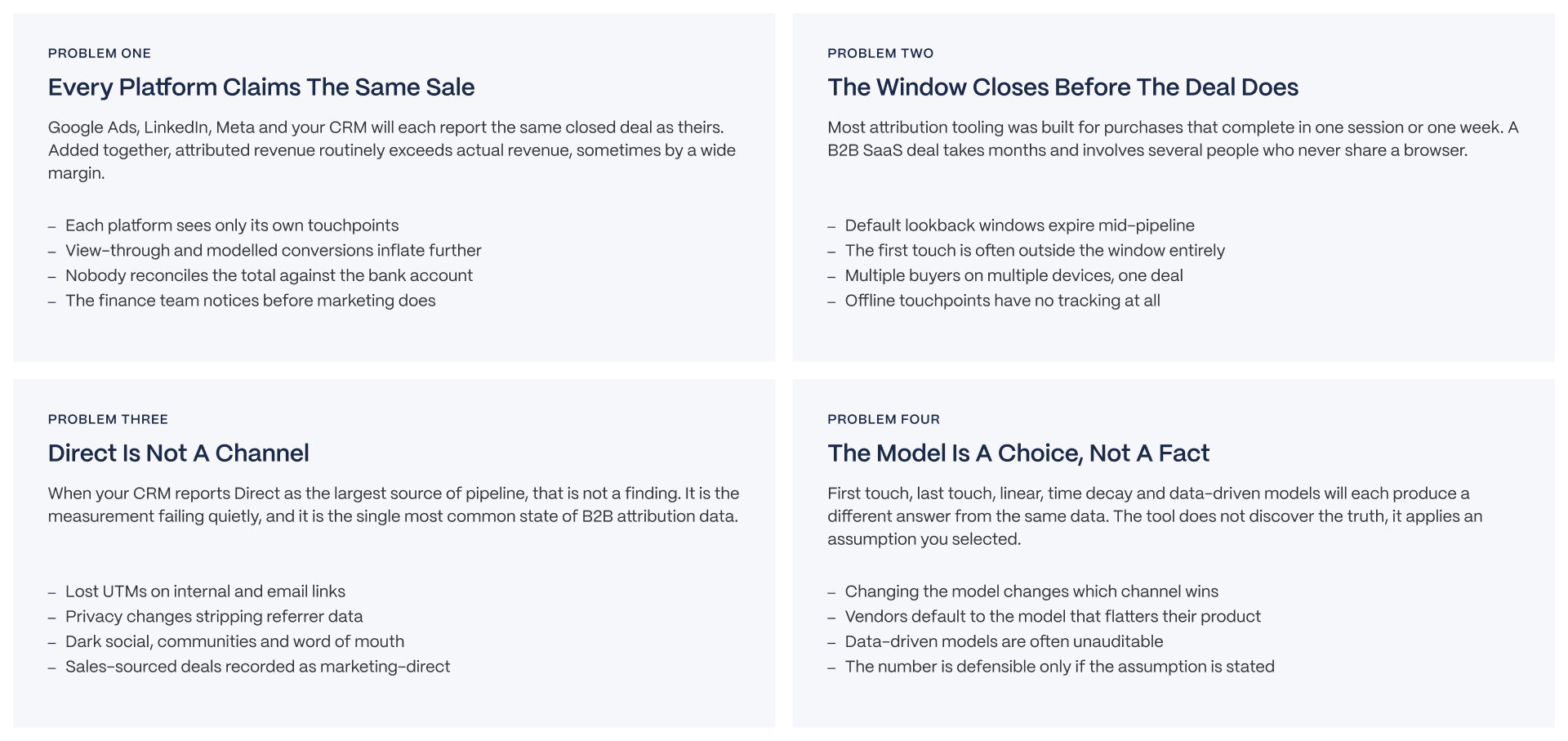
None of these four is solved by buying a better tool. Three of them are made worse by pretending one tool can solve them.
Here's a problem worth taking seriously because it's measurable, not theoretical. Every ad platform reports its own conversions, and those numbers were never designed to be added together.
Databox reports that when you sum up platform-reported conversions across channels, the total routinely comes out to 150 to 250 percent of a company's actual customer count. C3 Metrics' Data Lab found something similar from the revenue side: advertisers who added up what every platform claimed found the number implied a company two to four times larger than they actually were. Meta's over-attribution averages around 26 percent on its own, and Google Ads runs 15 to 20 percent.
A simple weekly check catches this: add up what every ad platform is claiming in conversions or revenue, and compare that total to your CRM's actual closed-won number. If the gap is above 10 to 15 percent, that's a sign your tracking needs attention, not a sign your reporting process is broken. Related reading: our pieces on digital advertising metrics and impressions versus clicks.
B2B-Native Attribution Platforms
These six tools were built specifically for B2B revenue attribution, reading data from a CRM and assigning credit across a full buyer journey rather than a single session.
Dreamdata
Dreamdata is a B2B revenue and account-based multi-touch attribution platform built on a warehouse-grade data model. Based in Copenhagen and New York, founded in 2018, and backed by a $55M Series B closed in October 2025, bringing total funding to $67M.
- What it's built for: Account-based B2B revenue attribution with full data ownership.
- Reads closed revenue from: Salesforce, HubSpot, Pipedrive.
- Lookback window: Not published.
- Account-level support: Yes, this is a core strength of the platform.
- Raw data export: Warehouse-grade export.
- Pricing: Vendor-published free tier (five seats, capped at two months of data history and three stage models). Paid Activation Starter reported by third parties at roughly $750/month. Advanced attribution is quote-gated.
- Clients they've named: Cognism, Clio, Finastra, Oyster.
- Strength: Deep, account-based modeling built specifically for B2B.
- Good to know: Dreamdata builds its data model from its own tracking starting at integration, and doesn't backfill from your CRM history. That means a full customer journey only becomes visible after roughly one sales-cycle length of data collection, and the free tier's two-month data cap is shorter than most B2B cycles, which makes real evaluation on the free plan difficult.
- Best fit: Mid-market to enterprise teams with clean CRM data and dedicated RevOps capacity.
HockeyStack
HockeyStack is a B2B revenue intelligence and go-to-market analytics platform that unifies sales and marketing data, with an AI analysis layer called Odin. Based in San Francisco, founded in 2021, with roughly 35 employees and a Series A raised in January 2025.
- What it's built for: Unified GTM analytics with AI-assisted insight generation.
- Reads closed revenue from: Salesforce and HubSpot, with attribution written back to the CRM.
- Lookback window: Not published.
- Account-level support: Yes.
- Raw data export: Limited on lower tiers, no API access.
- Pricing: Quote-only. Third-party figures cluster around $1,399/month entry, with G2 pricing data citing roughly $2,200/month for the Platform tier and typical annual commitments of $12,000 to $24,000. Onboarding is billed separately, reported at $5,000 to $15,000.
- Reported customers: 200-plus, by the company's own count.
- Strength: Combines attribution with an AI layer that helps surface insights, not just raw numbers.
- Good to know: Pricing isn't published, and G2 reviews repeatedly flag a learning curve during setup. Worth budgeting time for onboarding, not just money.
- Best fit: A team with meaningful pipeline value that wants attribution and AI-assisted analytics in one tool and has room for a premium contract.
Factors.ai
Factors.ai is an AI-powered account-based marketing and attribution platform combining visitor de-anonymization, account intelligence, multi-touch attribution, and a LinkedIn ad tool called AdPilot. Founded in 2020, with teams in the US and India, and $5.6M raised across a 2021 seed round and a 2023 pre-Series A.
- What it's built for: Account intelligence and attribution for teams already running paid ads on LinkedIn and Google.
- Reads closed revenue from: Salesforce, HubSpot, Marketo, Pardot, Outreach, all with bidirectional sync.
- Lookback window: Not published.
- Account-level support: Yes, company-level.
- Raw data export: Not published.
- Pricing: A free tier is available. Basic was previously reported around $199/month, with attribution starting around $399/month, though Factors removed published pricing during 2026 and now requires a demo for current numbers. Add-ons are priced separately, including Interest Groups (roughly $750/month, third-party estimate) and AdPilot (roughly $1,000/month, third-party estimate).
- Reported customers: Over 500 GTM teams, including Sprinklr, Celonis, and MoEngage.
- Strength: Strong account intelligence layer, useful beyond attribution alone.
- Good to know: It identifies companies visiting your site, not individual people, so you'll need a separate source for contact-level data. The strongest features assume you're already running meaningful ad spend on LinkedIn or Google.
- Best fit: Mid-market teams already investing in LinkedIn and Google Ads who want account intelligence layered on top.
Ruler Analytics
Ruler Analytics is a UK-based visitor-level multi-touch attribution platform with call tracking, form tracking, live chat tracking, and closed-loop CRM revenue reporting. It's worth flagging early: this is the one tool in this category that publishes an unlimited lookback window, which is a genuine differentiator for long B2B sales cycles.
- What it's built for: Closed-loop attribution connecting calls, forms, and chat to CRM revenue, with deterministic tracking across cookies, UTMs, gclid, fbclid, and device IDs.
- Reads closed revenue from: HubSpot, Salesforce, Pipedrive.
- Lookback window: Unlimited (vendor-stated).
- Account-level support: No, this is visitor-level rather than account-level.
- Raw data export: Pushes data to your CRM and analytics tools directly.
- Pricing: Vendor-published, via G2 vendor-provided figures. From £179/month (small/medium business), £584/month (mid), £999/month (large).
- Strength: The unlimited lookback window, plus strong offline conversion tracking through calls and forms.
- Good to know: Attribution runs at the visitor or contact level rather than account level, which matters if your deals involve multiple stakeholders. Historical session data isn't imported when you switch to Ruler, so your journey data starts fresh from implementation.
- Best fit: B2B or lead-gen teams where phone calls and offline conversions make up a significant share of the pipeline.
Attribution App
Attribution App offers multi-touch attribution with auditable, user-level data, plus marketing mix modeling, incrementality testing, and a Conversion API module. This is the most transparent pricing in the entire category.
- What it's built for: Auditable, exportable attribution for teams that want to own their data.
- Reads closed revenue from: Salesforce (with opportunity and closed-won mapping), HubSpot, Segment, Pipedrive, Marketo, Klaviyo.
- Lookback window: Custom, available on the Custom tier only.
- Account-level support: Yes, on the Custom tier.
- Raw data export: Yes, to Snowflake, BigQuery, and Databricks, on the Custom tier.
- Pricing: Vendor-published on the pricing page. Pro from $399/month, covering up to 10,000 monthly tracked visitors and all five attribution models. A Shopify plan is available at $199/month. Annual billing saves 16 percent. Overage is $10 per thousand visitors. Managed onboarding is optional at $2,500 to $5,000.
- Reported customers: Over 1,000, including Stanford, Vendr, Replit, and Reforge.
- Strength: The clearest, most published pricing structure of any tool on this list, and most customers report being live in under a day.
- Good to know: The features that matter most for B2B, account-level attribution and custom lookback windows, are only available on the Custom tier, not the published $399/month Pro plan.
- Best fit: Teams that want auditable, exportable attribution without negotiating a six-figure enterprise contract.
Heeet
Heeet is a CRM-native multi-touch attribution tool that runs entirely inside Salesforce and HubSpot, on native CRM objects, with no separate dashboard to log into. It's available on the Salesforce AppExchange and HubSpot Marketplace.
- What it's built for: Attribution that lives inside your CRM's native objects, so your data never leaves your CRM org.
- Reads closed revenue from: Salesforce and HubSpot natively.
- Lookback window: Not published.
- Account-level support: Yes, including handling multi-stakeholder deals and auto-assigning Contact Roles, which directly addresses the Salesforce attribution gap described earlier in this article.
- Raw data export: Data stays in your CRM rather than exporting elsewhere.
- Pricing: Not published on a standard tier page. Third-party estimate around $1,490/month for the Native plan, with custom pricing above that. The vendor positions this as a revenue intelligence platform rather than a tiered SaaS product, which is part of why pricing isn't published.
- Strength: Data never leaves your CRM, which is a real advantage in a security review, and setup takes hours rather than weeks.
- Good to know: It only works inside Salesforce or HubSpot ecosystems, so it's not an option if you're on a different CRM. It's also a smaller vendor than most others on this list.
- Best fit: A Salesforce or HubSpot-centric team that wants native attribution with minimal RevOps overhead.
CRM-Native and Enterprise Options
These tools run attribution inside a CRM you're likely already paying for, or an enterprise suite built for large-scale deployments.
HubSpot Marketing Hub Attribution
HubSpot's native multi-touch revenue attribution reads directly from HubSpot deals, with nine selectable models per the official knowledge base, updated June 21, 2026: linear, first interaction, last interaction, U-shaped, W-shaped, time decay with a seven-day half-life, full path, J-shaped, and inverse J-shaped. W-shaped and full path both require a deal-based interaction to work.
Worth a direct correction here, since it shows up wrong on other lists in this category: HubSpot doesn't publish a numeric lookback window for revenue attribution. Reports are scoped by whatever deal close-date range you select, and they trace back through the contact's stored engagement history. Any article citing a specific 30-day or 90-day HubSpot window is stating a number that doesn't exist in HubSpot's own documentation.
- Reads closed revenue from: HubSpot deals natively.
- Lookback window: Not a fixed number. Scoped by the close-date range you select, tracing the contact's full stored history.
- Account-level support: No, contact-level only.
- Raw data export: Standard HubSpot reporting export.
- Pricing: Vendor-published. Multi-touch revenue attribution requires Marketing Hub Enterprise at $3,600/month ($3,240/month on annual billing), plus a $7,000 one-time onboarding fee. Professional, at $800 to $890/month, includes custom reporting but not revenue attribution.
- Strength: Nine attribution models, comparable side by side, already included if you're on Enterprise.
- Good to know: It only sees interactions HubSpot itself tracked, so third-party ad clicks and some referrers often land in a generic "Direct" bucket rather than getting proper credit.
- Best fit: Teams already on, or planning to move to, HubSpot Enterprise. See our AI sales tools piece for more on the broader HubSpot-adjacent stack.
Salesforce Campaign Influence
Salesforce offers two versions worth distinguishing, since they're often conflated. Campaign Influence 1.0 is single-touch, crediting only the Primary Campaign Source. Customizable Campaign Influence supports multi-touch, with first-touch, last-touch, even distribution, and custom models. The lookback defaults to campaigns touched within the past year, and it's adjustable to match your sales cycle.
- Reads closed revenue from: Salesforce opportunities, via Contact Roles.
- Lookback window: Configurable, defaults to one year.
- Account-level support: Via Contact Roles, which requires manual maintenance.
- Raw data export: Standard Salesforce reporting.
- Pricing: No separate cost; it's bundled into your existing Salesforce license.
- Strength: No additional cost if you're already on Salesforce, and multi-touch is available in the Customizable version.
- Good to know: It depends entirely on manually maintained campaign members and Contact Roles. It can't see channels that aren't tied to a campaign at all, including SEO, direct traffic, referrals, and organic social. And as noted earlier, an opportunity with no Contact Role assigned shows no attribution at all, with no error to flag the gap.
- Best fit: Salesforce-centric teams running campaign-centric marketing with the operational discipline to keep Contact Roles maintained.
Adobe Marketo Measure
Formerly known as Bizible, founded in Seattle in 2011, acquired by Marketo in 2018 and later folded into Adobe's Experience Cloud as Adobe Marketo Measure. Worth distinguishing from Adobe Analytics, a separate enterprise suite with its own attribution capabilities, since the two names get mixed up often.
- What it's built for: Deep Salesforce-native attribution for large enterprise B2B organizations. Touchpoints are stored as objects directly inside Salesforce.
- Reads closed revenue from: Salesforce, with additional integrations to Marketo, Google, LinkedIn, Facebook, Bing Ads, Drift, and Demandbase.
- Lookback window: Not published as a standalone figure; tied to campaign and touchpoint data retention.
- Account-level support: Yes.
- Raw data export: Available through Salesforce and connected reporting tools.
- Pricing: Quote-only, typically bundled with Marketo Engage. Third-party estimates range from $30,000 to $100,000-plus per year, with a Vendr-reported median around $34,860.
- Strength: The deepest native Salesforce integration of any tool in this article, with six attribution models comparable side by side.
- Good to know: Implementation typically takes three to six months and requires Salesforce Campaign objects to be set up correctly first. Rollouts that skip careful preparation have reportedly stalled or failed quietly partway through.
- Best fit: Large B2B enterprises standardized on Salesforce, with sales cycles over 60 days and dedicated RevOps resources for a multi-month rollout.
Tools You Will See On Other Lists That Do Not Belong On This One
Four categories of tool show up on B2B attribution lists constantly, even though they weren't built to solve a B2B problem. Naming them here, and why they don't fit, is part of what makes this list more useful than most.
Data Pipelines, Which Assign No Credit
Funnel.io and Windsor.ai aren't attribution tools. They're data pipelines, and it's worth being direct about that distinction, since buyers researching attribution often evaluate them in the same search.
Funnel.io
A Swedish marketing data pipeline, founded in 2014, with over 590 connectors feeding data into warehouses and BI tools.
- What it does: Moves and normalizes marketing data. It doesn't assign attribution credit to anything.
- Pricing: Vendor-published, on a Flexpoints credit system. Starter at $200/month with 121 connectors and reporting-only destinations (no warehouse export). Business at $800/month with 579 connectors and warehouse export included. The free plan was removed in December 2025, and real-world costs commonly climb to $1,000 to $6,000/month with usage.
- Why it shows up on other lists: Buyers researching attribution tools are often also solving a data-plumbing problem, and the two searches overlap.
Windsor.ai
This is the tool we use ourselves, so we're disclosing that directly rather than burying it in a footnote. We run Windsor.ai daily to pull Search Console and GA4 data across six of our own brand properties.
- What it does: A no-code data pipeline with over 350 connectors and up to ten years of historical data. It has a light attribution layer, but it isn't a full model-selectable multi-touch attribution suite, and presenting it as one would be misleading.
- Pricing: Vendor-published, from $19 to $499/month, billed annually, metered by number of data sources. Unlimited users and all destinations are included on every paid plan.
- Why it's here: Same reason as Funnel.io. It's a genuinely useful tool for moving data, just not the thing this article is otherwise about. See our AI productivity tools piece for more on how pipelines fit into a broader B2B SaaS stack.
MMM And Incrementality
SegmentStream is a legitimate enterprise measurement platform, but it's not primarily a multi-touch attribution tool, and its pricing puts it out of reach for most mid-market teams anyway.
- What it does: Combines conversion modeling, incrementality testing with geo holdouts, marketing mix modeling, and multi-touch attribution, with an agency white-label option available. Models include first-touch, last paid click, last paid non-brand click, and custom MTA.
- Pricing: Custom, with a vendor-stated baseline starting around $5,000/month, tied to a minimum ad-spend threshold. This is enterprise-only pricing.
- Why it's grouped separately: It's worth understanding the broader category here, not just this one tool. Multi-touch attribution handles channel-level decisions using tracked touchpoints. Marketing mix modeling handles budget-level decisions from aggregate data, without individual tracking, which makes it more privacy-resilient but slower to react. Incrementality testing holds out a geography or audience segment to check whether either of the other two methods is actually telling the truth. At meaningful ad spend, running all three together tends to beat trusting any single method alone, and teams that rely on just one are usually the ones surprised when the numbers don't reconcile.
E-commerce Tools And GA4
These tools appear on B2B attribution lists regularly, and naming them plainly as the wrong fit is more useful than quietly leaving them off.
Triple Whale
- What it's built for: Shopify-first e-commerce intelligence, serving over 45,000 brands.
- Pricing: Free tier available, then paid plans from roughly $129 to $300/month for smaller stores, scaling with GMV (vendor-published).
- Why it doesn't fit B2B: It pulls revenue from store order data, not a B2B CRM pipeline, and has no account-level attribution.
Northbeam
- What it's built for: DTC attribution combined with econometric marketing mix modeling and geo-lift testing.
- Pricing: Vendor-published, Starter from $1,500/month.
- Why it doesn't fit B2B: It's built for brands spending heavily on paid media in a direct-to-consumer model, which is a fundamentally different buying motion than a B2B sales cycle.
Cometly
- What it's built for: Server-side tracking and conversion sync for ad optimization, with a B2B and Stripe-oriented pitch alongside its multi-channel DTC roots.
- Pricing: Third-party estimate, roughly $750/month for 50,000 sessions.
- Why it doesn't fit B2B (or at least isn't confirmed to): Its account-level depth for B2B use cases isn't clearly documented, and it's positioned primarily around ad optimization rather than full-funnel B2B attribution.
GA4
GA4 deserves honest treatment here since it's free and everyone reading this already has it installed somewhere.
- What it is: A general web analytics suite with an attribution reporting section, not a dedicated B2B revenue attribution platform.
- Models available: Three, since Google removed the rule-based models (first-click, linear, time-decay, position-based) in November 2023, citing adoption below three percent of conversions. What remains: data-driven, paid and organic last click, and Google paid channels last click. Several competing articles still list the removed models as current, so it's worth checking against Google's own current documentation.
- Lookback window: 90 days maximum, 30 days for acquisition events.
- Account-level support: No.
- Raw data export: Free BigQuery export of raw, event-level data, up to roughly a million events a day, which is a genuine strength since it outlasts GA4's 14-month UI data retention.
- Best fit: A free, directional baseline, not a full B2B attribution solution on its own.
Choosing
The Comparison Table
VP means the price comes from the vendor's own published pricing page. TP means the vendor gates pricing behind a demo and the figure comes from a third-party source. Figures checked August 2026 and should be re-verified directly with vendors before you budget against them, since pricing in this category changes often.
Twelve Questions And Three Mistakes
Twelve questions worth asking any vendor on your shortlist:
- What's your maximum lookback window, in writing, not just the default?
- Do you read closed-won revenue directly from our CRM, or estimate it?
- Is attribution available at the account level, or only per contact?
- Can we export the raw, event-level data, or only dashboard summaries?
- Which attribution models are available, and can we compare them side by side?
- What does full implementation actually cost, including onboarding?
- How long does implementation realistically take for a team our size?
- What happens to historical data if we switch away from you later?
- How do you handle deals with multiple contacts and stakeholders?
- Is there a per-visitor or per-event overage charge, and how does it scale?
- Can we see a reference client with a similar sales cycle length to ours?
- What data do you see that we're currently missing, and what do you miss that we currently see?
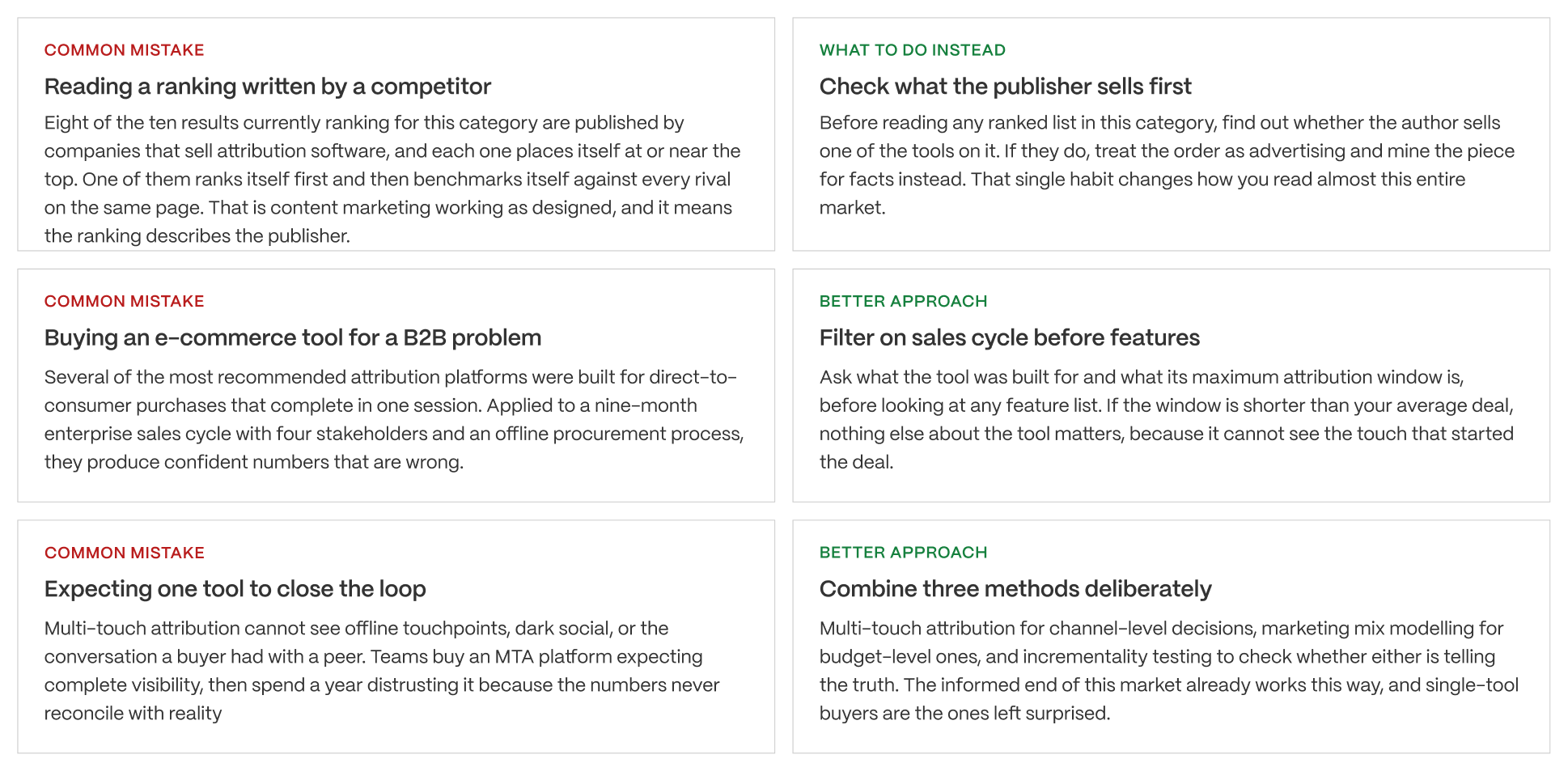
The second of these three costs the most, because the tool works exactly as designed and the answers are still wrong.
Questions one, two, and four eliminate most of the tools that get recommended to B2B teams by default. And the most expensive mistake in this whole category isn't picking the wrong vendor, it's buying an e-commerce attribution tool for a B2B sales problem.
The tool works exactly as designed. It just wasn't designed to answer your question, so the numbers it gives you will be confidently wrong rather than obviously broken.
Decision by Situation
Use this as a starting point, not a binding answer. The five-point framework is the real evaluation tool. Veza sells no attribution software and has used two of the tools discussed here, so treat this as shortlist logic from published information plus the questions in the checklist above.
SITUATION 1: YOU ARE NOT MEASURING ANYTHING YET
- Profile: spend is growing, the CRM says Direct is the biggest source, nobody trusts the numbers
- What to do first: fix tagging and CRM field hygiene before buying anything
- Why: most first attribution purchases fail because the underlying data was never clean. UTMs missing on email and internal links, campaign naming that three people invented separately, and lead source fields overwritten by the last touch. A tool laid over that produces confident nonsense faster.
The verdict: the cheapest improvement available to most B2B SaaS teams is not a tool, it is two weeks of tagging discipline.
SITUATION 2: MID-MARKET B2B SAAS, LONG SALES CYCLE
- Profile: six-figure marketing budget, deals take months, several stakeholders per account
- What matters: CRM revenue reading, account-level stitching, an attribution window longer than your cycle
- Where to start: the B2B-native platforms rather than the general-purpose ones
- Why: this is the segment the category serves worst, because most published comparisons blend B2B and direct-to-consumer tools without distinguishing them. Filter on what the tool was built for before you look at a feature list.
The verdict: three questions eliminate most of the shortlist. Ask them first.
SITUATION 3: YOU ALREADY RUN HUBSPOT OR SALESFORCE PROPERLY
- Profile: CRM is well maintained, campaign data is reasonably clean, budget is mid-size
- What to do first: exhaust the native attribution before buying a platform
- Why: HubSpot's own attribution reporting is included in Marketing Hub tiers and is materially better than teams expect, particularly when the CRM data is clean. The same applies to Salesforce campaign influence. Buying a platform to solve a problem the incumbent already addresses is a common and expensive mistake.
The verdict: start with what you own. Justify the point solution against it rather than in isolation.
SITUATION 4: THE PROBLEM IS DATA PLUMBING, NOT ATTRIBUTION
- Profile: the data exists across ad platforms, CRM and analytics but nobody can join it
- What to look at: data pipeline tools rather than attribution platforms
- Why: Funnel.io and Windsor.ai are frequently evaluated in the same search as attribution tools and they are a different category. They move and normalise data; they do not assign credit. For a team whose real problem is that nothing is connected, a pipeline plus a warehouse plus a model you control will outperform a dashboard you cannot audit.
- Disclosure: Veza uses Windsor.ai for Search Console and GA4 across six brand properties. That is the one tool in this article we have genuine daily experience with, and it is a pipeline rather than an attribution platform.
The verdict: diagnose which problem you have before shopping in the wrong category.
SITUATION 5: SPEND IS LARGE ENOUGH THAT THE ANSWER MATTERS
- Profile: seven-figure annual marketing spend, board-level questions about efficiency
- What to do: run three methods, not one
- Why: multi-touch attribution for channel-level decisions, marketing mix modelling for budget-level ones, and incrementality testing to check whether either is true. At this spend level the cost of running all three is small against the cost of misallocating a quarter's budget, and it is what the sophisticated end of the market already does.
The verdict: at scale, triangulation beats precision. One tool producing a confident number is the riskier position.
PRINCIPLE
Attribution has a structural honesty problem. Every advertising platform is incentivised to overcount its own contribution, every attribution vendor is incentivised to rank itself first, and the model that decides which channel wins is a choice somebody made rather than a fact anyone discovered. None of that means measurement is pointless. It means the number is only as good as the assumption behind it, and that the useful question is not which tool is best but which assumption you are willing to defend.
Not measuring anything yet
Start with GA4 as a free baseline while you get UTMs and lead-source fields cleaned up. Don't buy a $1,000-plus tool to sit on top of dirty data.
Mid-market B2B with a long sales cycle
Dreamdata, HockeyStack, or Factors.ai if budget and RevOps capacity allow. Attribution App if transparent pricing and full data ownership matter more to you than account-level depth out of the box. Heeet if your CRM is the system of record and a security review is part of your buying process. Ruler if phone calls and offline conversions make up a meaningful share of your pipeline.
Already running HubSpot or Salesforce properly
Exhaust the native attribution options first before buying a separate tool. Both HubSpot Enterprise and Salesforce Customizable Campaign Influence can answer a surprising amount, and you may already be paying for the capability.
The real problem is data plumbing, not attribution
If your marketing data isn't connected to a warehouse or BI tool at all, a pipeline like Funnel.io or Windsor.ai solves that specific problem, and it's a different (and usually cheaper) purchase than a full attribution platform.
Spend large enough that the answer really matters
Adobe Marketo Measure or SegmentStream, if you have the RevOps team and budget for a multi-month enterprise rollout.
One more thing before you buy anything: if your UTMs are inconsistent or your lead source field gets overwritten somewhere in your funnel, fix that first. A sophisticated attribution tool running on top of unclean data doesn't give you bad answers, it gives you confident, precise-looking answers that happen to be wrong, which is harder to catch than an obvious error. For more on the layer underneath the dashboard, see our marketing strategy services and conversion rate optimization.
Every advertising platform overcounts its own contribution. Every attribution vendor, understandably, ranks itself near the top of its own comparison page. The model that decides which channel gets credit for a sale is ultimately an assumption somebody chose, not a neutral fact. The useful question isn't which tool is objectively best. It's which assumption you're willing to defend to your own leadership team.
Closing
We sell none of these tools, which is part of why we can tell you which four to skip.
Four of the sixteen tools above show up on B2B attribution lists regularly and shouldn't make your shortlist, because they were built to measure a purchase that completes in a single session, not a B2B deal that takes months and involves a dozen people. Nobody selling attribution software has much reason to point that out to you.
We work with B2B SaaS teams on the layer underneath the dashboard: whether the underlying data is clean enough to trust, which question a given tool is actually answering, and what to change once you know. If your attribution numbers don't reconcile with what's actually in your bank account, that's the conversation worth having.
Work With Veza / See Our Case Studies
FAQs
What are the best marketing attribution tools for B2B SaaS?
For most mid-market B2B teams the shortlist is Dreamdata, HockeyStack, Factors.ai, Attribution App, Heeet and Ruler Analytics. Which one depends on your CRM, your sales cycle length and whether you need account-level attribution. Tools built for e-commerce, including Triple Whale and Northbeam, are frequently recommended and should not be shortlisted.
How much do marketing attribution tools cost?
From $19 a month for a data pipeline to $3,600 a month for HubSpot's Enterprise tier and $30,000 or more a year for Adobe Marketo Measure. Attribution App publishes $399 a month and Ruler from £179. Several vendors including HockeyStack, Dreamdata's paid tiers and Heeet quote only after a demo.
What attribution window do I need for B2B?
Longer than your average sales cycle, which usually means six to twelve months. GA4 caps at 90 days and 30 for acquisition, so the first touch often falls outside it entirely. Ruler Analytics offers an unlimited window. Most other vendors do not publish theirs, so ask for the maximum in writing.
Is GA4 enough for B2B attribution?
No. It cannot see closed revenue in your CRM, has no account-level attribution, and caps at a 90-day lookback. It also supports only three models since Google removed the rule-based ones in November 2023. It is useful as a free directional baseline and as a raw data source via free BigQuery export.
Does HubSpot have built-in attribution?
Yes, with nine selectable models, but multi-touch revenue attribution requires Marketing Hub Enterprise at $3,600 a month plus a $7,000 onboarding fee. It is contact-level rather than account-level and sees only HubSpot-tracked interactions, so third-party ads and referrers frequently land in Direct.
What about Salesforce Campaign Influence?
It is included in your licence and it is largely manual. Customizable Campaign Influence supports multi-touch models and a configurable window defaulting to one year. It cannot see SEO, direct, referral or organic social at all, and an opportunity with no Contact Role gets no attribution with no error shown.
Why does my attributed revenue exceed my actual revenue?
Because every platform counts the same deal as its own. Databox reports summed platform conversions routinely reaching 150 to 250 percent of actual customers, and C3 Metrics found aggregate platform revenue implying companies two to four times their real size. Compare the sum to CRM closed-won weekly.
What is the difference between MTA, MMM and incrementality?
Multi-touch attribution uses tracked touchpoints for channel decisions. Marketing mix modelling uses aggregate spend without tracking, which makes it privacy-resilient and slower. Incrementality testing holds out a geography or audience to check whether either is true. At meaningful spend, running all three beats trusting one.
Are Funnel.io and Windsor.ai attribution tools?
No. Both are data pipelines that move and normalise marketing data into warehouses and BI tools. They assign no credit. Buyers evaluate them in the same search, which is why they appear here, but a team whose real problem is that nothing is connected needs a pipeline rather than an attribution platform.
Do I need account-level attribution?
For B2B, usually yes. Gartner puts a complex buying group at six to ten decision-makers and Forrester's 2024 research puts the average at thirteen stakeholders, with 89 percent of decisions crossing departments. Contact-level attribution credits one of them, which misattributes enterprise deals systematically.
How long does implementation take?
From hours to six months depending on the tool. Heeet installs in hours because it runs inside your CRM. Attribution App reports most customers live in under a day. Dreamdata typically runs two to eight weeks. Adobe Marketo Measure typically runs three to six months and requires Salesforce Campaign setup first.
Has Veza tested these tools?
Two of the sixteen. We use Windsor.ai daily to pull Search Console and GA4 data across six brand properties, and GA4 as an analytics source. Everything else here comes from vendor documentation and dated third-party sources, marked as such. We sell no attribution software, which is why this list is ordered on criteria rather than commercial interest.