.jpeg)
13 Best AEO and GEO Agencies in 2026
AEO and GEO are services that are typically sold separately. However, there’s a common overlap in how agencies describe each of these terms. Many of them may offer one or both even if they serve a similar function - to help your brand be visible in AI search.
This article provides an overview of how and when AEO and GEO became separate marketing services, why agencies offer one or both, and what you can expect from an agency that offers either service.
Additionally, this post includes information on independent AEO and GEO research studies. Finally, we've created a checklist of questions you should ask your potential vendor before signing a contract.
The agency list you can find in this article will continue to grow, and we will update it soon.
AEO And GEO Are The Same Thing
Where The Two Terms Came From
When we look back to the early days of these two terms, the differences become much clearer.
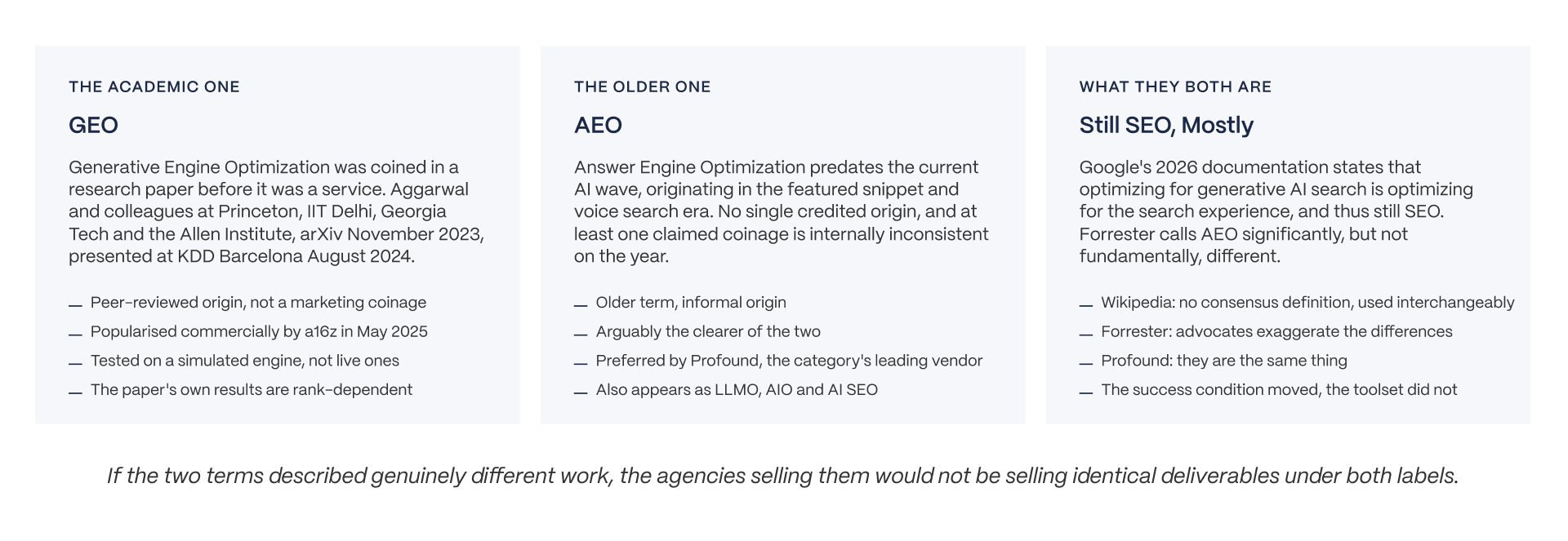
GEO originated from academia. Researchers affiliated with Princeton University, IIT Delhi, Georgia Tech, and the Allen Institute for AI published a research paper, "Generative Engine Optimization," on arXiv in November 2023. This research was later presented by the authors at the ACM SIGKDD Conference in Barcelona, August 2024. GEO was a research-based product long before agencies started selling it as a service.
AEO has a different history. The term grew after years of SEO work, specifically around Featured Snippets and Voice Search, years before the AI search was common. The goal was to create content structured in a way that allowed search engines and voice assistants to locate, understand, and return a direct answer.
GEO became more widely used in marketing after Andreessen Horowitz (a16z) published a May 2025 newsletter focused on the concept. That helped push GEO into the wider marketing conversation.
There is one other piece of context worth noting. In the same newsletter, a16z disclosed that it had investments in several companies working on GEO measurement. That does not invalidate the term or the underlying research, but it is relevant context when looking at how GEO entered the commercial market.
For more background, see our existing piece on SEO, GEO, AEO and LLM optimization, which this article builds directly on.
Why They Describe The Same Work
Here it’s all about how sources frame the same conclusion.
Profound, a company that sells AI search measurement software published “AEO vs GEO: Why they are the same thing.” In this article, Profound states that these two terms describe the same underlying work.
Digday made a similar point, describing AEO and GEO as different acronyms that agencies use for the same broader search.
Wikipedia says that as of early 2026 there’s no agreed academic definition that undoubtedly separates these two terms and that both can be used in practice.
We also found sources outside the agency and vendor market with the same conclusion.
Forrester Principal Analyst Nikhil Lai said that AEO is meaningfully different from traditional SEO, but it’s not different enough to be a separate discipline. He also says that marketing around AEO and GEO often overstates that difference to create a space for new tools and services.
Google’s 2026 documentation takes a similar attitude, saying that optimizing for generative AI search is still part of optimizing the search experience, which Google continues to describe as SEO.
From another viewpoint, there are legitimate counterpoints. Kai Spriestersbach states that LLMs and other types of search engine technology will process and produce content differently than traditional Search Engines. This means that there will be a need for different measurement tools and methodologies. From this perspective, GEO is more than just a new name for SEO.
For more on what answer engine optimization actually involves, see our piece on what answer engine optimization actually is.
Our Position, And Our Conflict
Our disclosure
When you see Veza Digital listed as one of the top AEO/GEO agencies, keep in mind that we sell AEO Services. So, the way you see our entry may be different than how you see other agencies since they review the categories they sell. For this reason, we have placed the list in alphabetical order instead of ranking them.
The problem with ranking agencies is that it would require us to determine which AEO Agency is best. Given that Veza Digital sells AEO services, if we rank in any other order, the list couldn’t be considered independent research. Since the list is in alphabetical order, there’s no potential conflict.
There is another reason we think this disclosure matters. For this search term, two of the top 10 results are Reddit threads rather than agency articles. One is titled “No Self-Ranking, Verified by Clutch Reviews.” That is a useful signal: people looking for information about AEO agencies are also looking outside agency websites for opinions and evidence.
We are doing the same thing here. We will explain what each agency says it offers, separate vendor claims from independent evidence where we can, and leave the final decision to the reader.
You can read more about our own AEO work on our AEO service page.
Thirteen Agencies
A few notes before we get into the agencies
The list is alphabetical: We are on this list, so putting Veza first would make this a ranking. We use alphabetical order for everyone for the same reason. We would expect any competitor doing the same comparison to follow that rule too.
Veza is held to the same standard: Veza Digital is our agency, and we apply the same criteria to our own profile as we do to every other agency here. If another agency is a better fit for what you need, hire them.
No one here has independently audited citation-lift data: None of the agencies in this list, including Veza, publishes an independently audited study showing how much its work increased citations in AI search. Percentage-based results in this category are self-reported unless there is independent verification. Keep that in mind when comparing case studies.
Some founding dates are unclear: Sources conflict on the founding years for Directive, Minuttia, and Kalicube, so we show ranges where needed. We left out headcount because third-party estimates vary and are not reliable enough for a useful comparison.
Profound is not included: Profound is a software product with an agency partner programme, not an agency. Some competitor lists include it alongside agencies, but we left it out because it does not fit the category we are comparing.
Six Agencies, C To M
Crackle PR
Specialism: B2B technology PR, with an emphasis on earned media, media relations, and visibility across AI-generated search results. Founded in 2020 by Parry Headrick and based in the Boston area.
AEO/GEO: GEO is presented as a core offering rather than an add-on. Its work includes LLM visibility audits, structured data, citation monitoring, and media strategies across ChatGPT, Perplexity, Claude, Gemini, and Google AI Overviews.
Named clients: Google, Schneider Electric, Chevron, G-P, ON24, Talkwalker, Creditsafe, and Artlist.
Limitation: The supplied material does not provide a dated, independently audited case study showing citation growth.
Directive Consulting
Specialism: B2B content marketing, SEO, paid media, PR, and organic growth for B2B and SaaS companies.
AEO/GEO: AI search is integrated into its broader content methodology. Directive says its briefs account for AI Overviews and that it tracks AI visibility through its Stratos platform rather than positioning AEO as a separate standalone service.
Named clients: Sumo Logic, Commusoft, Invoca, CIMS, Cirrus Insight, and Medallia, with Sumo Logic also featured in its case-study material.
Limitation: GEO sits within a much broader B2B marketing offering, so its AI-search work is less narrowly focused than agencies built around citation and LLM visibility.
Graphite
Specialism: SEO and growth marketing, with work spanning organic acquisition, content, technical SEO, and AI search visibility.
AEO/GEO: AEO is now a core part of the offering, covering prompt research, citation-ready content, technical AEO, brand sentiment, citation tracking, and offsite work such as Reddit. Graphite also publishes research on how offsite authority affects AI citations.
Named clients: Webflow, Fourthwall, BetterUp, and MasterClass are featured in the supplied case-study material. Webflow's case study reports a 94% increase in LLM share of voice.
Limitation: Graphite publishes specific AEO performance figures, but the supplied material does not establish an independently audited citation-lift study.
iPullRank
Specialism: Enterprise SEO, technical SEO, content strategy, AI search, and what iPullRank calls Relevance Engineering, combining information retrieval, AI, content strategy, digital PR, and UX.
AEO/GEO: GEO is a core service alongside technical SEO and content. Its methodology includes query fan-out coverage, citation frequency, AI referral traffic, benchmarking, and measurement of how content is retrieved and recommended by AI systems.
Named clients: American Express, Citi, SAP, HSBC, and Nordstrom.
Limitation: iPullRank publishes substantial technical research on AI search and became a Profound Agency Partner in July 2026, but the supplied material does not include a dated, independently audited citation-lift case study.
Kalicube
Specialism: Entity optimization, Knowledge Panels, Brand SERPs, and digital identity for personal and executive brands.
AEO/GEO: Its work is centered on helping search engines and AI systems understand entities, brands, and people. The agency was founded in 2015 and built its positioning around entity optimization and Brand SERPs before the current AEO wave. Its founder has also cited 2017 as the origin of the term AEO, although that date is inconsistent across the founder's own posts.
Named clients: The supplied material does not provide a specific client roster. Kalicube instead emphasizes its database and long-running work with brands, entrepreneurs, and digital entities.
Limitation: Its positioning is heavily focused on personal brands, executive visibility, Knowledge Panels, and entities, rather than the broader B2B SaaS website and content work covered by several other agencies in this list.
Minuttia
Specialism: B2B SaaS SEO, content, and AI search, with a narrow focus on SaaS companies rather than a broad digital marketing service mix.
AEO/GEO: AEO is a core discipline. Minuttia works across content, brand mentions, and AI-search visibility and has built its own tool for tracking ChatGPT, Gemini, and Perplexity citations, visibility scores, and average position.
Named clients: MarkUp.io, MarineTraffic, and Meilisearch.
Limitation: Its AI-search methodology and measurement system are largely based on Minuttia's own tools and reporting, with no independently audited citation-lift study provided in the supplied material.
Seven Agencies, O To V
Omniscient Digital
Specialism: B2B SaaS organic growth, SEO, content marketing, and GEO, with a focus on turning organic and AI visibility into business outcomes.
AEO/GEO: GEO is a defined service covering source-worthy content, brand and author entities, citation engineering, technical optimization, competitor analysis, and ongoing LLM visibility tracking.
Named clients: Convert, Jasper, Smartling, and Order.co are featured in the supplied client and case-study material. Its Convert case study reports an 81% increase in LLM visibility and 140% growth in AI citations.
Limitation: Its published performance figures are agency or client-reported results, and the supplied material does not establish an independently audited citation-lift study.
Omnius
Specialism: B2B SEO and AI Search marketing for SaaS and fintech companies, covering technical SEO, content marketing, programmatic SEO, and organic growth.
AEO/GEO: AI Search Optimization is a defined service covering AI crawler optimization, LLM content scoring, citation monitoring, zero-click queries, schema, llms.txt, URL architecture, content clustering, and AI-search tracking. Omnius also operates its own AI-search analytics product, Atomic AGI.
Named clients: Payoneer, WorldFirst, Meniga, Anna Money, Apexanalytix, TextCortex, Native Teams, AuthoredUp, Zencoder, Lsports, and Crustdata are among the companies named in the supplied material.
Limitation: Omnius combines AI search with a broader SEO and organic-growth program, which makes it harder to isolate the contribution of GEO from its wider SEO and content work.
Optimist
Specialism: SEO and AEO consulting for B2B technology companies, from Series A startups through larger organizations, with a focus on organic visibility and inbound pipeline.
AEO/GEO: AEO is integrated into its CORE framework alongside SEO. The process covers AI-search analysis, strategic roadmaps, content, technical work, and ongoing visibility tracking rather than treating AEO as a separate one-off service.
Named clients: Semrush, Glide, PostSig, ZoomInfo, Superhuman, and Stampli.
Limitation: Optimist publishes a clear methodology and unusually transparent service information, but the supplied material does not provide an independently audited citation-lift study. Its published results are based on agency case studies.
Siege Media
Specialism: SEO, content marketing, digital PR, affiliate partnerships, Reddit and community marketing, and GEO for SaaS, fintech, e-commerce, cybersecurity, education, and travel brands.
AEO/GEO: GEO is a core service built around citation research, BOFU content, digital PR, community presence, affiliate placements, content freshness, and LLM share-of-voice tracking. Siege says it has 13+ years of publisher and creator relationships supporting this work.
Named clients: Mentimeter, Zendesk, and Grow Therapy are featured in its GEO case studies. The supplied material reports that Grow Therapy nearly quadrupled its LLM visibility.
Limitation: Siege publishes detailed GEO research and performance figures, but the supplied material does not establish an independently audited citation-lift study.
Single Grain
Specialism: SEO and cross-platform search strategy covering Google, social platforms, AI tools, forums, and online communities.
AEO/GEO: AI search is part of its broader "Search Everywhere Optimization" approach, covering ChatGPT, Gemini, Perplexity, Claude, AI Overviews, Reddit, and other platforms. The work combines keyword research, competitor analysis, content optimization, reporting, and cross-channel promotion.
Named clients: Amazon Alexa, Nextiva, and Lever.co are featured in client testimonials.
Limitation: AI search is one component of a broad cross-channel SEO offering rather than a dedicated AEO/GEO service, making direct comparisons with more specialized agencies less straightforward.
Veza Digital
Specialism: B2B AEO, GEO, SEO, Webflow, and website optimization for SaaS, fintech, and technology companies. Its AEO work centers on the proprietary WAIO framework, which combines entity architecture, structured data, content, technical performance, and AI-search measurement.
AEO/GEO: A core service covering ChatGPT, Perplexity, Google AI Overviews, Google AI Mode, Gemini, Copilot, and Claude. Veza says its engagements include entity mapping, six or more schema types, AI crawler configuration, continuous LLM response testing, and monthly tracking through GA4 and Ahrefs. Its supplied case-study data reports 62 AI Overview citations for Chili Piper across 29 pages and 24 ChatGPT citations across 11 pages.
Named clients: Chili Piper, Grata, and TicketSpice are featured in the supplied AEO/GEO case studies. Veza reports 123% ChatGPT referral traffic growth from September 2024 to February 2025, 90%+ organic traffic growth post-migration, 70% conversion growth and 5X ROAS for Grata, and 44%+ user growth for TicketSpice. Its broader WAIO material also reports +363% LLM sessions for Concordium, +500% LLM key events for Concordium, +106% LLM key events month over month for Grata, and +24% LLM sessions month over month for Grata.
Limitation: Veza combines AEO/GEO with SEO, Webflow development, and website strategy, so its scope is broader than agencies focused only on AI search.
Virayo
Specialism: SEO and GEO for SaaS companies, with a focus on organic search, AI search visibility, content, digital PR, structured data, and pipeline.
AEO/GEO: GEO is presented as an end-to-end service covering AI-search audits, content optimization, LLM source analysis, citation building, brand monitoring, visibility tracking, structured data, and reporting. Virayo also integrates GEO with its existing SEO strategy.
Named clients: TestRail, Spotio, Cedreo, ForUsAll, and PCS Software are featured in the supplied material. A TestRail testimonial reports 2,000+ monthly LLM referral visits and 25-30 qualified trial signups.
Limitation: Virayo integrates GEO into its broader SEO strategy, and its published case studies combine organic and AI-search performance rather than isolating GEO's contribution.
What These Agencies Actually Deliver
Mostly Renamed SEO
Here's the honest split, and it's not really a criticism once you understand it: roughly eighty percent of what gets sold as AEO or GEO is established SEO work under a new name, and about twenty percent is genuinely new measurement work.
Schema markup, entity optimization, content restructuring, and citation building through digital PR are all disciplines that existed well before anyone started saying "AEO." Google and Forrester both say the fundamentals of good SEO still apply here, so an agency doing solid SEO work under new branding is still doing the right work, just with slightly misleading marketing around it.
For more on the mechanics of this work, see our guides on optimising for AI search agents and LLM optimisation practices for SaaS.
The Genuinely New Part Is Measurement
Prompt tracking and citation monitoring, meaning the practice of measuring whether and how often your brand shows up in an AI assistant's answers, genuinely didn't exist as disciplines two years ago, and they can't be done with a traditional SEO toolset.
This is the honest answer to whether AEO is a real, distinct thing: the optimization work is mostly SEO, the measurement work is genuinely new, and the measurement is actually the harder problem to solve well. See our roundups of AI Overview monitoring tools and our explainer on the AI visibility pyramid for more.
The Highest-Leverage Input Is Earned Media
A University of Toronto study submitted to arXiv on September 10, 2025, found that AI search tools show a systematic and fairly overwhelming bias toward earned media (meaning coverage on third-party sites you don't control) over content a brand publishes on its own site or social channels.
If that finding holds up, it reorders the priority list for this entire category: what moves citations most isn't restructuring your own pages, it's getting written about elsewhere. Worth flagging clearly: this is a preprint, meaning it hasn't yet been peer-reviewed, so it's a strong early signal rather than settled fact. Directionally, it points toward putting budget into digital PR rather than into more on-page content work.
Does It Actually Work
The Test That Found Nothing
Ahrefs ran a controlled study on this specific question, and it's worth reporting fully because no other list in this category mentions it. Between August 2025 and March 2026, they tracked roughly 1,885 pages that added JSON-LD schema markup against about 4,000 comparable pages that didn't.
The result: no meaningful citation growth in AI Mode or ChatGPT, and actually a 4.6 percent decline in AI Overview citations for the pages that added schema. Ahrefs also demonstrated that tools like ChatGPT, Claude, Perplexity, Gemini, and AI Mode mostly extract the visible HTML content on a page when retrieving information, and frequently ignore the JSON-LD schema entirely.
The plain conclusion: schema markup is good hygiene, not a lever that moves AI citations. Worth knowing, since schema implementation shows up in nearly every AEO agency's deliverables list, including on the search results for this exact article's topic.
The Forty Percent Figure, Properly Qualified
The number quoted across almost this entire category traces back to the same Princeton paper mentioned earlier. Its headline finding: certain techniques, specifically citing sources, adding quotations, and adding statistics, improved a page's visibility in AI answers by 30 to 41 percent, with increases over 40 percent reported across various queries.
Here's the caveat that almost nobody publishing this number includes. The same paper's Table 2 shows that identical technique cutting a rank-1 page's visibility by 30.3 percent, while lifting a rank-5 page's visibility by 115.1 percent. In other words, the effect is heavily rank-dependent, and it can actively hurt a page that's already the top-cited source for a query.
The test itself was run on a simulated generative search engine with a zero-sum, five-source setup, not on live ChatGPT or Perplexity. The edits tested were generated by an LLM, not applied by a human writer. And notably, an authoritative tone produced no significant improvement on its own, while keyword stuffing frequently performed worse than doing nothing at all. The headline number is real. The caveat belongs in the same breath as the number, not in a footnote three paragraphs later.
How Would You Even Verify It
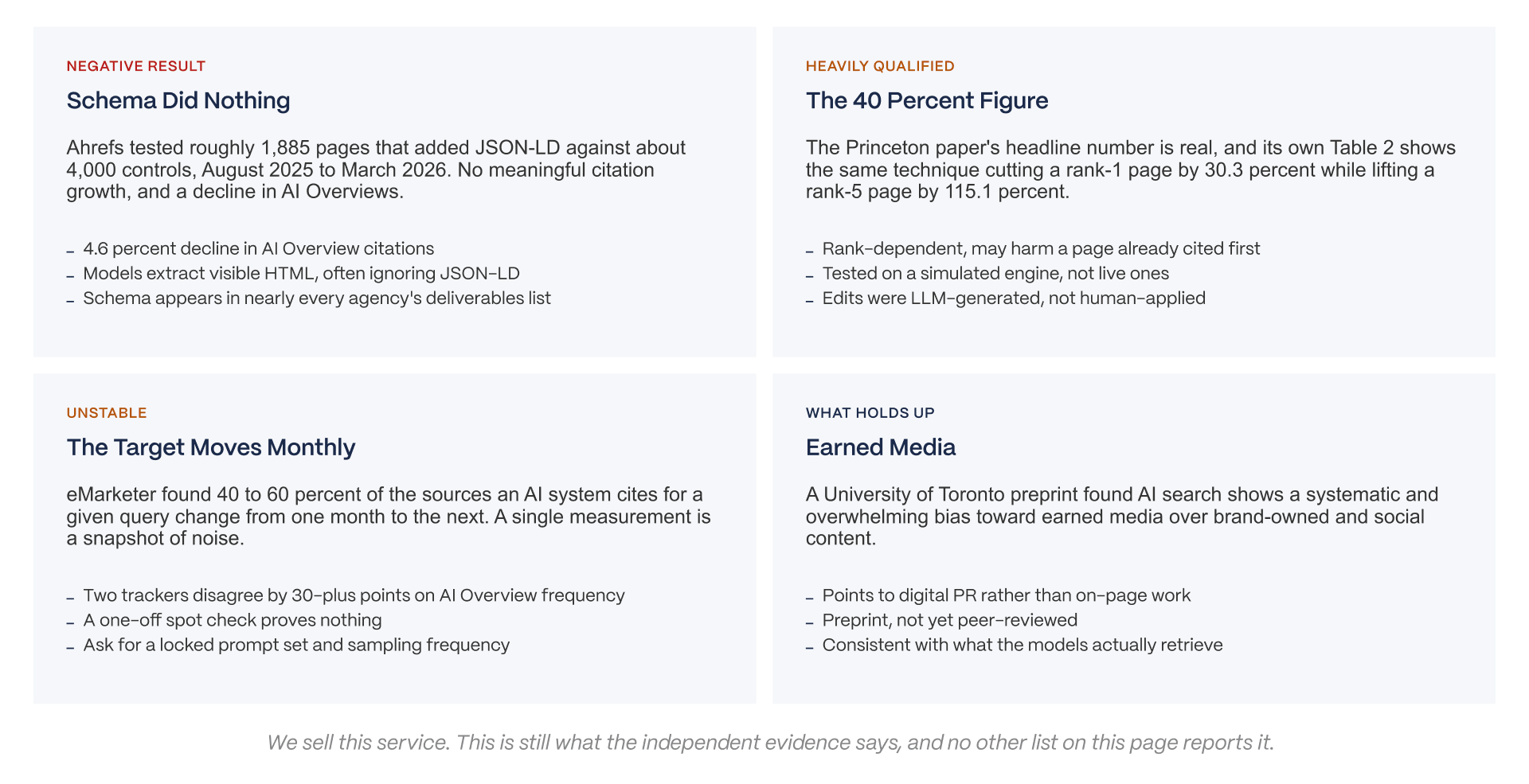
Here's the measurement problem stated plainly enough to actually act on. AI answers are non-deterministic, meaning the same question can get a different answer, with different sources cited, from one query to the next. eMarketer research found that 40 to 60 percent of the sources an AI system cites for a given query change from one month to the next. Two respected industry trackers disagree significantly on how often AI Overviews even appear in the first place: BrightEdge put the figure near 48 percent in early 2026, while Semrush put it near 15.7 percent as of November 2025.
The practical takeaway: if two established trackers can't agree within thirty percentage points on how often a feature even shows up, any single AI visibility score reported for one specific brand deserves real skepticism, and a one-time spot check tells you essentially nothing.
Ask any agency for a locked prompt set, named engines, and a stated sampling frequency, and ask directly whether you'd be able to reproduce their result yourself. See our roundup of LLM optimisation tools for tools that support this kind of ongoing tracking.
What It Costs And What To Ask
Pricing, Where It Exists
Almost nothing in this category is published upfront. Optimist and Omniscient Digital are the clearest exceptions we found.
Where pricing does exist, it ranges widely: think roughly $3,000 to $12,000 a month depending on the agency and scope, with the source marked as published or third-party estimated in each case. Worth sitting with for a second: a $12,000 monthly PR-native retainer and a $3,000 monthly advisory retainer are both real prices for something marketed under the exact same category name, which tells you how unstandardized this particular market still is.
Eight Questions
Eight questions worth asking any AEO or GEO agency before you sign anything, all on the same call if you're comparing multiple agencies:
Can you show me a live citation dashboard for an existing client? Not a screenshot, an actual live view in a tool like Profound, Peec, or Otterly. Reluctance here tells you most of what you need to know.
Which prompts, which engines, and how often will you sample? Unlocked prompts mean the reported number can move without the underlying work actually moving.
Can I reproduce your reported result myself? Given that 40 to 60 percent of cited sources change monthly, a result you can't reproduce is a result you shouldn't trust.
Can you show me two dated examples of citation-rate movement, not traffic? Traffic and rankings are the easy metrics to report, and they're the ones least connected to whether this specific work is actually doing anything.
What proportion of your effort goes to earned media versus on-page work? The strongest independent finding available right now points to third-party sources mattering more than your own pages.
What's your position on schema markup? Ahrefs found no citation lift and a small decline in AI Overviews. An agency that leads its pitch with schema work is worth a second look.
What are the contract term and exit terms? Watch for twelve-month minimums paired with vague deliverables in a category this unproven.
What would you tell us not to bother with? An agency that thinks everything in this category works is selling you something, not advising you.
Red Flags
A short list worth watching for. Any guarantee of specific AI citations or a guaranteed placement inside ChatGPT's answers, which is essentially the AEO version of a guaranteed number-one Google ranking and isn't something any agency actually controls, since the platforms decide independently.
Case studies that only show traffic numbers. A sample report that looks identical to a standard SEO dashboard with a new label slapped on it. The phrase "AI-ready" used as a buzzword with no specifics behind it. Twelve-month contract minimums offered before any kind of diagnostic. And a strategy that focuses only on your own domain, ignoring the third-party sources these AI models actually pull from.
Choosing
Decision By Situation
We sell this service, and we're on the list above once it's added, so we're not going to tell you who's "best." Here's how to narrow things down based on your own situation instead.
You have no AI visibility measurement at all. What you actually need is a measurement baseline, not a retainer. Without a locked prompt set and a starting number, you can't evaluate any agency's work, including ours. Basic tracking tools start around $25 to $99 a month. Buy the measurement before you buy the service.
Your SEO is already solid. What you need is earned media and citation-building work, not more on-page optimization. The strongest independent finding available points to third-party authoritative sources mattering more than your own pages. If your site is already well optimized, more on-page work is probably the lowest-return option on the table. Look at PR-native and citation-focused agencies rather than technical SEO shops.
Your site is technically difficult to work with. What you need is technical depth: JavaScript rendering, crawl access, and site architecture work. If AI crawlers can't actually retrieve your content in the first place, nothing downstream matters. This is where enterprise technical agencies genuinely earn their premium pricing.
The website itself is the constraint. What you need is design and build capability alongside the search work. This happens to be our category, and we're naming it because it's a real constraint some companies genuinely have, not because we want it to be yours. If your site works fine already, hire someone else. Fix the publishing constraint first, before buying more optimization work that just queues up behind it.
You're not convinced any of this is real. What you need is a paid diagnostic, not a twelve-month contract. Given the evidence covered in this article, that's a genuinely reasonable position to hold. Buy three months of measurement and one audit, then decide from there. An agency unwilling to sell you a standalone diagnostic is telling you something worth listening to.
Here's the underlying principle. Every list of best AEO agencies is written by someone selling AEO, including this one. The only defensible thing an agency can actually offer isn't a ranking; it's a set of criteria you can apply yourself to any agency you're considering, including the one handing you the criteria.
The evidence in this category is thinner than the marketing around it suggests. Ask for the dashboard, lock the prompts, and stay a little suspicious of anyone who sounds completely certain.
Running The Search
Keep this practical. Shortlist three agencies. Ask all eight questions above to all three, on comparable calls. Request one live dashboard view per agency before you sign anything.
Where a paid diagnostic is offered, buy that before committing to a retainer. See our AI search visibility audit and AEO audit services if a structured starting point would help.
The Honest Close
We sell this service. The independent evidence for its most heavily marketed tactics is weak, the measurement itself is unstable month to month, and the strongest finding available right now points toward earned media rather than anything happening on your own site. Anyone who sounds fully certain about this category is selling you something.
Closing
Everything above is what the independent evidence actually says about a service we charge for. Schema doesn't appear to move citations. The most-quoted study in this category is rank-dependent and ran on a simulated engine, not a live one.
Somewhere between forty and sixty percent of what an AI system cites changes every single month. None of that means this work is worthless, and it does mean nobody in this category should sound certain, us included. If you're thinking about starting, start with measurement rather than a retainer, and ask us the same eight questions you'd ask anyone else on this list.