TL;DR
Most AI marketing use case lists are focused on retailers. This means forecasting stock, predicting likelihood to buy, and chatbots for order status. However, B2B SaaS marketing uses different data sets. You'll need to consider CRM history, call histories, demand from search, product usage, and lengthy purchasing committees. This guide outlines 12 different AI use cases for B2B SaaS marketers in 2026. They're split into research and positioning; content and search; demand and pipeline; and marketing ops. Each use case has ratings of data required, risk of getting it wrong, and ownership. The general rule is that use cases built on data you already own, such as Search Console, call transcripts, and CRM history, pay off first, while use cases that act on customers without review, such as autonomous campaign changes, come last. We also include 5 real examples from practitioners. These range from self-testing ads (Anthropic), tracking weekly brand mentions, and those that require a sign-off. Start with one use case, a clear baseline, and a named owner.
What Counts as an AI Marketing Use Case in B2B Marketing
Here's what makes a marketing use case: it's a regular task where AI handles a specific part of the job and someone is responsible for the outcome. This means a couple of things don't qualify as use cases. For instance, if a team buys a tool but no one's in charge of it, that's not a use case. And if someone tries out an idea just once, that's not it either. To be a use case, the task has to happen repeatedly, AI has to have a clear role, and there has to be a person who's accountable for how it all turns out.
There are three types of AI that show up in these examples, and what sets them apart is how much review they need.
You've got predictive AI, which looks at past data to make predictions, like figuring out which leads are most likely to buy something. Then there's generative AI, which creates new content like text, images, or summaries - think content briefs or analyzing phone calls. And finally, you've got agents that can handle multiple tasks and use various tools, like keeping an eye on a marketing campaign and suggesting changes. The more an example relies on agents, the more important it is to have a human double-check things before making a decision. Our guide to generative AI in marketing covers the operating model and rules around the generative kind, and our explainer on what AI marketing is gives the wider definition.
Adoption is already widespread. The CMO Survey's spring 2026 edition shows 24.2% of marketing activity includes artificial intelligence. However, this doesn't necessarily mean it works. It just means that it is widely used. In B2B SaaS, there are some unique data sources to use. These will include CRM history with results, sales call recordings, Search Console performance and a buying committee who all leave different footprints. These use cases are based on this data rather than retail examples.
How We Rated Each Use Case: Customer Data, Risk and Ownership
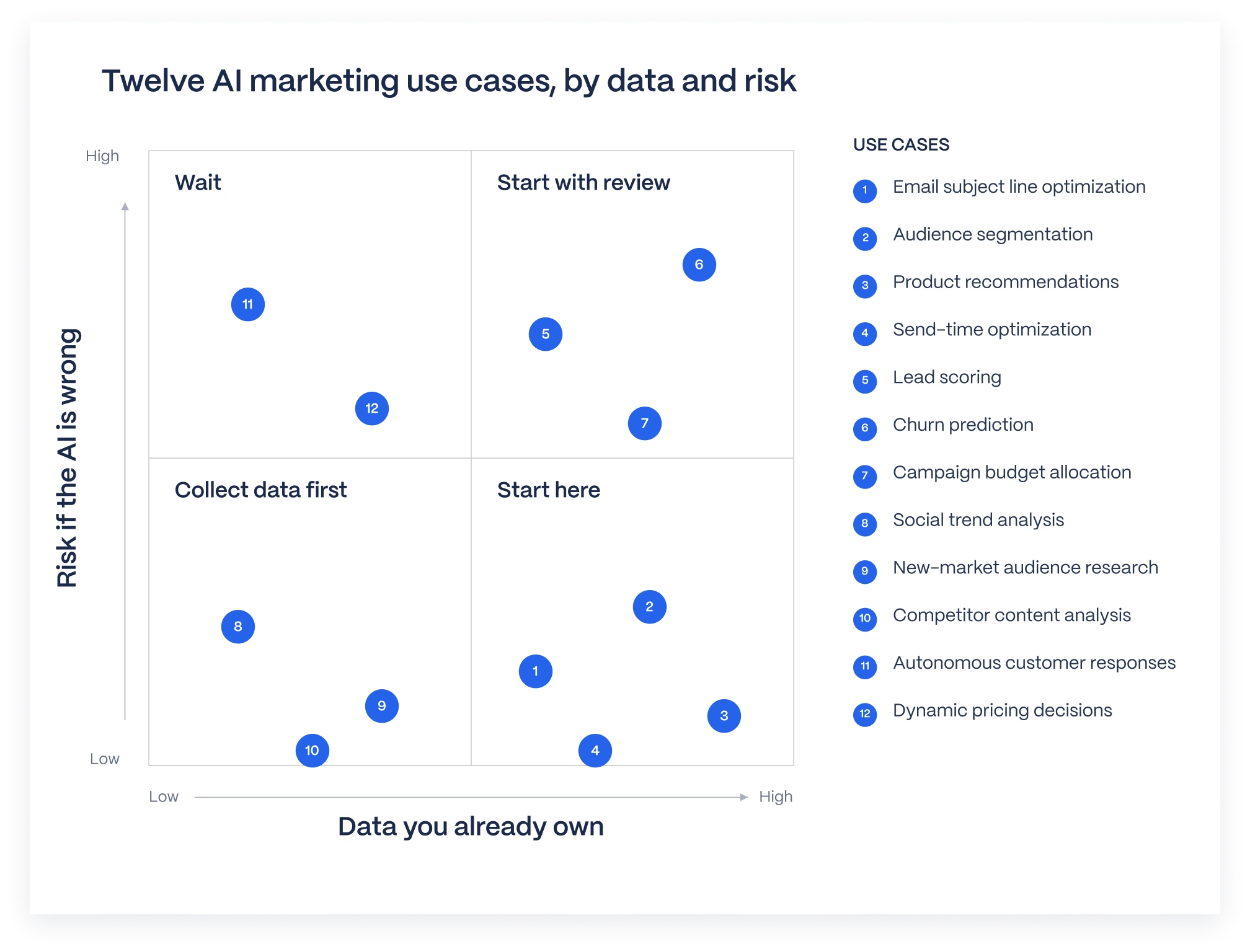
Each use case will have 3 scores:
- How ready is your data?
Do you already have clean data ( transcripts, Search Console history, CRM data with outcome fields)?
- How risky is it?
A draft document that will be edited by someone inside poses minimal risk, but if the AI makes mistakes in an email you send to a customer or when changing bids, you could lose money.
- Who is the decision maker?
This is the person who will approve the output and will be responsible.
Customer data will have the biggest impact on performance. If your CRM data is poor quality or sparse, you will get very confident results from the AI that you shouldn’t trust. As the AI is fluent, it will be hard to tell where it has gone wrong. If your team has 2 years' worth of closed deals and clean outcome fields, then you can use this. However, if your CRM data isn’t complete, then this should be fixed first. Your model will learn about the missing data.
These scores will create the matrix above to group your twelve use cases into 4 categories. The list below is ordered in order of how ready your data is. The first few will require less data and pose less risk, whereas the latter will require more data and pose more risk.
12 AI Marketing Use Cases for B2B SaaS Teams
Below are 12 use cases for B2B SaaS teams. Each explains what AI is used for, the information it requires, the kind of tool it involves, what could go wrong, who's in charge of making decisions, and the key thing to keep an eye on first.
1. Call and Win-Loss Analysis
AI summarizes transcripts of sales and churn calls into recurring objections, named competitors, and stated reasons for winning or losing. The data is recordings or transcripts your team already owns, often from a call recorder such as Gong, so this use case starts with material that exists. A person reading fifty calls misses patterns that a model can group in minutes, though a model can also overstate a theme that appeared twice, which is why summaries should link back to the source call.
Risk: low, because the output stays internal.
Owner: product marketing, who decides which findings change messaging.
First metric: the number of recurring objections documented each quarter, and whether messaging changes can be traced to them.
2. Review Mining for Messaging and Customer Behavior
AI reads review sites and community threads and turns them into the words customers use to describe the problem, the alternatives they considered, and the objections they raised. The data is public and often large, which makes it a good fit for a model. The output feeds messaging, since copy built from customers' own language tends to match how buyers search and talk. It also shows customer behavior that analytics cannot, such as why a buyer ruled a product out.
Risk: low, internal.
Owner: product marketing.
First metric: the number of messaging changes traced to customer language, reviewed each quarter.
3. Competitor Monitoring
AI watches competitor pricing pages, launches, and positioning, then summarizes what changed each week. The data is public pages, and the tool type is scheduled web monitoring paired with a summarizing model. Teams use it to keep battlecards current without a person checking a dozen sites. Summaries should state what changed on the page and avoid conclusions about why, since a model can speculate about intent with no evidence.
Risk: low, though any claim about a competitor that goes into public material needs checking first.
Owner: product marketing.
First metric: how many weekly summaries lead to an action, such as an updated battlecard or page.
4. Content Briefs and AI-Powered Content Creation
AI builds briefs from search results, SERP features, and keyword data, and drafts that a person edits. The data is search and keyword research, plus your messaging and glossary so the draft sounds like your company. Tools in this category include general AI assistants and SEO content tools, and our guides to AI SEO tools and ChatGPT for marketing cover them. The brief should list the statistics a writer needs to find and never supply the numbers itself.
Risk: medium, because the content is public.
Owner: the content lead, who approves every piece.
First metric: edit rounds per piece, and the share of drafts that pass review without factual corrections.
5. Content Refresh From Search Console Data
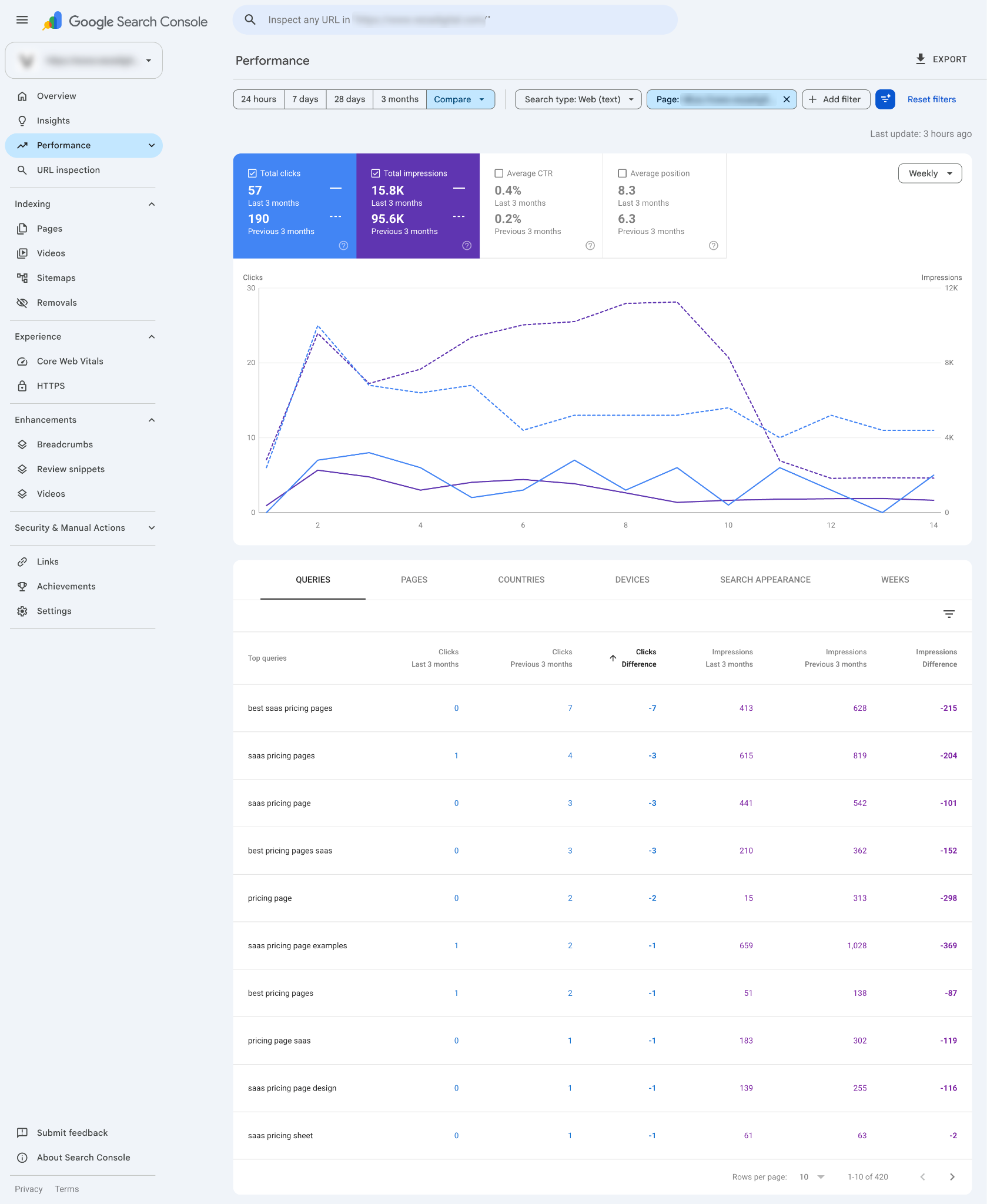
A Search Console page losing clicks
AI finds pages whose clicks or impressions are falling in Search Console and suggests what to update. The data is your own Search Console history, which makes this one of the strongest starting points, since the evidence of a problem is already in the data. A model can compare a declining page with the pages now outranking it and suggest missing sections, outdated claims, or changed intent.
Risk: low to medium, since refreshed pages are public but the pages already exist.
Owner: the SEO lead.
First metric: clicks and impressions on refreshed pages compared with a group of unchanged pages over the same period.
6. AI Search Visibility Tracking
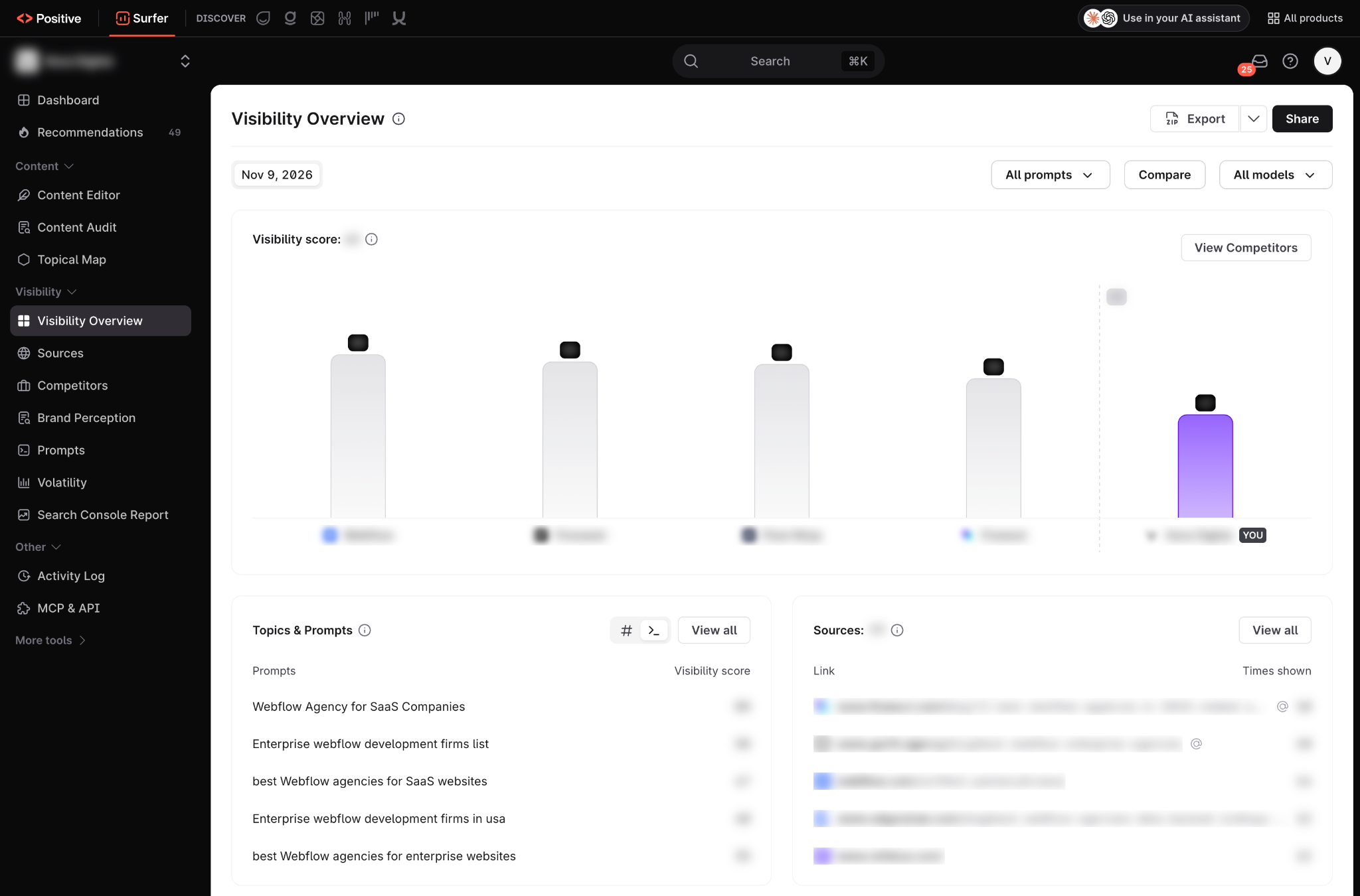
An AI visibility tracker view
AI search visibility tracking checks whether AI answers mention and cite your brand for the prompts your buyers ask. The data is a prompt list that reflects real buyer questions. Several SEO platforms now include this, with different limits and cadences, verified on 29 October 2026. Ahrefs includes 150, 300, or 600 tracked prompt checks a month depending on the plan, updated daily. Semrush One tracks 50 or 100 prompts daily.
Moz AI Explorer tracks 150 or 300 prompts, updated weekly. Mangools includes 500 prompts in every paid plan. Our guide to AI brand visibility tools covers the wider set.
Tracking shows where you stand, and the site decides whether AI answers cite you. That is what WAIO, Veza's methodology for Webflow sites, is built for, and as published on our Concordium case study, LLM sessions grew 363 percent, verified in GA4. That is our own client result and not an industry benchmark. Our answer engine optimization service covers the work.
Risk: low for measurement, though a team can misread a single week's numbers.
Owner: the SEO lead with content.
First metric: the share of tracked prompts where your brand appears and is cited.
7. Predictive Lead Scoring and Account Prioritization
AI scores leads and accounts from historical outcomes and intent signals, so sales spends time where deals are most likely. The data is CRM history with outcomes attached, and enough closed deals for patterns to exist. Many B2B teams have too few, which makes a model's confidence misleading. The tool type is CRM-native scoring or a dedicated platform.
Risk: medium, because the score routes sales time and a bad model sends reps to the wrong accounts.
Owner: marketing operations, with sales.
First metric: the share of closed-won deals that scored in the top tier, compared with your previous scoring rules.
8. ABM Research and Personalized Customer Experience
AI prepares account research and drafts first-pass personalization for target accounts: what the company does, what changed recently, and which of your messages fits. The data is your target account list, firmographics, and public company news. A person edits the drafts, since personalization that gets a detail wrong costs more credibility than a generic message would.
Risk: medium, because the output is customer-facing.
Owner: the ABM lead.
First metric: the reply or meeting rate on personalized outreach compared with generic outreach to similar accounts.
9. Paid Media Creative Testing and Bidding
Two kinds of AI work here. Platform bidding automation in Google Ads and LinkedIn adjusts bids toward a goal you set, and generative tools produce creative variants within character limits for testing. The data is your campaign history and the conversion events you feed back to the platform. The two together can move quickly, which is the reason for caps on both.
Risk: high, because money moves.
Owner: the paid media lead, with budget caps.
First metric: cost per qualified opportunity compared with a holdout campaign that does not use the automation.
10. Lifecycle Email Segmentation and Content Generation
AI proposes segments from product usage and CRM data, suggests send times, and drafts subject line variants and email copy. The data is behavioral and account data from the product and the CRM. Segmentation is the part with the most value, since sending the right message to the right group matters more than polished copy. A person reviews every message that goes to a customer.
Risk: medium. Owner: the lifecycle lead. First metric: conversion on the lifecycle step the email supports, compared with a control segment.
11. Reporting Automation
AI pulls GA4 and Search Console data into a narrative report, so the writing around the numbers does not take a day each month. The data is exports or connections from your analytics tools. The risk is that a fluent paragraph can state a number that does not match the source, so every figure needs a check against the original. Our guide to SEO reporting tools covers what teams use.
Risk: medium, since leadership acts on the numbers.
Owner: marketing operations.
First metric: the share of reported numbers that match the source in a spot check.
12. AI Agents for Campaign Monitoring
An agent watches campaigns across channels, flags problems such as a spending spike or a broken landing page, and recommends changes. The data is campaign and analytics feeds the agent can read. The rule that keeps it safe is approval before any action: the agent recommends and a person decides. Autonomous changes to live campaigns are where errors cost the most.
Risk: high if the agent acts alone, lower when it only recommends.
Owner: marketing operations.
First metric: the share of recommendations a person accepts, tracked next to any that would have caused harm.
Which AI Marketing Use Case to Start With: Match It to Your Data and AI Tools
Start where the data is already owned and the risk is low. That points to call and win-loss analysis (1), review mining (2), competitor monitoring (3), content refresh (5), and reporting automation (11). Each starts from material that exists, keeps the output internal or easy to correct, and gives a team a chance to build review habits before the stakes rise.
Add the review-gated use cases next: content briefs and creation (4), AI search visibility tracking (6), ABM research (8), and lifecycle email (10). These produce output that customers see or that shapes decisions, so they need a named reviewer from the start. Leave the autonomous ones for last. Bidding and creative automation (9) and campaign agents (12) move money and touch live campaigns, and predictive scoring (7) depends on CRM history that many teams have not yet cleaned.
The table above matches what a team already has to a first use case. A team with Search Console and a blog has a ready path into content refresh, and a team with recorded sales calls can begin with call analysis. Tools matter less than this match. For the wider planning question, see our guide to AI marketing strategy. Measuring results is a separate subject from choosing where to start, and this guide stays with the choice.
Guardrails That Keep AI Agents and Automation Safe
Five guardrails apply across the use cases, and they matter most for agents and automation. First, require approval before anything customer-facing or money-moving, so an agent recommends and a person acts. Second, keep logs of automated actions, so someone can see what ran and why. Third, set permissions per tool, giving each agent access to only what its task needs.
Fourth, name an owner for each use case, because an unowned automation is the one that drifts. Fifth, keep personal data out of tools that are not approved for it, and decide in advance which data can go where. Several of these costs, such as review time and data preparation, are easy to overlook, and our piece on the hidden costs of AI covers them. The rules on disclosure, reviews, and AI content that apply to marketing teams are covered in our guide to generative AI in marketing.
Five AI Marketing Use Cases in Practice: Published Examples
These five examples come from public sources and show how practitioners describe their own work. They are described here in our own words, and none of them is Veza's work. Where a source does not say who reviews the output, the table above says "Not stated".
Anthropic's growth marketing team describes using Claude Code with two sub-agents to turn spreadsheets of hundreds of ads into new variations within character limits, and a Figma plugin that makes up to 100 variations per run. That is use case 9. Anthropic makes Claude, so this is a vendor describing its own team's work.
A brand mention tracker built by Hiba Fathima scrapes Reddit, Hacker News, and Twitter every Monday to feed weekly content planning, covering use cases 2 and 3, and Kamil Rextin built an agent that tracks competitor LinkedIn ad placements and writes summary reports, covering use case 3. Both appear in a roundup of practitioners' posts.
Coupler.io's method exports Search Console queries of ten or more words, which mirror how people prompt AI assistants, and layers sales call transcripts and Slack threads to plan content that AI search cites. It covers use cases 1, 5, and 6. Coupler sells the data connector it recommends. Elaine Zelby connected Claude Cowork to HubSpot, Clay, Slack, and email, which is use case 8. For an agency view of building with agents, see our piece on how we build with agents.
Closing
Start with the data you own. Keep a person on every decision.
We help B2B SaaS marketing teams start AI where the data is ready, with a person signing off each step, and every site we build ships on WAIO so AI systems can read and cite it. If you want to pick the first use case together, talk to us.
AI marketing agency
Work With Veza
FAQs
How can AI be used in the field of marketing?
Research, content, search, demand and reporting; name four of the twelve.
What are the key trends in digital marketing for the future?
AI search visibility and agents with human approval; link Generative AI in Marketing once live.
What is the difference between generative AI and agentic AI in marketing?
Generative AI produces content; agents carry out multi-step tasks with tools.
What data does AI need to work in B2B marketing?
CRM history with outcomes, Search Console and analytics, call transcripts, product usage.
Which AI marketing use case should a B2B SaaS team start with?
One built on data you own with low risk, such as content refresh or call analysis.
Can AI replace a B2B marketing team?
No: it takes over defined parts of jobs; people own decisions.
How do you measure an AI marketing use case?
A baseline, a control and one first metric; link AI Marketing ROI once live.
What are the risks of AI in marketing?
Wrong outputs, privacy, brand drift and unreviewed automation.