.jpg)
Marketing operations usually becomes visible once something stops moving.
Campaigns sit in queues. Reports produce competing answers. Tools pile up without clear owners. Senior marketers spend their time administering systems instead of doing the work they were hired to do.
For B2B SaaS leaders, this makes the useful questions less about defining marketing ops and more about deciding what it should own, where its boundaries sit, and which bottlenecks justify building it in the first place.
What Marketing Ops Owns, and What It Should Refuse
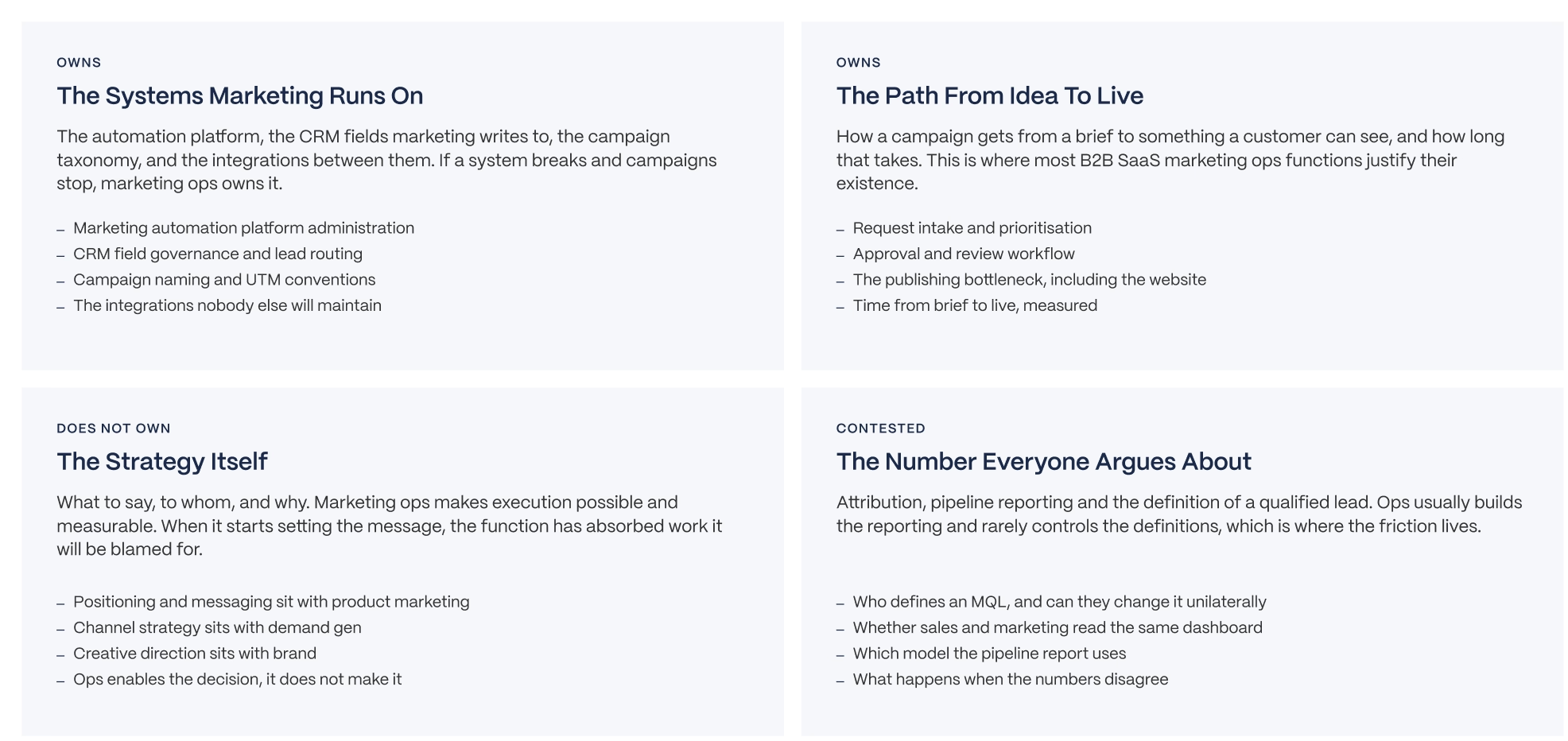
Marketing ops sits between strategy and execution. Its job is to ensure the systems, processes and handoffs behind marketing are fully functional, while making execution more measurable.
This can create a problem with scope, where almost anything operational can drift toward the function. With a lack of clear boundaries, marketing ops can turn into the place where work lands when nobody owns it.
The strongest functions are defined as much by what they refuse as what they take on.
The Ownership Question
Begin with the systems that marketing runs on.
Marketing ops needs to own or govern the infrastructure that is required to execute campaigns reliably: marketing automation, marketing fields feeding the CRM, campaign taxonomy, request intake, lead routing, and the integrations that connect those systems. It also needs to have visibility over the path from an idea being approved to that campaign going live.
The second responsibility matters because a functioning system isn’t valuable if the work is stuck in a queue for two weeks.
The boundary here sits around the decisions themselves. Positioning, messaging, creative direction and channel strategy need clear owners elsewhere in marketing. Ops can make those decisions executable, but absorbing them makes the function accountable for outcomes it wasn’t intended to control.
The middle can be messier. Attribution, pipeline reporting and definitions such as what qualifies as an MQL often cross with marketing, sales, and RevOps. Marketing ops might build the machinery without having authority over the definitions running through it.
For the B2B companies we work with, this is a distinction that impacts how the marketing operation works. Our marketing strategy services might shape what needs to happen, but operational ownership determines whether this strategy moves from decision to execution consistently.
Why This Article is Not a Framework
Marketing operations doesn't need another set of pillars.
There are already Four Pillars, the New Four Pillars, and the Three Pillars. They describe the discipline in different ways, and broadly, they’re all reasonable attempts to organize work that spans technology, data, process, and people.
Adding another framework would provide a neat diagram, but not necessarily help B2B SaaS leaders make better decisions. This is why this guide is organized around ownership and bottlenecks instead.
If you’re trying to decide whether to build a marketing ops function, the useful questions are practical ones. Where is work getting stuck? Which systems lack an owner? Which handoffs are failing repeatedly? Which numbers can’t be trusted? What work is consuming expensive marketing capacity without requiring marketing judgment?
These are questions that expose the operational cost of the current setup. They also prevent you from creating a function because marketing has become complicated, and then handing it every complicated problem. This is a common mistake.
Marketing ops should remove bottlenecks from marketing execution. It should make the machinery more reliable, the handoffs clearer, and the results easier to measure.
The test throughout this guide will focus on what breaks when nobody owns the work.
When to Build the Function
Most companies don’t typically decide to start doing marketing operations. The work already exists.
Someone has to manage the tools, fix broken handoffs, reconcile reports, and chase campaign requests. The point where a dedicated function becomes necessary occurs when work starts consuming capacity or slowing execution.
This means that the hiring decision should begin with evidence of a bottleneck, not an assumption that a growing marketing team needs marketing ops.
Five Signals
Marketing operations is typically taking place long before anyone has a title. The question revolves around whether it’s happening deliberately or being absorbed by whoever has the least resistance to saying no.
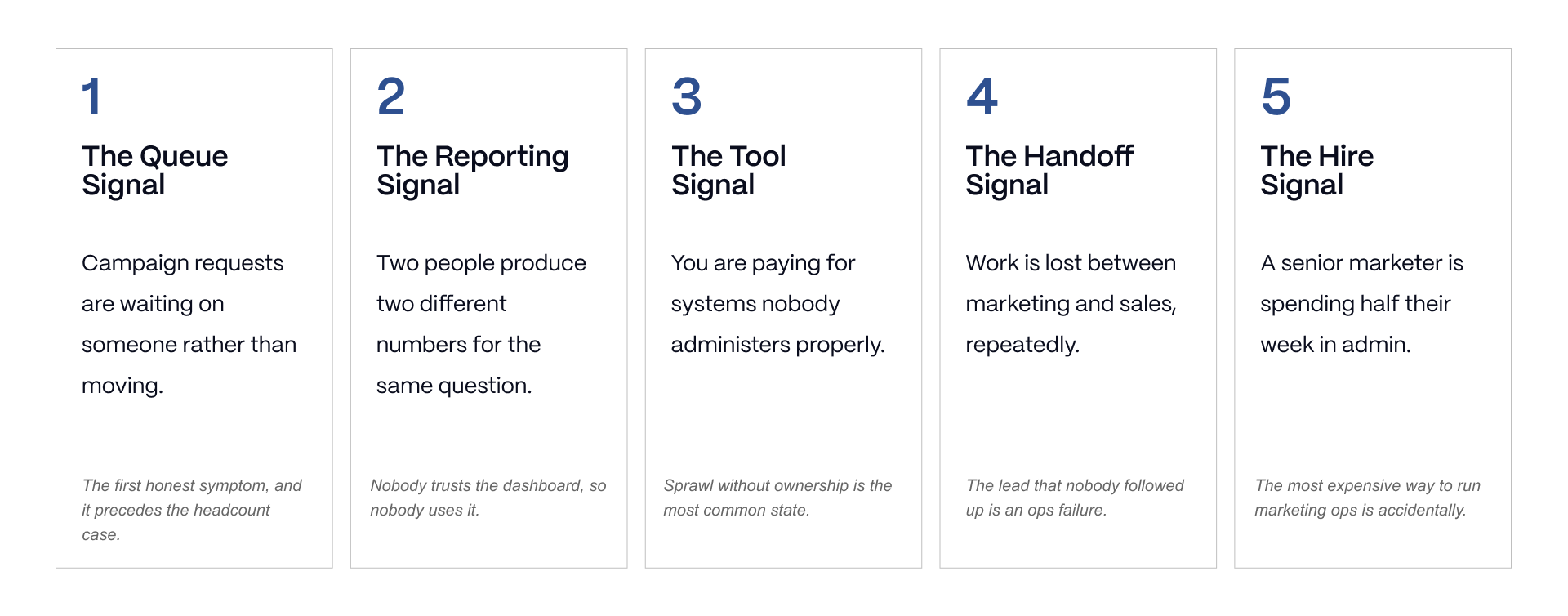
For scaling companies, five signals are incredibly useful.
Campaign requests start queuing behind people as opposed to moving through a defined process. Different people produce different answers to the same reporting question. Tools accumulate without anyone responsible for administering them. Leads or campaign information repeatedly disappear during handoffs between marketing and sales.
There’s also a people problem. Senior marketers start spending a significant part of their week on unnecessary administration.
Any one of these creates friction. Several appearing together suggest the company has a marketing operations function in practice, but no dedicated owner.
The case for hiring marketing ops is strongest when the company can point to examples of operational work that’s already being done badly, or by people whose time is more valuable somewhere else.
When Not to Hire Yet
Not every marketing problem requires an operations hire.
If your campaigns are underperforming because of weak positioning or messaging, better processes can give you systems and the same disappointing results.
Scale is also important. A three-person marketing team running a small tool stack might find they spend more time creating and maintaining a dedicated operations function than what they actually lose in operational friction.
There’s another simple test before adding this role:
Make sure you name the specific bottleneck that this hire is going to remove.
If nobody is able to identify the constraint, the company is hiring to feel more organized, instead of solving a demonstrated operational problem.
The Stack, Including the Layer Nobody Lists
The majority of marketing operations stacks are built around the same core layers. They automate repetitive work, keep data usable, coordinate execution, measure performance, and manage the content marketing produces.
That consensus is useful, but it also leaves a gap. A stack can support every stage of a campaign internally and still fail at the point where that work needs to reach customers.
The Five Layers Everyone Agrees On
Automation handles repeatable activity such as email sequences, lead nurturing and campaign workflows. Marketing ops typically owns or administers the systems, because without that ownership manual work returns and execution becomes harder to scale.
CRM and data give marketing and sales a shared record of leads, accounts, and campaign activity. Ownership is often shared across marketing ops, RevOps and sales ops, but poor governance can make reporting and routing unreliable.
Work management coordinates requests, responsibilities, deadlines and dependencies across campaigns. Marketing ops typically governs workflows, with AI project management tools increasingly lending support to this layer. Without this, intake moves into the likes of Slack and email.
Analytics can transform campaign and customer data into reporting that marketing leaders can act on. Ownership is often shared, but without a dependable analytics layer, teams can spend more time debating numbers than actually using them.
Content and assets provide somewhere to store, govern and reuse the material campaigns depend on. Marketing ops might share ownership with brand and content teams, with the broader B2B SaaS AI stack supporting the way material gets produced.
These five layers cover the majority of the machinery. They don’t necessarily cover the final mile.
The Sixth Layer
Read the technology-stack sections in the marketing operations guides currently ranking for this topic and one omission stands out: the website itself is rarely treated like an operational layer.
Airtable lists project management, automation, analytics and reporting, content and asset management, collaboration, and data and integration platforms. Atlassian focuses on work management and campaign execution, while Claravine focuses on data governance and taxonomy.
That omission makes more sense when you understand the way companies are structured. The website often sits with engineering or design as opposed to marketing operations. Marketing can own the campaign, automation, and reporting, but still have to join a queue when a landing page or website change needs to go live.
Marketing ops then inherits the delay without owning the constraint that causes it.
This is why publishing should be treated as a sixth layer. All the layers above it can function properly, but a lot of the work they coordinate needs to reach customers. If publishing consistently requires another team’s capacity or development cycle, this becomes a binding constraint on marketing execution.
The fix is dependent upon the company, and it might mean changing the CMS, introducing design systems, giving marketing greater publishing rights, changing the relationship between marketing and engineering, or rebuilding the delivery layer completely.
If your company has the website itself as the constraint, enterprise Webflow delivery is one option. The crucial decision comes before choosing your platform: determine whether publishing is actually where campaigns wind up losing time, then fix the infrastructure responsible.
The Contested Middle
The most challenging marketing operations problems tend to sit between teams as opposed to inside a single system. Marketing ops can build the reporting infrastructure and keep the data moving in the right direction. When the definitions that feed these systems are contested, technical ownership will only deal with part of the problem.
Who Owns the Definitions
Marketing ops configures the criteria, builds the fields, and produces the reporting. But then you need to consider who actually makes the decision about what qualifies? Marketing? Sales? RevOps? Can one of those teams change the definition without agreement from the others?
These questions are essential because reporting is dependent upon shared definitions. When these definitions are undocumented, they will often get renegotiated when somebody challenges the numbers. This is the worst moment to discover that two teams have been measuring different things.
Luckily, there is a straightforward diagnostic. Ask two people independently how many qualified leads marketing produced last month. If you get two different answers, investigate before buying another reporting tool. No platform is able to create a single source of truth when people using it haven’t agreed on what the truth means.
Marketing ops can govern the definition once it exists. It shouldn’t be expected to settle the underlying commercial disagreement alone.
The Numbers Ops is Blamed For
Attribution and pipeline reporting create a similar problem. Marketing ops frequently builds the machinery, so it becomes responsible for explaining the output regardless of who chose the assumptions behind it.
An attribution model isn’t a fact discovered by software. Instead, someone decides how credit is supposed to be assigned across touchpoints, and different models can produce different interpretations of the same customer journey.
[ADD “MARKETING ATTRIBUTION TOOLS” → /post/marketing-attribution-tools once article is live - PENDING INTERNAL LINK]
This is a distinction that matters when evaluating B2B analytics tools or interpreting basic measures such as impressions versus clicks. Better tooling can improve collection, analysis and reporting, but it can’t decide which definitions the business needs to use.
Without this agreement, marketing ops winds up defending a number it helped to produce but never actually chose.
The First Ninety Days
The first ninety days of marketing operations should start with finding where execution is already losing time.
This means you need to resist the urge to begin with new tools or redesign every process immediately. Establish where the bottlenecks are, who owns them, and what they’re costing the marketing function before you decide what needs to change.
The Sequence
Start with one number: how long does it take a campaign to move from brief to live?
Take the last ten real campaigns and measure the time between those two points. It’s one of the simplest ways to see how efficiently marketing teams turn decisions into execution, but most teams have never calculated it.
Next, find where that time went. Was the campaign waiting for approval? Creative? Data? A landing page? Someone with publishing access? The total tells you there’s a problem, and the breakdown tells you where to look.
From there, audit the infrastructure around the work. List every paid marketing system and who administers it. Check whether two people can produce the same reporting number. Document how requests enter the team, review campaign naming and UTMs, and make sure you establish who controls definitions.
The most important step here is to identify what marketing can’t ship without another team.
Items one, two and eight in the checklist can be completed in a single afternoon. Together, they create much of the business case for everything that follows because they expose the delay, its source, and the work marketing can’t control.
Many functions do the reverse and begin by buying tools. This can risk adding to the technology before anyone has established which constraint that technology is meant to remove.
What to Avoid
Three mistakes can undermine marketing operations before the function has the chance to work: hiring ops to solve a strategy problem, buying tools to compensate for a broken process, and leaving publishing with no clear owner.
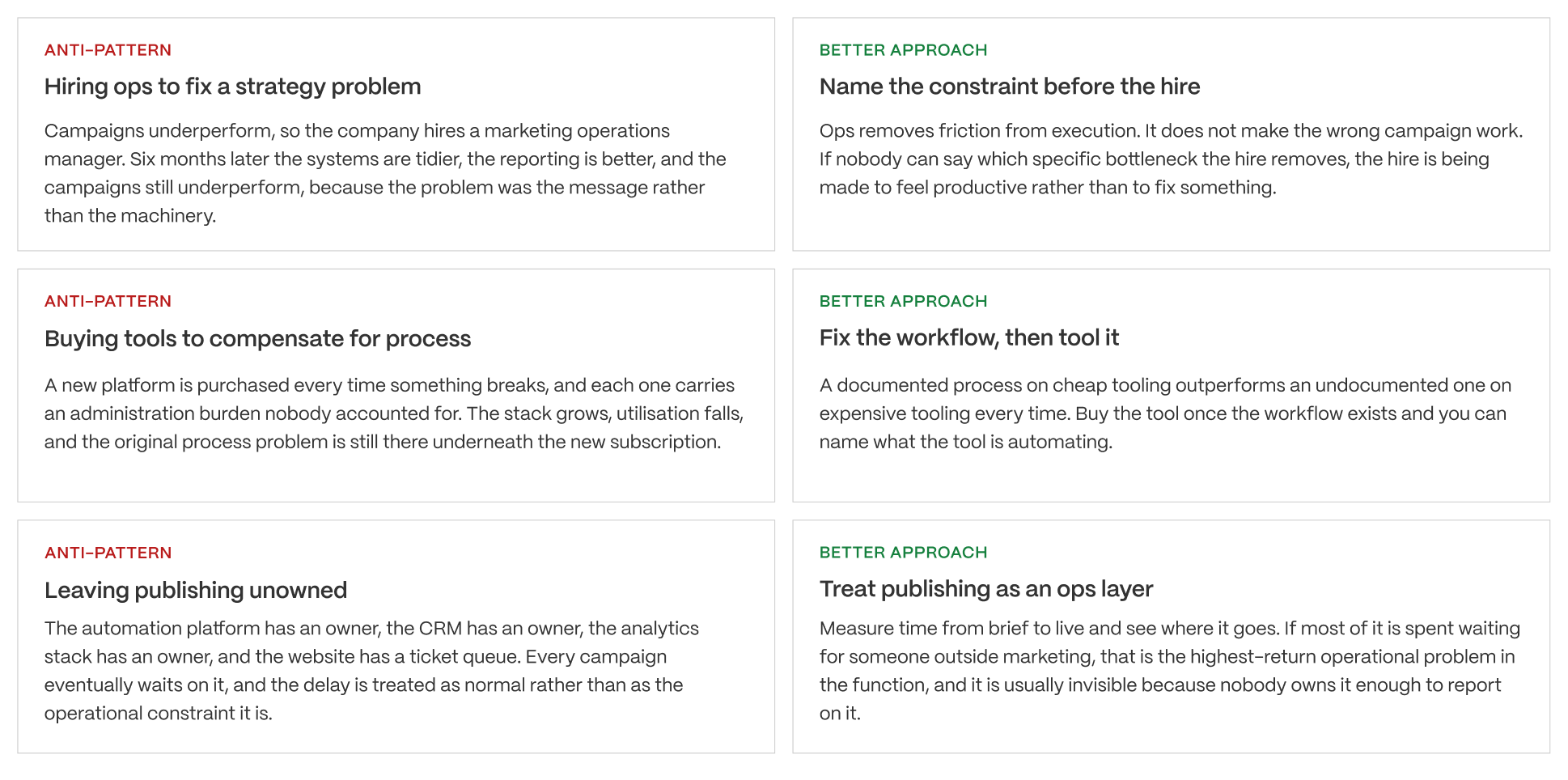
All three make the same mistake, which is addressing something around the bottleneck without actually removing the bottleneck itself.
Understanding how an agency supports B2B growth can help determine where external support makes sense, but ownership still needs to be clear internally.
Marketing operations is ultimately the discipline of removing bottlenecks from execution. The bottleneck worth finding first is the one nobody’s been asked to own.
The bottleneck worth finding is the one nobody was asked to own.
Supporting copy: Most marketing ops problems get diagnosed as tooling problems because tooling is the part with a budget line. The harder ones are structural: a layer of the stack with no owner, a definition two teams read differently, a queue everybody works around rather than fixes. We work with B2B SaaS teams on the execution layer, which usually means making the website something marketing can ship on without filing a ticket. If your campaigns are waiting on somebody rather than moving, that is the conversation worth having.
FAQs
What is marketing operations?
The function that makes marketing execution possible and measurable. It owns the systems marketing runs on, the path from brief to live, and the reporting on both. It does not own strategy, messaging or channel decisions, and functions that absorb those get blamed for outcomes they do not control.
When should a B2B SaaS company hire for marketing ops?
When campaign requests are queuing rather than moving, when two people produce different numbers for the same question, or when a senior marketer is spending half their week on admin. The test is whether you can name the specific bottleneck the hire removes in one sentence.
What does a marketing ops team actually own?
The automation platform, CRM field governance, campaign taxonomy, request intake and the integrations nobody else maintains. In practice the most valuable thing it owns is time from brief to live, because that number is measurable, improvable and almost never tracked.
What is the difference between marketing ops and revenue ops?
Scope. Marketing ops covers the marketing function's systems and execution. Revenue ops covers the whole go-to-market motion including sales and customer success. Smaller companies frequently run one function under either name, and the label matters less than whether the handoffs are owned.
What tools does a marketing ops function need?
Fewer than most stacks contain. Automation, a CRM, work management, analytics and content management cover the standard layers. The more useful question is which of those has a named administrator, because systems without one are where the outages come from.
Why do marketing campaigns take so long to launch?
Usually because of one bottleneck rather than general slowness. Measure time from brief to live on your last ten campaigns and find where the time went. In most B2B SaaS companies the largest bucket is waiting to publish, because the website sits outside marketing's control.
Is the website part of marketing operations?
It should be, and almost no guide treats it that way. Read the tech stack sections of the articles ranking for this topic and the website is absent from all of them, which accurately reflects that it usually sits under engineering. That is exactly why it becomes the constraint.
How do you measure whether marketing ops is working?
Pick one metric the function genuinely influences, not five. Time from brief to live is the strongest candidate because it is measurable, currently unowned, and improvable. Reporting on five metrics nobody acts on is how ops functions become invisible.