.jpg)
Claude and ChatGPT are so close in 2026 that trying to choose between them on headline features does not help you make an informed decision. Instead, for B2B SaaS organizations, the true decision comes with understanding where each of them fits across workloads, teams, existing ecosystems, and AI infrastructure.
This comparison will focus on that decision, asking which platform your business should standardize on, where you should be using both, and what factors, ultimately, change the economics at scale.
The Question Everyone Answers Is Not the One You Are Asking
Most Claude vs ChatGPT comparisons are designed to help an individual choose a chatbot. Organizations face different decisions, because they have to determine which platform needs to become part of their operating environment, which workloads belong there, and whether standardizing on one platform creates greater value than routing work between both. For teams that are evaluating the wider landscape of AI tools for B2B marketing, this is a distinction that matters far more than declaring which chatbot produces the more appealing answer.
What Changed in 2026?
The first reason you need to reconsider the comparison is very simple: both product families have changed considerably.
OpenAI’s GPT-5.6 family reached general availability on 9 July 2026, followed by price reductions for Terra and Luna on 30 July 2026. Anthropic’s current model lineup spans Haiku 4.5, Sonnet 5, Opus 5, and Fable 5, giving organizations multiple performance and cost tiers rather than a single Claude model to evaluate.
The consumer pricing ladders have also converged around broadly similar shapes. Both vendors offer entry-level access, approximately $20 individual subscriptions, and higher-capacity tiers that extend to roughly $100 and $200 per month.
That makes one of the SERP’s favorite comparisons increasingly irrelevant. Saying Claude and ChatGPT both cost roughly $20 per month actually explains very little to an organizational buyer.
The essential differences emerge when examining what happens across hundreds of seats, different workload mixes, API consumption, and the systems already surrounding each platform. Price still matters, but headline subscription price is no longer the decision variable.
Both Clear the Governance Bar
The second difference is more consequential: there’s no clear and obvious governance disqualifier.
Both OpenAI and Anthropic maintain SOC 2 compliance and provide organizational offerings with controls that include SSO, administrative management, business-data protections, and data-residency options. Both also provide business environments where customer data isn’t used to train models by default.
That matters because enterprise AI evaluations frequently become much simpler when one candidate fails security, privacy, or procurement review. Here, neither platform gives the buyer that shortcut.
That contrasts with our Grok and ChatGPT comparison, where governance creates a more meaningful separation between platforms.
For Claude vs ChatGPT, security review remains crucial, but it doesn’t provide the universal answer. Once both platforms clear your organization’s governance requirements, the decision moves downstream into workload, ecosystem, modality, and economics.
The Five Questions That Decide It
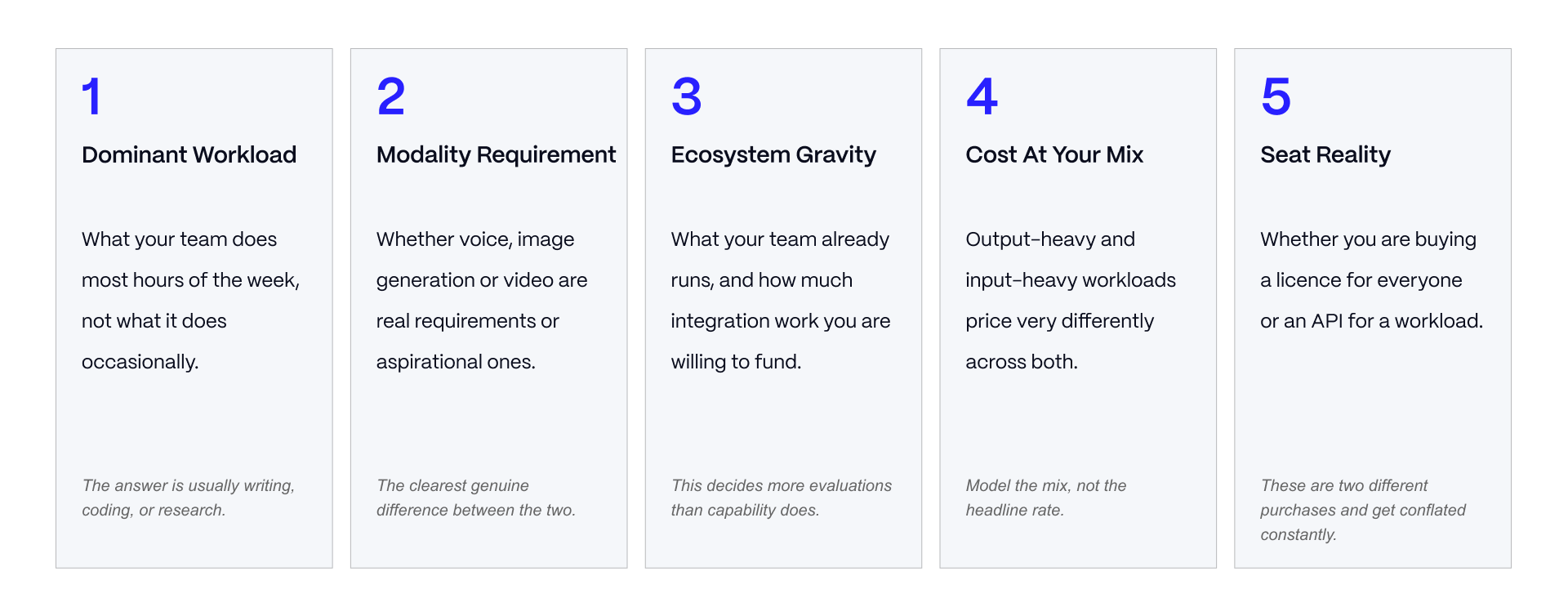
The organizational decision here comes down to five questions:
Dominant Workload: What does your organization actually need the platform to do the most often? Writing, coding, research, analysis, multimodal work, and agentic workflows can all produce different answers.
Modality Requirement: Is text the center of the workload, or do image, voice, video, and other modalities materially impact platform value?
Ecosystem Gravity: Where do your people, data, applications, and workflows already live? Switching costs matter when AI becomes infrastructure as opposed to another browser tab.
Cost at Your Mix: What does your actual combination of seats, models, API calls, and token consumption cost? Headline subscription prices can’t answer that.
Seat Reality: Who genuinely needs premium access, and who can work effectively on lower-cost tiers or routed workflows?
Governance is deliberately absent. It’s not unimportant. It’s absent because both platforms already clear the baseline governance bar for organizational evaluation. Once the threshold is met, these five questions are what actually separate them, and they reflect the same workflow-first approach we use with the AI companies we work with when evaluating where AI belongs in the organization.
Current Lineup and What Each is For
The model names matter less than the jobs that they are designed to perform. Both Anthropic and OpenAI offer multiple capability tiers, which means that organizations should avoid automatically routing every request through the most powerful and expensive model. The better approach is to establish a default for everyday work, then escalate workloads when additional reasoning or performance justifies the cost. For a wider view of the category beyond these two platforms, check out our guide to AI chatbots compared.
Anthropic’s Claude Models
Anthropic’s current Claude lineup spans Fable 5, Opus 5, Sonnet 5, and Haiku 4.5, but most organizations don’t need to treat all four as interchangeable options.
Sonnet 5 is the natural default for broad organizational use, balancing reasoning capability with the speed and economics required for everyday writing, analysis, coding, and knowledge work. Opus 5 sits above it for workloads where deeper reasoning justifies additional cost, including complex technical problems, and higher-stakes analytical tasks.
Haiku 4.5 serves a different purpose. Its lower cost and faster responses make it better suited to high-volume, repeatable workloads where using a frontier model would add expense without creating proportional value. Fable 5 sits above the Opus class for the most ambitious, long-running workloads, including complex coding projects, multi-stage knowledge work, and agentic tasks that can run for extended periods.
Sonnet and Opus-class models support context windows of up to one million tokens, while Haiku 4.5 supports 200,000, and all support image input. Anthropic’s current models also use adaptive thinking, allowing reasoning depth to respond to an effort setting rather than relying solely on fixed thinking budgets.
The practical lesson is simple: Claude is already a routing decision, not a single model purchase.
OpenAI’s GPT-5.6 Family
OpenAI follows a similar tiered structure with its GPT-5.6 family. Sol is the flagship model, with Sol Pro providing a higher-reasoning mode, while Terra targets balanced everyday workloads and Luna prioritizes high-volume work at lower cost.
For most organizations, Terra is more relevant to the Claude comparison than simply asking if Sol is able to outperform Anthropic’s strongest model. Sol and Sol Pro matter when reasoning quality is worth paying for, while Luna changes the economics of repetitive workloads where frontier-level capability is not necessary.
That distinction is missing from many Claude vs ChatGPT comparisons. A genuinely inexpensive model tier means that OpenAI’s cost position depends heavily on workload routing. Comparing only flagship models makes OpenAI appear more expensive than a production environment using Luna for high-volume tasks and escalating only the requests that need greater capability.
Context also varies according to how the platform is purchased. Within ChatGPT, Plus and Business currently support up to 256,000 tokens, while Pro reaches 400,000, with approximately one million tokens available through the API.
That difference is important because an employee buying a ChatGPT seat and an engineering team building on OpenAI’s API are purchasing access to related technology through fundamentally different operating models.
Head-to-Head Reference
The reference table below brings the current models, context windows, consumer tiers, and API economics into one place. It should be treated as a dated purchasing reference as opposed to a permanent specification sheet. Both vendors change models, limits, and pricing frequently enough that every figure should be checked against primary documentation before publication.
The other distinction is even more important: seat pricing and API pricing answer different questions. A $20 employee subscription tells you what interactive access costs. Per-token API pricing tells you what automated production workloads cost. Comparing one vendor’s seat price with another vendor’s API economics produces a number, but not a useful purchasing decision.
Pricing, Including What Claude Max Actually Is
Headline subscription prices make Claude and ChatGPT look more similar than they actually are. The meaningful differences appear when you separate seat access from usage headroom and API consumption. For organizations standardizing AI across different workloads, the question surrounds what each dollar actually buys.
Consumer Tiers Compared
Anthropic’s consumer ladder begins with Claude Free, followed by Pro at $17 per month when billed annually, or $20 month-to-month. Above Pro, Max 5x starts at $100 per month and Max 20x costs $200. ChatGPT offers Free, Go at $8 per month, Plus at $20, and Pro at $100 or $200, alongside Business at $20 per seat per month when billed annually with a two-seat minimum. Enterprise pricing is custom.
Two differences matter more than the broadly similar shape of those pricing ladders.
First, OpenAI has a genuinely low-cost paid entry point. ChatGPT Go at $8 creates a middle ground between free access and a full $20 individual subscription that Anthropic currently doesn’t match. For organizations distributing AI access across larger teams with different usage requirements, that additional tier can materially change seat economics.
Second, Anthropic includes Claude Code and Cowork across every paid tier. That makes the headline subscription comparison less useful for engineering-heavy organizations, because the value of a Claude seat extends beyond conversational access into coding and agentic work.
The cheapest subscription therefore depends on what the employee actually needs to accomplish. Comparing $20 against $20 without comparing the workloads included in those seats misses the more essential purchasing question.
What Claude Max Actually Removes
Claude Max is frequently treated as though it provides access to a more capable version of Claude, but it doesn’t.
Every paid Claude tier reaches the same model family. What Max purchases is additional usage headroom. Max 5x provides five times the usage allowance of Pro within a rolling five-hour session, while Max 20x increases that allowance to twenty times Pro.
The constraint removed here is the session and weekly usage cap, as opposed to the model capability ceiling.
Fable 5 adds another wrinkle. On Max, access to Fable 5 is included up to half of the plan’s weekly usage limits. Beyond that allowance, continued Fable usage is available through metered usage credits. Max therefore provides substantially greater capacity for demanding users, but it shouldn’t be interpreted as buying a better underlying model.
This distinction produces a straightforward purchasing rule: if your team isn’t hitting Claude’s session limits, Max buys you nothing.
For a lot of users considering the $100 Max 5x tier, the first question should be whether Pro is creating a measurable capacity constraint. If it’s not, upgrading means spending an additional $80 per month for headroom that is going unused.
Max makes sense for sustained, high-volume Claude users. It shouldn’t be treated as Claude’s equivalent of paying to unlock a superior model.
API Pricing and a Worked Example
API economics make the comparison more interesting. Claude Fable 5 costs $10 per million input tokens and $50 per million output tokens, followed by Opus 5 at $5/$25, Sonnet 5 at $2/$10, and Haiku 4.5 at $1/$5. OpenAI prices GPT-5.6 Sol at $5/$30, Terra at $2/$12, and Luna at $0.20/$1.20.
Consider a support summarization pipeline processing 30 million input tokens and six million output tokens per month.
For Sonnet 5:
(30 x $2) + (6 x $10) = $120/month
For Terra:
(30 x $2) + (6 x $12) = $132/month
For Luna:
(30 x $0.20) + (6 x $1.20) = $13.20/month
Caching changes the Claude calculation again. If 40% of Sonnet’s 30 million input tokens qualify for the $0.20 cached-input rate, the input calculation becomes:
(18 x $2) + (12 x $0.20) = $38.40 input
Adding six million output tokens at $10 brings the monthly total to:
$38.40 + $60 = $98.40/month
This is where the hidden costs of AI become important. Output tokens cost roughly five to six times more than input across these chat and agent workloads, meaning routing work to the appropriate tier can matter more economically than choosing Claude or OpenAI in the first place.
Where the Difference is Real
Claude and ChatGPT overlap across enough everyday workloads that marginal differences in model performance rarely settle the organizational decision. The more useful comparison is where the platforms differ structurally. Multimodality creates the clearest separation, while coding and knowledge management reveal differences in how each platform fits into the wider operating environment.
Multimodality, the Widest Gap
Multimodality is where the difference between Claude and ChatGPT becomes more difficult to ignore.
ChatGPT includes image generation across its consumer tiers, with tighter limits on Free and greater capacity as users move up the pricing ladder. Voice is similarly available across tiers, while voice with video becomes available from Go upward.
One common distinction which is now outdated is that OpenAI discontinued Sora as a standalone customer experience in April 2026, meaning neither ChatGPT nor Claude currently provides consumer video generation. Comparisons that still position Sora as an active ChatGPT advantage are comparing the platforms as they existed previously, as opposed to operating today.
Claude takes a different approach to visual output. It provides voice mode, and can produce visual material through Artifacts, including diagrams and SVG-based outputs.
That creates one of the few areas where workload can decide the comparison immediately. If teams routinely need to generate or manipulate images alongside text, ChatGPT offers a more complete, multimodal environment. If visual generation is peripheral to the workload, the advantage becomes substantially less important.
The point is not that more modalities automatically make a platform better, but rather that modality requirements need to be established before comparing anything else. A capability your organization uses every day matters more than ten marginal differences in features it rarely touches.
Coding, Closer Than the SERP Says
Coding produces a much less decisive result.
Claude Code is Anthropic’s agentic terminal tool and is included across paid Claude plans, drawing from the same usage allowance as other Claude activity. Organizations can also run it at API rates. OpenAI’s Codex similarly extends agentic coding across ChatGPT tiers, including limited access for Free users.
Both products have moved beyond autocomplete. They can take on multi-step engineering work, inspect codebases, execute tasks, and operate with substantially greater autonomy than an earlier generation of coding assistants.
That makes simplistic benchmark verdicts increasingly difficult to defend. Search results routinely declare either Claude or OpenAI the stronger coding platform by citing different tests, versions, or evaluation conditions. Published SWE-bench Verified results illustrate the problem: Claude Opus 5 has been reported at approximately 96%, while GPT-5.6 Sol results vary between sources and evaluation conditions. Independent testing complicates the picture further, with Snorkel AI’s Senior SWE-Bench placing Claude Fable 5, Claude Opus 5, and GPT-5.6 Sol in a three-way tie at 34.7% on its tasteful pass@1 measure. The evidence supports treating both platforms as frontier coding systems rather than declaring a universal winner.
Market adoption provides a different signal. Menlo Ventures estimates that Anthropic accounts for around 54% of enterprise code-generation spend compared with OpenAI’s ~21%. This is evidence of buyer preference, but not evidence that Claude is the better coding model.
For companies making the decision today, workflow fit, repository environment, developer adoption, and economics are more defensible criteria than declaring a universal benchmark winner. Our guide to the best AI coding tools explores this wider category in greater depth.
Memory Versus Projects
A quieter difference can matter more once either platform becomes organizational infrastructure.
ChatGPT Memory creates continuity automatically across conversations by retaining useful information about an individual user’s preferences and context. That is valuable for personal productivity, but it has an organizational limitation: the memory belongs to the user’s account rather than functioning as shared institutional knowledge.
Claude Projects approach continuity differently. Projects are explicit, shareable containers that combine documents and conversations around a common knowledge base. Instead of content accumulating primarily around an individual, relevant information can be intentionally assembled around the work.
For an organization, that distinction is bigger than a preference between two context features.
ChatGPT’s approach favors individual continuity. Claude Projects favor deliberate portable project context. The better approach depends on whether the knowledge should follow the employee or remain attached to the work.
Once hundreds of employees make use of AI, this becomes a knowledge-governance question: where does organizational context live, who can access it, and what happens to that context when the person who created it moves on?
Governance and Seat Economics
Governance rarely produces a simple winner between Claude and ChatGPT because both platforms clear the requirements that the majority of businesses expect from enterprise AI. The biggest difference lies in where those controls appear in the pricing ladders. Security requirements impact which tier procurement will approve, and this means that governance can alter the true cost of standardization before model usage is even a factor.
Both Clear the Bar, Differently
At headline level, governance coverage is actually incredibly comparable.
Both OpenAI and Anthropic maintain SOC 2 compliance and offer business environments where organizational data for model training isn’t used by default. Both support SSO, while enterprise offerings expand into controls that include SCIM provisioning, audit logs, and role-based access management.
Data residency is available from both vendors. OpenAI publishes support across 10 data-residency regions, which gives multinationals greater control over where customer content gets stored and processed.
The pattern continues in regulated healthcare environments. Anthropic provides a HIPAA-ready Enterprise offering, while OpenAI supports HIPAA requirements via its Enterprise tier.
None of this makes the platforms identical. Individual controls, deployment options, and contractual terms still need to be mapped against an organization’s own security requirements. But those differences increasingly sit at the edges of the evaluation rather than at the gate.
This reinforces the argument from Section 1. Governance matters enormously, but it doesn’t provide a universal Claude versus ChatGPT answer. For most B2B SaaS organizations evaluating these two vendors, both can clear the initial enterprise security bar.
Where Governance Sits in Each Ladder
The more useful comparison lies in how much organizations need to spend before they access the controls they need.
OpenAI separates Business from Enterprise. Business provides the governance baseline many mid-market organizations need, including SSO, SOC 2 coverage, and no training on business data by default. Enterprise adds heavier controls including SCIM, role-based access, encryption key management, and data residency.
This is a distinction that leads some mid-market organizations to reach their governance threshold at approximately $20-$25 per month, instead of instantly moving to a custom Enterprise agreement.
Anthropic follows a broadly similar progression. Claude Team includes SSO and no training on organizational data by default, while Enterprise introduces the heavier administrative and security controls required by more complex companies.
The practical instruction here lies in identifying the tier your currency security review actually requires before modeling seat economics.
Teams regularly calculate AI budgets around the subscription tier their employees want. Procurement might ultimately need a different one. If SCIM, advanced access controls, residency, or other enterprise requirements force an upgrade, that governance tier is the real starting price.
This is a crucial distinction for businesses planning enterprise delivery, where security and procurement requirements need to be designed into technology decisions, as opposed to addressed post-rollout.
What Enterprise Buying Data Shows
Enterprise purchasing patterns suggest that organizations are already moving away from treating AI as a single-vendor decision.
Menlo Ventures estimates that Anthropic now captures roughly 40% of enterprise LLM spend, compared with 27% for OpenAI and 21% for Google. The same research estimates that OpenAI held approximately half of enterprise LLM spending in 2023.
These figures should be understood for what they are: one research firm’s estimate of the enterprise market, rather than an objective measure of the best platform.
What they reveal is a market that is becoming more distributed. Enterprise buyers aren’t simply identifying the strongest general-purpose model and standardizing every workload around it. Different models and platforms are winning different parts of the technology stack based on coding, knowledge work, economics, infrastructure, and other organizational requirements.
This is the larger lesson for a Claude versus ChatGPT decision. Standardization reduces complexity, but trying to force every workload into one vendor creates a different type of inefficiency.
The market numbers here are increasingly the visible result of thousands of organizations reaching the same conclusion: the right enterprise AI strategy might be one standard in which consistency matters, with deliberate routing elsewhere when the workload calls for it.
Making the Decision
By this point in the process, deciding between Claude vs ChatGPT is more like an allocation problem. Both clear the baseline governance bar, both offer frontier-level capability, and both provide multiple tiers for routing workloads by cost and complexity. The final decision here comes down to identifying where the differences matter to your business, and refusing to pay for what you don’t need.
Decision Criteria Checklist
A useful evaluation needs to start with the work as opposed to the platforms competing to perform it. Before standardizing on Claude, ChatGPT, or a combination, you need to consider the answers to the following questions:
- What is the dominant workload? Identify where employees will spend the majority of their AI-assisted time, whether that’s writing, coding, research, analysis, or multimodal work.
- Does modality materially affect the decision? Determine whether image generation, voice, or visual workflows are essential requirements rather than occasional conveniences.
- Which ecosystem creates less friction? Consider where your data, applications, repositories, and existing workflows already live
- What does each option cost at your actual usage mix? Model seats and API consumption separately, including the effect of routing high-volume work via the use of cheaper models.
- Which tier will procurement actually approve? Map governance requirements to the subscription tier needed to satisfy them before comparing headline prices.
Questions one, two, and five decide most evaluations. The remaining criteria refine the answer by revealing where integration friction or workload economics might mean the need for a change in allocation.
Common Decision Mistakes
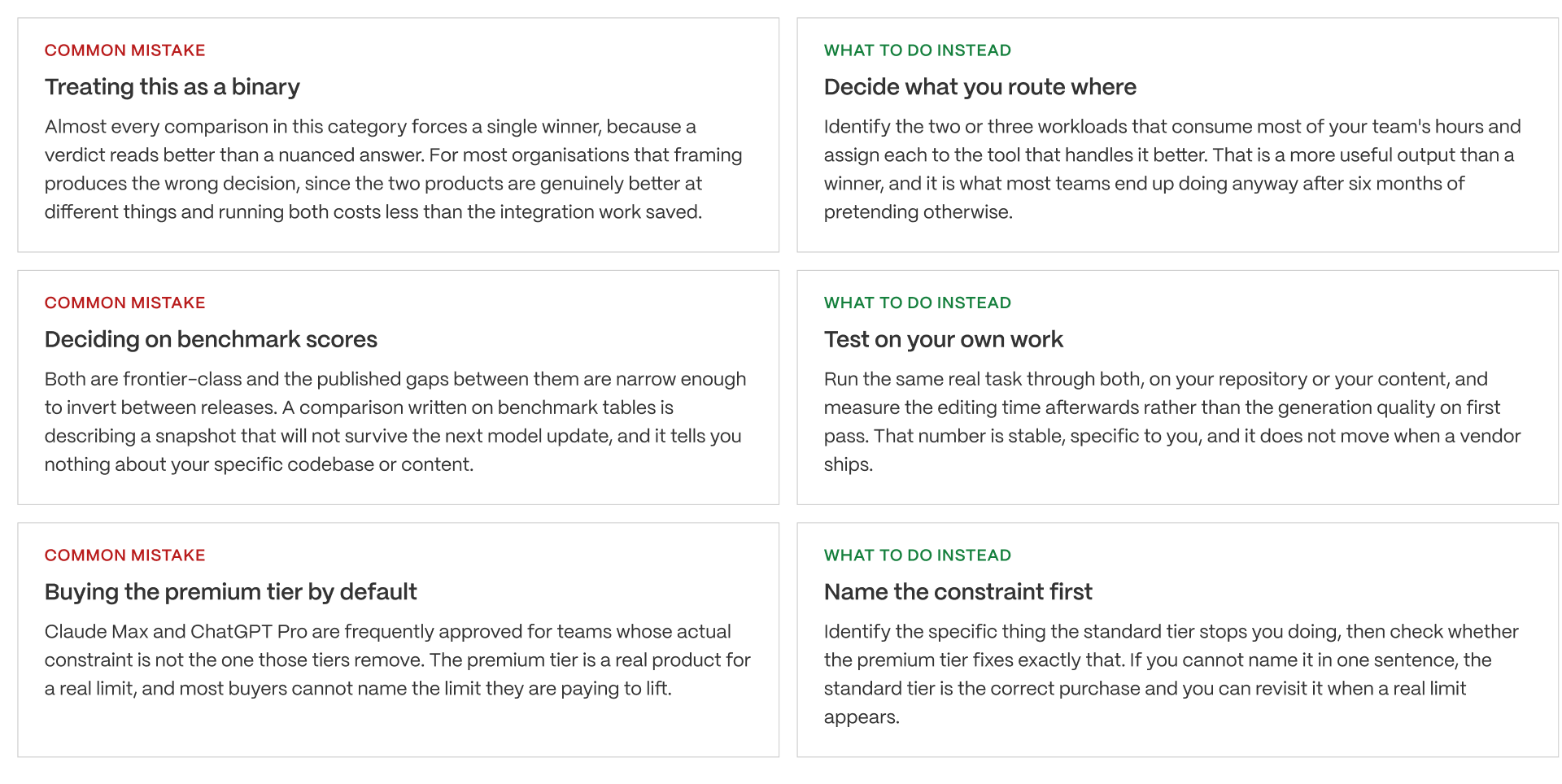
The first mistake that is commonly made is treating the Claude vs ChatGPT decision as a binary one. Much of the comparison content surrounding these platforms assumes that evaluating vendors needs to end with choosing a vendor. But, as this guide shows, this framing is less useful once the different workloads begin to produce different answers.
The second mistake comes with deciding from benchmark scores. Coding evaluations demonstrate why this is unreliable. Results change according to the model version, benchmark, evaluator, agent harness, and testing methodology, while managerial differences will rarely communicate how effectively a platform performs inside its operating environment.
The third mistake is buying the premium tier by default. Claude Max is not necessary if users are not reaching Pro’s usage limits. Similarly, routing routine API workloads through a flagship model is a waste or money when cheaper tiers can perform the role just as effectively.
In each instance, the mistake lies in buying theoretical capability instead of solving a measured organizational requirement.
Decision by Workload
DECISION BY WORKLOAD
Use this as a starting point, not a binding answer. The five-point framework is the real evaluation tool. The workload gets you to the right shortlist.
WORKLOAD 1: LONG-FORM WRITING AND EDITORIAL
- Profile: content teams, documentation, research writing, anything published under the company name
- Top constraints: consistency across length, editorial control, tone stability
- Recommended starting point: Claude
- Why: the difference in editorial consistency over a long document is one of the two genuine gaps in this comparison. It shows up in how much editing a draft needs rather than in how good the first paragraph is, which is why it does not appear in benchmark comparisons.
The verdict: a real difference, narrowing over time, currently still worth deciding on.
WORKLOAD 2: MULTIMODAL AND VOICE
- Profile: teams producing visual content, or anyone who needs voice as a working interface rather than a novelty
- Top constraints: image generation quality, voice interaction, breadth of modality
- Recommended starting point: ChatGPT
- Why: this is the clearest and widest genuine difference in the comparison. Claude handles text and image input; ChatGPT offers voice mode and image generation. If either is a real requirement, the decision is effectively made before you evaluate anything else.
The verdict: the most decisive single dimension in the article.
WORKLOAD 3: SOFTWARE ENGINEERING
- Profile: engineering teams using AI assistance at meaningful volume
- Top constraints: multi-file handling, repository context, output reliability
- Recommended starting point: test both, seriously
- Why: both are frontier-class here and the published benchmark gaps are narrow enough to invert between releases. Claude Code and Codex are both credible. The variable that matters is your codebase, its conventions and its size, and no published comparison can tell you how either performs against those.
The verdict: the one workload where reading a comparison is genuinely insufficient.
WORKLOAD 4: RESEARCH AND ANALYSIS
- Profile: analysts, strategists, anyone synthesising across many sources
- Top constraints: source handling, citation reliability, long-context reasoning
- Recommended starting point: close, with a slight edge to whichever has the research tooling your workflow needs
- Why: both handle long context well and both have research modes. The differentiator is usually integration with where your sources live rather than raw reasoning quality. Be honest that this is a narrow gap.
The verdict: too close to decide on capability. Decide on workflow fit.
CROSS-WORKLOAD: THE HYBRID POSITION
- Profile: most B2B SaaS organisations above about twenty people
- Top constraints: seat cost, routing complexity, prompt portability
- Recommended starting point: both, routed by workload
- Why: the seat cost of running both for the teams that need each is frequently lower than the productivity cost of forcing one tool onto a workload it handles worse. This is what most organisations arrive at eventually, and arriving there deliberately is cheaper than arriving there after two migrations.
The verdict: the honest answer for more organisations than the category is willing to say.
PRINCIPLE
Every other comparison in this series has a gate in it. DeepSeek has a compliance gate. Grok has a verification and brand adjacency question. This one has neither, because both vendors clear the enterprise bar, and that changes what the article is for. There is no risk to route around here, only fit to match. Which means the useful output is not a winner but an allocation, and any comparison that hands you a single name has skipped the work.
The final decision becomes clearer once platforms are allocated according to workload instead of ranked in the abstract.
Long-form writing and editorial: Claude is a strong candidate when sustained text-based knowledge work, document context, and deliberate project organization dominate the workload. For companies building AI deeply into editorial campaigns, the wider question becomes, how the platform fits into a wider AI content strategy.
Multimodal and voice: ChatGPT has the clearer advantage when image generation, voice, and visual interaction are regular parts of the workflow. This is one of the few requirements that can materially narrow the decision before economics enters the discussion.
Software engineering: Treat this as an environment and adoption decision rather than a benchmark contest. Claude Code and Codex are both capable agentic development systems, so repository fit, developer preference, workflow integration, and actual usage economics should determine allocation. Organizations using agents beyond engineering need to make the same distinctions.
Research and analysis: Both platforms are viable. The better choice depends on the type of research, context requirements, existing ecosystem, and how outputs need to be shared or retained across the organization. For teams using AI to support search and discovery workflows, the same allocation principle applies to adjacent disciplines such as answer engine optimization, where workflow fit matters more than simply choosing the model that is the most capable.
Hybrid: For many B2B SaaS organizations, this is the most logical outcome. Standardize where consistency, governance, and procurement simplicity create value, instead of deliberately routing workloads elsewhere when other platforms also provide a meaningful advantage.
Every other comparison in this series has a gate somewhere in the evaluation. Claude vs ChatGPT doesn’t. Neither platform fails the baseline requirements strongly enough to make this decision for you.
This changes what useful comparisons should be producing, and the answer here is an allocation instead of a winner. Any comparisons that give organizations the same name have ultimately skipped the most crucial and essential part of the decision.
Standardising on one is a decision. Standardising by accident is not.
Most organisations end up running both of these, and most get there by drift rather than by decision. Teams buy what they prefer, the finance team notices eighteen months later, and nobody can say what the stack is for. We work with B2B SaaS teams on the layer underneath the tool choice: what the workload actually costs, what procurement will approve, and how the whole thing supports the growth motion it is meant to serve. If you are making this decision now, it is cheaper to make it deliberately.
FAQs
Which is better, Claude or ChatGPT?
Neither, consistently. Claude is stronger on long-form editorial consistency and holds roughly half the enterprise code generation market. ChatGPT is stronger on multimodality, with image generation and voice that Claude does not match. For most organisations the honest answer is to route by workload rather than standardise on one, which is what enterprise buying data suggests is already happening.
Is Claude better than ChatGPT for writing?
For long-form work, generally yes. The difference shows up in how much editing a draft needs across a full document rather than in how good the opening paragraph is, which is why it rarely appears in benchmark comparisons. For short-form, social and multimodal content, ChatGPT's breadth usually matters more than the editorial gap.
Is Claude Max worth it?
Only if your team is hitting usage limits. Max is not a model upgrade, and every paid Claude tier reaches the same models. Max 5x gives five times Pro's allowance per rolling five hour session and Max 20x gives twenty times. If you are not hitting session caps on Pro, Max buys you headroom you will not use.
How much do Claude and ChatGPT cost?
Both ladders converged in 2026. Claude runs Free, Pro at seventeen to twenty dollars monthly, and Max at one hundred or two hundred. ChatGPT runs Free, Go at eight, Plus at twenty, and Pro at one hundred or two hundred, with Business at twenty per seat annually. OpenAI's eight dollar tier has no Claude equivalent.
Which is cheaper on the API?
It depends on the tier, not the vendor. Claude Sonnet 5 at two and ten dollars per million tokens sits close to GPT-5.6 Terra at two and twelve. GPT-5.6 Luna at twenty cents and one dollar twenty undercuts everything for workloads that tolerate it. Output rates dominate chat and agent workloads, so model the mix.
Which is better for coding?
Closer than most comparisons suggest. Both ship agentic coding products, Claude Code and Codex, and published benchmarks contradict each other because results are quoted without provenance. Menlo Ventures estimates Anthropic holds around fifty four percent of enterprise code generation spend, which reflects buyer preference. Test on your own repository.
Can Claude generate images?
No, not in the way ChatGPT does. Claude produces visual output through Artifacts, diagrams and SVG rather than photorealistic image generation, and it has a voice mode but not ChatGPT's voice breadth. If image generation is a requirement, that decides the question before anything else is evaluated.
What is the difference between ChatGPT Memory and Claude Projects?
Memory is automatic and personal, stored per user across conversations. Projects are explicit and shared, holding documents and chats against a common knowledge base. For an individual, Memory is more convenient. For a team standardising a tool, Projects is the better home for institutional knowledge because context is deliberate and portable.
Are both safe for enterprise use?
Yes, both clear the bar. Both hold SOC 2, offer no-training defaults on business tiers, SSO, admin controls and residency options. That is genuinely different from some comparisons in this category where one vendor is disqualified on compliance. Check which tier carries the controls your security review requires, because it may be above the one your team wants.
Should we use both?
For many organisations, yes. The seat cost of running both for the teams that need each is frequently lower than the productivity cost of forcing one tool onto a workload it handles worse. Enterprise spend data suggests most large organisations have already reached this position. Arriving there deliberately costs less than arriving after two migrations.