.jpeg)
Most of the answers to the question “Grok or ChatGPT?” that you can find online can be confusing. Some comparisons cite business deals that never happened. Others claim that ChatGPT can create video, when technically, it cannot.
In this article, we’ll verify the details of each model, including pricing, capabilities, and available options, using information directly from both companies’ official websites. If a particular detail is not explicitly stated by the provider, we’ll make that clear.
There’s another problem with many of the existing Grok vs. ChatGPT comparisons: who they are written for. They are rarely framed from the perspective of someone leading a marketing or engineering team.
If you are responsible for deciding which of these two models your company will rely on, you care about governance, the actual costs, and whether the vendor’s public reputation could become something your team has to explain to customers. This article treats those questions as key topics, not as afterthoughts.
What You Are Actually Choosing Between
The Current Lineup, Verified
Let’s start with information that is available right now.
xAI's Grok 4.5 became the flagship model on July 8, 2026. It has a 500,000-token window, which is a way of measuring how much text the model can hold in its head at once.
Grok 4.3, an earlier model, has a bigger window at 1,000,000 tokens, and it costs less to run.
That is a little unusual, showing that newer is not always bigger here.
OpenAI's GPT-5.6 family reached general release on July 9, 2026. It comes in three versions: Sol, Terra, and Luna, each built for a different budget and workload.
If you find any comparison naming other model versions, keep in mind that market no longer exists.
What Each One Actually Wins
Each tool has its purpose, strengths, and weaknesses. In the following lines. we will break down Grok and ChatGPT in terms of what they are generally better at.
Grok is narrowly better for live social media data, since it can pull information from X in a way ChatGPT cannot match. You get “live research” happening in front of you where the model reads hundreds of sources before generating an answer.
Grok also wins on video generation, mostly because OpenAI shut down its consumer video tool.
When it comes to ChatGPT, this model wins clearly on governance and compliance depth, which matters a lot for a company going through a security review.
ChatGPT has better coding performance backed by real, published test results, rather than performance claims nobody can check.
Speaking of the current pricing for most usage patterns, Grok tends to win on cost at high volume.
Neither tool wins across the board, and that is the honest answer.
The Five Questions That Decide It
Before we deal with pricing and features in more detail, the next five questions help most companies decide right away.
- Does the tool meet all of your compliance and data security needs?
- Is there potential for this platform to pose a brand risk that may have to be addressed by you with your customer base?
- Are you really going to use actual time-sensitive information coming in from the internet, or are you using social media as an archival method, so you do not have to provide "real time" access to this type of information?
- How much is the product at your usage levels, vs what was stated initially?
- Is there documentation to support these claims, rather than statements made about performance?
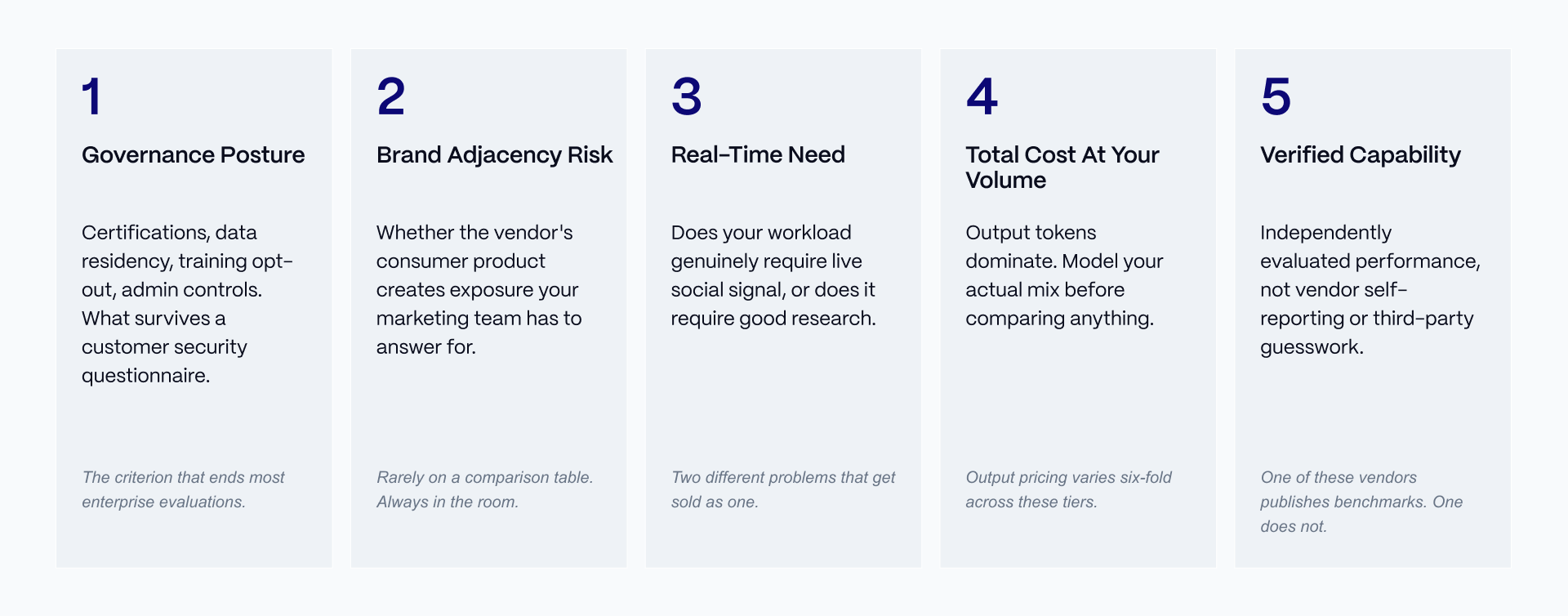
Governance comes first for this audience for a simple reason. It is not one factor among many, but a gate. If a tool fails your company's security review, none of the other questions matter, so it makes sense to check that one first.
If you are weighing this decision against your wider marketing technology stack, our guide to AI tools for B2B marketing teams covers where tools like these fit into a growth motion. This kind of evaluation is part of how we approach SaaS growth marketing for the companies we work with.
Capability, Honestly Assessed
Real-Time X Access, Mechanically
This is the most overstated feature on the entire topic, so it is worth explaining exactly how it works.
Grok has a developer feature called x_search. When a request calls for it, the tool searches public posts on X by keyword, by meaning, or by user, and it can pull full conversation threads. You can limit the search to a list of up to twenty accounts, exclude another list of up to twenty, and set a specific date range. It can also read images and video attached to posts if needed.
This costs $5 for every 1,000 calls.
To clarify, this is not a "live" feature where you get a constant, real-time view of everything happening in the world. The tool finds information in response to each call. Public post data only, so data from private accounts and deleted posts will not be accessible. Testers (independent of xAI) report finding the results in approximately 30 to 60 vseconds, so use this as a rough guide rather than a guaranteed timeframe.
ChatGPT's equivalent is web browsing and a feature called Deep Research, which is more built out for structured research with clear citations. It does not have anything like Grok's connection to a live social network.
Video and Image Generation
Here is the single biggest factual error showing up across current comparisons.
Sora, the video-generating AI from OpenAI, was closed to consumers on April 26, 2026. They also announced that the Sora API will be discontinued on September 24, 2026. Today, there is no video generation tool from ChatGPT accessible to the general public.
On the other side, Grok Imagine has been launched (currently functional with paid access), generates video, and is priced at $0.05-$0.25/sec of video generated based on resolution.
Regarding images, OpenAI recently introduced a new image model called GPT-Image 2 on April 21, 2026. This comparison review states that many other reviews are using an older image model, which was previously removed in favor of GPT-Image 2.
Context Window and Coding
To recap the memory sizes: Grok 4.3 holds 1,000,000 tokens, Grok 4.5 holds 500,000, and GPT-5.6 is reported at roughly 1.05 million tokens (this last figure is not confirmed on OpenAI's own page, so treat it as an estimate rather than a fact). On xAI's side, using more than 200,000 tokens at once costs double the normal rate.
On coding ability, OpenAI has published its own first-party test results for GPT-5.6, and other researchers have independently tracked those results over time. xAI has not published its own coding benchmark for Grok 4.5. The numbers floating around online come from outside researchers, and they do not agree with each other.
That does not mean Grok is worse at coding. It means there is no solid, checkable evidence yet, and a buyer cannot act on a claim nobody can verify. If coding performance matters to your decision, the honest move is to run your own test on your own codebase rather than trust either set of claims.
Pricing and Tiers
Is Grok Free, and What Does Free Mean
Yes, Grok has a free tier. It includes real-time web and X search with limits, a voice mode, and some connected tools, though usage is capped.
Here is what is worth being honest about.
xAI does not publish an exact message limit for the free tier on its own pricing page. A commonly repeated number, ten prompts every two hours, was apparently retired around June 2026, so treat that figure as outdated rather than current. Free image generation was also moved behind the paywall around March 2026.
SuperGrok and the Paid Tiers
SuperGrok costs $30 a month. This is confirmed directly on xAI's pricing page. It includes Grok 4.5, higher usage limits, a feature called Expert, and image and video generation.
xAI also lists two more tiers, SuperGrok Lite and SuperGrok Heavy, but does not show a price for either one on its own page. Figures commonly quoted for these two tiers (often around $10 and $300) are not confirmed by xAI directly, so treat them as estimates rather than settled prices.
ChatGPT has more tiers overall: Free, Go, Plus, Pro, Business, and Enterprise.
Note: None of the consumer plan prices for ChatGPT were confirmed directly on a primary OpenAI page during research for this article, so treat any specific ChatGPT consumer price you see, including in this article, as an estimate that should be checked on OpenAI's own site before you rely on it.
For teams producing a high volume of content with these tools, our piece on SaaS SEO covers how to manage output quality at scale.
API Pricing and a Worked Example
Numbers speak louder than tier names here, so here is what the developer pricing actually looks like, in dollars per million tokens (input and output separately).
Grok 4.5 costs $2.00 to send text in and $6.00 to get text back. Grok 4.3 costs $1.25 in and $2.50 out. A smaller Grok model, called grok-build-0.1, costs $1.00 in and $2.00 out.
On OpenAI's side, GPT-5.6 Sol costs $5.00 in and $30.00 out. Terra launched at $2.50 in and $15.00 out. Luna launched at $1.00 in and $6.00 out. On July 30, 2026, OpenAI cut Terra's price by about 20 percent and cut Luna's price by about 80 percent, so those launch numbers are already out of date.
Here is what that means with real numbers.
Picture a company sending 50 million tokens in and getting 10 million tokens back in a month. On Grok 4.3, that runs about $87.50. On Grok 4.5, about $160.00. On GPT-5.6 Terra at its original launch price, about $275.00. On GPT-5.6 Sol, about $550.00.
One more cost most comparisons miss entirely: xAI charges separately for tool calls like the X search feature, at $5 per 1,000 calls. If your use case involves a lot of real-time lookups, your actual bill will run higher than the token pricing alone suggests. For more on managing this kind of cost against real output, see our guide on SEO foundations for B2B SaaS.
Modeling AI cost against a real workload, not just a price sheet, is work we do with clients as part of SaaS growth marketing.
Governance and Brand Risk
This section matters most for a company that has to get a tool approved before anyone can use it.
Certifications and Controls Compared
OpenAI holds SOC 2 Type 2 certification along with ISO 27001, 27017, 27018, and 27701. It also holds CSA STAR certification and PCI-DSS for handling payments. It offers data residency options, admin audit logs, a compliance API, and the ability to bring your own encryption key.
xAI states on its own pages that it holds SOC 2 Type I and Type II.
It offers Grok Business at $30 per seat, and a Grok Enterprise tier with custom single sign-on, directory syncing, and account provisioning. It also offers an add-on called Vault, which gives a company its own encryption keys and a dedicated, separated environment for its data.
The honest summary: xAI has a real, improving enterprise product, and OpenAI currently covers more certification ground overall.
Data Handling and Training
Both companies say they do not train their models on your company's private data.
OpenAI states it does not train on business or API data by default, and it deletes removed data within 30 days when an admin requests it.
xAI states that Business tier data stays private and is never used for training, and Enterprise customers can set custom data retention rules.
Here is the practical step worth taking either way: ask for the current SOC 2 report and data processing agreement under a non-disclosure agreement, rather than relying only on what a marketing page says. A signed audit report and a claim on a website are two different things.
Brand Adjacency
This is the consideration almost no comparison covers, and it is the one a marketing leader will actually get asked about.
Here are the facts as reported, stated plainly and without added opinion. On January 16, 2026, the California Attorney General's office sent xAI a cease-and-desist letter about nonconsensual intimate deepfake images, citing specific sections of California's civil and penal codes.
Regulators in the EU and India also opened reviews of the same issue in early 2026. In response, xAI put image generation behind a paywall and added safeguards, including prompt filters and checks after an image is generated.
Here is the strategic point worth weighing, stated neutrally. Restricting a feature on the enterprise product does not automatically separate your company's brand from the public conversation about the consumer product. That is a factor to think through when picking a vendor, not a verdict on which one to choose.
Building engineering standards that hold up under a real security review is part of how we approach enterprise delivery with clients.
Where Each One Fits
Where Grok Genuinely Wins
Grok is a strong fit for market and social monitoring, tracking a product launch as it unfolds, catching an early sign of a PR problem, watching what competitors are saying, and spotting a trend before it peaks.
It also tends to cost less at high volume, mostly because of how output pricing is structured. And it currently has video generation built in, since ChatGPT does not.
Picture a concrete example. A team wants to track mentions of a competitor's product launch across X in real time, pull the most relevant threads, and summarize sentiment every few hours. Grok's search tool is built for exactly this kind of workflow.
Where ChatGPT Genuinely Wins
ChatGPT is the stronger choice for anything customer-facing that will go through a security review, for research work that needs to cite its sources clearly through Deep Research, for coding work backed by evidence you can check, and for a wider range of supported formats overall.
The strongest single argument for ChatGPT is the quality of the proof behind it. Published, checkable performance results and published certifications are things a buyer can actually verify, not just take on faith. Evaluating output quality at this level of detail is part of our SEO practice when we assess any AI tool for a client.
Running Both
For many companies operating at scale, the honest answer is to use both tools, each for what it does best.
Route social monitoring and cost-tolerant, high-volume work to Grok. Route customer-facing work and anything compliance-sensitive to ChatGPT.
Worth noting: running two tools adds real overhead, both in the extra system you need to connect them and in the extra evaluation work of managing two vendors. There is also a genuine upside beyond capability.
Since both companies changed their prices within weeks of each other this year, spreading your usage across two vendors reduces how exposed you are if one of them raises prices again. Just make sure that benefit is worth the added complexity before you commit to it.
Making the Decision
Decision Criteria Checklist
The first three questions on this checklist decide the outcome for most B2B SaaS companies: does it pass governance, does it carry brand risk, and do you actually need real-time data. Answering those first saves you the trouble of modeling costs for a tool your security team was always going to reject.
Common Decision Mistakes
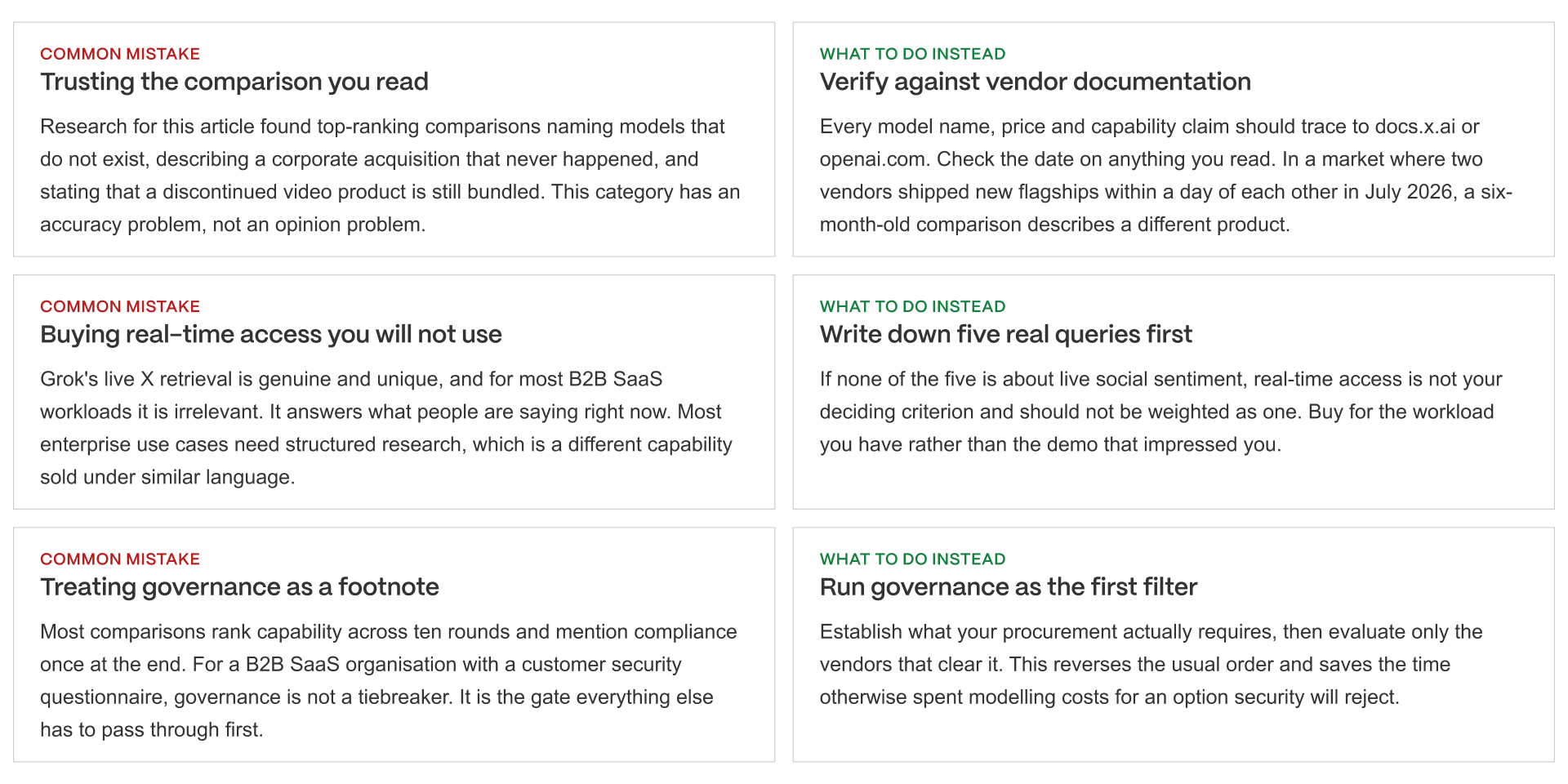
The first mistake on that list is unusual to call out directly, but it is the most useful thing in this entire article: do not trust a comparison, including this one, without checking the underlying vendor pages yourself before you make a decision.
The other two mistakes are just as costly. Buying a real-time feature you will not use adds cost for nothing, and treating governance as something to sort out later instead of first is how a project gets rejected after the budget is already spent.
Decision by Use Case
DECISION BY USE CASE
Use this as a starting point, not a binding answer. The five-point framework is the real evaluation tool. The use case gets you to the right shortlist.
USE CASE 1: CUSTOMER-FACING PRODUCT FEATURES
- Profile: B2B SaaS shipping AI features that customers touch, subject to security review
- Top constraints: certifications, data residency, training opt-out, contractual guarantees
- Top use cases: in-product AI, anything a customer questionnaire will ask about
- Recommended starting point: ChatGPT on Business or Enterprise
- Why: OpenAI publishes SOC 2 Type 2 alongside ISO 27001, 27017, 27018 and 27701, with mature admin controls and residency options. xAI's enterprise product is real and improving, with SOC 2 Type I and II stated, SSO, SCIM and a Vault add-on, but it does not yet match that certification breadth and it carries brand adjacency considerations a customer may raise.
The verdict: governance decides this before capability is discussed.
USE CASE 2: MARKET AND SOCIAL MONITORING
- Profile: teams that genuinely need to know what is being said right now
- Top constraints: recency, coverage of public social conversation, cost per query
- Top use cases: launch monitoring, competitor tracking, crisis detection, trend spotting
- Recommended starting point: Grok
- Why: the X Search tool provides on-demand retrieval of public posts with handle filtering and date ranges, which no competitor matches. Understand the shape of it: this is retrieval when queried, not an always-on feed, it covers public posts only, and it bills at $5 per 1,000 calls on top of tokens.
The verdict: the one capability where Grok has a real and defensible edge.
USE CASE 3: HIGH-VOLUME INTERNAL WORKLOADS
- Profile: internal tooling, summarisation, classification, no regulated data
- Top constraints: cost per token at scale, particularly output pricing
- Top use cases: bulk processing, internal agents, document handling
- Recommended starting point: Grok 4.3, or GPT-5.6 Luna after verifying its post-cut rate
- Why: at 50 million input and 10 million output tokens per month, Grok 4.3 runs about $87.50 against roughly $275 for GPT-5.6 Terra at launch pricing. Output pricing drives that gap. OpenAI cut Luna by around 80 percent on 30 July 2026, which may reverse it, so verify before committing.
The verdict: the cheapest option changed twice this quarter. Re-run the arithmetic rather than inheriting a conclusion.
USE CASE 4: VIDEO AND VISUAL CONTENT
- Profile: marketing teams producing short-form visual content
- Top constraints: availability, quality, moderation policy fit
- Top use cases: social clips, campaign visuals, concept work
- Recommended starting point: Grok Imagine for video, either for images
- Why: OpenAI discontinued Sora as a consumer product on 26 April 2026, so ChatGPT currently has no first-party consumer video generation. Grok Imagine generates video on paid tiers at $0.05 to $0.25 per second depending on resolution. For images both are capable, with OpenAI's GPT Image 2 launched in April 2026.
The verdict: video is Grok by default rather than by merit, and the position may not hold.
USE CASE 5: LONG DOCUMENT AND CODEBASE WORK
- Profile: teams processing large documents, contracts or repositories
- Top constraints: context window, cost of long context, output reliability
- Top use cases: contract analysis, codebase review, research synthesis
- Recommended starting point: Grok 4.3 for window and cost, ChatGPT for verified coding performance
- Why: Grok 4.3 offers a 1,000,000 token window at lower cost than the 500,000 token flagship, which is counter-intuitive and useful. On coding specifically, OpenAI publishes first-party benchmarks and xAI has not for its current flagship, so the evidence is asymmetric even where capability may not be.
The verdict: split by task. Window and cost favour Grok. Evidence favours ChatGPT.
PRINCIPLE
The question this article is asked is which assistant is better. For a business the question is narrower and more answerable: which one clears your governance requirement, and among those, which is cheaper at your actual token mix. Capability differences between frontier models compress every quarter. Governance posture, cost structure and evidence quality do not, and those are the three things worth deciding on.
For customer-facing product features, choose ChatGPT, because it carries stronger published certifications and a clearer paper trail for a security review.
For market and social monitoring, choose Grok, because of its direct connection to X.
For high-volume internal workloads where cost matters most, Grok is usually cheaper based on current pricing.
For video and visual content, Grok is the only one of the two with an active video generation tool right now.
For long documents or large codebases, Grok 4.3's bigger context window is often the better and cheaper fit, even though it is not the newest model.
The one principle to hold onto: the gap in raw capability between these models keeps shrinking every few months. Governance posture, cost structure, and the quality of evidence behind a claim do not shrink the same way. Those are the things worth weighing the decision on.
Final Word
This comparison exists because the alternatives are not accurate, and because almost none of them are written for someone who has to get a tool through a security review.
We work with B2B SaaS teams on the layer underneath the model choice: what the workload actually costs, what procurement will approve, and how the tool fits the growth motion it is meant to serve. If you are making this decision now, let's talk.
Related reading: our CRO tooling stack covers adjacent tools worth evaluating alongside this decision. Our Webflow agency work often sits right next to these kinds of platform decisions for growing B2B SaaS teams.
Work With Veza | See Our Case Studies
Disclaimer
Both companies changed models and prices multiple times within weeks of each other in mid-2026, and figures in a fast-moving category like this go out of date quickly. Every price, tier name, certification, and date above should be checked directly against docs.x.ai and openai.com on the day you read this, not assumed to still be accurate. This article is meant to help you think through the decision, not to replace your own research. Before you commit budget, start a security review, or sign a contract based on anything here, confirm the current details yourself and loop in your procurement or security team.
FAQs
Is Grok free?
Yes, there is a free tier with real-time web and X search, voice mode and connectors, subject to rate limits. xAI does not publish specific message caps on its pricing page, and the commonly quoted ten prompts per two hours was retired around June 2026. Image generation moved behind the paywall in March 2026.
How much is SuperGrok?
SuperGrok is $30 per month and includes Grok 4.5, higher rate limits, Expert, and image and video generation. SuperGrok Lite and SuperGrok Heavy appear on the pricing page without displayed prices. Figures circulating for those two tiers are unverified and should be treated as such.
Is Grok cheaper than ChatGPT?
On API pricing, usually yes, driven by output rates. At 50 million input and 10 million output tokens per month, Grok 4.3 runs about $87.50 against roughly $275 for GPT-5.6 Terra at launch pricing. OpenAI cut Luna sharply on 30 July 2026, so verify current rates before concluding.
Does Grok really have real-time access to X?
Yes, but it is on-demand retrieval rather than a live feed. The x_search tool queries public posts when a request calls for it, supports handle filters and date ranges, and bills at $5 per 1,000 calls. Private accounts and deleted content are out of scope.
Can ChatGPT generate video?
Not currently. OpenAI discontinued Sora as a consumer product on 26 April 2026, with the API sunsetting on 24 September 2026. Grok Imagine generates video on paid tiers at $0.05 to $0.25 per second depending on resolution. Many comparisons still state otherwise.
Which is better for coding?
The evidence is asymmetric. OpenAI publishes first-party GPT-5.6 benchmarks that are independently tracked. xAI has not published first-party coding benchmarks for Grok 4.5, and circulating third-party figures conflict. Run a representative test on your own codebase rather than accepting either position.
Is Grok SOC 2 compliant?
xAI states SOC 2 Type I and II on its own pages and offers Grok Business at $30 per seat and Grok Enterprise with SSO, SCIM and a Vault add-on. OpenAI holds SOC 2 Type 2 plus ISO 27001, 27017, 27018 and 27701. Request the current report and DPA under NDA rather than relying on either marketing page.
Does Grok train on my data?
Not on Business tier data. xAI states that Business data is not used for training. OpenAI likewise does not train on business or API data by default. Both are vendor commitments and should be confirmed contractually rather than assumed.
Which has the bigger context window?
Grok 4.3 at 1,000,000 tokens, which is larger than the newer Grok 4.5 flagship at 500,000. GPT-5.6 is reported at roughly 1.05 million as a secondary figure. For long document work the older Grok model is often the better and cheaper choice.
Can we use both?
At scale, often yes. Route social monitoring and cost-tolerant bulk work to Grok and customer-facing or compliance-sensitive work to ChatGPT. It also hedges pricing volatility, which is real: both vendors changed prices within weeks this quarter. Cost the abstraction layer before assuming it pays.