.jpg)
Website governance usually becomes important before anyone calls it website governance.
Pages start appearing without clear approval. Product messaging changes depending on which team wrote it. Navigation grows without anybody deciding what belongs there. Small website changes create problems elsewhere that nobody anticipated.
Website governance is about deciding who has the authority to make changes to your website. For B2B SaaS companies, the goal is to ensure the decisions that shape your site have clear ownership as more teams start contributing to it.
The Symptoms Before the Word
An ungoverned website seldom looks broken. Typically, it works well while accumulating dozens of small decisions that nobody owns.
That is why the problem can be challenging to spot. Each individual change makes sense to the person making it. The damage only becomes obvious when those decisions start contradicting each other.
You Have This Problem Before You Have the Vocabulary
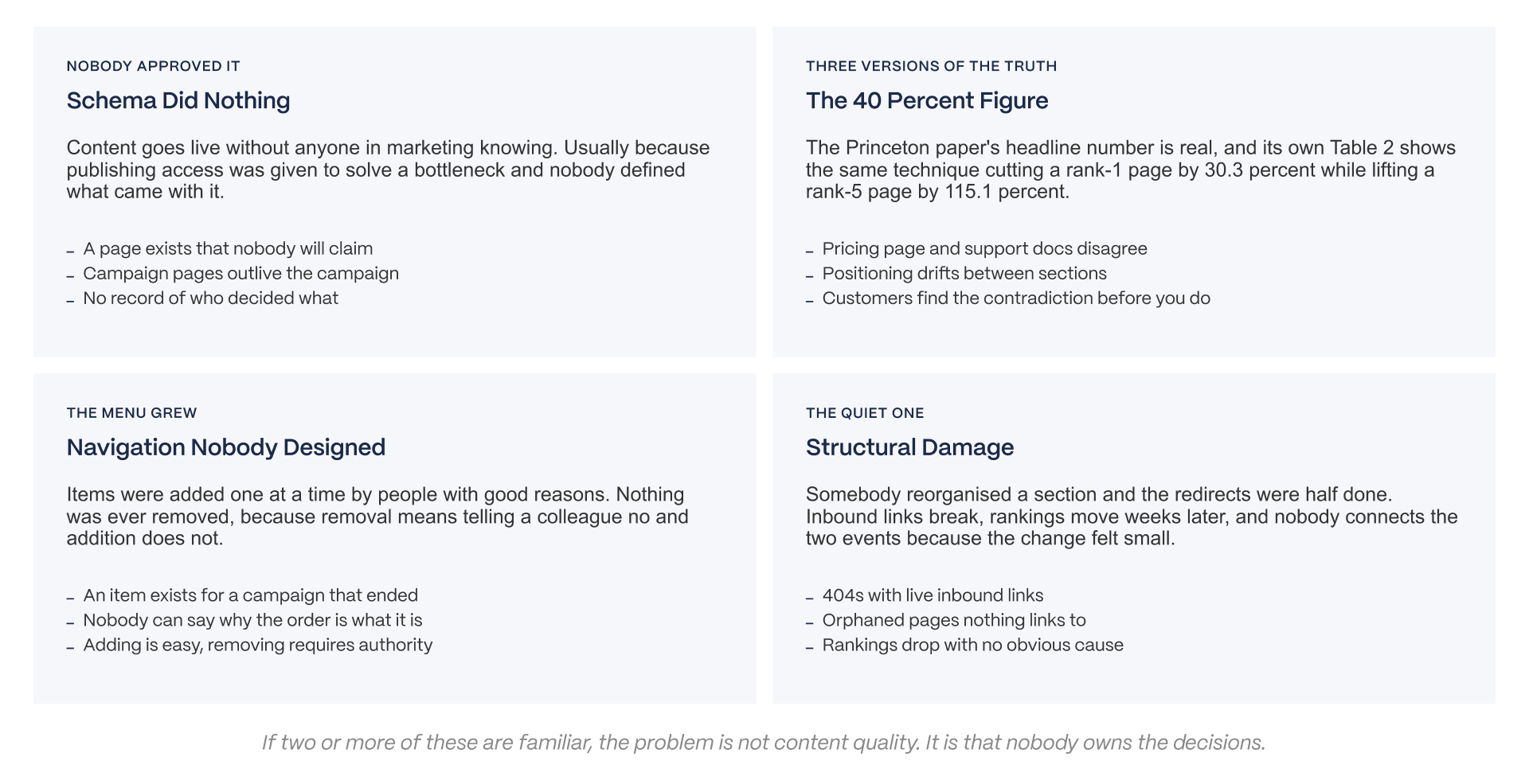
A page went live last week and nobody in marketing knows who approved it.
Product marketing describes a feature one way. Sales enablement describes it another. Support has published a third explanation, and a customer is the first person to notice that it contradicts the pricing page.
Then there’s the navigation item somebody added for a campaign that ended months ago. Nobody removes it because nobody knows who has the authority to make that decision.
Or somebody reorganizes part of the website and the redirects never get finished. The change looked small at the time. But weeks later, inbound links lead to 404s and pages that used to perform have disappeared from the structure.
B2B companies we work with often experience these problems once multiple teams begin contributing to the same website. This is in direct contrast to B2B SaaS websites worth studying, where the experience is clearer and easier to understand, irrespective of the team contributing.
The difference comes down to ownership.
These are not isolated writing, design, or CMS problems. They’re decisions about what can exist on the website, what can change and who has the authority to decide.
That is website governance.
What Governance Is Not
Simply put, website governance refers to the system used to decide what happens to your website, as well as who makes and enforces those decisions.
This makes it different from content governance, which deals specifically with the content lifecycle, and how content gets created and maintained.
It's also different to data governance, which deals with the way your organization manages the quality, security, and availability of its data.
IT governance focuses on technology, systems, security, and controls responsible for supporting the organization. Website governance overlaps with each of these, but with a narrower scope.
This means questions like: who can approve a new page? who can change a template?, who decides whether something belongs in navigation?, and who has the final say when two teams describe products differently become crucial for B2B SaaS marketing leaders.
These decisions become more important as the site grows. Following every new enterprise website design trend will do little to create a coherent website if nobody has authority over what ultimately gets published.
That is the problem this guide addresses: who decides what happens to the marketing website, and what happens when nobody does.
Who Decides What
Good website governance does not require every decision to pass through a committee. It requires clarity about who has the authority to make the decisions that affect the site.
For B2B SaaS companies, that means assigning ownership at two levels: the decisions themselves and the permissions that determine who can put those decisions into practice.
Four Decisions Someone Must Own
Start with four decisions.
Who decides whether a new page should exist? Who decides what belongs in the navigation? Who makes the final call on how the product is described? And who signs off on accessibility and legal requirements?
Each needs one named owner.
That doesn’t mean the owner makes every decision alone. Product marketing might consult sales before changing messaging. Marketing might involve UX or SEO before changing the navigation. Legal will need input from the teams responsible for accessibility.
However, consultation is not the same as accountability. If five people contribute to a decision and no one has final authority, the outcome will tend to default to whoever asks more persistently.
This is particularly visible with website navigation. Adding an item is simple to justify because the team that requests it has an immediate reason. Removing one is more challenging because somebody needs the authority to decide that another team’s priority no longer belongs there.
The same principle applies across the website. Governance works when everybody understands who has the final call, even when multiple people contribute to making the decision.
The goal here is not to build a complicated RACI. Name a single person for each decision. A committee can contribute expertise, but it can’t replace individual accountability.
Publishing Access is a Governance Decision
Decision-making authority means very little if CMS permissions allow somebody else to bypass it.
Publishing access therefore needs the same deliberate ownership as the content itself. In practice, there should be a distinction between three levels of access: people who can draft content, people who can publish it, and people who can change templates or navigation.
That third group deserves particular scrutiny.
A poorly written page can create a local problem. A template change can affect hundreds of pages, while a navigation change can alter how visitors move through the entire website. Permission to publish ordinary content shouldn’t automatically include the ability to make these changes.
Run a straightforward audit. List everyone who can publish to your website today. For each person, ask who granted this access, why they needed it and whether they still do.
Access is typically granted to remove an immediate bottleneck and then never reconsidered. Over time, permissions accumulate while the original reasons disappear.
Your CMS should make those boundaries enforceable. For companies considering enterprise Webflow delivery, publishing permissions and CMS structure should therefore be treated as governance requirements rather than configuration details.
Access here needs to reflect the decision someone is responsible for, rather than just what the CMS allows them to change.
Sizing It to Your Company
More governance does not necessarily mean better governance.
The right amount depends on the number of people who are contributing to your website, how closely they work together, and how much authority they already share. The goal is to introduce structure when coordination starts breaking down, not before.
When Informal Coordination Stops Working
Informal coordination genuinely works at small scale.
If five people work together in the same marketing team, they likely will not require a website governance document. Telling them otherwise is how governance earns a reputation for creating unnecessary process.
The transition begins when publishing starts to grow faster than communication.
At the first stage everyone talks daily. Decisions happen through conversation because the people changing the website already share context.
At the second stage, several teams publish and coordinate occasionally. Product marketing launches new pages. Demand generation creates campaign content. Support maintains its own resources. Everyone is still broadly aligned, but nobody sees every change.
At the third, multiple functions publish with different goals and no shared context. Each team can make perfectly reasonable decisions in isolation while collectively making the website less coherent.
There’s no universal headcount at which one stage evolves into another. A more useful signal is whether the people who publish the website still speak to one another regularly enough to understand what everyone else is changing.
Once publishing access exceeds daily communication, informal coordination starts to lose its advantage.
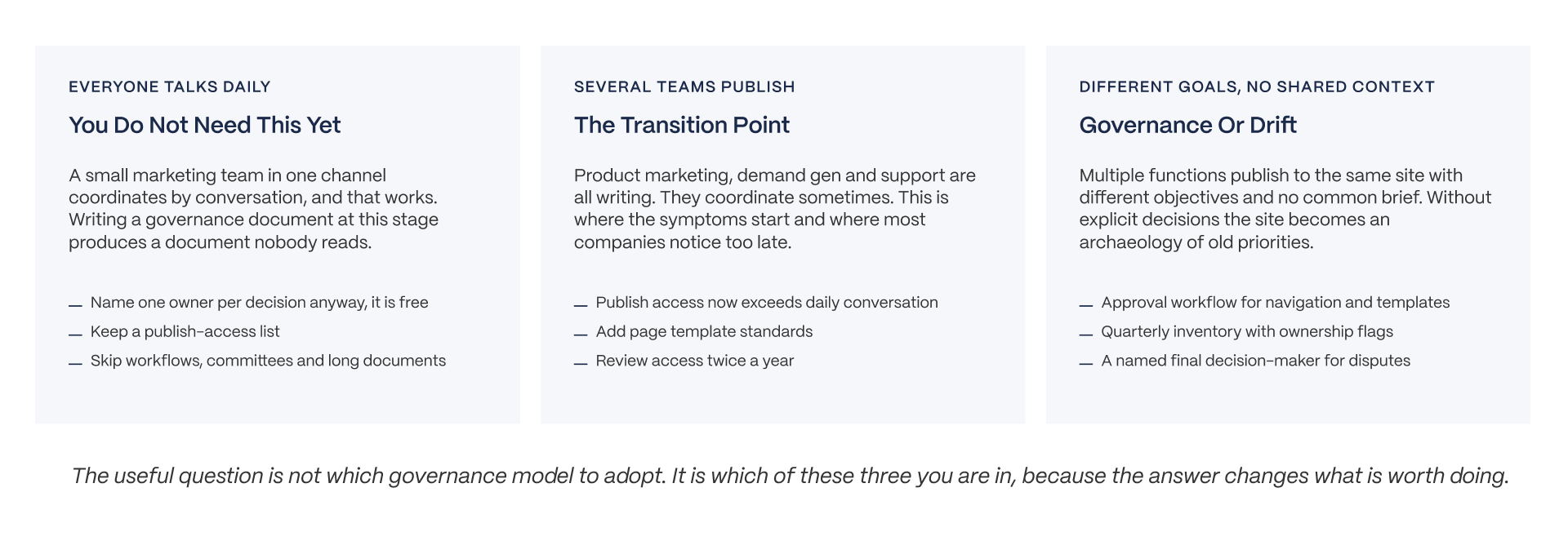
The crucial question here surrounds whether or not you've reached the point where a conversation alone is no longer enough when it comes to coordinating the website.
The Smallest Useful Version
When you reach that point, start with the smallest controls that solve identifiable problems.
First off, give each important website decision a single owner. It costs you nothing, and ensures someone definitively has the final say.
Second, make sure you maintain a list of everyone who has publishing access, and review it a couple of times per year. This should take around an hour, and will prevent permissions from accumulating.
Third, create a short page-template standard. New pages need to inherit an agreed structure instead of becoming miniature redesign projects each time another team needs one. The same principle needs to inform your CMS structure and enterprise Webflow delivery.
Finally, make sure you run a quarterly content inventory that flags pages with no clear owner or traffic. You don’t need an elaborate scoring system. Instead, you need visibility into what has accumulated, as well as a person with authority to act on it.
At smaller scales, skip elaborate approval workflows, governance committees and documents longer than two pages. Those controls may become useful as the organization grows, but copying them prematurely creates a process without solving a problem.
Start with ownership, access, standards and visibility. Add more governance only when the website gives you a reason to.
Accessibility, Legal and What it Costs to Skip
Website governance also determines whether standards will hold up once the launch process is complete.
Accessibility is a great example of this. Your website can launch after an accessibility review and might regress as new pages, templates and components get layered on top. You also need to understand the legal position, and how much it depends on where the business operates, which makes clear ownership essential.
What Actually Applies to a Private Company
ADA Title II is aimed at state and local government entities, while Title III is far more relevant for private businesses across the US. The DoJ states that Title III is applicable to businesses that qualify as public accommodations, and has consistently taken the position that their ADA obligations extend to goods and services offered online. [Source: U.S. Department of Justice, Guidance on Web Accessibility on the ADA]
The European Accessibility Act needs to be qualified. Since June 28, 2025, it’s applied to specified products and consumer-facing services across the EU, including e-commerce services. Crucially for B2B SaaS companies, those e-commerce provisions concern services provided to consumers with a view to concluding a consumer contract. B2B SaaS companies shouldn’t assume having EU customers automatically places their marketing website within the EAA’s e-commerce provisions. [Source: Directive (EU) 2019/882, European Accessibility Act]
For governance purposes, the larger lesson is more straightforward. Accessibility can’t be something checked once during redesign and then completely ignored. Instead, it should be a publishing standard with someone responsible for enforcing it, otherwise every component, template, and page presents another opportunity for regression.
Legal position checked: 25 September 2026. Sources: U.S. Department of Justice and Directive (EU) 2019/882 (European Accessibility Act).
The Cost of Doing Nothing
Governance failures rarely arrive as one expensive event. Instead, they accumulate.
Pages stay live because it’s unclear if they are still needed. Redirects are partially implemented after sections move. Messaging drifts. Publishing permissions survive well after the reason they were initially granted.
Over time, these accumulated inconsistencies become so large that another redesign feels like the best answer. Discussions about what a website costs become discussions about paying to clean up ownerless decisions.
Many redesigns are governance failures with a design budget attached to them. But the site did not suddenly become wrong. It became uncoordinated. And rebuilding it without updating who can publish and who has final authority only serves to rekindle the problem.
Good web design can fix what visitors see today. Governance determines whether it stays fixed as the company grows.
Items one, three and eight take an afternoon and produce two findings that matter the most: who can change the website, and whether anybody has the authority to remove what no longer belongs there.
FAQ
What is website governance?
Who decides what happens to your website, and how those decisions get made. In practice it means four things having a named owner: whether a page can exist, whether something can go in the navigation, how the product is described, and whether it is accessible and legally sound.
What is the difference between website governance and content governance?
Website governance covers decisions about the whole site, including navigation, templates and publishing access. Content governance covers the content lifecycle specifically, from creation through review to retirement. Content governance sits inside website governance, and both are separate from data governance, which is a different function entirely.
Do we need a website governance policy?
Not necessarily a policy. You need named owners for four decisions, which is free. A written policy becomes worth the effort when the number of people who can publish exceeds the number who talk to each other daily, which is usually somewhere past a single coordinated marketing team.
Who should own the website in a B2B SaaS company?
One person per decision rather than one person for everything. Marketing typically owns whether pages exist and what goes in the navigation, product marketing owns how the product is described, and legal signs off on accessibility and compliance while marketing owns the check itself.
What happens without website governance?
Pages appear that nobody approved, three teams describe the product differently, the navigation grows and never shrinks, and reorganisations leave half-finished redirects. The cost is invisible until a redesign, which is frequently a governance failure with a design budget attached.
Does ADA Title II apply to our website?
Only if you are a state or local government entity. Most articles on this topic are written for the public sector, which is why Title II dominates them. A private B2B SaaS company should be looking at the European Accessibility Act if it sells into the EU, and at the Title III position in the US.
How often should we review website governance?
Review publish access twice a year and run a content inventory quarterly. The policy itself rarely needs changing. What changes is who has access, which drifts continuously because access is granted to solve problems and almost never revoked afterwards.
Is a CMS enough to handle governance?
No. A CMS enforces permissions, which is one part of it. It cannot decide whether a page should exist, whether the navigation change is right, or whether two teams are contradicting each other. Those are decisions, and software does not make them.