.jpg)
AI is no longer an experiment in web design, but a fundamental tool that is reshaping how business websites are designed, optimized, and personalized. The change has not just been in what AI can do, but in the way it fits into production workflows.
Instead of replacing designers and developers, modern AI tools work in conjunction with them, and are becoming intelligent design partners. They are integral for assisting with layout generation, accessibility, automation, and personalization, while continuing to rely on human judgement to shape strategy and brand expression.
The challenge for businesses is not whether AI should be a part of web development, but it’s more about understanding the specific AI trends that actually deliver value, which are purely hype, and how best to adopt them while maintaining quality.
AI Website Builder Trends 2026 (Featured Snippet)
AI website builder trends for 2026 focus on advanced AI design assistants that help generate layouts and suggest real-time improvements, personalization engines, automation of code generation and prototyping, and AI-driven UX optimization based on user behavior, and accessibility compliance automation. The biggest shift is AI moving from basic template integration to intelligent design partnership. Businesses need to look to prioritize platforms that integrate AI meaningfully into workflows, rather than as surface-level marketing features.
Abstract
AI is transforming the way in which websites are built, but not all AI capabilities are created equal. In 2026, the most effective AI website builder trends center on design assistance, personalization, automation, UX optimization, and accessibility.
This guide breaks down the AI trends shaping modern website builders, separating what is production-ready from what is overhyped. We will explore how AI is changing design workflows, enabling personalization at scale, improving accessibility, and accelerating development, while highlighting the importance of the human element as well.
Written for marketing leaders, business owners, and digital strategists, this article provides a practical lens on AI adoption. At Veza Digital, we track AI in web development since its early adoption and help clients implement the capabilities that move the needle for your business.
Quick-Reference 2026 AI Website Development Trends:
Emerging AI Capabilities in Website Builders
AI website builders in 2026 are no longer defined by one-click site generation. The most meaningful advances are happening in how AI understands design context, assists decision-making, and optimizes layouts based on real user behavior. These capabilities are reshaping how websites are planned, built, and refined, without removing human control from the process.
Advanced AI Models for Website Design
Modern AI website builders are powered by next-generation models such as GPT-4+ and purpose-built design models trained specifically on web layout, UX patterns, and front-end best practices. These systems are increasingly multi-modal, understanding both text and visual structures, allowing them to translate written intent into usable design output.
This enables full-page layouts to be generated from prompts, component suggestions based on content-type, automatic response variants, and consistent style matching across pages. More importantly, these models are becoming context-aware. Instead of producing generic layouts, they interpret hierarchy, spacing systems, and brand intent to generate designs that feel cohesive rather than templated.
AI is also improving design personalization at system level. Builders can now learn brand preferences over time, suggest styles aligned with specific industries, enforce design system rules, and even generate tailored layout variations for different user segments.
Natural language interaction plays a key role here. Designers can refine work conversationally by adjusting hierarchy, adding sections, or aligning designs to brand guidelines without manually rebuilding layouts.
Key insight: The most effective AI models don’t just generate designs, but they actually understand design principles and apply them contextually.
AI-Powered Design Assistants
AI-powered design assistants are becoming the most practical and widely adopted AI feature in website building. These tools work alongside designers in real time, offering layout improvements, typography pairing recommendations, color harmony suggestions, and spacing or alignment fixes as work progresses. Instead of replacing creative judgment, they act as a second set of eyes, flagging inconsistencies and suggesting refinements that speed up decision-making.
Design assistants are also transforming early-stage workflows. Automated prototyping allows teams to generate wireframes from short descriptions, explore multiple layout directions instantly, and iterate quickly without rebuilding components manually. Full-page mockups can be created directly from briefs, with variations generated for different audiences or use cases, and device previews handled automatically.
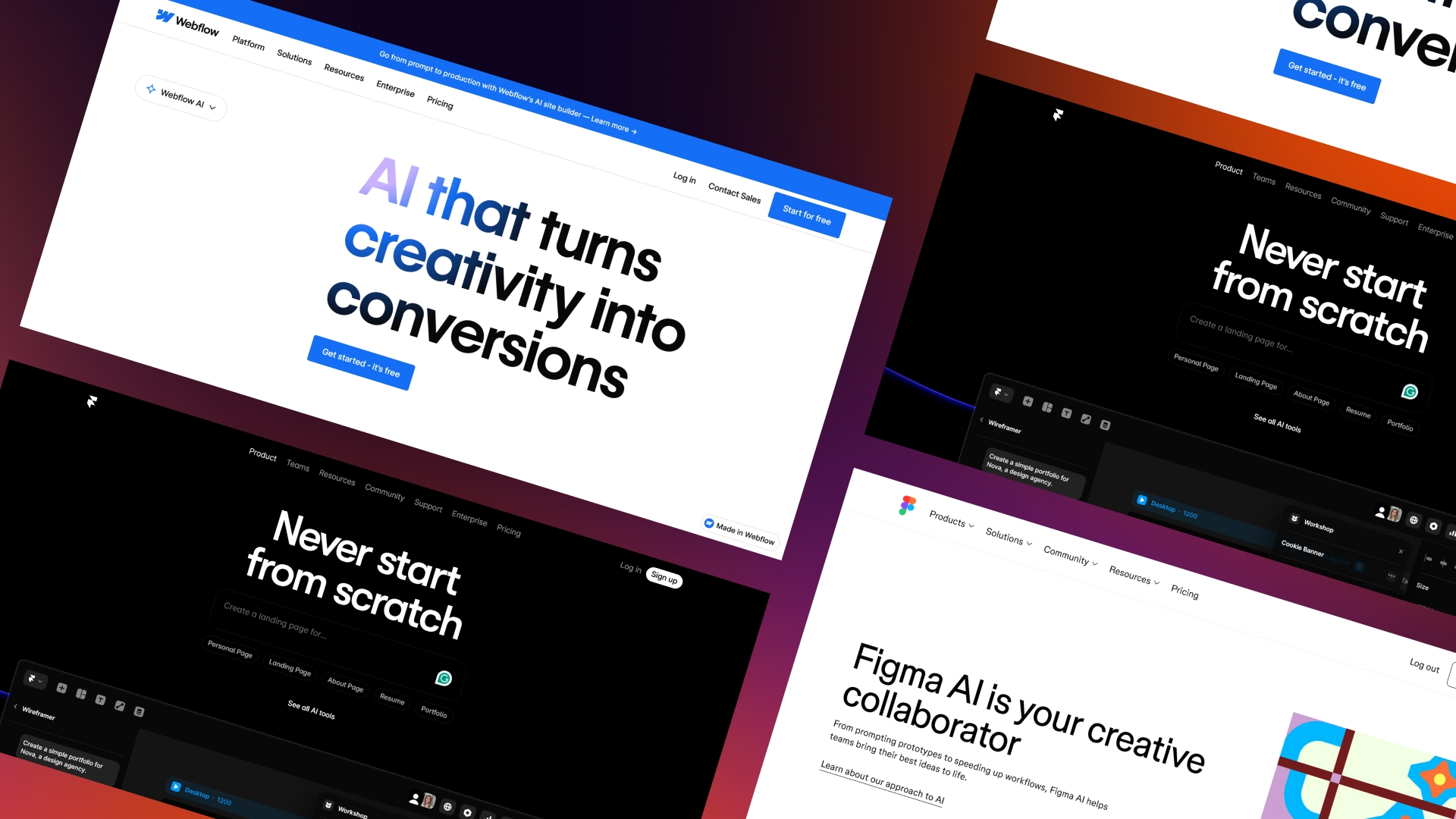
What’s working today includes the Webflow AI features, Framer’s AI-assisted layout generation, and Figma’s growing ecosystem of AI plugins. Standalone AI design tools also play a role, but the strongest results are coming from AI that’s deeply embedded within the platform itself. Looking ahead, tighter platform integration will become more commonplace, as well as providing accurate brand learning, as well as collaborative AI assistants that support teams as opposed to individual users.
AI Layout Optimization
Beyond generation and assistance, AI is increasingly focused on optimizing layouts based on how users actually behave. Modern builders can analyze heatmaps, scroll depth, click patterns, and conversion paths to inform layout changes automatically. This moves optimization away from guesswork and toward evidence-based design decisions.
AI-driven responsiveness is also evolving. Instead of relying on fixed breakpoints, systems can generate device-specific layouts and context-aware adjustments that respond to performance data. This ensures layouts adapt not just to screen size, but to how users engage across devices.
More advanced systems introduce predictive design behavior, anticipating likely user paths, pre-rendering high-probability content, and dynamically reordering sections to improve engagement. Over time, this enables personalized layouts that evolve per user segment while maintaining brand consistency.
Key insights: AI layout optimization goes beyond responsive design and creates layouts that adapt to real user behavior, not just screen size.
AI Capabilities Overview Table
Personalization and Customization Trends
AI-driven personalization is one of the most prominent shifts in website building for 2026. Instead of static experiences, modern AI website builders enable sites to adapt dynamically to whomever a visitor is, how they behave, and what they are most likely to need next. This results in more tailored customer experiences, as well as better engagement, and more measurable conversion gains.
Personalization Engines for User-Centric Design
AI-powered personalization engines operate in real-time, continuously analyzing user signals such as behavior, traffic source, location, device, and engagement patterns. These signals are used to segment visitors dynamically and assemble pages on the fly, adjusting layout, messaging, CTAs, and content order without manual intervention.
Rather than relying on predefined segments alone, AL models detect patterns and predict intent. Returning visitors might see a different hero message, high-intent users may be served conversion-focused CTAs, and industry-specific content can be prioritized automatically. Navigation paths can adapt to likely next actions, while content blocks reorder themselves based on relevance and engagement likelihood.
For B2B SaaS companies, this enables more advanced use cases such as company-size messaging, industry-specific value propositions, and account-based experiences, which are all key factors for the best CMS for SaaS. Importantly, these systems learn continuously, optimizing personalization decisions over time based performance data.
Key insights: Personalization in 2026 isn’t about showing someone their name. Instead, it’s about showing the right content in the right order, and doing so at the right moment.
Advanced Customization Features
Alongside personalization, AI website builders are offering far more granular customization control. As opposed to all-or-nothing automation, teams are able to fine-tune AI behavior via style parameters, component-level controls, and brand rules, ensuring AI output stays on-brand.
Automated branding systems apply brand kits consistently across pages, enforcing typography, color usage, spacing, and asset organization at scale. This is particularly valuable for large sites and multi-page SaaS platforms where consistency is hard to manually maintain.
Feedback loops close the gap between automation and intent. Performance data, user testing results, and A/B test outcomes feed back into AI systems, creating continuous improvement cycles. AI deals with routine decisions, while humans retain strategic control.
Key insights: The most effective AI platforms balance automation with human oversight, which helps amplify creativity rather than replacing it.
Personalization Use Cases Table
Automation and Productivity Enhancements
.avif)
Automation is where AI website builders deliver some of their most immediate and measurable value. In 2026, AI is no longer limited to visual suggestions, but instead actively reduces manual effort across design, development, and iteration, allowing teams to move faster without compromising on quality.
Streamlined Development Processes
Modern AI website builders automate many of the repetitive tasks that traditionally slow down development, especially with regards to traditional CMS (check out Webflow vs WordPress). Code is generated directly from visual designs, responsive breakpoints are created automatically, images are optimized at upload, and metadata such as titles, descriptions, and alt text can be generated contextually. These capabilities significantly reduce setup time while improving baseline quality and consistency.
AI-assisted prototyping accelerates early-stage workflows even further. Teams are able to generate wireframes from basic descriptions, explore multiple layout concepts in minutes, and iterate rapidly before committing to production. This makes stakeholder reviews faster and more effective, with presentation-ready mockups available early in the process.
The productivity impact is substantial. Initial builds are typically 50%-70% faster, revision cycles shrink due to clearer early validation, and automated quality checks help catch common issues before launch. Because AI enforces consistency across components and layouts, teams spend less time fixing edge cases and more time refining strategy and experience.
Crucially, automation integrates directly into existing workflows. AI features are embedded within tools like Webflow and Figma, enabling smoother handoffs, auto-generated documentation, and greater version control support.
Key insight: The goal isn’t to automate everything. The goal is to remove repetitive work so humans can focus on creative and strategic decisions.
Efficiency in Website Redesigns
AI is continuing to transform how redesigns are planned and executed. Instead of starting from scratch, AI tools analyze existing sites to identify outdated design patterns, performance issues, UX friction points, and accessibility gaps. Some platforms can benchmark layouts against modern best practices.
Based on this analysis, AI generates targeted recommendations, and suggests layout improvements, component upgrades, performance optimizations, and design system refinements. For large sites, changes can be propagated across multiple pages using batch processing and design system updates, making enterprise-scale redesigns far more manageable.
The ROI is clear - redesigns complete faster, cost less, and are grounded in data rather than opinion, leading to stronger outcomes.
Automation Capabilities Table
User Experience and Accessibility Innovations
AI is fundamentally changing the way user experiences are designed, optimized, and maintained. In 2026, accessibility and UX are not one-off design elements, they’re continuous optimized systems that are powered by user behavior and automated compliance.
AI-Enhanced User Experience (UX)
AI-enhanced UX is focused on anticipating user needs and removing friction before it becomes a huge problem. Predictive UX systems analyze behavioral signals, such as things like navigation patterns and prior interactions. This is used to preload likely content, surface relevant information faster, and help guide users through optimized conversion paths.
Unlike static personalization, real-time adaptation allows interfaces to adjust dynamically. Content blocks can be reordered based on engagement, CTAs can change depending on intent signals, and exit-intent behaviors can trigger alternative messaging or offers. These adjustments happen continuously, without requiring manual redesigns or A/B test setup for every variation.
User journey personalization becomes more sophisticated as well. Different users experience different paths based on lifecycle stage, engagement depth, or behavioral triggers, enabling stage-appropriate content delivery and more efficient conversion optimization.
AI systems monitor key UX metrics at scale, including time on page, scroll behavior, click patterns, bounce rates, and conversion paths. Rather than replacing traditional user research, AI augments it by identifying patterns across thousands of sessions that would otherwise not be noticed.
Key insight: AI UX isn’t about replacing user research, but instead it’s about continuous optimization based on real behavior at scale.
Accessibility-First Design Systems
Accessibility is one of the most impactful areas where AI delivers immediate value. AI accessibility tools can automatically check designs and content against WCAG guidelines, flag contrast issues, generate alt text, test keyboard navigation, and validate screen reader compatibility.
Automation turns accessibility into continuous monitoring, as issues are detected in real-time, and fixes are automatically, and batch corrections can be applied across entire sites or design systems. Compliance reports can be generated on demand, reducing both legal risk and operational overhead.
For companies taking charge of multiple regions, AI allows accessibility at scale. Continuous auditing ensures new pages remain compliant, while centralized dashboards make it easier to manage accessibility across large digital ecosystems.
This matters because 15-20% of the global population deals with disabilities, and accessibility improvements are a great way to benefit all users, not just those with impairments. Accessible sites also perform better in search and provide a much clearer and more usable experience.
Key insight: AI makes accessibility achievable at scale, and what was once required expensive audits can now be continuously monitored and improved.
UX and Accessibility Table
Market Adoption and Business Opportunities
AI website builders aren’t just about experimentation in 2026, and they are now becoming an integral part of how companies design, build, and iterate their customers’ digital experiences. However, it’s important to consider that adoption is also very different depending upon company size, industry, and maturity.
Adoption of AI Website Builders by Businesses
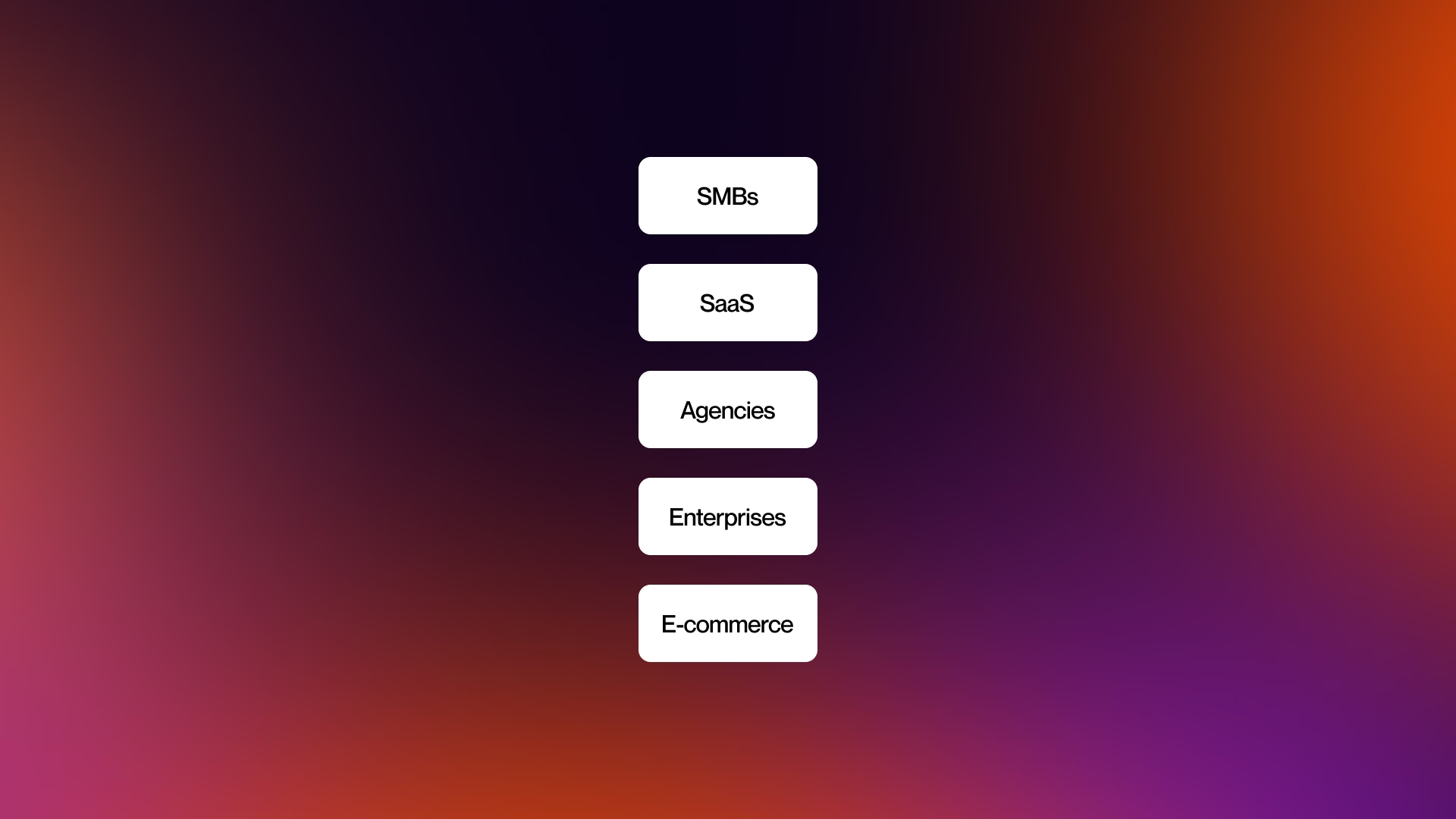
Adoption of AI website builders is accelerating fastest among SMBs, where cost sensitivity and speed-to-market are critical. Smaller teams that don’t have in-house developers, AI-powered builders offer a way to achieve professional-quality sites faster and at lower upfront cost. As a result, SMB usage is already widespread.
Enterprise adoption is steadily growing, and larger organizations tend to be slower due to things like security, governance, and integration requirements. Agencies are typically somewhere in the middle, integrating AI tools in order to speed delivery, reduce rework, and improve margins, which we’ve seen firsthand across our case studies.
Industry adoption has varied. E-commerce leads due to clear ROI from conversion optimization and personalization. SaaS adoption is evolving fast because marketing teams push for faster and more effective iteration. Professional services show moderate uptake, while enterprise organizations remain selective and use AI primarily within controlled environments.
Key adoption drivers include the pressure to save money, speed up launches, address talent shortages, and stay competitive. Barriers surrounding things like output quality, integration, learning curves, and a loss of control provide difficulties, but as the platform grows, these issues become less.
Key insights: Adoption isn’t about replacing agencies, but instead it is about finding partners who can utilise AI effectively to deliver better results much faster.
Opportunities for Innovation
AI reshapes business models across the entire web ecosystem. Agencies are evolving to embrace AI-augmented services, combining automation with strategic design and UX expertise. Hybrid DIY-plus-professional models are emerging, where clients handle simple updates while agencies are focused on complex systems and growth optimization.
For SMBs, AI helps facilitate faster market entry, as well as reducing dependency on agencies. When it comes to enterprises, AI allows the scaling of digital properties without increased costs, as well as supporting data-driven optimization at scale. Platform innovation continues to accelerate, as Webflow is expanding AI across design, CMS, and personalization.
Market Adoption Table
Future Design and Development Trends
AI website builders are proving to be a game-chander for modern organizations, because they shape how sites present over time. In the future, the next step of innovation will not focus on more features, but instead the fundamental focus will be on the importance of collaboration between AI and humans across the entire web design landscape.
AI-Driven Web Design Trends
2026 is set to bring fresh changes to the design process via more adaptive, dynamic, and individualized aesthetics. AI-generated visuals are veering away from the more common patterns, and toward frameworks based around audience behavior and data.
Templates are also evolving, with AI-customized templates adapting to brand inputs and historical performance. Over time, this can help to improve layout choices and visual hierarchy, and prevent you from having to start from scratch on every project.
International design trends are also having a major impact on AI, because the majority of LLMs are trained on international design trends, which enables cross-cultural adaptation and automated localization. This is essential to help brands maintain greater consistency, while you are also able to tailor your experiences to different regions.
This provides a new design model in which humans guide creative direction and brand expression, while AI is focused on variation, generation, and optimization.
Development Trends in AI Website Builders
When it comes to development, there is a fine line between design and engineering, and AI-driven developments are becoming clearer, cleaner, and requiring fewer manual fixes. Designers can utilize production-ready developments, while developers take charge of the integrations that are a little more complex.
The ability to future-proof your website design is also becoming more commonplace. AI helps with automatic updates, codebases, and regular performance monitoring in order to reduce long-term technical debt and keep sites aligned with best practices as standards continue to evolve.
Challenges and Ethical Considerations
There are plenty of challenges and ethical considerations that businesses must account for. AI brings simplification, but it needs to be utilized in the most effective way. Despite the rapid progress AI can provide, it is not without limitations, and it’s imperative that businesses understand these.
Addressing AI Limitations
It’s important to understand that without clear guidance, AI-generated output can feel generic, dull, and actually be more damaging to your brand long-term. Struggles with brand-voice and oversimplification of complex subject matters are just a couple of the key risks involved. Context awareness isn’t brilliant, and this can be a particular issue with B2B messaging.
Those who are able to utilize AI most effectively are those who implement it as an efficiency layer rather than for creative decision-making. AI is perfect for suggesting improvements, handling repetitive tasks, and accelerating the drafting process. But, as the recent error-filled AI-generated Deloitte report to the Australian government showed, accountability doesn’t simply vanish because work is faster.
While AI can help your business move quicker, it is vital to remain human in the loop, especially with regards to retaining control over strategy and narrative. Knowing when to override AI recommendations is essential for retaining brand integrity and control in the process.
Ethical Implications
Ethics continues to be a fundamental part of the process of running a modern business, and AI adds a layer of complexity to this. In order to utilize AI in the most ethical way possible requires trust, transparency, and responsibility. Personalization requires the use of user data, elevating the importance of consent, privacy, and stringent data handling processes.
Privacy oriented personalization is core for AI-driven experiences that look to fulfill compliance and data regulations. But, transparency is also essential, and it should be made clear to users when AI is influencing things like content and layout, especially when it comes to conversion-driven experiences.
Challenges & Solutions Overview
Conclusion
2026 marks a stark shift in the way AI is transforming website design, build, and optimization. No longer does AI exist merely as a background tool, but instead it has evolved into a hugely powerful and important design partner. The enterprises that are enjoying the greatest successes are not replacing humans with AI, but, instead, they are utilizing AI to complement the human element, coupling its efficiency with human creativity.
Some of the key trends that are having the greatest impact include AI design assistants that boost quality output, personalization engines that enhance relevance, and accessibility automation that helps fulfil compliance requirements. These all allow companies to move faster without having to sacrifice things like quality.
The logical next step will be built around strategic adoption. This means assessing the AI features your business is already utilizing, and identifying opportunities to integrate AI in ways that move the needle and make a measurable difference.
At Veza Digital, we help B2B SaaS companies navigate the world of AI integration without AI-powered Webflow development services. The Veza Agency Network combines Webflow expertise with a practical understanding of AI to build faster and remain more personal.
Ultimately, AI is transforming how websites are built, and Veza Digital’s B2B SaaS web design expertise lets us leverage AI-powered Webflow development to build faster, personalize better, and stand out long-term. Get in touch with our team to talk about your AI-powered website, future-proof your business, and work with Veza to build the perfect AI-powered site.
FAQ
General
What are the biggest AI website builder trends for 2026
AI website builders are essential for the future, and 2026 is set to include trends like advanced design assistance, real-time personalization, automated layout generation, and scalable accessibility.
Are AI website builders replacing human designers?
No. In fact, the most successful cases of using AI website builders are found when they are used to complement the human element, handling repetitive tasks to free up human designers to focus on strategy, creativity, and complex decisions.
Which AI website builder is best for businesses?
The best AI website builder is the one that best fulfils the needs and requirements of your business. Webflow stands out for its ability to be able to combine AI capabilities with production-ready control, scalability and flexibility.
Capabilities
Can AI design a complete website?
AI can generate full layouts and draft content, but for high-quality websites to thrive it requires human oversight, which plays a key role in brand alignment and usability.
How does AI personalization work in website builders?
AI personalization is essential for being able to analyze user behavior, source data, and the ability to adjust content, layouts, and CTAs in real time.
What AI features should I prioritize?
Businesses need to be prioritizing AI design assistants, as well as UX optimization, personalization engines, and workflow automation in order to be able to deliver measurable gains and efficiencies.
Adoption
Is AI website building suitable for enterprise?
Yes. AI website design and building is increasingly becoming more and more suitable for businesses, particularly when paired with platforms that offer governance, security, and a human element. Get in touch with Veza Digital to find out more.
How do AI website builders compare to traditional development?
AI website builders are crucial for reducing build time, iteration cycles, and manual effort, while still needing human expertise for more complex implementation.
What's the ROI of AI-powered website building?
AI-powered website building brings ROI via faster launches, reduced production costs, and better conversion rates, with more efficient use of design and development.
Future
What AI capabilities are coming next?
It’s hard to understand the evolution of AI as it seems to be growing so rapidly, but next-gen capabilities will likely include predictive design systems, smarter personalization, and continually evolving design systems.
How will AI change web design in the future?
The future of web design is set to become more adaptive and data-driven under the influence of AI, with greater personalization, and a shift taking designer roles toward greater creative strategy and direction.
Should I wait for AI to improve before building a website?
No. You can (and should) get started right away. Use existing AI capabilities, alongside a human element, to ensure you iterate and optimize your business over time, instead of delaying growth while waiting for future advancements.